


Startup Fundraising Explained: From Bootstrapping to VC Funding
Master startup fundraising from bootstrapping ($0) to Series A ($10M+). Stage-wise guide with 2026 amounts, valuations, investor types, and pitch deck strategies.
Most startups fail before raising VC funding. 87% of founders bootstrap initially, proving self-funding works until product-market fit proves itself.
Fundraising = exchanging equity for capital to accelerate growth. Wrong stage or amount kills startups—40% run out of runway post-funding due to mismatched expectations.
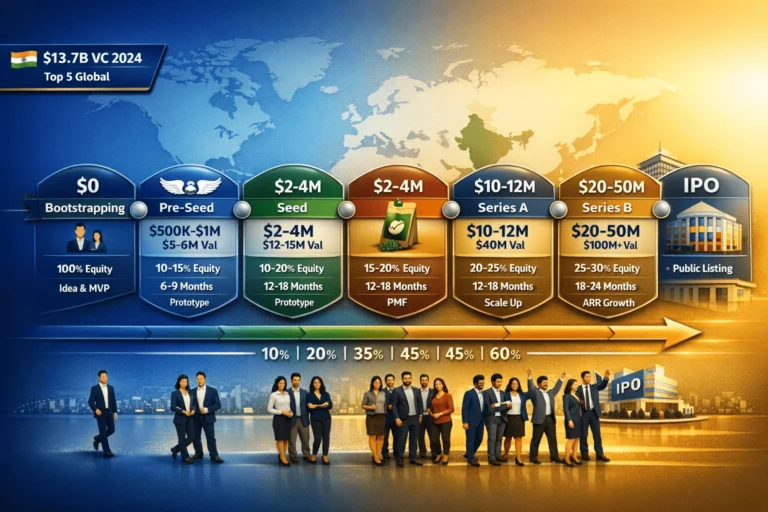
India’s VC funding hit $13.7B in 2024 (1.4x YoY), ranking top 5 globally with $12.1B+ new funds in 2025. 58% target early-stage—perfect timing for founders.
This stage-wise fundraising roadmap reveals typical amounts, valuations, investors, timelines, and pitfalls for 2026. From $0 bootstrapping to $15M Series A, you’ll know exactly when/how much to raise.
What Is Startup Fundraising?
Startup fundraising = raising external capital by selling equity to investors in exchange for growth acceleration.
Core equation: Capital raised ÷ Monthly burn rate = Runway months. 12-24 months typical runway per stage.
Fundraising stages progression:
- Bootstrapping (founder savings, revenue)
- Pre-seed (friends/family, angels)
- Seed (angels, seed VCs, accelerators)
- Series A (VC funds)
- Series B+ (growth VCs, PE)
- IPO/Acquisition (public markets)
| Stage | Avg Amount | Avg Valuation | Equity Given | Runway |
|---|---|---|---|---|
| Pre-seed | $0.5-1M | $5-6M | 10-20% | 12-18 mo |
| Seed | $2-4M | $12-15M | 15-25% | 12-24 mo |
| Series A | $10-12M | $40M | 20-25% | 12-20 mo |
India specifics: $13.7B VC in 2024, 40% YoY growth, early-stage focus.
Understanding fundraising basics leads to optimal first step—bootstrapping.
What Is Bootstrapping in Startup Fundraising?
Bootstrapping = funding growth using founder savings + revenue. No external capital, 100% founder ownership.
When to bootstrap:
- Validate MVP (minimum viable product)
- Achieve product-market fit (PMF)
- Generate first revenue ($10K-50K MRR)
- Build initial team (3-7 people)
Bootstrapping advantages:
1. Full control (no investor board seats)
2. Revenue discipline (profitability focus)
3. Higher valuations (no dilution early)
4. Investor leverage (“We’re revenue-positive”)
2026 bootstrapping stats:
- 87% startups bootstrap initially
- Basecamp, Mailchimp reached $100M+ ARR bootstrapped
- India: 62% founders self-fund first 12 months
Bootstrapping pitfalls:
- Slow growth (limited marketing budget)
- Burnout risk (founders wear all hats)
- Missed opportunities (can’t hire fast enough)
Exit bootstrapping when:
- $10K+ MRR proven
- 50-100 paying customers
- 18-month runway needed for next leap
Example: Zoho bootstrapped to $1B ARR before any external funding—proving revenue-first works.
Bootstrapping builds foundation. Next: pre-seed for MVP validation.
When Should You Raise Pre-Seed Funding?
Raise pre-seed when you have MVP + initial traction but need capital for product development and early hires.
Pre-seed characteristics:
Amount: $500K-$1M average
Valuation: $5-6M pre-money
Equity: 10-20% dilution
Timeline: 3-6 months to close
Runway: 12-18 months
Pre-seed investors:
- Friends & Family (₹5-50 lakh checks)
- Angel investors (individual HNWIs)
- Micro-VCs ($100K-500K tickets)
- Accelerators (Y Combinator, Techstars: $120K for 7%)
What pre-seed investors want:
1. Exceptional team (prior exits, domain expertise)
2. Massive market ($1B+ TAM)
3. Clear problem (validated by 50+ interviews)
4. MVP demo (working prototype)
5. Early traction (waitlist, LOIs, beta users)
Pre-seed pitch deck: 10 slides max – Problem, Solution, Market, Team, Traction, Ask.
India pre-seed 2026: Blume Ventures, IndiaQuotient lead with $100K-500K checks.
Success metric: Close $750K at $5M valuation for 15-month runway to seed readiness.
How Much Seed Funding Should You Raise?
Seed funding validates product-market fit (PMF) and scales to $50K-100K MRR.
Seed characteristics:
Amount: $2-4M average (2025 data)
Valuation: $12-15M pre-money
Equity: 15-25% dilution
Timeline: 4-8 months
Runway: 12-24 months
Seed investors:
- Angel networks (Indian Angel Network, Mumbai Angels)
- Seed VCs (Blume, Better Capital)
- Accelerator alumni funds
- Corporate VCs (early bets)
Seed readiness milestones:
- $10K+ MRR (or equivalent)
- 50-100 paying customers
- 40%+ MoM growth
- 5-10 person team
- Unit economics (LTV > 3x CAC)
Seed valuation formula: 12-24x ARR or traction multiple (users, revenue).
India seed 2026: Accel India, 3one4 Capital average $2.5M checks.
“Seed rounds average $2-4M at $12-15M valuation with 15-25% equity,” Waveup 2025 analysis.
Seed proves PMF. Series A scales proven business.
What Happens in Series A Fundraising?
Series A scales proven business models to $1M+ ARR with repeatable growth.
Series A characteristics:
Amount: $10-12M average
Valuation: $40M pre-money
Equity: 20-25% dilution
Timeline: 6-12 months
Runway: 12-20 months
Series A investors: Institutional VCs (Sequoia, Accel, Peak XV)
Series A milestones:
- $500K-1M ARR
- 100%+ YoY growth
- Positive unit economics (LTV:CAC >3:1)
- 20-50 person team
- GTM framework (sales, marketing channels)
Term sheet terms:
- Preferred stock with liquidation preference
- Board seat for lead investor
- Pro-rata rights (future round participation)
- Anti-dilution protection
India Series A 2026: Peak XV, Lightspeed $10-15M rounds at $40-60M valuations.
Pitfall: 40% Series A startups fail within 18 months—raise for specific milestones, not general expenses.
How Does Series B Funding Differ?
Series B scales market leadership with $5M+ ARR and proven GTM.
Series B characteristics:
Amount: $20-50M
Valuation: $100-200M
Equity: 15-20%
Timeline: 6-9 months
Series B focus:
- Market expansion (new geographies)
- Product diversification
- Enterprise sales (large accounts)
- International growth
Investors: Growth VCs, PE crossover funds
Milestones:
- $5M+ ARR
- 50%+ YoY growth
- Enterprise customers (₹10 lakh+ ACV)
- 100+ employee scale
How To Prepare Your Pitch Deck?
Pitch deck = 12-slide document convincing investors to fund your startup.
Proven 12-slide structure:
- Problem (market pain, customer quotes)
- Solution (your product demo)
- Market Size ($1B+ TAM)
- Business Model (revenue streams)
- Traction (revenue, users, growth)
- Competition (positioning matrix)
- Go-to-Market (sales/marketing plan)
- Team (founder pedigrees)
- Financials (3-year projections)
- The Ask (amount, valuation, use of funds)
- Vision (10-year opportunity)
- Thank You (contact details)
2026 pitch deck trends:
Deck design tips:
- 10-15 words per slide
- 1 key metric per visual
- Founder storytelling voice
- PDF + live demo combo
Explore top 5 global startup fundraising methods 2026.
How To Create Winning Pitch Deck (Step-by-Step)
Build an investor-ready pitch deck in 7 days following a proven structure.
Times Needed: Days: 07, Hours: 20, Minutes: 00
Estimated Cost: Currency: USD, Price: 0 (DIY) or 500 (professional design)
Description: Complete guide to creating a 12-slide investor pitch deck with templates, examples, design best practices, and common mistakes to avoid for maximum fundraising success.
Step 1: Define Your Narrative Arc
Step Title: Structure 3-Act Story (Problem-Solution-Scale)
Step Description: Act 1: Massive problem + your unique solution. Act 2: Traction proof + business model. Act 3: Market opportunity + specific ask. Limit 12 slides maximum—investors spend 3 minutes average.
Step 2: Research Market & Competition
Step Title: Validate $1B+ TAM & Positioning
Step Description: Use Statista, reports for TAM/SAM/SOM. Create a 2×2 competitive matrix showing your unique advantage. Quantify the problem ($X billion wasted annually).
Step 3: Showcase Traction Metrics
Step Title: Highlight Revenue/Users/Growth Charts
Step Description: Revenue chart (MRR/ARR growth), user acquisition funnel, cohort retention. Cohort analysis proves PMF—show 40%+ Day 30 retention.
Step 4: Build Financial Model
Step Title: Create 3-Year Projections + Unit Economics
Step Description: Revenue forecast, burn rate, runway calculation. LTV:CAC >3:1 minimum. Include cap table showing post-money ownership.
Step 5: Design Professional Visuals
Step Title: Use Canva/Figma for Clean Templates
Step Description: 1 visual per slide, 10-15 words maximum, consistent branding. Export PDF + Google Slides for live demos. Test readability on mobile.
Step 6: Practice 10-Minute Delivery
Step Title: Rehearse Investor Pitch 50+ Times
Step Description: Time yourself (10 minutes max). Answer 30 common objections (competition, churn, margins). Record + get founder feedback.
Step 7: Launch Fundraising Process
Step Title: Send Decks to 200+ Targeted Investors
Step Description: Use OpenVC, Signal for investor research. Personalized warm intros 10x response rate. Track opens, follow up on Day 3.
Tools Name: Canva, Figma, Google Slides, PitchBook, OpenVC
Materials Name: Traction data, financial model, competitor research, founder bios
Get complete fundraising package with investor database.
What Mistakes Kill Fundraising Rounds?
70% of fundraising failures stem from 8 avoidable mistakes:
- Wrong timing (raise too early/no traction, too late/no runway)
- Unrealistic valuation (20-30% above market destroys terms)
- Weak pitch deck (>20 slides, no traction, vague ask)
- Poor investor targeting (spray-and-pray vs. 100 perfect fits)
- No data room (investors ghost without docs)
- Single lead obsession (diversify term sheets)
- Ignoring economics (LTV<CAC kills deals)
- Burnout pitching (6-month max timeline)
Fix: Target 100 investors, expect 10 meetings, 3 term sheets, 1 close.
FAQ: Startup Fundraising Stages
$500K-$1M at $5-6M valuation (10-20% equity). Provides 12-18 month runway for MVP validation, early hires, initial traction. Friends/family + angels typical sources.
$2-4M at $12-15M valuation (15-25% equity). Funds PMF proof to $50K-100K MRR, 10-person team. Seed VCs + angels, 12-24 month runway.
$500K-1M ARR, 100% YoY growth, LTV>3x CAC, 20-person team. Raise $10-12M at $40M valuation for GTM scaling. Institutional VCs only—6-12 month process.
Pre-seed/seed: 3-6 months. Series A: 6-12 months. Start 12 months before runway ends. Base case: 6-12 months seed with clean data room.
Pre-seed 10-20%, Seed 15-25%, Series A 20-25%. Total dilution target <60% by Series C. Founders retain 10-20% at IPO.
India 20-30% lower than US but growing faster (40% YoY). Seed: $1.5-3M India vs $2-4M US. Top 5 global VC market 2026.
No—Basecamp, Zoho hit $100M+ ARR bootstrapped. VC accelerates 10x but demands 10x returns. Choose based on control vs. speed.
SAFE = Simple Agreement for Future Equity (no valuation now). Priced round = set valuation/terms immediately. Pre-seed loves SAFEs (faster, founder-friendly).
Key Takeaways
- Fundraising = equity for capital. 12-24 months runway for each stage.
- Bootstrapping first: 87% startups validate PMF self-funded.
- Pre-seed ($500K-1M, $5-6M val): MVP + traction, friends/angels.
- Seed ($2-4M, $12-15M val): PMF proof, seed VCs.
- Series A ($10-12M, $40M val): Scale GTM, institutional VCs.
- India VC: $13.7B 2024 (40% YoY), top 5 global.
- Pitch deck: 12 slides max—Problem, Solution, Traction, Ask.
- 70% failures from timing/valuation/deck mistakes.
- Target 100 investors, expect 10 meetings, 3 term sheets.
- LTV >3x CAC minimum every stage.
- 6-month fundraising timeline max—start early.
- 58% new India funds early-stage 2026.
Next Steps
Launch your fundraising process this week:
Week 1: Audit Readiness
- Calculate runway (capital ÷ burn)
- Benchmark traction vs. stage metrics
- Build cap table (current ownership)
Week 2: Create Pitch Deck
- Follow 12-slide structure
- Design professional visuals
- Practice 10-minute delivery
Week 3: Target 100 Investors
- Research via OpenVC, Signal
- Secure 20 warm introductions
- Send personalized deck emails
Week 4+: Execute Meetings
- Schedule 10 investor calls
- Prepare data room (financials, contracts)
- Negotiate term sheets
Prepare your pitch deck now using proven 12-slide template. Success rate triples with professional design + traction proof.
StartupMandi’s Complete fundraising package includes investor database, pitch optimization, term sheet negotiation. Start free audit.
Conclusion
Startup fundraising follows predictable stage-wise roadmap—bootstrapping validates, pre-seed builds MVP, seed proves PMF, Series A scales GTM.
2026 timing perfect: India VC $13.7B+ (40% growth), 58% new funds early-stage. Raise right amount at right valuation or risk 40% runway failure.
Core principles:
1. Traction > idea—$10K MRR unlocks seed.
2. 12-slide pitch deck—problem, solution, traction, ask.
3. 100 investors targeted, 3 term sheets expected.
4. LTV 3x+ CAC proves economics.
Global benchmarks guide 2026 raises:
See top 5 startup fundraising methods globally 2026 for advanced strategies.
StartupMandi accelerates fundraising with investor introductions, pitch deck optimization, valuation benchmarking. 500+ founders raised $150M+ using our roadmap. Book fundraising strategy session.
Your stage, your amount, your timeline—execute now.
Resources: Startup Fundraising Tools
Pitch Deck & Financials:
Investor Research:
- OpenVC Database – 10K+ investors
- Signal by NFX – Warm intros
- PitchBook – Valuations/comps
Legal & Term Sheets:
Accelerators/India Funds: