

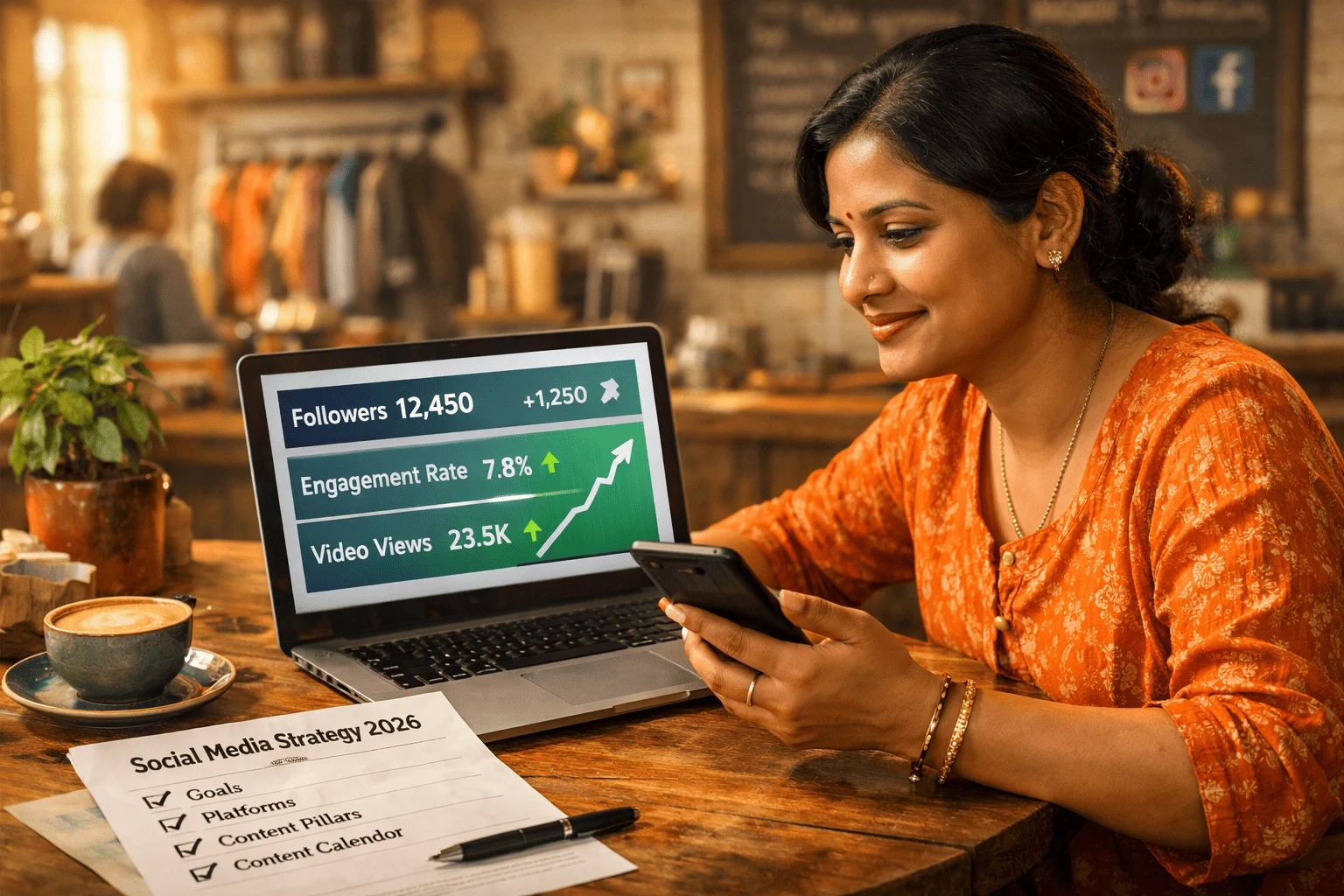
If you want the best social media strategy for small businesses in 2026, focus on three things: pick 2–3 right platforms, post consistent value (not just promotions), and build real relationships that convert to customers. 62% of the global population now uses social media, so your customers are already scrolling; the real question is whether they see you or your competitors.
What Is the Best Social Media Strategy for Small Businesses?
The best social media strategy for small businesses is a simple, repeatable system: choose the right platforms, post a balanced mix of value and promotion, show up consistently, and drive people toward clear business goals (calls, DMs, visits, or website actions).
Instead of copying big brands with huge teams, small businesses win by being:
- Focused – 2–3 platforms only, not “everywhere”.
- Helpful – majority of posts teach, show, or entertain, not just sell.
- Consistent – realistic posting frequency you can maintain for 6–12 months.
- Human – faces, stories, behind-the-scenes, not just product flyers.“Small businesses get better social results when they show up consistently with value-driven, human content not just discounts and ads.” — Small Business Social Media Trends Report, 2025
Quick Summary
- Social media is non‑negotiable in 2026: 62% of the world is on social, and customers expect small businesses to show up online.
- The best strategy is simple and realistic: 2–3 platforms, value‑first content, consistent posting, and clear calls‑to‑action.
- Short‑form video (Reels, Shorts, TikTok) dominates reach—TikTok holds ~40% of short‑form market share, with Reels and Shorts around 20% each.
- Use the 70/20/10 content rule: 70% value, 20% community/curation, 10% promotion.
- Follow a 30‑day action plan: define goals, pick platforms, set content pillars, batch content, and review analytics monthly.
Why Should Small Businesses Prioritize Social Media in 2026?
You should prioritize social media because customers now research, compare, and decide on businesses directly from Instagram, Facebook, and YouTube, often before they ever visit your website.
Key reasons it matters:
1. Customers expect a visible online presence
64% of consumers say a strong online presence is important when choosing a small business.
2. Social media influences buying decisions
Short‑form videos and social proof posts heavily impact where people eat, shop, and book services.
3. It’s cost‑effective compared to traditional ads
You can start with organic posts and low‑budget campaigns instead of large ad spends.
4. It boosts all your other marketing
Social media amplifies your website content, reviews, and offers to people who already follow your brand.
Which Platforms Should Small Businesses Focus On?
In 2026 most small businesses should focus on Facebook, Instagram, and WhatsApp or YouTube, depending on audience and content style.

Top Platforms for Small Businesses (2025/2026)
Simple rule:
- If you’re local B2C (salon, café, gym): Facebook, Instagram, WhatsApp.
- If you’re education / coaching / expert: Instagram, YouTube, LinkedIn.
- If you’re B2B or high‑ticket services: LinkedIn, YouTube, plus one social proof platform (Instagram or X).
If you already feel overwhelmed, this guide from StartupMandi on social media marketing strategy for small businesses that actually works gives you a more detailed starting point specific to small brands.
How Often Should Small Businesses Post on Social Media?
Aim for a consistent, sustainable rhythm—not daily burnout. Data‑backed studies suggest 1–2 posts/day on Facebook, 3–5 posts/week on Instagram and LinkedIn, and 2–5 short‑form videos per week on TikTok or Reels.
Recommended Posting Frequency (2026)
Remember: quality beats quantity. A single, helpful Reel that answers a real customer question is more valuable than seven random posts in a week.
How Should Small Businesses Plan Their Content Mix?
Use a 70/20/10 content rule—70% helpful value, 20% community + curated content, 10% direct promotion so your feed doesn’t feel like a constant sales pitch.

70/20/10 Social Media Content Rule
70% Value Content (Teach/Show/Help)
How‑to tips, demos, before‑afters, FAQs, educational carousels, checklists. Example: “5 Signs Your AC Needs Servicing Before Summer.”
20% Community & Curated Content
Customer shout‑outs, user‑generated content, local collaborations, behind‑the‑scenes, industry news.
10% Direct Promotional Content
Offers, discounts, launch posts, limited‑time deals, “book now” posts. This ratio keeps your audience engaged while still leaving space for sales content.
Example 1‑Week Content Plan (Instagram)
| Day | Post Type | Category (70/20/10) |
|---|---|---|
| Mon | Carousel “3 DIY tips” | 70% Value |
| Tue | Customer testimonial | 20% Community |
| Wed | Reel “Quick demo” | 70% Value |
| Thu | Team behind‑the‑scenes | 20% Community |
| Fri | Offer: weekend promo | 10% Promotion |
How Important Is Short‑Form Video for Small Businesses?
Short‑form video is now the easiest way for small businesses to get reach without huge budgets. Over 90% of Gen Z and Millennials watch short‑form videos, and video is projected to make up 82% of global internet traffic by 2025.
Key stats to keep in mind:
- TikTok commands ~40% of the short‑form video market, while Instagram Reels and YouTube Shorts each hold around 20% in many markets.
- YouTube Shorts generates over 200 billion daily views, nearly triple what it did just a year earlier.
- Viewers decide within a few seconds whether to keep watching, so your hook (first 3 seconds) is critical.
For a small business, that means:
- Use Reels/Shorts/TikTok to attract new people.
- Use Stories, carousels, and posts to nurture and convert them.
How Can Small Businesses Turn Followers into Customers?
Move people from scrolling to talking using clear calls‑to‑action DMs, WhatsApp, website visits, or bookings and combine organic content with smart, targeted ads when you’re ready.
Simple Follower‑to‑Customer Funnel
- Discovery
- Reels, Shorts, TikToks, shareable posts.
- Trust Building
- Educational content, testimonials, reviews, behind‑the‑scenes.
- Conversion
- Clear CTAs: “DM us ‘PLAN’ for a quote”, “Book via link in bio”, “Tap WhatsApp button to order”.
- Retention
- After‑sale follow‑ups, story updates, loyalty offers, and community posts.
You can accelerate this funnel using AI‑powered social media advertising services for example, StartupMandi’s social media advertising service by AI agents helps build funnels that bring not just likes, but leads and sales.
How To Build a Simple Social Media Strategy (Step‑by‑Step)
Times Needed: 30 Days, 10 Hours
Estimated Cost: 0 USD (optional tools/ads)

Steps:
1. Define goals that actually matter (Day 1, 1 hour)
Decide whether your primary goal is awareness (followers, reach), leads (DMs, enquiries), or sales (orders, bookings). Write down 1–2 measurable goals for the next 90 days.
2.Choose 2–3 platforms only (Day 2, 1 hour)
Based on your audience and business type, pick 2–3 platforms (e.g., Facebook + Instagram + WhatsApp). Ignore everything else for now, so your effort is focused.
3. Create 3–5 content pillars (Day 3, 1 hour)
Decide recurring themes: education, behind‑the‑scenes, testimonials, product highlights, local stories. Map each pillar to your 70/20/10 content mix.
4. Plan a 4‑week content calendar (Days 4–5, 2 hours)
Use a simple sheet to schedule 3–5 posts per week per platform. Assign pillar + format (Reel, Story, image, carousel) and basic caption idea.
5. Batch create content once a week (Weekly, 2 hours)
Spend 2 hours each week filming 3–5 short videos and capturing photos. Then write captions and schedule posts using a free or low‑cost tool.
6. Engage 15–20 minutes daily (Ongoing)
Reply to comments, respond to DMs, react to local posts, and engage with your followers. Think of it as digital networking.
7. Review analytics and refine monthly (Day 30, 1 hour)
Check which posts performed best, which times worked, and what brought DMs or clicks. Double down on what works; cut what doesn’t.
Tools Name: Meta Business Suite / Creator Studio, Canva, basic scheduling tool (Buffer/Later)
Materials Name: Simple content calendar sheet, smartphone camera, brand photo folder
For a deeper, Startup Mandi‑style version of this process, you can also read “Social Media Marketing Strategy for Small Businesses That Actually Works” which builds on the same principles with more examples.
Key Takeaways Section
- The best social media strategy for small businesses is simple, consistent, and realistic—not a copy‑paste of big brand tactics.
- Focus on 2–3 platforms where your audience already spends time—usually some combination of Facebook, Instagram, WhatsApp, YouTube, or LinkedIn.
- Use the 70/20/10 content mix to balance value, community, and promotion so your feed feels helpful—not pushy.
- Short‑form video now dominates reach: TikTok holds ~40% of short‑video share, with Reels and Shorts around 20% each.
- A 30‑day, 10‑hour plan is enough to set up a solid strategy: goals, platforms, content pillars, calendar, batching, engagement, and monthly review.
Next Steps
- Pick your 2–3 primary platforms today—no more “we’re on everything but active nowhere”.
- Write down 3–5 content pillars and match them to the 70/20/10 rule.
- Make a one‑month content calendar with 3–5 posts per week per platform.
- Batch shoot short videos this weekend—simple tips, FAQs, or behind‑the‑scenes.
- Set a daily 15‑minute “engagement alarm” to answer comments, DMs, and interact with your local community.
- After 30 days, review what worked, then either double down yourself or bring in a partner to scale your results.
Conclusion
If you’ve been overwhelmed by social media, remember this: you don’t need a complex “big brand” plan to win. The best social media strategy for small businesses in 2026 is a realistic, action‑oriented system that fits into your week, builds relationships, and gently nudges people toward buying from you.
By focusing on a few right platforms, a clear content mix, short‑form videos, and consistent engagement, you can turn your social pages from “inactive brochures” into customer magnets that quietly work in the background for your business.
When you’re ready to go beyond DIY, tools and services powered by AI like Startup Mandi’s social media advertising service by AI agents can help you run smarter campaigns that bring measurable results, not just vanity metrics.
Frequently Asked Questions
Aim for 15–30 minutes per day for engagement plus 1–2 hours per week to batch content. That’s enough for 3–5 posts/week on 2 platforms if you stay focused.
There’s no single “best”, but Facebook, Instagram, and WhatsApp are top choices for most local and B2C businesses, while LinkedIn and YouTube work best for B2B and experts.
Most small businesses start seeing clear traction in 60–90 days of consistent posting and engagement but strong brand and revenue impact typically take 6–12 months.
You can start fully organic and still grow using short‑form video and value‑first posts. Later, adding small-budget paid campaigns can speed up growth and lead generation.
Use the 70/20/10 rule—70% helpful, 20% community/curation, 10% promotion. This keeps followers engaged while still driving sales when it matters.
Not mandatory, but incredibly powerful. With short videos dominating attention and platforms like TikTok, Reels, and Shorts owning most reach, you’re leaving money on the table if you ignore video.
Start with voice‑over, product‑only, or text‑based Reels, or show your hands instead of your face. You can build confidence gradually—what matters most is consistency and value.
If you have time but no budget, start yourself using this guide. When you need to scale faster, consider partners like AI‑assisted social media advertising services that combine strategy, content, and ads for you.
Few Links Suggestions for more Research & Facts Check
- Social Media Marketing Strategy for Small Businesses That Actually Works
- Social Media Advertising Service by AI Agents
- Digital Marketing for Small Businesses in 2026: What Actually Works
- Digital Marketing Trends That Will Shape Business Growth in 2026
- How to Start Digital Marketing for New Business: Complete Guide