


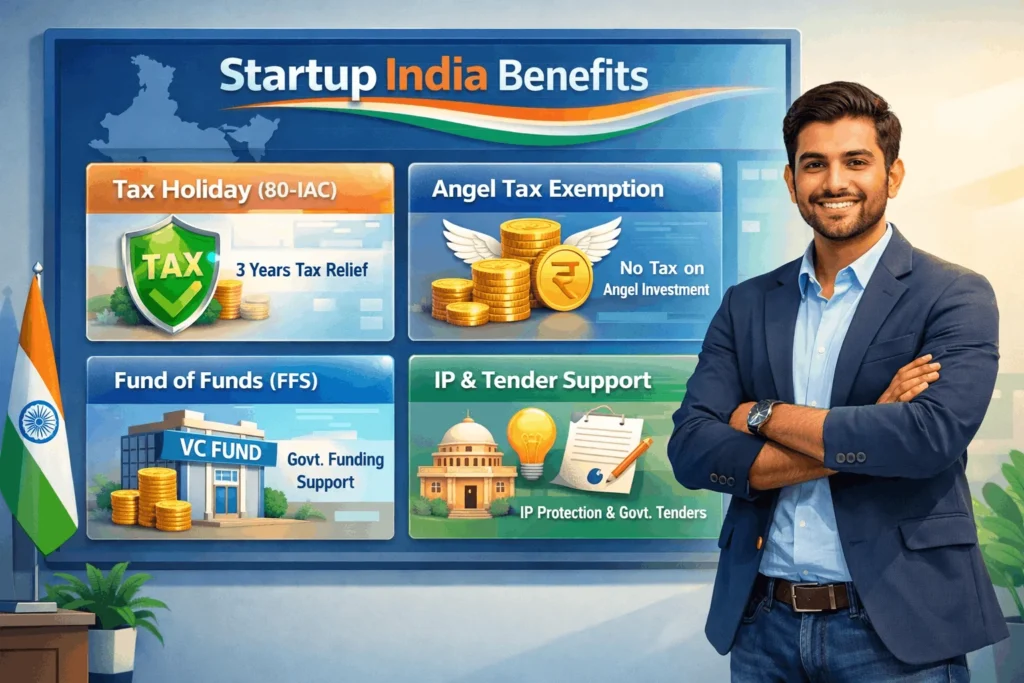
If you are building a startup in India, Startup India can literally change your financial runway. With the right recognition and approvals, you can access tax holidays, angel tax exemption, easier funding, and priority in government tenders.
This guide explains Startup India benefits in plain language—tax exemptions, funding, and non-financial perks—along with eligibility and application paths so you can decide if and when to apply.
What Is Startup India and DPIIT Recognition?
Startup India is a flagship initiative of the Government of India to support innovation-driven startups through tax incentives, funding support, and regulatory relaxations.
The scheme is anchored by DPIIT (Department for Promotion of Industry and Internal Trade), which grants official “DPIIT-recognized startup” status on the Startup India portal.
Once recognized, your startup becomes eligible to apply for tax exemptions (80-IAC, Section 56), IPR support, and several funding-linked schemes.
Who Is Eligible Under Startup India?
To access Startup India benefits, you must first qualify as a DPIIT-recognized startup.
1. What Are the Core Eligibility Conditions?
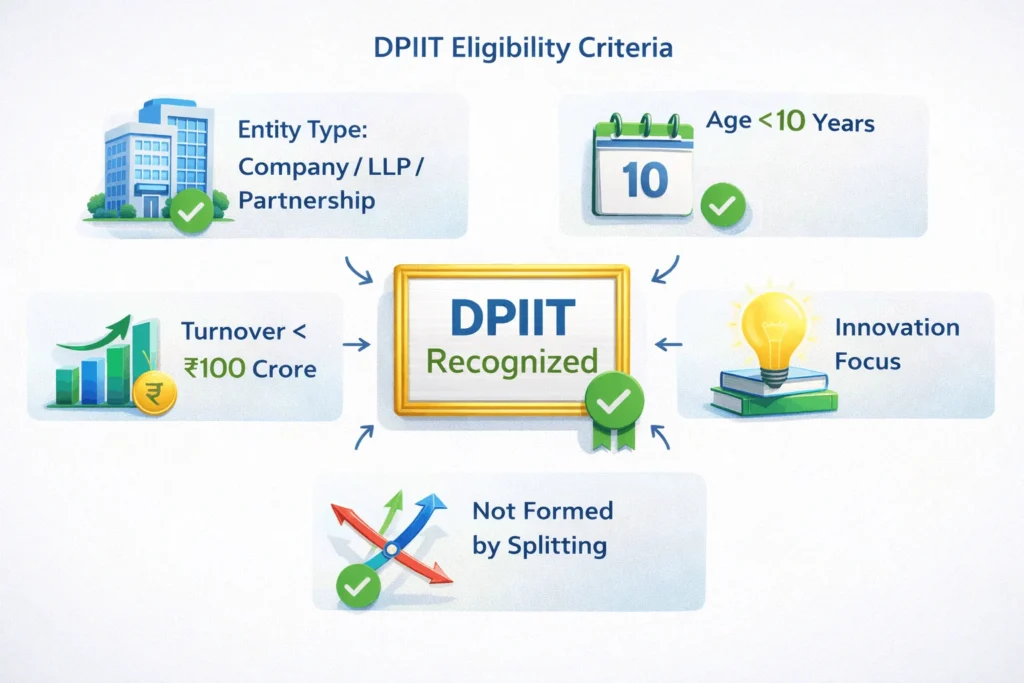
As per Startup India and ClearTax guidelines, your entity must:
- Be incorporated as a Private Limited Company, LLP, or Registered Partnership Firm.
- Be less than 10 years old from the date of incorporation.
- Have annual turnover below ₹100 crore in any financial year.
- Work towards innovation, development, or improvement of products, processes, or services, or have a scalable business model with high employment/wealth potential.
- Not be formed by splitting or reconstructing an existing business.
DPIIT-recognised startups also become eligible to apply for specific tax exemptions and angel tax relief under subsequent sections.
2. What Is the Basic Recognition Process?
- Register on the Startup India portal and/or NSWS (National Single Window System).
- Upload incorporation documents, PAN, pitch description, and innovation details.
- DPIIT evaluates and issues a certificate of recognition if conditions are met.
ClearTax and RegisterKaro note that recognition is the essential first step before any tax exemption applications.
What Tax Exemptions Does Startup India Offer?
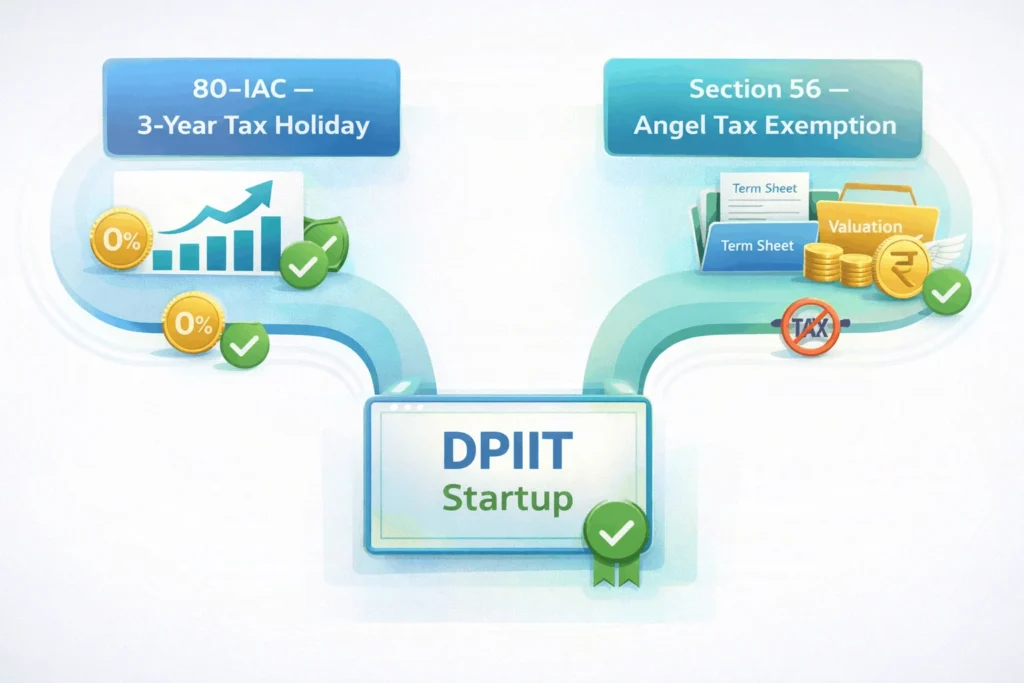
Startup India offers three major tax-related benefits to eligible, DPIIT-recognized startups:
- Income tax holiday under Section 80-IAC
- Angel tax exemption under Section 56(2)(viib)
- Certain capital gains tax reliefs under Sections 54EE and 54GB
1. What Is 80-IAC Income Tax Exemption?
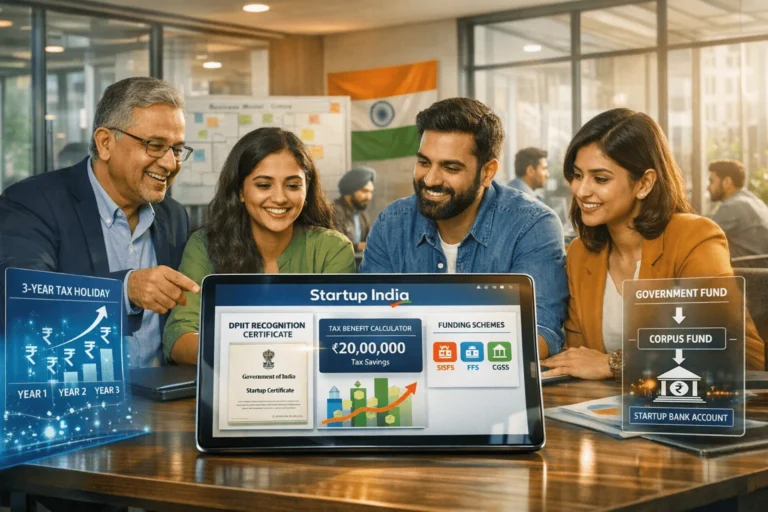
Section 80-IAC allows eligible startups to claim a 100% deduction of profits for three consecutive years within the first ten years of incorporation.
Key points from Startup India and TaxTMI:
- Applies only to DPIIT-recognized startups.
- Must be a company or LLP incorporated on or after 1 April 2016 and less than ten years old.
- Turnover must be less than ₹100 crore in any year.
- Must obtain an IMB (Inter-Ministerial Board) certificate confirming innovation and eligibility.
Once approved, the startup can choose any three consecutive assessment years out of the first ten years to claim 100% profit deduction.
ClearTax notes that this tax holiday can significantly lighten working capital pressure in early years.
2. What Is Angel Tax Exemption Under Section 56(2)(viib)?
Section 56(2)(viib), commonly called angel tax, normally taxes the premium amount received above the fair market value (FMV) of shares issued to investors.
DPIIT-recognized startups can apply for exemption from this provision when issuing shares to resident investors, meaning they do not pay tax on the premium amount if conditions are met.
Key conditions laid out by DPIIT and RegisterKaro:
- Startup must be DPIIT-recognized.
- Must file Form 2 declaration with DPIIT through the Startup India portal.
- Exemption usually covers share issues to resident investors, with Budget 2023 expanding relief to some notified foreign jurisdictions.
TaxTMI and K Alok & Associates highlight that the IMB and CBDT evaluate applications and approvals usually take 2–4 months.
3. What About Capital Gains Exemptions?
In addition, Startup India recognition enables access to capital gains relief under Sections 54EE and 54GB when specified conditions are met, such as reinvesting gains into notified funds or eligible startups.
This can reduce tax outgo when founders or investors exit and reinvest into eligible instruments.
What Funding Benefits Come With Startup India?
Startup India does not directly write cheques to every startup, but it unlocks easier access to government-backed funding channels.
1. What Is the Fund of Funds for Startups (FFS)?
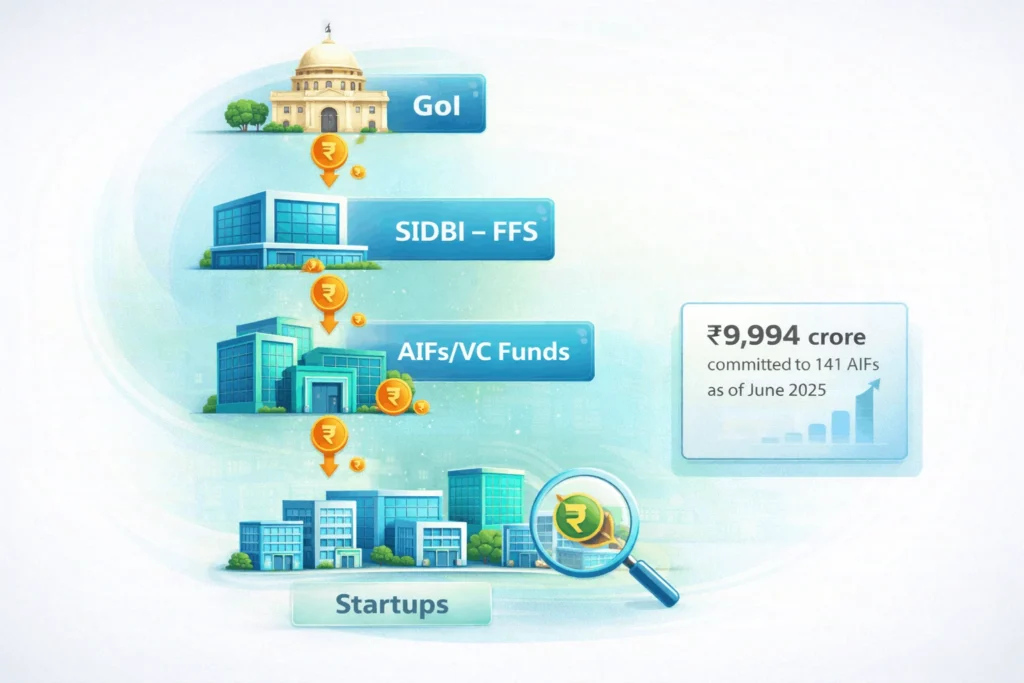
The Fund of Funds for Startups (FFS) is a ₹10,000 crore corpus managed by SIDBI to catalyse venture capital investments into startups.
Key features from PIB and SIDBI:
- SIDBI does not invest directly in startups. It contributes to SEBI-registered AIFs (Alternative Investment Funds).
- AIFs receiving FFS commitments must invest at least 2x the amount received into startups (e.g., ₹200 crore into startups for ₹100 crore from FFS).
- As of June 30, 2025, FFS had committed ₹9,994 crore to 141 AIFs, significantly expanding capital available to Indian startups.
Being DPIIT-recognized often improves your visibility and eligibility across such VC funds, although each AIF has its own selection criteria.
2. How Does SIDBI Support Startups With Loans?
Beyond equity, SIDBI offers multiple loan schemes for startups and MSMEs, often with collateral-free options and lower interest rates.
Highlights from SIDBI loan scheme overviews:
- Many schemes allow collateral-free loans up to ₹1 crore, often backed by CGTMSE (Credit Guarantee Fund Trust for Micro and Small Enterprises).
- Some project schemes finance up to 75% of project cost with repayment tenures of up to 7–10 years.
- Lower interest rates and faster processing make SIDBI loans attractive for working capital and expansion.
While not strictly limited to DPIIT-recognized startups, recognition strengthens credibility and documentation for such applications.
What Non-Tax, Non-Funding Benefits Does Startup India Provide?
Startup India also offers important regulatory, IP, and market access benefits that often get overlooked.
1. How Does Self-Certification and Compliance Relief Work?
Recognized startups are allowed to self-certify compliance with some labour and environmental laws for a limited period, reducing early compliance burden.
Startup Movers and official guidelines mention:
- No routine inspections for certain labour laws for up to 5 years unless there is a credible complaint.
- Easier compliance processes, often through online filings and self-declarations.
This enables founders to focus more on building products instead of managing inspections in the early years.
2. What About IPR and Fast-Track Patents?
Startup India also provides IPR (Intellectual Property Rights) support, especially for patents and trademarks:
- Fast-track patent examination and processing for recognized startups.
- Significant fee rebates (up to 80%) on patent and trademark filings compared to large entities.
- Assistance from empanelled facilitators for filing and managing IP, with professional fees often reimbursed or subsidised.
This encourages innovation-led startups to protect their IP early at much lower cost.
3. How Does It Help With Government Tenders?
Recognized startups often enjoy preference in public procurement and tenders:
- Relaxed prior experience and turnover conditions in certain tenders for eligible startups.
- Ability to bid in government and PSU tenders even without extensive track record, if other conditions are met.
ClearTax and RegisterKaro note that this can be a significant revenue source for B2G and B2B startups targeting public-sector customers.
How To Apply for Startup India Recognition and Tax Exemptions?
Times Needed: Days: 45, Hours: 08, Minutes: 00
Estimated Cost: Currency: INR, Price: 0–30,000 (DIY vs consultant)
Description: A 45‑day roadmap to get DPIIT recognition and then apply for 80‑IAC and angel tax exemptions under Startup India, including document preparation and typical approval timelines.
Step 1: Check Entity and Eligibility Fit
Confirm Your Startup Meets Basic Criteria
Verify that your entity type, age, and turnover match Startup India’s eligibility conditions. Ensure your business model is innovation- or improvement-led and not formed by splitting an existing company.
Tools Name: Startup India portal, NSWS portal, eligibility checklist
Materials Name: Incorporation certificate, PAN, basic pitch deck
Step 2: Apply for DPIIT Recognition Online
File DPIIT Startup Recognition Application
Create an account on the Startup India or NSWS portal, complete the online form, and upload incorporation documents, business description, innovation details, and founder information. Track status until you receive the DPIIT recognition certificate.
Tools Name: Startup India portal login, document scanner, PDF editor
Materials Name: MOA/LLP agreement, pitch note, shareholding pattern
Step 3: Apply for 80-IAC Tax Holiday
Submit Section 80-IAC Tax Exemption Request
After recognition, apply for 80‑IAC via the dedicated form on the Startup India portal. Provide financials, projections, and proof of innovation for IMB and CBDT evaluation. Approvals typically take 2–4 months.
Tools Name: Startup India 80‑IAC form, CA-certified financials, tax portal
Materials Name: Audited statements, projected P&L, IMB questionnaire responses
Step 4: Apply for Angel Tax (Section 56) Exemption
File Form 2 for Section 56(2)(viib) Exemption
Before or around your fundraising, submit Form 2 to DPIIT with valuation details, investor list, and justification for exemption. Monitor the IMB review and keep investors updated on progress to align funding timelines.
Tools Name: Startup India portal, valuation report tool, cap table software
Materials Name: Valuation report, term sheets, share subscription agreements
FAQ on StartupIndia DPIIT Registration
No. It is optional but highly beneficial for eligible innovation-driven entities seeking tax reliefs, easier compliance, and improved funding access.
No. Eligibility requires that the startup be less than 10 years old from the date of incorporation, with turnover under ₹100 crore in any year.
No. 80‑IAC is a separate application requiring IMB and CBDT approval. Recognition is necessary but not sufficient.
Yes, if you qualify separately under each section. Many recognized startups apply for both profit tax holiday (80‑IAC) and premium exemption under Section 56(2)(viib).
Typical timelines reported: DPIIT recognition in 3–6 weeks, angel tax exemption in 2–3 months, and 80‑IAC approvals in 2–4 months, depending on case complexity.
No. It doesn’t guarantee funding but improves your visibility and eligibility for VC/AIFs supported under the Fund of Funds and other schemes.
Yes, if they meet innovation and scalability criteria and are not simply trading or reselling without clear value addition.
Yes, as long as the entity is incorporated in India and meets DPIIT criteria. Angel tax rules for non-resident investors are evolving and tied to notified countries.
Key Takeaways
- Startup India is more than a logo—it unlocks tax holidays, angel tax relief, and easier access to government-backed funding for eligible, innovation-driven companies.
- DPIIT recognition is the entry gate; without it, you cannot apply for 80‑IAC or Section 56(2)(viib) exemptions.
- 80‑IAC offers a 100% profit deduction for any three consecutive years within the first ten years, subject to IMB approval and turnover limits.
- Angel tax exemption under Section 56(2)(viib) prevents taxation of share premiums above FMV for recognized startups that meet conditions.
- Beyond tax, Startup India provides IPR support, compliance relief, tender advantages, and an improved funding environment through FFS and SIDBI-led schemes.
Next Steps You Can Follow
- Validate eligibility against DPIIT criteria (entity type, age, turnover, and innovation focus).
- Apply for DPIIT recognition on the Startup India portal and gather necessary documents for 80‑IAC and Section 56 exemptions.
- Discuss with your CA or advisor which three years to claim 80‑IAC, and align angel tax exemption timelines with your fundraise.
- Explore funding opportunities via SIDBI-backed AIFs, loan schemes, and relevant government tenders once recognized.
Conclusion
Startup India can be a powerful accelerator for Indian founders when used strategically. By securing DPIIT recognition and then carefully applying for 80‑IAC, angel tax exemption, and other incentives, you can extend your runway, reduce tax burdens, and access a richer pool of capital and public opportunities.
The key is to treat Startup India benefits as part of your overall funding and tax planning strategy, not a one-off certificate. With the right timing and documentation, these schemes help you focus energy and capital on building a product, team, and business model that can scale.
REFERENCE LINKS USED FOR RESEARCH
Official Startup India scheme and benefits page
Startup India 80-IAC tax exemption guidelines
Detailed overview of Startup India eligibility and tax incentives
Angel tax and 80-IAC exemption process explained
PIB note on Fund of Funds for Startups and SIDBI implementation




Thanks for breaking down the Startup India benefits so clearly—especially the tax exemptions and angel tax relief part. It’s helpful to see how DPIIT recognition unlocks real financial advantages, especially for early-stage startups. The mention of the registration pause and the expected restart in March also gives us a clearer timeline to plan ahead.
Thank you for your comment. To use your site link & generate backlink on our platform, 1st go through a paid plan on this page: https://startupmandi.in/services/digital-services/premium-brand-promotion-on-startupmandi/
Thanks for breaking down the Startup India benefits so clearly—especially the tax exemptions and angel tax relief part. It’s helpful to see how DPIIT recognition unlocks real financial advantages, especially for early-stage startups. The mention of government tender priority also highlights how the program supports long-term growth, not just short-term funding.
Thank you for your comment. To use your site link & generate backlink on our platform, 1st go through a paid plan on this page: https://startupmandi.in/services/digital-services/premium-brand-promotion-on-startupmandi/
Thanks for breaking down the Startup India DPIIT 2026 benefits so clearly—especially the tax exemptions and angel tax relief part. It’s reassuring to see how the recognition can significantly reduce financial burdens and open doors to government-backed funding. This kind of clarity is exactly what startups need when navigating the ecosystem.
Thank you for your comment. To use your site link & generate backlink on our platform, 1st go through a paid plan: https://startupmandi.in/services/digital-services/premium-brand-promotion-on-startupmandi/