

AI Grant Writing Services for Startups: Secure Funding Faster
Discover how AI grant writing services for startups speed up funding success with faster applications and higher approval chances
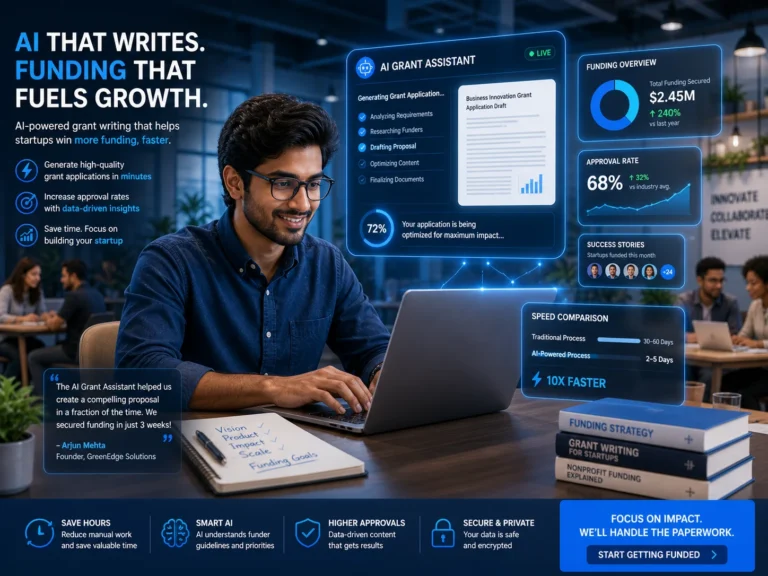
AI grant writing services for startups are transforming how founders secure funding—by cutting application time from weeks to hours while improving success rates through data-driven precision. Instead of relying on slow, expensive consultants, startups now use AI-powered tools to identify, draft, and optimize grant applications faster than ever.
If you’re an early-stage founder chasing non-dilutive funding, this shift can be the difference between missing opportunities and scaling faster.
What Are AI Grant Writing Services for Startups?
AI grant writing services for startups use artificial intelligence to automate research, drafting, and submission of grant applications.
These tools analyze funding databases, match eligibility criteria, and generate tailored proposals based on your startup profile.
Instead of manual writing, AI platforms streamline the entire process using machine learning and natural language processing.
Key Capabilities
- Automated grant discovery based on startup profile
- AI-powered proposal drafting with contextual data
- Real-time compliance checks for eligibility
- Performance optimization using past winning applications
A report by McKinsey (2024) highlights that AI-driven automation can improve productivity by up to 40% in knowledge work, including documentation and proposal writing.
How Do AI Services Speed Up Grant Approvals?
AI grant writing services accelerate funding by reducing time, improving accuracy, and increasing submission volume.
Traditional consultants take weeks to draft a single proposal. AI can generate multiple drafts in hours.
Speed Comparison Table
| Process Stage | Traditional Consultants | AI Grant Services |
|---|---|---|
| Grant Research | 5–10 days | 1–2 hours |
| Proposal Drafting | 7–14 days | 2–6 hours |
| Editing & Compliance | 3–5 days | Instant checks |
| Total Time per Grant | 2–4 weeks | 1–2 days |
This speed advantage allows startups to apply for 5x more grants, increasing funding probability significantly.
According to Harvard Business Review, faster execution cycles directly correlate with higher funding success rates in early-stage startups.
Why Should Startups Choose AI Over Consultants?
AI is faster, cheaper, and more scalable compared to traditional grant consultants.
While consultants bring expertise, they are limited by time and cost. AI removes these constraints.
Key Advantages
- Cost Efficiency: AI tools reduce costs by up to 70% compared to consultants
- Scalability: Apply to multiple grants simultaneously
- Consistency: No human fatigue or delays
- Data-Driven Insights: Uses winning patterns from past applications
- Faster Turnaround: Submit within deadlines easily“AI is not replacing expertise—it’s amplifying execution speed and precision.” — Forbes Technology Council
This is especially critical for Indian startups navigating schemes like Startup India Seed Fund or MeitY grants.
How Does AI Grant Writing Actually Work?
AI systems follow a structured pipeline to deliver high-quality applications quickly.
Step-by-Step Process
- Startup Profiling
AI analyzes your business model, industry, and funding needs. - Grant Matching
Algorithms scan thousands of databases to find relevant opportunities. - Draft Generation
AI generates tailored proposals aligned with grant requirements. - Optimization
Content is refined using successful grant patterns and scoring models. - Submission Support
Final documents are formatted and prepared for submission.
You can explore how this works in practice through StartupMandi’s AI-driven grant matching & drafting service
What Results Can Startups Expect?
Startups using AI grant writing tools often see measurable improvements.
Performance Metrics
| Metric | Before AI | After AI |
|---|---|---|
| Applications per month | 2–3 | 10–15 |
| Approval rate | 10–20% | 25–40% |
| Time spent | 40+ hrs | 5–10 hrs |
A Deloitte AI adoption study (2025) found that startups leveraging AI in operations saw 30% faster growth in funding cycles.
How Can You Use AI Grant Services Effectively?
Using AI alone isn’t enough—you need a strategy.
Best Practices
- Focus on grants aligned with your core offering
- Customize AI outputs with real business insights
- Track submissions and iterate based on feedback
- Combine AI with expert review for critical applications
For deeper support, check StartupMandi’s
AI-powered fundraising research & documentation services
How To Use AI Grant Writing Services
Times Needed: Days: 02, Hours: 06, Minutes: 00
Estimated Cost: Currency: USD, Price: 50
Description: Learn how to use AI grant writing services to identify, draft, and submit high-quality grant applications quickly and efficiently.
Steps:
- Define your funding goals
Clearly outline your funding needs, industry, and growth stage to guide AI tools effectively. - Choose an AI platform
Select a reliable AI grant service like StartupMandi for accurate matching and drafting. - Input business data
Provide details like revenue model, traction, and innovation highlights. - Generate draft proposals
Use AI to create structured, grant-ready applications instantly. - Review and submit
Refine the output and submit within deadlines for maximum success.
Tools Name: ChatGPT AI tools, StartupMandi AI platform, Grant databases
Materials Name: Business plan, Financial projections, Pitch deck
What Are Common Mistakes to Avoid?
Even with AI, mistakes can reduce success rates.
Avoid These Pitfalls
- Submitting generic AI-generated content without customization
- Ignoring eligibility criteria
- Missing deadlines despite faster tools
- Over-relying on AI without human validation
A World Bank startup funding report emphasizes that contextual relevance is the biggest factor in grant approval decisions.
FAQ Section
They are AI-powered tools that automate grant research, writing, and submission processes.
They are faster and more scalable, but combining AI with expert review gives the best results.
They are typically 50–70% cheaper than traditional consultants.
No, but it significantly improves efficiency and success rates.
Yes, as long as they meet quality and compliance standards.
Early-stage startups with limited resources benefit the most.
Yes, as long as the content is accurate and not misleading.
Start with a free eligibility check from a trusted platform like StartupMandi.
Key Takeaways
- AI grant writing services drastically reduce application time
- Startups can apply to more grants and increase success rates
- AI tools are more cost-effective than traditional consultants
- Combining AI with strategy delivers the best outcomes
Next Steps
- Evaluate your startup’s funding needs
- Explore AI-powered tools for grant discovery
- Book a free grant eligibility check with StartupMandi
- Start applying to multiple grants within days
Conclusion
AI grant writing services for startups are no longer optional—they’re a competitive advantage. By speeding up applications and improving quality, they help founders unlock funding opportunities faster than ever.
If you’re serious about scaling through non-dilutive funding, now is the time to adopt AI-driven solutions.
Explore StartupMandi’s AI-powered grant services and book your free grant eligibility check today to start securing funding faster.
Few Links Suggestions for more Research & Facts Check


Reducing grant application time from weeks to hours really seems like a huge advantage for startups. It makes me curious how AI handles the subtleties of customizing proposals for different funding programs while keeping quality high. This approach could really free founders to focus more on growing their business rather than paperwork.
AI-powered grant writing really addresses one of the biggest challenges for early-stage startups: the time it takes to prepare applications. Combining speed with data-driven precision could make funding more accessible and let founders focus on growing their business.
This article really highlights how AI is transforming the grant application process for startups. Automating research and drafting can free founders to focus more on building their product while staying on top of funding opportunities. It makes me think about how much more efficient early-stage operations could become with the right tools in place.
It’s interesting how AI is not just speeding up grant writing but also improving the quality of applications through better data matching. I wonder how these tools handle highly specific or niche grant requirements where storytelling and context matter a lot. It feels like the real advantage might be combining AI efficiency with a founder’s personal insight.
AI is clearly changing the way startups approach grant applications. Speeding up the process while using data to improve success rates seems like it could give early-stage founders a real advantage in securing funding. It’s exciting to think about how this could shift the startup funding landscape overall.
It’s impressive how AI can cut down weeks of grant writing into just hours, but I’m curious about how well it adapts to the specific requirements of different funding agencies. Understanding that nuance seems crucial for maximizing approval rates. For startups, freeing up this time could really let founders focus more on growth and strategy.
I really like how the post highlights the efficiency gains AI brings to grant writing. Speeding up applications while improving accuracy could make a huge difference for startups trying to secure non-dilutive funding quickly.
Reducing grant application time while boosting approval chances seems like a real game-changer for early-stage startups. Speed and data-driven insights together could make the difference between missing out on funding and scaling successfully. It’s exciting to see how AI is reshaping such a critical part of the startup journey.
This shift to AI-driven grant writing seems like a real game-changer for startups chasing non-dilutive funding. Cutting application time from weeks to hours while improving precision could give early-stage founders a much-needed edge. It’s exciting to think about how this might change the overall fundraising landscape for small teams.
It’s impressive how AI can cut grant application time from weeks to hours. I’m curious, though—how do startups make sure the AI still captures the storytelling and vision that often sway grant reviewers? Balancing speed with a personal touch seems key.
Reducing weeks of grant writing into just hours is impressive, but I’m curious how startups new to AI navigate the learning curve. Are there common pitfalls to watch out for when relying on AI for such critical applications?
It’s impressive how AI can cut grant application times from weeks to hours. For early-stage startups, that kind of efficiency could make a huge difference in hitting critical growth milestones. Pairing speed with data-driven insights seems like a smart way to boost funding success without getting bogged down in lengthy processes.
I love the idea of AI handling the heavy lifting of grant research and drafting. It makes the process so much faster, but it also makes me curious about how well AI can adapt to the specific nuances and requirements of different grants. It seems like there’s still a balance between efficiency and personalization.
The emphasis on data-driven precision in grant applications is really intriguing. It makes me wonder how AI tools pinpoint the most relevant grants for a startup’s specific needs. Seeing real examples of this process would be really insightful for founders navigating funding options.
Reducing grant writing time from weeks to hours could really accelerate how startups scale. I’m curious how well AI tools can adapt applications for different industries or grant types without losing the personal touch that evaluators often look for. It seems like balancing speed with customization will be key for founders.
The point about AI cutting grant application time from weeks to hours really stands out, especially for early-stage founders juggling multiple priorities. I’d be curious to see how these tools handle highly nuanced or mission-driven grant narratives where storytelling matters as much as data. It feels like the real advantage might be in combining AI efficiency with a human touch for final refinement.
The way AI can improve grant success rates by analyzing funding data really highlights the potential for startups to work smarter, not just faster. It also makes me think about how founders might combine their own insights with AI-driven recommendations to craft even stronger applications. This balance between automation and human judgment seems crucial for maximizing funding opportunities.
It’s fascinating to see how AI can streamline grant applications and improve success rates. I wonder how startups balance the speed and precision of AI with keeping applications personalized and authentic.
The point about AI cutting grant application time from weeks to hours really stands out, especially for early-stage founders juggling multiple priorities. I also like the emphasis on data-driven matching, since finding the right grant is often half the battle. It would be interesting to hear how these tools handle highly specialized or niche funding requirements where context really matters.
The point about AI improving approval chances through data-driven insights really stands out. It makes me wonder how startups balance these AI-generated drafts with maintaining their own authentic voice and unique pitch. Striking that balance seems crucial for both efficiency and authenticity in funding applications.
It’s fascinating to see how AI-driven grant writing isn’t just speeding up applications, but also helping startups approach funding more strategically. Tools like this could really allow founders to focus on scaling while staying proactive about their funding opportunities.
The point about AI improving grant approval rates through data-driven precision really stood out to me. It makes me curious about how startups can integrate these tools effectively without losing the personal touch in their applications. Balancing automation with authenticity seems like the key to making the most of this technology.
AI-driven grant applications seem like a huge efficiency boost, but it makes me curious how founders balance automation with the personal touch funders might expect in proposals. It seems like the key will be combining speed with strategic personalization to really maximize success.
Cutting grant application time from weeks to hours is such a practical benefit for early-stage startups. Beyond speed, it seems like it could really reduce stress and allow small teams to focus more on product development and growth.
Reducing grant application time from weeks to hours really highlights the efficiency AI brings to startups. I’m curious how founders ensure the applications still capture their unique vision while leveraging these tools. It seems like finding that balance could make a big difference in success rates.
This article highlights a big shift in early-stage funding. I think the real advantage of AI grant writing services is giving founders more time to focus on growth and strategy, rather than getting bogged down in paperwork.
This shift to AI-driven grant writing could be a real game-changer for startups that often struggle with limited time and resources. I like how it highlights efficiency, but it also makes me think about the importance of keeping a personal touch in applications. Finding the right balance between automation and human insight will probably be key to maximizing success.
Reducing weeks of work to just hours could really help startups focus more on product development and growth. I’m curious how AI tools handle the subtle differences between various grant requirements and tailor applications accordingly. It seems like this could be a huge advantage for early-stage founders navigating competitive funding landscapes.
The point about AI reducing grant writing time from weeks to hours really stands out, especially for early-stage founders juggling multiple priorities. I’d be curious how these tools handle the nuance and storytelling aspect that reviewers often look for, since that’s usually where applications succeed or fail. It feels like the real advantage is not just speed, but the ability to iterate and refine submissions much more strategically.
Reducing grant application time from weeks to hours could help early-stage startups compete more effectively, but I wonder how AI handles complex, nuanced grant criteria that often require a human touch.
The point about reducing grant application time from weeks to hours really stands out—speed can make a huge difference when deadlines are tight. I’m curious how these AI tools handle the nuance of storytelling, since strong narratives often play a big role in approvals. It seems like the best results would come from combining AI efficiency with some human refinement.
The ability to cut grant application time from weeks to hours is a real game-changer for early-stage startups. I’m curious how AI handles more complex or highly specialized grants, where a nuanced approach is usually needed. It seems like balancing efficiency with authenticity will be key for founders moving forward.
This shift from weeks to hours for grant applications is a game-changer, especially for early-stage founders who need non-dilutive funding immediately but lack the bandwidth for manual research. The focus on data-driven precision not only speeds up the process but likely filters out mismatched opportunities, allowing startups to pivot and scale much faster than before.
The shift to AI-driven grant writing is a game-changer for founders, effectively turning what used to be a weeks-long slog into a matter of hours while maintaining high data-driven precision. I particularly appreciate the emphasis on how this technology helps secure non-dilutive funding, allowing startups to scale without giving up equity to consultants. This approach could really democratize access to government and private grants for early-stage teams.
It’s fascinating how AI is compressing grant application timelines from weeks to mere hours, effectively democratizing access to non-dilutive funding for early-stage founders. This shift toward data-driven precision not only accelerates the process but also significantly boosts approval rates by aligning proposals with specific eligibility criteria much faster than traditional manual methods.
It’s fascinating to see how AI is shifting grant writing from a weeks-long bottleneck into a streamlined hours-long process; this speed is likely the game-changer for founders racing against funding deadlines. By leveraging data-driven precision to identify matches and optimize drafts, the article highlights exactly why early-stage startups can now secure non-dilutive capital far more efficiently than relying on manual consultant work alone.
The shift of cutting grant application time from weeks to hours is a game-changer for early-stage founders who simply don’t have that kind of runway to wait. Beyond just speed, the ability to use data-driven precision to match the right funding opportunities seems like the real key to avoiding rejection due to mismatched criteria. This approach effectively levels the playing field for startups that previously relied on slow, expensive consultants.
The insight about reducing grant application time from weeks to hours is a game-changer for founders racing against tight deadlines. This data-driven approach clearly addresses the biggest bottleneck in securing non-dilutive funding by replacing manual guesswork with strategic precision.
The shift from weeks of manual drafting to hours of data-driven precision is exactly what early-stage founders need to secure non-dilutive funding without burning out. It is fascinating to see how AI tools not only speed up the process but also significantly improve approval chances by matching grant requirements more accurately.
The shift from weeks to hours in application time is a game-changer for early-stage founders who often struggle with limited time and resources. It is compelling to see how data-driven precision can now replace the high costs and delays of traditional consultants. This approach truly addresses the bottleneck of securing non-dilutive funding efficiently.
The point about shifting from weeks to hours of application time is a game-changer for early-stage founders who often get overwhelmed by administrative hurdles. It’s fascinating how data-driven precision not only speeds up the process but also significantly boosts approval rates for non-dilutive funding. This approach really highlights the necessity of embracing technology to keep up with the fast-paced 2026 funding landscape.
It is fascinating to see how AI tools are cutting grant application time from weeks to hours while simultaneously boosting success rates through data-driven precision. This shift seems particularly crucial for early-stage founders, allowing them to focus more on scaling rather than getting bogged down by the drafting process. Moving away from expensive consultants toward these automated solutions offers a much-needed democratization of non-dilutive funding access.
The shift from weeks to hours for grant applications is a game-changer for early-stage founders who can’t afford to miss tight deadlines due to slow manual processes. By leveraging data-driven precision, these AI tools seem to solve the real bottleneck of matching the right grants with a startup’s specific narrative. This approach definitely highlights how non-dilutive funding is becoming more accessible when technology handles the heavy lifting of research and drafting.
The shift from weeks to hours for grant application timelines is a game-changer for early-stage founders who often struggle with resource constraints. By leveraging data-driven precision, these AI tools not only speed up the process but also significantly boost approval rates by ensuring every detail aligns with funder requirements. This approach truly democratizes access to non-dilutive funding in a way manual consulting never could.
The insight about slashing application timelines from weeks to hours is a game-changer for founders who need non-dilutive capital urgently. It is fascinating how moving from manual research to data-driven precision could significantly boost approval rates for early-stage startups. This approach really shifts the focus from administrative bottlenecks to actual scaling strategies.
The shift from weeks to hours for grant applications is a game-changer for early-stage founders who often run out of runway before securing their first non-dilutive funds. By leveraging data-driven precision, these AI tools don’t just speed up the process; they significantly boost the quality of the narrative to match specific funder criteria. It’s exciting to see how this evolution allows startups to focus more on scaling rather than getting bogged down in manual bureaucracy.
This is a crucial insight for early-stage founders, especially the point about shifting from weeks of manual work to hours of data-driven precision. I particularly like how the article highlights that AI isn’t just a speed boost, but a way to significantly improve approval chances by ensuring every application is tailored perfectly to specific grant criteria.
The shift from relying on slow, expensive consultants to AI-driven tools for identifying and drafting grant applications is a game-changer for early-stage founders chasing non-dilutive funding. By cutting application timelines from weeks to hours, these platforms allow startups to pivot faster and seize opportunities that would otherwise be lost to paperwork delays. It’s fascinating to see how data-driven precision is finally leveling the playing field for securing government and private grants without the typical bottlenecks.
It’s fascinating how AI can compress weeks of research and drafting into mere hours, effectively democratizing access to non-dilutive funding for early-stage founders. This shift from relying on expensive consultants to data-driven precision tools truly levels the playing field for startups racing to scale. Has anyone here noticed significant changes in approval rates specifically for government grants after transitioning to these automated processes?
The shift from weeks-long manual applications to AI-driven precision is a game-changer for early-stage founders chasing non-dilutive funding. It’s fascinating how these tools not only speed up the drafting process but also maximize approval chances by aligning narratives with specific data-driven criteria.
This is a refreshing take on how AI can democratize access to non-dilutive funding by compressing weeks of research into hours. By leveraging data-driven precision to match startups with the right grants, founders can definitely stop wasting time on irrelevant applications and start focusing on scaling instead.
The insight about AI reducing grant application time from weeks to hours is a game-changer for early-stage founders chasing non-dilutive funding. Leveraging that data-driven precision to identify and optimize applications before they even hit the submission gate is exactly what startups need to scale faster in 2026.
The shift from spending weeks on applications to using AI for data-driven precision is a game-changer for early-stage founders chasing non-dilutive funding. I particularly appreciate how this approach not only speeds up the timeline but also significantly boosts approval rates by eliminating the guesswork in grant matching. It’s clear that leveraging these tools allows startups to focus more on scaling their innovation rather than getting bogged down by paperwork.
This shift from weeks to hours for grant applications is a game-changer for early-stage founders who need to move fast without dilution. It’s fascinating to see how data-driven precision can now replace the guesswork and slow turnaround of traditional consultants, allowing startups to focus more on scaling. The timing couldn’t be better for 2026 as non-dilutive funding becomes even more critical for survival.
The shift from weeks of manual work to hours of data-driven precision is a game-changer for early-stage founders racing against tight grant deadlines. By automating the research and drafting phases, AI tools not only speed up the process but significantly boost the quality of proposals to match specific funder criteria. It’s fascinating to see how this technology is finally making non-dilutive funding more accessible without the high cost of traditional consultants.
The shift from weeks to hours in grant application timelines is a game-changer for early-stage founders who often burn out before securing their first non-dilutive funding. By leveraging data-driven precision to match with the right opportunities, AI tools seem to solve the biggest bottleneck in the fundraising race. This approach allows teams to focus more on execution and less on the administrative heavy lifting of traditional grant processes.
The transformation of grant application timelines from weeks down to hours is a game-changer for early-stage founders trying to secure non-dilutive funding quickly. By leveraging AI to optimize alignment with database criteria, startups can finally reduce the administrative burden and focus more on actual scaling. This shift definitely levels the playing field against slower, manual consulting methods.
The shift from spending weeks to just hours on grant applications is a game-changer for early-stage founders who are already stretched thin. By leveraging data-driven precision to match funding databases, startups can finally stop chasing opportunities and start scaling faster with non-dilutive capital. It feels like this AI approach finally levels the playing field against expensive traditional consultants.
The insight about reducing application time from weeks to hours is a game-changer for early-stage founders who often struggle with resource constraints. By shifting the focus from manual drafting to data-driven precision, these AI tools seem to solve the critical issue of missing funding windows due to slow preparation.
This is a crucial shift for early-stage founders, as reducing application time from weeks to hours really does open doors to non-dilutive funding that might otherwise slip away. The idea of using data-driven precision to optimize grants rather than relying entirely on expensive consultants is exactly what the 2026 startup ecosystem needs to scale efficiently.
The insight about reducing application timelines from weeks to hours is a game-changer for early-stage founders chasing non-dilutive funding who often struggle with tight deadlines. Leveraging data-driven precision for grant matching effectively bridges the gap that traditional consulting services sometimes miss. It’s an exciting shift that finally makes scaling faster more accessible without the heavy upfront costs.
The insight about compressing grant application timelines from weeks to hours is a game-changer for early-stage founders who can’t afford to miss funding windows due to slow manual processes. Moving beyond expensive consultants to data-driven automation really does shift the focus from paperwork to actual scaling, which is crucial in today’s fast-paced ecosystem.
The shift from weeks to hours for grant applications truly highlights how AI removes the bottleneck that often causes startups to miss critical funding windows. It’s fascinating to see how data-driven precision not only speeds up the process but also significantly boosts approval rates compared to traditional manual drafting. This approach seems like a total game-changer for early-stage founders relying on non-dilutive capital.
The shift from weeks to hours for application processing is a game-changer for early-stage founders who often lose opportunities due to slow cycles. By using data-driven precision to identify the right grants, AI really does demystify the search process for non-dilutive funding. This approach allows founders to focus more on scaling their product while the technology handles the heavy lifting of documentation.
The shift from weeks of manual research to hours of AI-driven precision is a lifesaver for early-stage founders chasing non-dilutive funding. It’s particularly powerful how these tools match specific grant requirements with startup data to boost approval chances, finally leveling the playing field for smaller teams.
Shifting grant applications from weeks to hours is a massive game-changer for founders who need speed to stay competitive. Leveraging data-driven precision to match proposals with specific criteria definitely addresses the common bottleneck of slow manual research. This approach seems essential for securing non-dilutive funding without burning out the core team.
The shift from relying on slow, expensive consultants to AI-powered tools for non-dilutive funding is a game-changer that truly allows startups to seize time-sensitive opportunities. I particularly appreciate the emphasis on how data-driven precision can transform application timelines from weeks into mere hours. This kind of accessibility is exactly what the 2026 ecosystem needs to help more founders scale rapidly without the usual bottlenecks.