




E-E-A-T SEO: How to Build Trust, Authority, and Rankings in 2026
Here’s why E-E-A-T SEO matters : E-E-A-T SEO matters because Google wants content that feels credible, useful, and grounded in real experience. If you want stronger visibility in 2026, the goal is not just to publish more content, but to prove that your content deserves trust. E-E-A-T stands for Experience, Expertise, Authoritativeness, and Trustworthiness, and it helps search engines judge whether your content should be trusted, cited, and ranked.
This guide shows how to strengthen those signals with author bios, proof, data, structure, and clear site trust cues.
What Is E-E-A-T SEO?
E-E-A-T SEO is the practice of improving your content and website so they show real experience, expertise, authority, and trust. In fact, Google’s quality guidance and recent SEO coverage keep emphasizing these signals because they help users find more reliable answers.
For bloggers and content marketers, this means your article should do more than explain a topic. Instead, it should show who wrote it, why they know it, and why the page can be trusted. That is especially important in 2026, when AI-driven search and AI Overviews reward clearer proof and stronger structure.
“Trust is not a bonus signal anymore; it is the foundation of helpful content.”
How Does E-E-A-T Work?
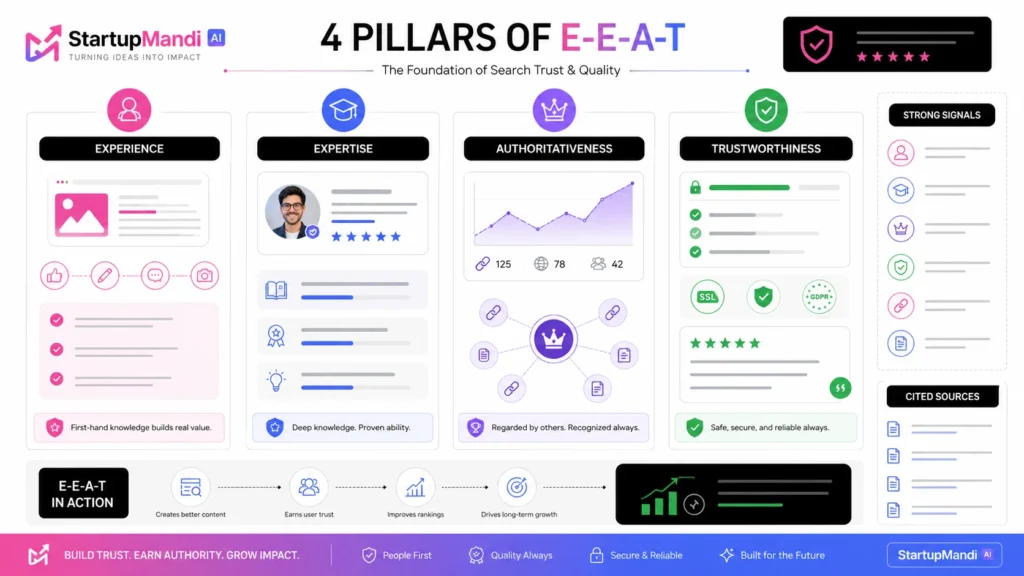
E-E-A-T is not a single checkbox. It is a collection of signals that work together across your content, authorship, site structure, and external reputation.
Here is the simplest way to think about it :
- Experience means you have first-hand knowledge.
- Expertise means you understand the topic deeply.
- Authoritativeness means others recognize your value.
- Trustworthiness means users and search engines can rely on your page.
This framework matters because generic content is easier to ignore. When your article includes original insight, proof, and a clear author, it becomes easier to trust and easier to cite.
Why Does E-E-A-T Matter Now?
E-E-A-T matters more now because search is getting more competitive and more interpretive. In fact, SEO coverage in 2026 repeatedly connects E-E-A-T with AI search visibility, trust signals, and content quality.
It also matters because users are more skeptical. A page that looks thin, anonymous, or recycled can lose trust fast. By contrast, a page with author transparency, evidence, and clean formatting feels more useful and more credible. According to one 2026 SEO guide, pages with stronger E-E-A-T signals are better positioned for modern ranking systems and AI citations. Meanwhile, another practical checklist notes that schema, author bios, reviews, and accuracy are central to trust-building.
In addition, these signals work best when they are consistent across the whole site, not just one article. For example, a strong author bio, updated sources, and clear page policies can all reinforce credibility at the same time. As a result, readers are more likely to trust the content, and search systems are more likely to treat it as reliable.
How Do You Show Experience In E-E-A-T?
Show experience by proving you have actually done the thing you are writing about. That can include screenshots, case studies, personal results, process notes, or photos of real work.
For example, here are five strong ways to show it:
- Add first-hand examples from your own work.
- Include screenshots, photos, or behind-the-scenes details.
- Explain what worked, what failed, and what you changed.
- Share small case studies with measurable outcomes.
- Write in a way that sounds human, specific, and practical.
As a result, this is one of the easiest trust upgrades you can make. A reader can usually tell the difference between a researched article and a lived one.
How Do You Show Expertise?
Show expertise by making your content accurate, complete, and clearly informed. That means using correct terminology, defining key terms, and covering the topic deeply enough to answer the real question.
For instance, a strong expertise signal often includes :
- Clear author credentials.
- Accurate citations and supporting sources.
- Detailed explanations instead of vague summaries.
- Updated information that reflects current best practices.
If your content is about SEO, for example, it should not just repeat basic advice. Instead, it should explain why the advice matters, how to apply it, and what a reader should avoid.
How Do You Build Authority?
Authority comes from recognition. It grows when other credible sites mention, cite, or link to your content, and when your site develops depth around one topic.
For example, a simple authority-building approach looks like this :
| Authority Signal | What It Means | Example |
|---|---|---|
| Topical depth | You cover a subject thoroughly | A pillar page plus supporting articles |
| External mentions | Others reference your brand | Guest posts, citations, backlinks |
| Consistent authorship | One clear expert voice | Named author with bio and profile |
| Structured content | Easy to scan and reuse | H2s, lists, tables, FAQs |
This is where internal linking also helps. When related posts support one another, your site starts to look more like a serious resource and less like a collection of disconnected pages.
How Do You Build Trust?
Trust starts with clarity. First, readers should easily see who wrote the content, why the page exists, how to contact you, and whether the information is current.
To build trust, use these signals :
- Named authors instead of anonymous bylines.
- Strong About and Contact pages.
- Accurate facts and updated dates.
- HTTPS and clear site policies.
- References to reputable sources.
In addition, trust also improves when your page avoids exaggeration. A calm, transparent tone usually performs better than overpromising language.
What Should You Put On A Page?

A good E-E-A-T page should feel useful in under a minute. In fact, readers should immediately know what the page covers, who wrote it, and why they should keep reading.
Use this simple content structure:
- Direct answer in the first paragraph.
- Clear definition of the topic.
- Practical steps or examples.
- Proof, sources, or data.
- Next steps or checklist.
As a result, this format also helps AI systems extract useful answers more easily, which supports discoverability in modern search experiences.
Which Signals Matter Most?
Some signals matter more than others when you want better E-E-A-T performance. The most useful ones are the ones readers can actually see and verify.
| Signal Type | Why It Matters | Priority |
|---|---|---|
| Author bio | Shows who wrote it | High |
| First-hand examples | Proves experience | High |
| External citations | Supports accuracy | High |
| About page | Builds trust | Medium |
| Internal links | Reinforces topical depth | Medium |
| Schema markup | Helps machine readability | Medium |
The biggest mistake is treating E-E-A-T like a decorative add-on. It should shape the content itself, not just the footer or author box.
How Do You Improve E-E-A-T Fast?
You can improve E-E-A-T quickly by fixing the pages that matter most first. Start with your main articles, then move to author pages, trust pages, and older posts that need updates.
In practice, a fast improvement plan looks like this:
- Add a real author bio.
- Add one proof element per article.
- Update outdated facts and stats.
- Link to credible external sources.
- Improve About, Contact, and policy pages.
Meanwhile, one practical guide recommends balancing new content with refresh work, because freshness and accuracy support credibility over time.
What Mistakes Should You Avoid?
The most common E-E-A-T mistakes are easy to fix once you notice them. They usually come from trying to publish quickly without adding enough proof or clarity.
For instance, avoid these mistakes:
- Anonymous authorship.
- Thin or repetitive content.
- Outdated statistics.
- Weak or missing citations.
- Generic advice with no examples.
In other words, if your article could be copied and published on ten other sites without losing meaning, it probably needs more experience and specificity.
How To Improve E-E-A-T
Times Needed : 3 Days, 6 Hours, 30 Minutes
Estimated Cost : USD 0
Description : A practical workflow to improve E-E-A-T signals on a blog through authorship, proof, trust pages, and content updates.
Steps :
- Audit key pages
Review your top pages for weak authorship, outdated facts, thin sections, and missing trust signals. - Add author proof
Include a real bio, experience notes, and links to relevant profiles or work samples. - Strengthen trust pages
Update About, Contact, Privacy, and editorial policy pages so readers can verify who is behind the site. - Cite reliable sources
Add supporting links from credible publications, official documentation, and expert resources. - Refresh and enrich
Update old posts with new examples, better structure, and stronger proof elements.
Tools Name
- Google Search Console.
- Google Analytics.
- Grammarly.
- Screaming Frog.
Materials Name
- Author bio.
- Source list.
- Content checklist.
- Updated site policies.
FAQ
It means Experience, Expertise, Authoritativeness, and Trustworthiness. These signals help search engines and users judge whether content is reliable.
It is better treated as a quality framework than a single ranking factor. Strong E-E-A-T usually supports better visibility over time.
Bloggers can show E-E-A-T with named authors, first-hand experience, useful examples, citations, and transparent site pages.
AI content does not automatically hurt E-E-A-T. The problem is generic or unverified content; human review and original insight make it stronger.
Adding a real author bio is one of the fastest improvements because it immediately increases transparency.
Because AI systems need content they can trust and extract clearly. Structured, credible pages are better suited for AI visibility.
Yes, when they support the argument and come from reliable sources. Data-backed claims strengthen expertise and trust.
Every site benefits, but it matters especially for advice-heavy or high-stakes topics. Those pages need stronger trust and accuracy signals.
Key Takeaways
- E-E-A-T SEO is about proving trust, not just using keywords.
- Experience is shown with real examples and first-hand detail.
- Expertise grows through accuracy, depth, and clear authorship.
- Authority improves when others cite or mention your work.
- Trust comes from transparency, policies, and reliable sourcing.
Next Steps
- Audit your top three blog posts for missing E-E-A-T signals.
- Update your author bio and About page this week.
- Add one new proof element to each key article.
- Refresh any outdated posts with current examples and sources.
Conclusion
E-E-A-T SEO helps your content feel more trustworthy, and that matters more in 2026 than ever before. When you focus on real experience, better structure, and visible proof, your content becomes more useful for readers and easier for search systems to trust.
Start with your highest-value pages and improve the signals readers can verify quickly. For broader site-wide growth, connect this work with your overall content strategy and your keyword research framework, and visit StartupMandi Global for more resources and support.
Few Links Suggestions for more Research & Facts Check
- Google Search Central SEO Starter Guide — useful for foundational SEO guidance.
- Search Engine Journal on E-E-A-T — useful for practical on-page application.
- Google’s Heading and title format — useful for content structure and readability.
- W3C Headings Tutorial — useful for hierarchy and accessibility.
- Google Search Central Docs — useful for broader search documentation.




Thanks for writing this — VV ULTIMATUM at / has been useful for similar workflows.