

Start-up Business Loans: Essential Capital for First-Time Founders 💰
Start-up business loans represent critical financial mechanisms enabling entrepreneurs to transform ideas into operational ventures. Loans for start-up businesses serve diverse purposes—from initial equipment purchases through working capital management—providing structured capital without equity dilution. Understanding this landscape empowers first-time founders to access optimal financing matching their specific needs.
The startup ecosystem has transformed dramatically. India’s government-backed schemes (MUDRA, Stand-Up India) now distribute billions supporting new entrepreneurs—democratizing access previously limited to well-connected founders. Combined with private lenders, this ecosystem creates unprecedented opportunity for serious business builders.
Start-up Business Loans – 2026 Overview 📈
Government programs expanded dramatically: MUDRA (₹10 lakh limit), Stand-Up India (₹10 lakh limit), CGTMSE guarantee scheme (85% guarantee)
NBFCs & fintech disrupting banks: Approval timelines compressed from weeks to days
Collateral-free loans maturing: Unsecured lending to early-stage startups increasing rapidly
Equipment financing simplified: Specialized loans where equipment serves as collateral
Invoice financing enabling cash flow: Fastest capital access (1-5 days) for service businesses
Understanding Start-up Business Loans: Types & Mechanisms
Loans for start-up businesses cluster into distinct categories—each serving specific business stages, capital amounts, and founder circumstances. Understanding these distinctions enables strategic matching between funding need and loan source.
Government-Backed Schemes: Lowest Cost Capital Available
MUDRA Loans: Micro Units Development & Refinance Agency: 🏛️
MUDRA scheme provides collateral-free microloans up to ₹10 lakh specifically supporting micro and small enterprises. This represents most accessible entry point for first-time founders lacking credit history.
MUDRA loan characteristics:
Loan categories by business scale:
Shishu (up to ₹50,000): Startups in idea validation stage
Kishore (₹50,001-₹5 lakh): Established operations seeking expansion
Tarun (₹5 lakh-₹10 lakh): Mature startups transitioning to scale
Zero collateral requirement: Personal guarantee only
Interest rates: 7-12% typically, lower than commercial banks
Approval speed: 1-2 weeks typical
Approval rate: 95%+ for eligible applicants with proper documentation
Stand-Up India Scheme: ₹10 Lakh Support for Underrepresented Groups: 👥
Government initiative specifically supporting SC/ST entrepreneurs and women founders with loans up to ₹10 lakh. This scheme prioritizes capital accessibility for historically underrepresented communities.
Stand-Up India characteristics:
Target beneficiaries: SC/ST entrepreneurs, women founders (non-agriculture)
Loan amount: Up to ₹10 lakh per borrower
Repayment period: 5-7 years with moratorium options
Interest rates: 7-10% typical (lower than commercial rates)
Processing timeline: 3-4 weeks typical
Private Bank & NBFC Loans: Faster, Flexible Options
Unsecured Business Loans: 💳
Banks and NBFCs provide ₹10K-₹1 lakh unsecured loans based primarily on founder creditworthiness and business potential. These loans require no collateral but demand strong personal credit history.
Unsecured loan characteristics:
Approval criteria: Credit score 700+, income verification, business plan quality
Interest rates: 10-15% typical (premium for credit risk)
Approval speed: 2-4 weeks typical
Loan amount: ₹10,000-₹100,000 typical for startups
Processing: Mostly digital, minimal documentation
Working Capital Loans: 🏪
Short-term financing covering operational expenses—salaries, inventory, utilities—managing cash flow gaps during irregular revenue periods.
Working capital loan characteristics:
Purpose: Operating expense management, not capital investment
Tenure: 6-24 months typical
Interest rates: 12-18% typical
Approval speed: 1-2 weeks (fastest among traditional loans)
Flexibility: Can renew annually based on business performance
Eligibility & Documentation: What Lenders Actually Require
Loans for start-up businesses demand rigorous documentation proving founder credibility and business viability. Understanding requirements enables efficient application preparation.
Core Eligibility Criteria for Startup Loans
Personal & Business Qualifications:
Age: Minimum 18-21 years (varies by lender)
Business registration: Registered entity (Partnership, Pvt Ltd, LLP, Sole proprietorship)
Credit history: 650+ CIBIL score preferred (some govt schemes accept lower)
Business vintage: Some lenders require 6-12 months operation (MUDRA allows pre-revenue)
Income documentation: ITR, salary slips, or projected income statements
Business Plan Evaluation:
Market validation: Evidence of customer demand
Competitive advantage: Clear differentiation strategy
Revenue projections: Realistic 3-year financial forecasts
Use of funds: Specific breakdown showing capital deployment
Essential Documentation Checklist
Personal Documents:
Identity proof (Aadhaar, PAN, Driver’s License)
Address proof (utility bill, rental agreement)
Bank statements (6-12 months)
Income verification (ITR, salary slips, or projections)
Business Documents:
Business registration certificate
PAN of business and founders
GST registration (if applicable)
Business bank statements
Detailed business plan (2-5 pages minimum)
Supporting Materials (Strengthen Application):
Market research reports
Competitive analysis document
Letters of intent from potential customers
Product prototypes or samples
Team credentials proving sector expertise
Application Process: Step-by-Step
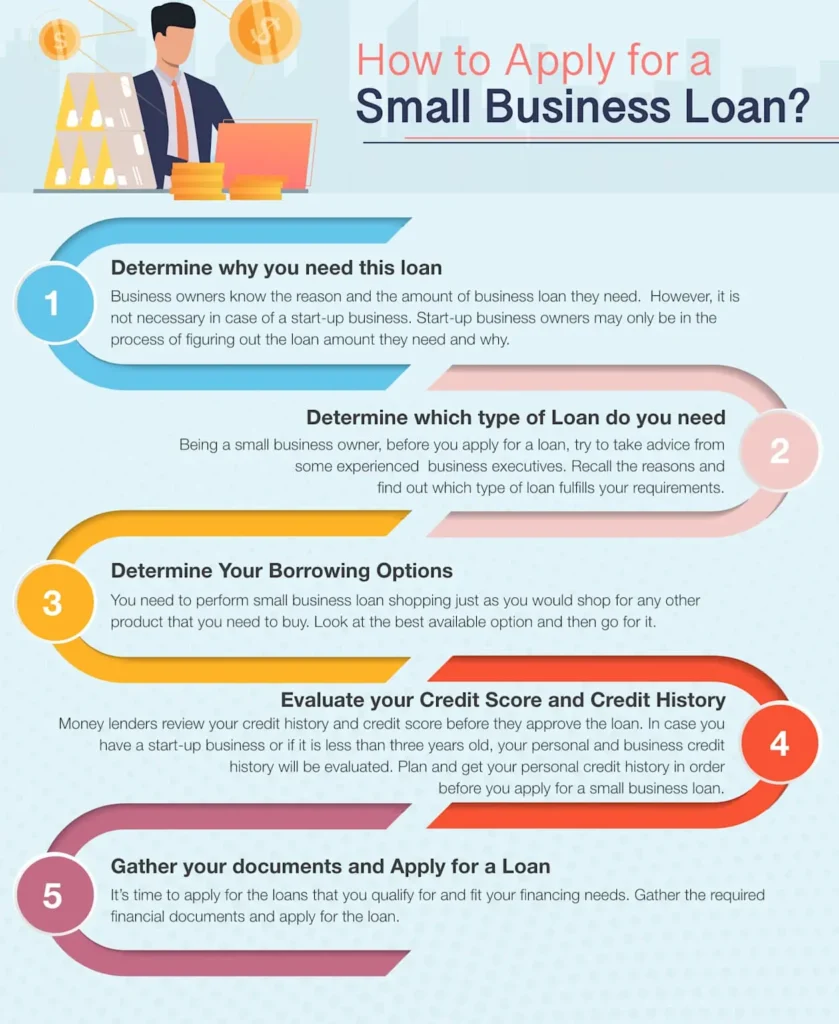
Phase 1: Assessment (Week 1-2) 📋
Estimate precise capital requirements—avoid over-borrowing creating excessive EMI burden. Break down expenses: equipment (₹), workspace (₹), hiring (₹), inventory (₹), marketing (₹__).
Phase 2: Research & Comparison (Week 3-4) 🔍
Compare minimum 5 lenders evaluating: interest rates, processing fees, repayment terms, collateral requirements, approval timeline, customer reviews.
Phase 3: Prepare Documentation (Week 5-6) 📝
Gather all materials from checklist above—incomplete applications cause rejections or delays.
Phase 4: Submit Application (Week 7-9) ✅
Submit online or offline depending on lender preference. Ensure accuracy—errors cause processing delays or rejections.
Phase 5: Verification & Review (Week 10-12) 🔎
Lender conducts credit check, income verification, business viability assessment. Some require property inspections or guarantor interviews.
Phase 6: Approval & Disbursal (Week 13+) 💸
Loan approval notification, agreement signing, fund transfer to business bank account.
Strategic Tips: Maximizing Loan Approval & Minimizing Cost
Loans for start-up businesses approval depends significantly on application quality and founder preparation level. Strategic execution dramatically improves success probability.
Boosting Loan Approval Probability
Build Exceptional Business Plan: 📊
Most startup loan rejections stem from weak business plans, not creditworthiness. Create comprehensive 3-5 page plan including: market opportunity ($__ market size), competitive advantage, revenue model, 3-year projections, use of loan funds, founder expertise.
Demonstrate Financial Discipline: 💼
Maintain 6-12 months business bank statements showing discipline
Keep personal accounts clean (no overdrafts or bounces)
File accurate GST returns (proves sales verification)
Maintain ITR documentation even for low incomes
Leverage Guarantor Strength: 👥
If founder creditworthiness weak, strong guarantor (parents, established business friend) dramatically improves approval probability. Guarantor must have: 650+ credit score, regular income, clean credit history.
Compare Interest Rates Systematically: 🎯
Interest rate differences of 2-3% create substantial lifetime cost variations on ₹10 lakh loan, 5 year tenure:
| Interest Rate | Monthly EMI | Total Interest Paid | 5-Year Total Cost |
|---|---|---|---|
| 8% (best case) | ₹1,861 | ₹21,660 | ₹1,21,660 |
| 10% (average) | ₹1,886 | ₹23,160 | ₹1,23,160 |
| 12% (higher) | ₹2,112 | ₹26,720 | ₹1,26,720 |
| 15% (premium) | ₹2,373 | ₹32,180 | ₹1,32,180 |
Shop 5+ lenders before committing
Negotiate rate reduction showing loan comparison quotes
Consider government schemes (7-10%) before commercial banks (10-15%)
Improve credit score 50+ points reducing rate 1-2%
Managing Startup Loan Successfully
Cash Flow Alignment: 💰
Ensure monthly revenue projections exceed EMI by minimum 40% buffer. If ₹50K monthly EMI, project ₹70K+ monthly revenue minimum.
Repayment Discipline: ⏰
Never miss EMI payment—single default damages credit severely
Set up auto-debit ensuring automatic payment
Make prepayments when possible (saves interest)
Refinance when credit improves (reduce rate)
Fund Deployment Rigor: 🎯
Use loan funds exactly matching approved plan. Deviation indicates mismanagement to lender, complicating future borrowing.
Conclusion: Strategic Start-up Business Loans Enable Sustainable Growth 🚀
Start-up business loans provide essential capital transforming entrepreneurial vision into operational reality. Loans for start-up businesses span diverse options—from government-backed MUDRA providing ₹10 lakh collateral-free capital, through private lenders offering flexible unsecured loans, to equipment financing supporting asset-heavy operations.
Success requires: 1) Clear understanding of capital needs, 2) Matching requirements to optimal loan type, 3) Preparing exceptional documentation, 4) Strategic comparison of lenders, 5) Disciplined repayment management.
For first-time founders in 2026, government schemes (MUDRA, Stand-Up India) represent optimal starting point—lowest interest rates (7-10%), zero collateral, highest approval probability. Once business establishes track record, private lenders offer greater flexibility and faster approval.
At StartupMandi, we recognize start-up business loans success requires expert guidance navigating scheme selection, documentation preparation, and negotiation. Explore our comprehensive loan selection guide comparing all 10+ startup financing options with calculators and checklist templates. Discover our detailed MUDRA & Stand-Up India roadmap walking through application process with government contact information.
For ambitious first-time founders ready to launch successfully, start-up business loans provide the capital foundation enabling sustainable growth. Visit our complete loan approval checklist ensuring application completeness and approval probability. Connect with our lending advisors developing customized financing strategies aligned with your startup profile and capital needs.
The capital exists. Government backing removes collateral burden. Your move.
Disclaimer
This blog provides informational and educational insights about start-up business loans and financing options. It is not financial or investment advice. All loan decisions carry financial obligations and risks. First-time entrepreneurs should consult qualified financial advisors, accountants, and legal professionals before committing to any loan agreement. Past loan approval success does not guarantee future results. Thorough comparison of all lenders and terms is essential before commitment. Interest rates, schemes, eligibility criteria, and processing timelines are subject to change—verify current details directly with lenders.
Frequently Asked Questions About Start-up Business Loans
Q1: Which start-up business loans should first-time founders pursue first?
Start with MUDRA loans (₹10 lakh, 7-12% interest, collateral-free). These government-backed loans specifically support first-time entrepreneurs with minimal documentation. Success builds credit history enabling private lender access (unsecured or commercial loans) with improved terms.
Q2: How much can I borrow through start-up business loans?
Typical amounts span ₹5,000-₹50 lakh depending on loan type: MUDRA (up to ₹10 lakh), Stand-Up India (up to ₹10 lakh), unsecured loans (₹10K-₹1 lakh), term loans (₹25K-₹50 lakh). Borrow only what you can realistically repay—monthly EMI shouldn’t exceed 40% monthly revenue.
Q3: What’s realistic timeline from application to receiving funds?
Typical timeline spans 4-12 weeks depending on loan type: MUDRA (2-3 weeks fastest), unsecured loans (2-4 weeks), term loans (4-6 weeks), government schemes (8-12 weeks slowest). Start process 2-3 months before funds needed.
Q4: Can I get loans for start-up businesses without personal credit history?
Yes—government schemes (MUDRA, Stand-Up India) approve primarily on business potential. However, strong guarantor (parent, established entrepreneur) helps significantly. Lack of credit history isn’t disqualifying—weak business plan is.
Q5: What happens if I cannot repay startup loan on schedule?
Payment default severely damages credit score, triggers legal action, affects future borrowing. Contact lender immediately about restructuring before missing payment—most approve repayment term extensions or temporary payment reductions. Never ignore payment obligations.
Referring Blog / Fact Source
- Startup India: Official Government Funding Schemes & Guidelines
- Assam Tribune: Start-up Business Loans – Complete Guide for First-Time Entrepreneurs
- Aditya Birla Capital: Complete Guide to Start-up Business Loans
- MUDRA Official: Micro Units Development & Refinance Agency Information
- Stand-Up India Official: Government Scheme for SC/ST & Women Entrepreneurs

Mariyam Bandookwala
i am a professional content writer with a strong focus on clarity, strategy, and audience engagement—helping brands communicate smarter and grow faster.