


startupmandi-blog-background

Small Business Loans 2026: Best Bank & Govt Options to Get Approved Fast 💸

Discover bank loans for small businesses—explore MUDRA loans, eligibility criteria, document requirements & approval tips. Secure funding now! 📊

Business loans for small business have become the backbone of entrepreneurial growth in India. 📈

Whether you’re launching a startup or expanding an existing enterprise, accessing the right financial support determines your success trajectory. Additionally, small businesses constitute 90% of Indian enterprises, yet many struggle with capital gaps. 

Moreover, traditional banking often imposes stringent criteria that startups cannot meet. Therefore, understanding loan types, eligibility requirements, and approval strategies is crucial. Furthermore, government schemes like MUDRA have democratized access to credit for micro and small enterprises. 

In fact, over ₹33 lakh crore has been sanctioned under the MUDRA scheme. Finally, this comprehensive guide will help you navigate the landscape of bank loans for small businesses with confidence.

Here’s what this blog covers:

  1. Exploring Diverse Business Loan Types – Understand secured, unsecured, MUDRA, CGTMSE, and Stand-Up India loans

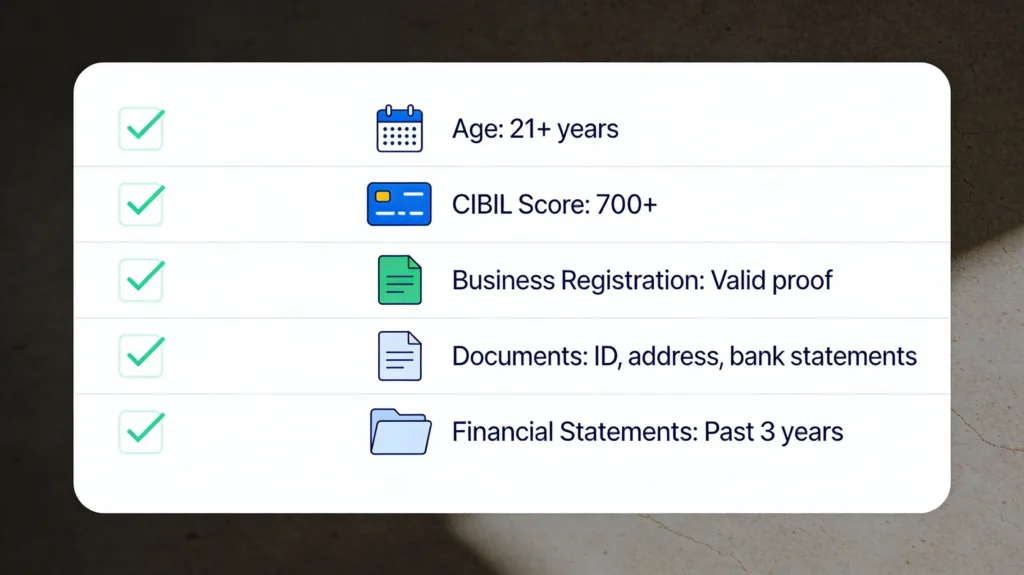
  2. Eligibility Criteria & Documentation Requirements – Know age limits, credit scores, and documents needed

  3. Government Schemes for Small Businesses – Discover collateral-free options and special initiatives

  4. Interest Rates & Repayment Terms – Compare costs and tenure across lenders

  5. Approval Tips & Common Rejection Reasons – Learn what banks want to see in your application

  6. Step-by-Step Application Process – Navigate from assessment to fund disbursement

  7. Key Takeaways & Next Steps – Actionable recommendations for securing your loan

Business loans come in different flavors.

Each type serves specific business needs and has distinct characteristics. Therefore, choosing the right loan significantly impacts your financial burden. Moreover, understanding these distinctions helps you match your business requirements with appropriate financing. Additionally, lenders offer various structures to accommodate diverse entrepreneur profiles.

Secured vs. Unsecured Business Loans

Secured loans require collateral, such as property, machinery, or equipment. Consequently, banks perceive lower risk and offer competitive interest rates starting at 7% to 12%. However, you must pledge valuable assets, which creates personal liability. Furthermore, the loan approval process takes longer due to asset valuation. 

In contrast, unsecured loans need no collateral but carry higher interest rates (12% to 18%). Yet, approval happens faster—often within 24-48 hours. Additionally, unsecured loans are ideal for businesses lacking substantial assets. Therefore, your choice depends on your asset base and time constraints.

MUDRA Loans: The Game-Changer 🎯

The Pradhan Mantri MUDRA Yojana (PMMY) transformed small business financing in India. Notably, this government-backed scheme offers collateral-free loans up to ₹20 lakh across three categories. First, Shishu loans provide up to ₹50,000 for micro businesses. Second, Kishore loans range from ₹50,001 to ₹5 lakh for growing enterprises. Third, Tarun loans cover ₹5 lakh to ₹10 lakh for established businesses.

Additionally, interest rates typically range from 10% to 14%, making them highly competitive. Moreover, small-value Shishu loans don’t require income proof, simplifying documentation significantly. Furthermore, both new and existing businesses can apply. Importantly, no personal guarantees or collateral are mandatory. Thus, MUDRA loans democratize credit access for aspiring entrepreneurs.

business-loans-for-small-business-complete-guide-2026
MUDRA loan categories with loan amount ranges visualization
Checkout Our Latest Services

Government Schemes & Special Initiatives 🏛️

India’s government recognizes entrepreneurial challenges faced by specific groups. Consequently, multiple schemes provide tailored financing solutions. Therefore, these initiatives aim to bridge credit gaps for underserved communities.

CGTMSE: Collateral-Free Government Guarantee

The Credit Guarantee Trust Scheme for Micro and Small Enterprises (CGTMSE) provides government-backed guarantees on collateral-free loans up to ₹10 crore. Importantly, the guarantee covers up to 85% of the loan amount, reducing lender risk. Additionally, eligible businesses in manufacturing and service sectors can avail benefits. 

Moreover, interest rates remain competitive at 10% to 13%. However, only micro and small enterprises engaged in specific activities qualify. Furthermore, borrowers must have a valid PAN and business registration. Thus, CGTMSE offers a middle ground between complete collateral-free loans and fully secured borrowing.

Stand-Up India Scheme: Empowering SC/ST & Women Entrepreneurs 💪

The Stand-Up India scheme specifically targets historically marginalized groups. Consequently, SC/ST entrepreneurs and women business owners receive loans from ₹10 lakh to ₹1 crore for greenfield enterprises. Importantly, greenfield signifies first-time ventures in manufacturing, services, trading, or agri-allied sectors. Additionally, interest rates typically range from 11% to 14%. 

Moreover, the scheme mandates that at least 51% shareholding belongs to SC/ST or women entrepreneurs. Furthermore, lenders provide handholding support including financial literacy training, mentoring, and project preparation assistance. Thus, Stand-Up India combines financing with comprehensive business support.

Eligibility Criteria & Documentation Essentials 📋

Securing a business loan requires meeting specific eligibility benchmarks. Therefore, understanding these criteria prevents wasted effort on applications you cannot qualify for. Moreover, different lenders follow RBI guidelines but may have additional requirements. Additionally, early preparation strengthens your application substantially.

Core Eligibility Requirements

CriteriaDetails
Age18 to 65 years at time of application (varies by lender)
CitizenshipMust be Indian citizen with valid residency proof
Credit ScoreMinimum 650-700 CIBIL score (higher scores get better rates)
Business StatusSelf-employed, proprietor, partnership, or registered entity
Business AgePreferably 24+ months operational (MUDRA has exceptions)
Income RequirementMinimum ₹3,00,000 annual income (varies by scheme)
Credit HistoryNo loan defaults or outstanding dues to banks/NBFCs
Business TypeNon-agricultural, non-farming income-generating activities
 

Each criterion strengthens your profile significantly. Therefore, assess your position honestly before applying.

Essential Documents You Must Prepare

Documentation accuracy determines approval speed. Consequently, incomplete submissions lead to rejections or delays costing valuable time. Therefore, organize these documents before approaching lenders:

  1. Identity & Address Proof: Aadhar, PAN, Voter ID, Passport

  2. Business Registration: GST certificate, MSME Udyam registration, trade license

  3. Financial Statements: Balance sheet and P&L for last 3 years

  4. Tax Returns: Business and personal ITR for 2-3 years

  5. Bank Statements: 6-12 months of business account statements

  6. Collateral Details: Property papers, asset ownership certificates (if applicable)

  7. Business Plan: Detailed plan with revenue projections and fund utilization details

Presenting organized documentation creates professional impressions. Furthermore, lenders quickly assess viability when documents are complete. Additionally, digital copies speed up verification processes significantly.

business-loans-for-small-business-complete-guide-2026
Business loan eligibility criteria checklist illustration

 Approval Tips & Application Strategy 🎯

Getting business loan approval requires strategic planning and preparation. Therefore, understanding what lenders evaluate helps optimize your application. Moreover, most rejections stem from preventable issues. Additionally, proactive measures significantly boost approval chances.

Tips to Strengthen Your Business Loan Application

1. Maintain a Strong Credit Score Above 700 ✅

Your credit score is the first assessment filter for lenders. Therefore, prioritize improving your CIBIL score before applying. Moreover, a score above 750 dramatically increases approval odds and better interest rates. Additionally, pay all bills on time, reduce credit utilization below 30%, and clear outstanding debts. Furthermore, check your credit report for errors and dispute them immediately.

2. Create a Detailed, Realistic Business Plan 📊

Lenders want confidence in your vision and execution capability. Therefore, develop a comprehensive business plan outlining current financial status, market analysis, and growth strategies. Moreover, include realistic revenue projections for 3-5 years supported by market research. Additionally, clearly explain how you’ll utilize loan funds and generate returns. Furthermore, unrealistic projections trigger rejection immediately.

3. Demonstrate Consistent Revenue & Positive Cash Flow 💰

Banks assess your repayment capacity through financial stability. Therefore, maintain steady revenue showing your business’s sustainability. Moreover, present 6-12 months of bank statements highlighting consistent cash inflow. Additionally, calculate your Debt Service Coverage Ratio (DSCR); above 1.25 demonstrates healthy repayment capacity. Furthermore, seasonal businesses should show awareness of slack periods and mitigation strategies.

4. Be Transparent About Your Business’s Financial Health 🤝

Honesty builds lender trust and relationships. Therefore, disclose any past financial challenges or defaults openly. Moreover, explain how you recovered and what systemic changes prevent recurrence. Additionally, lenders respect transparency and may approve despite historical issues if recovery is evident. Furthermore, hiding problems leads to outright rejection when discovered.

5. Manage Your Debt-to-Income Ratio Strategically 📈

Lenders analyze your ability to service existing debt plus new loan obligations. Therefore, calculate your debt-to-income ratio; maintain it below 36%. Moreover, repay smaller outstanding debts before applying for new loans. Additionally, consolidate multiple debts into single manageable obligations. Furthermore, lower ratios significantly improve approval odds.

6. Select the Right Loan Type Matching Your Needs 🔍

Loan purpose and amount must align with your business reality. Therefore, neither borrow excessively nor inadequately. Moreover, clearly articulate how loan funds will be deployed. Additionally, request amounts justified by business size and projected returns. Furthermore, mismatch between loan size and business needs triggers immediate rejection.

Common Reasons Lenders Reject Applications

Understanding rejection causes helps you avoid them. Consequently, most denials result from preventable issues:

  1. Poor Credit Score – Scores below 650 face near-certain rejection

  2. Inconsistent Cash Flow – Revenue gaps suggest repayment inability

  3. Incomplete Documentation – Missing documents cause automatic rejection

  4. Insufficient Collateral – Secured loans denied if asset value insufficient

  5. High Existing Debt – Debt-to-income ratios above 36% trigger rejection

  6. Unclear Business Plan – Vague or unrealistic projections signal risk

  7. Limited Experience – Startups without industry expertise face scrutiny

  8. Industry Risk – High-risk sectors face stricter evaluation

Prevention beats correction significantly. Therefore, address these issues before submitting applications.

Checkout Latest Grants Listed

Step-by-Step Application Journey

Step 1: Assess Your Funding Needs Precisely

Begin by determining exact funding requirements. Therefore, calculate startup costs or expansion expenses accurately. Moreover, avoid requesting excessive amounts that might seem unrealistic. Additionally, include buffer for unforeseen expenses (typically 10-15% extra). Furthermore, clarity about fund usage impresses lenders significantly.

Step 2: Check Your Eligibility Against Requirements

Review each lender’s specific criteria thoroughly. Therefore, ensure you meet minimum age, credit score, and business age requirements. Moreover, assess whether you have sufficient documentation. Additionally, apply only to schemes matching your profile. Furthermore, pre-qualification saves time and prevents rejections.

Step 3: Compile Complete Documentation

Organize all required documents systematically. Therefore, create a checklist and verify completeness. Moreover, ensure documents are current and certified where needed. Additionally, maintain both originals and copies. Furthermore, organized documentation accelerates processing dramatically.

Step 4: Choose the Right Lender & Loan Type

Compare lenders based on interest rates, tenure, fees, and processing time. Therefore, evaluate whether banks, NBFCs, or fintech platforms suit your needs. Moreover, read terms and conditions carefully. Additionally, traditional banks offer better rates but stricter criteria. Furthermore, online lenders approve faster but charge higher rates.

Step 5: Complete Application Accurately

Fill forms carefully, providing accurate information. Therefore, any discrepancies trigger verification delays or rejections. Moreover, explain gaps in employment or business history proactively. Additionally, double-check calculations in financial fields. Furthermore, submit applications during business hours for immediate acknowledgment.

Step 6: Submit Documents & Track Status

Submit complete documentation to your chosen lender. Therefore, obtain submission receipts immediately. Moreover, maintain application reference numbers for follow-ups. Additionally, ask for expected timeline for approval. Furthermore, some lenders provide online portals for status tracking.

Step 7: Lender Reviews & Verifies Your Profile

The lender conducts background checks and verification. Therefore, respond promptly to information requests or site visits. Moreover, be prepared for clarifying questions about your business. Additionally, maintain communication throughout verification. Furthermore, cooperation demonstrates trustworthiness and sincerity.

Step 8: Receive Loan Approval & Disbursement

Upon approval, you’ll receive a sanction letter detailing loan terms. Therefore, review all conditions carefully before acceptance. Moreover, sign necessary agreements and complete final formalities. Additionally, funds typically disburse within 3-5 working days. Furthermore, some lenders provide partial disbursement based on milestone completion.

Conclusion & Key Takeaways 🎊

Business loans for small business have democratized entrepreneurial finance in India. Consequently, government schemes like MUDRA have made capital accessible to millions. Therefore, with proper preparation and strategy, securing funding is achievable. Moreover, understanding loan types, eligibility, and approval strategies transforms your financing journey. Additionally, the critical steps are: assess your needs honestly, prepare comprehensive documentation, maintain strong credit, and present realistic business plans.

Your Next Action Steps:

  1. Assess Your Eligibility against multiple loan schemes

  2. Prepare Documentation systematically and completely

  3. Build Your Credit Score to 700+ if needed

  4. Develop a Detailed Business Plan with realistic projections

  5. Compare Lenders across banks, NBFCs, and fintech platforms

  6. Submit Your Application with organized documentation

  7. Monitor Progress and respond promptly to lender requests

💼 At StartupMandi, we help entrepreneurs navigate the complex financing landscape. Our expert advisors provide personalized guidance on loan selection, documentation, and application strategy. Additionally, our blog offers continuous insights on startup funding, government schemes, and business growth strategies. Therefore, visit StartupMandi.in regularly for updates and resources. Moreover, leverage our network of verified lenders and financial experts. Furthermore, join our community of successful entrepreneurs who’ve scaled their businesses with strategic financing.

⚠️ DISCLAIMER

This blog post is for informational purposes only and should not be construed as financial, investment, or professional advice. Loan eligibility criteria, interest rates, terms, and conditions vary significantly across lenders and are subject to change. Therefore, verify current information directly with lending institutions before making financial decisions. Moreover, interest rates, documentation requirements, and approval timelines depend on individual business profiles, creditworthiness, and market conditions. Additionally, past performance or examples cited do not guarantee future results. Furthermore, borrowers should carefully review all loan agreements, terms, and conditions before signing. Consequently, consult qualified financial advisors, accountants, or legal professionals for personalized guidance on your specific business financing needs. StartupMandi does not endorse any particular lender and recommends comparing options from multiple institutions. Finally, this content reflects information accurate as of January 2026 and may require updates based on regulatory changes or market conditions.


FAQs ❓

1. Can I get a business loan without collateral?

Yes, absolutely. MUDRA loans, many NBFC products, and CGTMSE guarantee schemes offer collateral-free financing. Moreover, unsecured business loans don’t require collateral but charge higher interest rates. Additionally, government schemes specifically support collateral-free borrowing for eligible businesses.

2. What credit score is required for business loan approval?

Most lenders require a minimum CIBIL score of 650-700. However, scores below this face rejection unless you have exceptional business revenue or strong collateral. Additionally, scores above 750 unlock better interest rates and larger loan amounts. Furthermore, MUDRA Shishu loans don’t check credit scores for amounts up to ₹50,000.

3. What’s the fastest way to get a business loan approved?

Online lenders and fintech platforms approve within 24-48 hours but charge higher interest rates. Moreover, traditional banks take 5-7 working days but offer competitive rates. Additionally, having complete documentation speeds up approval regardless of lender. Furthermore, unsecured loans process faster than secured loans requiring collateral valuation.

4. Are startup business loans different from small business loans?

Yes, startup loans are for new ventures, typically with looser revenue history requirements. Moreover, they rely more on business plans and founder credentials. Additionally, small business loans usually require 24+ months operational history. Furthermore, government schemes like Stand-Up India specifically support startup-stage businesses.

5. How can I improve my chances of loan approval?

Improve credit score to 700+, prepare detailed business plans with realistic projections, maintain consistent revenue and cash flow, organize complete documentation, manage debt-to-income ratios below 36%, and be transparent about your business’s financial health. Moreover, applying for loans matching your business profile and qualifications significantly improves approval odds.

Mariyam Bandookwala
Mariyam Bandookwala

i am a professional content writer with a strong focus on clarity, strategy, and audience engagement—helping brands communicate smarter and grow faster.

Articles: 34

Leave a Reply

Your email address will not be published. Required fields are marked *