




Why Are Backlinks Important for SEO? A Beginner’s Guide for 2026

Why are backlinks important for SEO? Backlinks are links from other websites to your own site. In simple terms, they can act as recommendations that help search engines understand your content, discover your pages, and assess your website’s credibility. They can also bring visitors directly from another website.
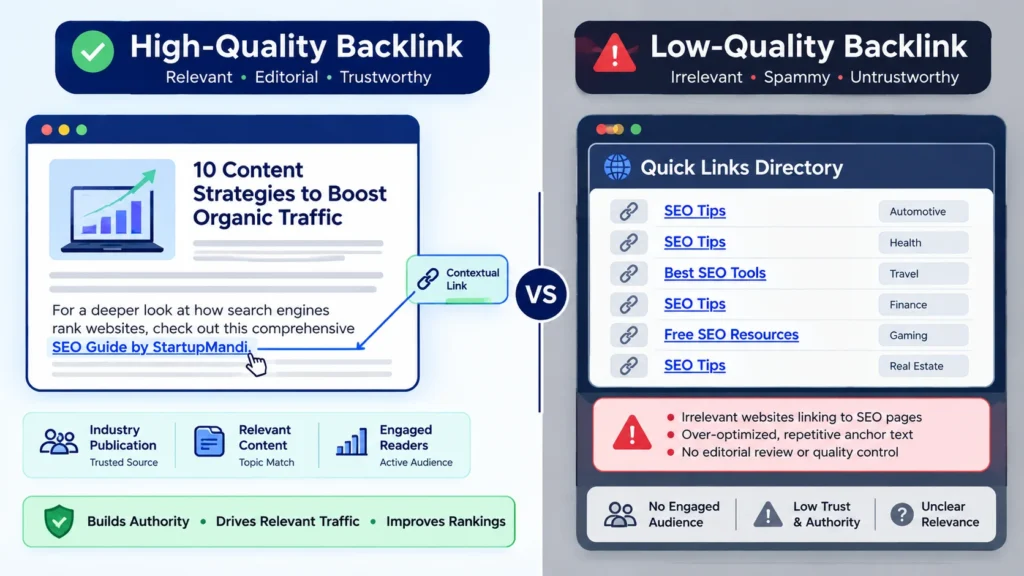
However, not all backlinks have the same value. For example, one natural link from a respected industry publication may be more useful than dozens of unrelated links from low-quality directories. This is because a relevant link provides stronger topic context, editorial trust, and a genuine opportunity to attract interested readers.
Ultimately, backlinks do not guarantee higher rankings. Instead, they work best alongside helpful content, clear website structure, technical SEO, and a positive user experience. Explore more practical digital marketing insights on StartupMandi Global.
“Backlinks, or inbound links, are hyperlinks from one website to another.”
What Is Backlinks in SEO?
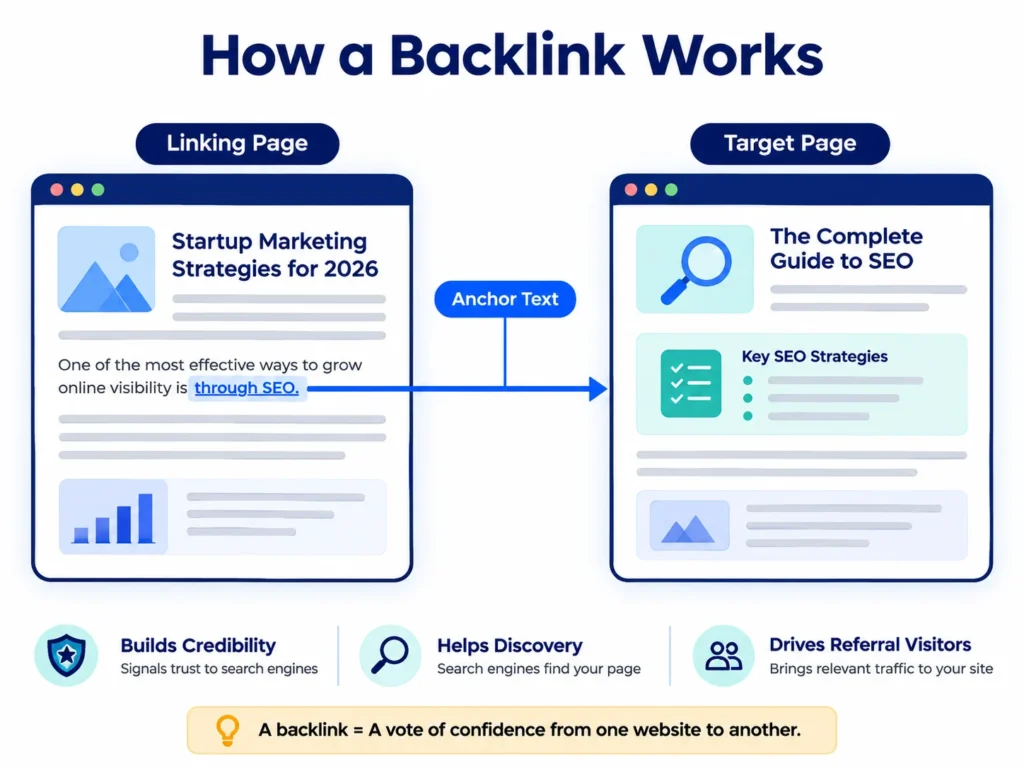
A backlink is an incoming link from one website to a page on another website. For example, if a marketing blog links to a StartupMandi guide about link building, that incoming hyperlink is a backlink for StartupMandi.
Backlinks are also called inbound links or external inbound links. They are part of off-page SEO because they originate outside your own website.
A backlink normally contains three important elements :
| Element | Meaning | Example |
|---|---|---|
| Linking page | The page containing the link | A marketing article |
| Anchor text | The clickable words | “quality backlink strategies” |
| Target page | The page receiving the link | Your SEO guide |
The link’s context matters. A backlink surrounded by useful information about SEO is more relevant than a link placed randomly in a footer or unrelated directory.
Why Are Backlinks Important for SEO?
Backlinks are important for SEO because they help search engines understand which pages are useful, trustworthy, and relevant. When another website links to your content, it can act as a recommendation and show that your page may be valuable to readers.
In addition, backlinks connect your website with people who are already interested in your topic. As a result, they can help search engines discover your pages, support your website’s authority, and bring more relevant visitors through referral traffic. However, the quality and relevance of a backlink matter more than the total number of links.
How Do Backlinks Signal Trust?
When an independent website links to your content, it may be showing that the publisher finds your page useful and trustworthy. In this sense, a backlink is similar to a professional recommendation: someone is directing their audience to your information.
Moreover, a relevant link from a respected website can strengthen your brand’s credibility and help search engines understand your topic. However, backlinks are only one part of SEO. Search engines also consider content quality, relevance, technical performance, and user experience, so no single backlink can guarantee higher rankings.
Moz describes backlinks as “votes of confidence”. Therefore, reputable links can help signal trust, authority, and relevance when they appear naturally within useful content.
How Can Backlinks Support Rankings & SEO?
Backlinks can support rankings by providing external evidence that a page is useful or authoritative. Pages with strong, relevant backlink profiles often compete more effectively for difficult search queries.
Still, ranking performance depends on multiple factors :
- Search intent and content usefulness.
- Topic relevance and topical coverage.
- Technical accessibility and page experience.
- Internal linking and website structure.
- The quality, context, and diversity of external references.
Therefore, publishing excellent content remains essential. A backlink can strengthen a valuable page, but it cannot rescue content that fails to answer the reader’s question.
How Do Backlinks Help Search Engines Discover Pages?
Search engines follow links across the internet to discover new and updated pages. Therefore, when another website links to your content, it creates an additional path for search engine crawlers to find and understand that page.
This can be especially helpful for new websites, recently published articles, and pages with few internal links. However, backlinks are not the only way to improve content discovery. In addition, a clear internal linking structure and an updated XML sitemap can help search engines locate your most important pages more efficiently.
As a result, combine backlinks with strong site navigation and relevant internal links to make your content easier for both search engines and visitors to find.
How Can Backlinks Generate Referral Traffic?
A backlink can send visitors directly from one website to another. This type of visitor activity is called referral traffic. Referral traffic can be valuable because people usually click a link after reading related content. For example, someone exploring an article about startup marketing may follow a link to a useful research report, template, or strategy guide.
As a result, these visitors are often more interested in your topic and may spend more time exploring your website. Moreover, if the linked page provides exactly what they need, referral traffic can also support engagement, brand awareness, and conversions.
The quality of referral traffic depends on :
- The linking website’s audience.
- The placement and visibility of the link.
- The relevance of your destination page.
- The usefulness of the content after the click.
A link that produces qualified visitors may be valuable even when it produces little measurable ranking impact.
What Makes a Backlink High Quality?
A high-quality backlink usually comes from a trustworthy website that covers a related topic. In addition, it should appear naturally within useful content and give readers a clear reason to visit your page.
However, the best backlink is not always the most difficult one to earn. Instead, its value depends on how well it matches the topic, supports the reader, and fits the publisher’s content. Therefore, focus on creating helpful resources that websites can confidently reference, rather than simply trying to collect as many links as possible.
Is Relevance More Important Than Quantity?
Relevance is one of the most important factors when evaluating a backlink. In simple terms, a link is more useful when it comes from a website that discusses the same industry, subject, or audience as your content. For example, a link to a startup funding guide from a business publication makes sense because both topics are closely connected. On the other hand, a link to the same guide from an unrelated entertainment directory may provide little SEO or audience value.
Therefore, when building backlinks, focus on websites that naturally fit your topic. This approach can improve credibility, attract more interested visitors, and make your link-building efforts more effective.
Does Linking-Site Authority Matter?
Authority matters because established websites often have strong reputations, reliable content, and loyal audiences. As a result, a backlink from a trusted publication may send valuable signals and relevant visitors to your website. However, metrics such as Domain Authority are scores created by SEO tools. They are not official Google ranking factors. Therefore, use these metrics to compare websites and find potential opportunities, but do not treat them as absolute proof of link quality.
Moreover, a smaller publication that specializes in your industry may be more valuable than a large, unrelated website. In the end, relevance, trust, audience fit, and editorial quality should guide your decisions.
Does Backlinks Placement Affect SEO?
A link placed naturally within the main content is usually more useful than one hidden in a footer or sidebar. This is because readers can see the link while they are already learning about the topic. In addition, good placement can make the link feel more trustworthy and encourage people to click it. The surrounding words also give search engines important context about the linked page.
Therefore, place backlinks within relevant, helpful paragraphs whenever possible. Avoid adding links to large lists of unrelated websites, as they may appear less useful to both readers and search engines.
Should Anchor Text Match Keywords?
Anchor text is the visible, clickable part of a hyperlink. It should describe the destination naturally.
Good examples include :
- “beginner’s guide to link building.”
- “backlink quality checklist.”
- “StartupMandi’s SEO research report.”
Avoid forcing the exact same keyword into every backlink. A natural profile can include brand names, descriptive phrases, partial keywords, and neutral wording.
| Backlink characteristic | Generally stronger approach | Riskier approach |
|---|---|---|
| Relevance | Related topic and audience | Unrelated website |
| Placement | Main editorial content | Footer or link farm |
| Anchor text | Natural description | Repeated exact-match phrase |
| Purpose | Helps readers learn more | Exists mainly to manipulate rankings |
| Source | Credible, maintained publication | Spam-heavy or automated site |
Which Backlinks Type Are Important For SEO?
Different backlink types can serve different marketing and SEO purposes. Their value depends on context, editorial control, relevance, and user benefit.
What Are Editorial Backlinks?
Editorial backlinks are links that publishers add naturally because they find your content useful. For example, they may reference your original research, practical guide, online tool, or expert opinion. These links can be valuable because the publisher chooses to recommend your content to its audience. Moreover, original data is especially useful for earning editorial links. A survey of 100 founders could become a detailed report, simple charts, a media pitch, and a short summary article.
As a result, one research project can create several useful content assets and give journalists more reasons to cite your work.
What Are Guest-Post Backlinks?
Guest-post backlinks are links you may earn by writing a helpful article for a relevant publication. In this process, your main goal should be to share genuine expertise and provide useful information for the host website’s audience.However, guest posting can become risky when the website has poor-quality content or no connection to your industry. It is also risky when you publish repetitive articles, use the same exact-match anchor text too often, or pay for links designed to manipulate rankings.
Therefore, choose reputable publications, create original content, and include links only when they are relevant and genuinely helpful to readers.
What Are Nofollow, Sponsored, and UGC Links?
Some links use attributes that describe their relationship :
| Attribute | Typical use |
|---|---|
rel="nofollow" | You do not want to endorse or fully vouch for the destination |
rel="sponsored" | The link is paid, sponsored, affiliate-related, or otherwise compensated |
rel="ugc" | The link appears in user-generated content, such as comments or forums |
For paid relationships, use appropriate disclosures and link attributes. Never assume that buying a link guarantees SEO value.
Can Directories and Resource Pages Help?
Relevant industry directories, professional associations, local listings, and resource pages can help people discover your business. In addition, they may improve your online visibility when the listing is genuine, accurate, and connected to your industry. For example, a local business directory or professional association may help you reach an audience that is already interested in your products or services. However, avoid submitting your website to hundreds of unrelated directories.
Instead, focus on a smaller number of trusted platforms that are useful to your audience. This approach is more relevant, more credible, and safer than mass submissions.
How Can You Earn High-Quality SEO Backlinks?
The most sustainable link-building strategies create something people genuinely want to cite, share, or recommend.
- Publish original research. Survey customers, founders, or professionals and publish transparent findings.
- Create useful tools. Build calculators, templates, checklists, or interactive resources.
- Offer expert commentary. Provide concise insights on timely topics journalists and publishers are covering.
- Use digital PR. Turn data, trends, and expert opinions into media-worthy stories.
- Reclaim unlinked mentions. Ask publishers to link company, product, founder, or research mentions.
- Repair broken links. Suggest a closely matching resource when a relevant page contains an outdated link.
- Build industry relationships. Collaborate on webinars, research reports, events, and expert roundups.
A useful resource should make the publisher’s page better. That principle improves outreach because you are offering value rather than simply requesting promotion.
How Do You Build Backlinks Step by Step?
How much time and money does it require?
- Times Needed : Days: 07, Hours: 04
- Estimated Cost : Currency: USD, Price: 0–300
- Description : Create one useful, citation-worthy asset, identify relevant publishers, and conduct personalized outreach while tracking links, responses, and referral traffic.
- Tools Name : Google Search, Google Sheets, Google Search Console, Ahrefs or Moz
- Materials Name : Original research or guide, outreach email, publisher list, backlink tracking sheet
What steps should you follow?
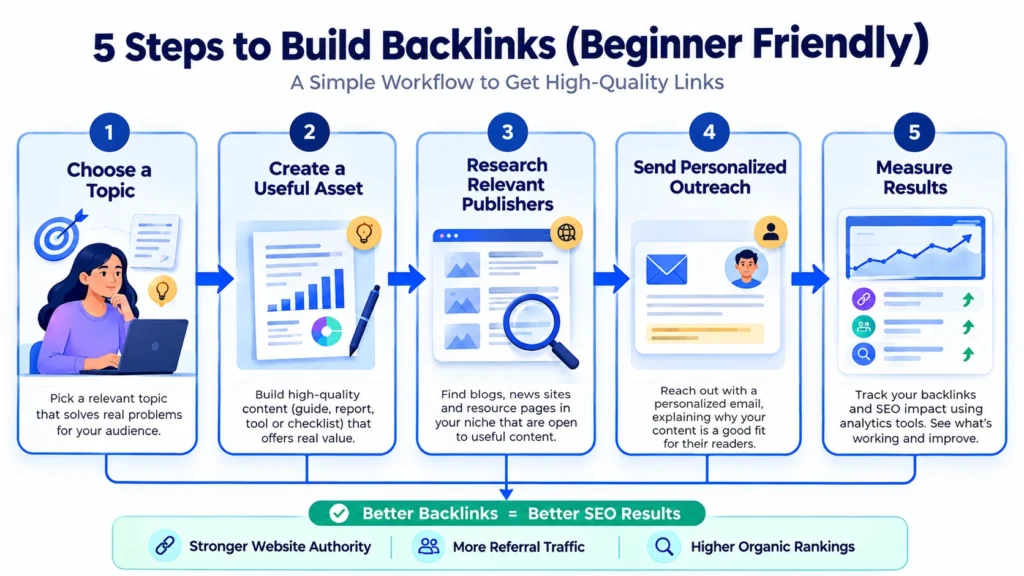
- Choose a linkable topic : Select a topic your audience searches for and publishers may need to reference.
- Create a useful asset : Produce original research, a clear guide, a chart, a template, or a practical tool.
- Build a relevant prospect list : Find websites, journalists, newsletters, and resource pages covering your topic.
- Personalize your outreach : Explain why your asset helps that publisher’s readers. Avoid generic mass emails.
- Track meaningful outcomes : Record replies, earned links, referring domains, referral visits, and content performance.
What Backlinks Practice Should You Avoid For SEO?
Avoid tactics that create links primarily to manipulate rankings rather than help users.
- Buying links that pass ranking value without proper disclosure or attributes.
- Using automated tools to create large volumes of unnatural links.
- Publishing low-quality guest posts across unrelated websites.
- Repeating exact-match anchor text unnaturally.
- Exchanging links at scale only to influence rankings.
- Using private blog networks or spam-filled directories.
- Targeting irrelevant websites simply because they show a high SEO metric.
Google’s spam systems may detect and remove the ranking benefit of manipulative links. A June 2026 industry report described Google’s spam update as affecting link-related ranking benefits when systems identify spam patterns.
This is why sustainable link building should prioritize useful content and genuine editorial interest.
“Quality backlinks from relevant, high-authority websites matter more than having a large number of low-quality links.”
How Should You Measure Backlinks SEO Performance?
Backlink success should be measured through more than a link count. A useful report combines SEO, audience, and brand metrics.
| Metric | What it tells you |
|---|---|
| Referring domains | How many distinct websites link to you |
| Referral sessions | How many visitors arrive through links |
| Referral engagement | Whether those visitors find the page useful |
| Organic impressions | Whether visibility changes over time |
| Organic clicks | Whether search traffic increases |
| Unlinked mentions | Whether brand awareness is expanding |
| Conversions | Whether referral or organic users take action |
Track the page receiving each backlink, not just your homepage. A link to a specific research report may support that page more directly than a general sitewide link.
Also remember that SEO tools use different databases and scoring systems. Compare trends consistently instead of treating one metric as a definitive ranking measurement.
FAQ
Yes. Backlinks can still support authority, discovery, referral traffic, and organic visibility. However, relevance, editorial quality, and usefulness matter more than raw quantity.
There is no universal number. The required link profile depends on the topic, competition, search intent, content quality, and strength of competing pages.
Yes. They can send referral visitors directly from another website. They may also support organic visibility when combined with strong content and other SEO fundamentals.
Paid links intended to manipulate rankings can violate search-engine guidelines. Paid relationships should be disclosed and use suitable link attributes.
Start with useful guides, original research, practical tools, digital PR, expert commentary, broken-link outreach, and relevant partnerships.
No. Do not react to every unfamiliar link. First assess whether the link is genuinely harmful, manipulative, or connected to a broader problem. Consider professional advice before using disavow tools.
What Are the Key Takeaways?
- Backlinks are external references that connect another website to your content.
- They can support trust, relevance, discovery, rankings, referral traffic, and brand awareness.
- Quality beats quantity when links are relevant, editorial, useful, and naturally placed.
- Backlinks work best with helpful content, technical SEO, internal links, and clear search intent.
- Original research, tools, expert commentary, and digital PR can create strong link opportunities.
- Avoid paid, automated, irrelevant, and manipulative link schemes.
- Measure referring domains, referral traffic, organic visibility, engagement, and conversions.
Conclusion
Backlinks are important for SEO because they provide external context, help search engines discover content, bring referral traffic, and strengthen your page’s credibility. However, you do not need to chase every possible link. Instead, create useful resources that solve real problems and deserve to be cited. Then promote them through original research, digital PR, expert commentary, helpful outreach, and relevant partnerships.
Start with one important page. Improve its content, add original examples or data, and make it easy for publishers to reference. Next, find five relevant websites that already discuss your topic. Contact them only when your resource genuinely helps their readers. Finally, review your results after 30–60 days. Look beyond the number of backlinks and check for qualified visitors, brand mentions, new relationships, and improved visibility. For more startup and digital marketing insights, visit StartupMandi Global.
What External Sources Support This Guide?
Use authoritative, relevant sources to support definitions and technical explanations.
- Moz’s Backlink Guide explains backlinks, authority, referral traffic, crawling, link types, and quality factors.
- Mailchimp’s Backlinking Guide explains how backlinks can support authority, discovery, referral traffic, and brand visibility.
- Google’s Search Spam Update Coverage provides current context about spam systems and link-related ranking benefits.
- Ahrefs’ 2026 SEO Statistics provides industry data about links and search traffic relationships.
Statistics and correlations should be described carefully. A relationship between backlinks and search traffic does not prove that link quantity alone causes higher rankings.