


What Is a Backlink Submission Site? How to Choose the Right Platform
Learn what a backlink submission site is, how different platforms work, and how to choose a safe, relevant place to publish content and earn links.

A backlink submission site is any platform where you can submit your website, article, profile, or resource in exchange for a link back to your site. The value depends entirely on the platform’s relevance, editorial standards, audience, and whether the link appears in a genuinely useful context.
For website owners, bloggers, SEO executives, startups, and agencies, choosing the right platform matters more than chasing long lists. StartupMandi’s Become a Publisher – StartupMandi Global – a publisher network for getting content in front of relevant audiences – illustrates a quality-focused approach to content publishing and link acquisition.
What Is a Backlink Submission Site?
A backlink submission site is a website that accepts user-submitted content, profiles, listings, or resources and publishes them with at least one link pointing back to your domain.
Common examples include:
- Business directories and local listings.
- Article submission platforms and Web 2.0 blogs.
- Guest-post and contributor websites.
- Publisher marketplaces and content networks.
- Review platforms and product directories.
- Community forums and Q&A sites.
The term “backlink submission site” covers many different models. Some are simple directories with minimal review. Others are editorial publications with strict guidelines. Some are content marketplaces connecting writers with publishers. Some are community platforms where links appear inside answers or discussions.
“A backlink submission site is not automatically good or bad. Its value depends on relevance, editorial quality, and audience fit.” — Practical SEO principle aligned with Google’s link-quality guidance.
Is Every Backlink Submission Site The Same?
No. A generic directory that auto-approves thousands of unrelated sites is very different from an editorial publication that reviews content, checks facts, and publishes only when it serves readers.
A 2026 analysis of backlink submission platforms warns that most raw lists are spam-heavy and recommends filtering by traffic, relevance, editorial review, and alignment with Google’s link policies. Backlynk’s 2026 spam-safe filter explains why many directories are not worth using.
The critical distinction is whether a real person or editorial process evaluates the submission before publishing.
How Does Backlink Submission Work?
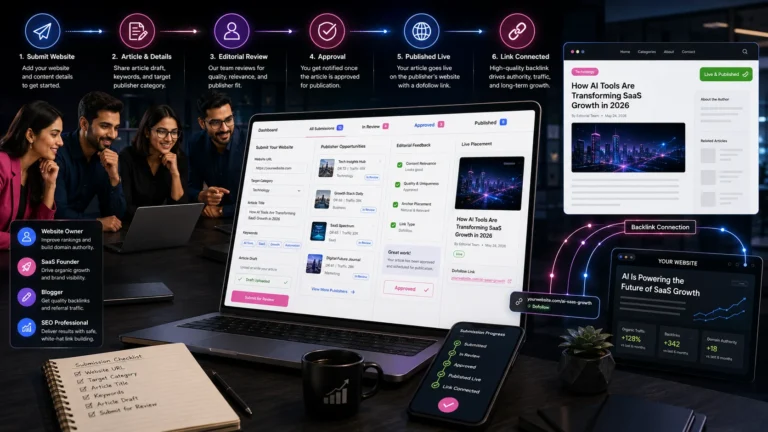
Backlink submission works by presenting your website or content to a platform that may publish it with a link. The process varies by platform type.
Typical steps include:
- Finding a relevant platform.
- Reviewing submission guidelines.
- Creating a profile, listing, or article.
- Submitting your content or website details.
- Waiting for approval or automatic publication.
- Verifying that the live page contains your link.
Some platforms publish instantly, while others require editorial review. Some charge a placement fee, while others are free. Some allow dofollow links, while others use nofollow, sponsored, or UGC attributes.
A 2026 guide to backlink submission websites describes them as purpose-built platforms for publishing profiles, articles, or resource pages with attached backlinks. It emphasizes that they work best when deployed with editorial integrity, topical relevance, and governance. IndexJump’s ultimate guide explains these categories and use cases.
| Submission Type | Typical Workflow |
|---|
| Submission Type | Typical Workflow |
|---|---|
| Directory listing | Create profile, add details, receive listing page |
| Article submission | Write article, submit draft, receive published post |
| Guest post pitch | Pitch topic, write article, receive editorial placement |
| Marketplace order | Select publisher, submit content, receive live link |
| Community answer | Answer question, include relevant link, receive post |
Transition: Understanding the workflow is useful, but the real decision is which platform best fits your goals.
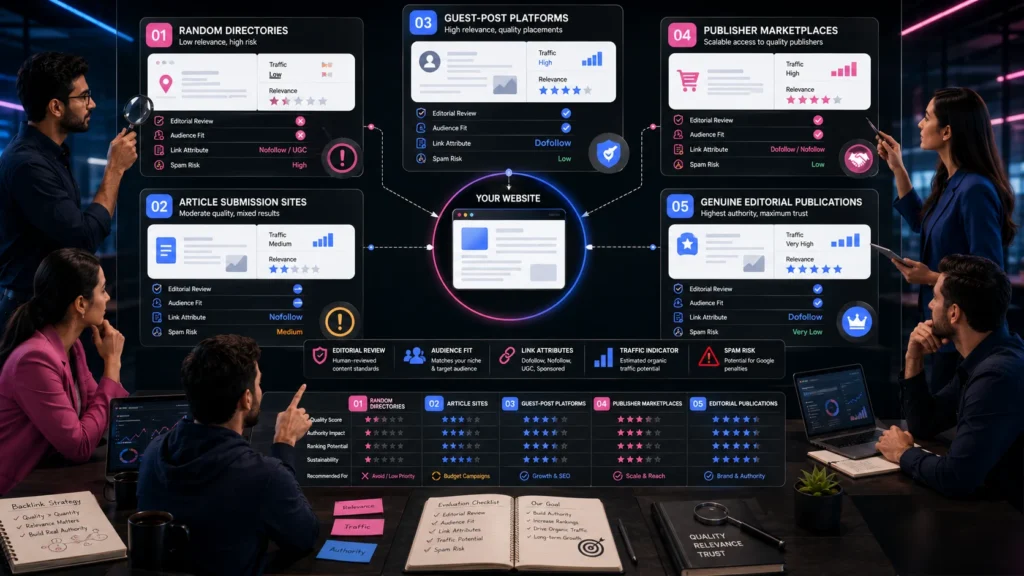
What Types of Backlink Submission Platforms Exist?
Backlink submission sites fall into several categories, each with different strengths, risks, and best-use scenarios.
What Are Random Backlink Directories?
Random backlink directories are large, often low-quality lists of websites organized by category, region, or niche. Many accept submissions automatically or with minimal review.
Characteristics include:
- Thousands of unrelated listings.
- Thin or auto-generated descriptions.
- Heavy outbound-link pages.
- Little visible editorial oversight.
- Mixed or unclear link attributes.
These directories can be useful for basic business discovery or local citations when they are reputable and niche-specific. However, mass submission to low-quality directories rarely moves rankings and can create a spammy backlink profile.
Google defines link spam as creating links mainly to manipulate search rankings. Its policies include examples of manipulative practices such as buying links that pass PageRank, excessive link exchanges, and automated link generation. Google’s link-spam guidelines should guide your directory choices.
What Are Article Submission Websites?
Article submission websites allow you to publish articles, blog posts, or long-form content on their domain, often with one or more links back to your site.
Examples include:
- Web 2.0 platforms such as Medium, WordPress.com, and Blogger.
- Article networks and content hubs.
- Niche blogs that accept external contributions.
- Community publishing sites and long-form platforms.
A 2026 overview of Web 2.0 submission sites explains that these platforms let users create and publish content for free on high-authority domains. They are widely used for off-page SEO and link building when content is relevant and non-spammy. TheStacc’s Web 2.0 list describes common categories and use cases.
The SEO value depends on whether the article is original, useful, and aligned with the platform’s audience.
What Are Guest-Post Platforms?
Guest-post platforms connect writers and businesses with websites that accept external articles. They may operate as curated networks, outreach services, or content marketplaces.
Key features include:
- Topic and niche filters.
- Publisher details and metrics.
- Pricing and turnaround times.
- Content and link guidelines.
- Editorial review and revisions.
A 2026 guide to backlink marketplaces compares platforms such as Linksman, Collaborator, Bazoom, and WhitePress. It highlights differences in pricing, link types, and delivery speed for agencies and SEO professionals. Jeenam Infotech’s marketplace comparison provides a useful overview.
Guest posts are most valuable when the publisher has a real audience, strong topical alignment, and editorial standards.
What Are Publisher Marketplaces?
Publisher marketplaces are structured ecosystems where businesses can find publishers, submit content, or request publication opportunities. They often provide standardized workflows, transparent pricing, and centralized reporting.
Advantages include:
- Easier publisher discovery.
- Clear content requirements.
- Streamlined communication.
- Consistent reporting formats.
- Reduced manual prospecting.
These platforms blur the line between backlink submission sites and content publishing platforms. The critical distinction from spam is that content must be genuinely useful, not thin articles written solely to place links. Backlynk’s 2026 analysis emphasizes this boundary.
What Are Genuine Editorial Publications?
Genuine editorial publications are websites that publish content primarily to serve their readers, not to sell links. They may accept guest articles, expert commentary, original research, or case studies.
Characteristics include:
- Clear editorial guidelines.
- Real authors and bylines.
- Consistent publishing schedule.
- Topical focus and audience fit.
- Natural, contextual links.
An editorial backlink lives inside published content because a writer or editor decided to include it. Nobody paid for placement in a price list, and nobody submitted a form to get auto-listed. Vefogix’s editorial vs directory comparison explains why editorial review matters.
Transition: Once you understand the platform types, the next question is what makes a submission platform genuinely valuable.
What Makes a Backlink Submission Platform Valuable?
A backlink submission platform is valuable when it combines relevance, editorial quality, audience fit, and safe link practices.
Why Does Relevance Matter?
Relevance means the platform serves an audience that could reasonably benefit from your product, service, research, or article. A marketing publication may be relevant for an SEO tool. A startup directory may be relevant for a SaaS product. A local directory may be relevant for a regional business.
Evaluate:
- Topic alignment.
- Audience location and industry.
- Existing content themes.
- Search visibility and traffic.
- Reader intent and use cases.
A 2026 study of AI visibility and backlinks found that link quality showed a 0.65 Pearson correlation with AI mentions, the strongest signal in the research. Quality here includes relevance, authority, and contextual fit, not just raw link count. Semrush’s backlinks and AI search study explains these findings.
Why Is Editorial Quality Important?
Editorial quality indicates whether the platform reviews content for accuracy, usefulness, and readability before publishing. It reduces spam, improves user experience, and strengthens the credibility of any link placed on the page.
Look for:
- Clear submission guidelines.
- Visible editors or reviewers.
- Well-structured articles.
- Original examples and data.
- Consistent tone and formatting.
Platforms with editorial review are less likely to be flagged as link schemes. Google’s link-spam guidance targets links created mainly to manipulate rankings rather than to help readers. Google’s spam policies provide the policy context.
How Does Audience Fit Influence Value?
Audience fit describes whether the platform’s readers match your target market. A small, highly relevant audience can be more valuable than a large, unrelated one.
Consider:
- Industry and job roles.
- Geography and language.
- Pain points and goals.
- Purchase intent and stage.
- Content consumption patterns.
If your article solves a real problem for that audience, the link becomes a natural reference rather than a forced insertion.
What Role Do Link Attributes Play?
Link attributes tell search engines how to treat a link. Common types include dofollow, nofollow, sponsored, and UGC.
Understand:
- Whether the link is followed or nofollow.
- Whether sponsored attributes are required.
- Whether UGC is used for community content.
- How the attribute aligns with the content type.
- Whether the link still drives referral traffic.
A 2026 analysis of backlinks and AI visibility found that nofollow and dofollow links correlated with AI mentions almost identically, with less than a 2% difference. This suggests that link attributes matter less for AI visibility than authority and context. Competlab’s AI visibility research provides the data.
How Does Editorial Content Differ From Low-Quality Submission?
Editorial content and low-quality link submission differ in purpose, process, and long-term value.
What Defines Editorial Content?
Editorial content is created primarily to inform, educate, or entertain readers. Links appear because they genuinely support the article’s topic.
Features include:
- Reader-first headlines.
- Original insight or data.
- Practical examples and steps.
- Natural, contextual links.
- Clear authorship and expertise.
An editorial backlink lives inside published content because a writer, editor, or site owner decided to include it. Vefogix’s editorial-backlink explanation highlights this distinction.
What Defines Low-Quality Link Submission?
Low-quality link submission focuses on placing links with minimal regard for readers. Content is often thin, generic, or heavily optimized for anchors.
Warning signs include:
- Repetitive, keyword-stuffed articles.
- Multiple unrelated links on one page.
- No visible editorial review.
- Pages with hundreds of outbound links.
- Little or no organic traffic.
Google’s link-spam policies include examples of manipulative practices such as buying links that pass PageRank, excessive link exchanges, and automated link generation. Google’s link-spam documentation explains what to avoid.
| Factor | Editorial Content | Low-Quality Submission |
|---|---|---|
| Primary goal | Help readers | Place links |
| Review process | Manual editorial check | Minimal or none |
| Link placement | Contextual and relevant | Forced or excessive |
| Content depth | Useful and original | Thin and generic |
| Long-term value | Sustainable authority | Short-term or risky |
Transition: With these distinctions clear, you can now evaluate specific platforms more confidently.
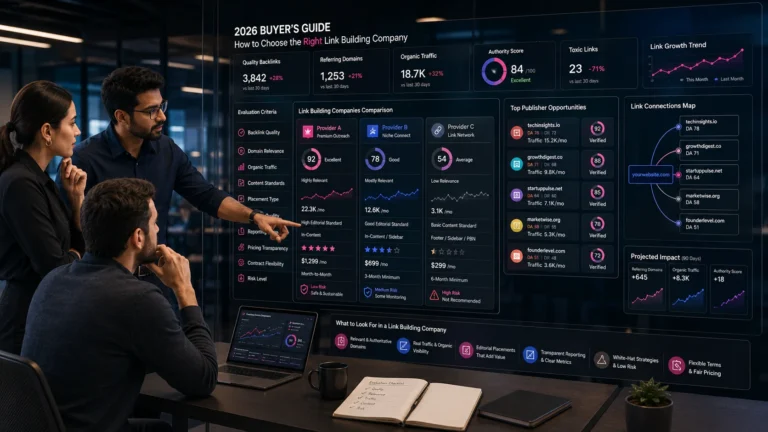
How Should You Choose the Right Platform?
Choosing the right platform requires matching your goals, content, and risk tolerance with the platform’s strengths and policies.
Which Questions Should You Ask?
Before submitting, ask:
- Does this platform serve my target audience?
- Is there a real editorial or quality review?
- Are links contextual and relevant?
- What link attributes will be used?
- Can I see recent published examples?
- How long does content remain live?
- What are the content and link guidelines?
- Is the pricing transparent and reasonable?
A 2026 guide to backlink submission sites recommends filtering by traffic, relevance, editorial review, and alignment with Google’s link policies instead of chasing raw lists. Backlynk’s spam-safe filter explains this approach.
What Metrics Should You Review?
Review both quantitative and qualitative signals:
- Organic traffic and visibility.
- Topical relevance and niche focus.
- Content quality and depth.
- Referring-domain diversity.
- Link attributes and anchor patterns.
- Indexation and public accessibility.
- Author profiles and editorial consistency.
A 2026 study of AI visibility found that domains with stronger backlink authority, measured by Authority Score, are mentioned more often in AI-generated answers. Big visibility gains appear mainly once a site reaches higher authority tiers. Semrush’s AI visibility study provides the research context.
How Can You Test a Platform Safely?
Start with a small pilot:
- Select one relevant platform.
- Submit one high-quality article or profile.
- Track publication time and communication.
- Verify the live link and attributes.
- Monitor referral traffic and indexing.
- Decide whether to scale or stop.
Avoid mass submission until you confirm quality, relevance, and safety.
How Does StartupMandi Help Connect Content With Publishers?
StartupMandi helps connect content with publishers by providing a structured ecosystem where businesses, writers, and publishers can collaborate on relevant, useful content.
Instead of operating as another generic backlink submission site, StartupMandi focuses on:
- Matching content with relevant audiences.
- Supporting editorial-quality submissions.
- Encouraging useful, non-spammy articles.
- Providing clear publishing opportunities.
- Building long-term visibility and trust.
If you are looking for a place to publish your content, you can explore StartupMandi’s publisher network via Become a Publisher – StartupMandi Global – the targeted StartupMandi landing page for relevant content publication.
For additional context on evaluating link-building partners, you can also read 10 Questions to Ask Link Building Companies Before Hiring in 2026 – a decision framework for assessing agencies and providers.
Frequently Asked Questions
1. What is a backlink submission site?
A backlink submission site is a platform where you can submit your website, article, profile, or resource and receive a link back to your domain.
2. Are all backlink submission sites safe for SEO?
No. Some are reputable and relevant, while others are low-quality directories or spam-heavy networks that can harm your backlink profile.
3. What is the difference between a directory and an editorial publication?
A directory lists many websites with minimal review. An editorial publication publishes content primarily to serve readers, with editorial oversight and contextual links.
4. Should I prioritize dofollow or nofollow links?
Both can be useful. Dofollow links may support traditional ranking signals, while nofollow links can still drive referral traffic and contribute to brand and AI visibility.
5. How do I know if a backlink submission site is worth using?
Check relevance, editorial quality, audience fit, link attributes, traffic indicators, and whether the platform aligns with Google’s link-spam policies.
6. Can I submit the same article to multiple sites?
Duplicate or near-duplicate articles can create thin-content issues. It is safer to create unique, platform-specific content for each submission.
7. How long does it take to see results?
Results vary by platform. Some directories publish instantly, while editorial sites may take days or weeks. Ranking and visibility effects usually appear over months.
8. Is StartupMandi a backlink submission site?
StartupMandi operates as a content publishing ecosystem that connects writers and businesses with relevant publishers, rather than a generic backlink directory.
Key Takeaways
- Not all backlink submission sites are equal.
- Relevance and editorial quality matter more than volume.
- Directories, article sites, guest platforms, and marketplaces serve different goals.
- Editorial content creates sustainable authority; low-quality submissions create risk.
- Test platforms with small pilots before scaling.
- Align every submission with Google’s link-spam policies.
Next Steps
- Define your target audience and content goals.
- Shortlist three to five relevant platforms.
- Review each platform’s guidelines and recent content.
- Prepare one high-quality article or profile.
- Track publication, link attributes, and referral traffic.
Conclusion
A backlink submission site can be a useful tool when it is relevant, editorially sound, and aligned with safe link practices. The real opportunity lies in choosing platforms that treat your content as a resource for readers, not just a link placement.
If you want to explore a quality-focused publishing ecosystem, visit Become a Publisher – StartupMandi Global – the targeted StartupMandi landing page for relevant content publication. You can also review How to Submit Your Website for Backlinks and Get Published – a practical guide to the complete submission-to-publication journey.
Transparency note: This article is educational and includes a promotional reference to StartupMandi Global. Publication availability, link attributes, review requirements, pricing, and approval decisions may vary by platform.