



How to Submit Your Website for Backlinks and Get Published
Learn how to submit your website for backlinks through relevant publishers, prepare better content, avoid spam, and turn submissions into live links.
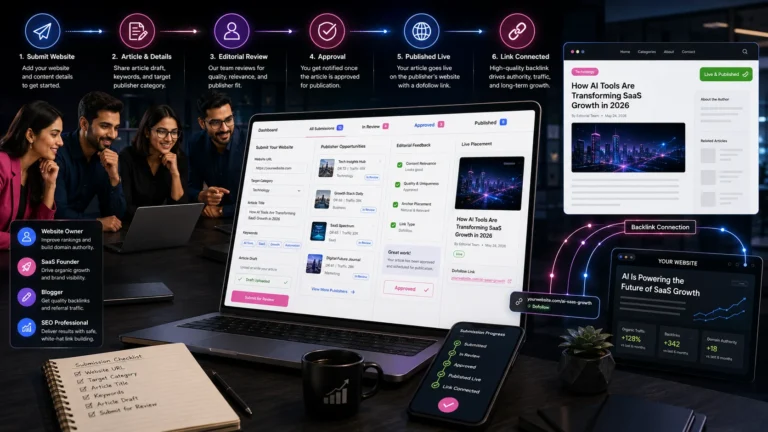
If you want to submit website for backlinks, do not begin by sending your URL to hundreds of random directories. The safer process is to find a relevant publishing platform, review its requirements, prepare useful content, submit it for approval, and confirm the final article contains a live, relevant backlink.
For website owners, bloggers, SaaS founders, and agencies, StartupMandi’s Become a Publisher – StartupMandi Global – a publisher opportunity for getting content in front of relevant audiences – can support this submission-to-publication journey.
What Does “Submit Website for Backlinks” Mean?
“Submit website for backlinks” means presenting your website, article, product, or expert content to another platform for possible publication with a relevant link back to your site.
The process usually involves:
- Identifying a relevant website or publisher.
- Checking its editorial and link policies.
- Preparing an original article or resource.
- Submitting your pitch, draft, or website details.
- Receiving editorial approval.
- Confirming that the published page contains your backlink.
This is different from submitting a URL to Google for indexing. Google Search Console helps site owners request crawling or submit sitemaps, but it does not create an external backlink. Google explains that URL Inspection can request indexing for an individual page, while sitemaps help Google discover groups of URLs. Google’s URL Inspection documentation explains this distinction clearly.
A backlink submission site may offer a business listing, contributor profile, resource page, guest article, or publisher marketplace. The value depends on the platform’s relevance, editorial standards, audience, and ability to provide genuine referral visibility.
“Submitting a URL helps search engines discover or recrawl a page. It does not automatically earn authority or create a backlink.” — Practical SEO distinction based on Google Search Central guidance.
Is Website Submission The Same As Link Building?
No. Website submission is one possible link-building activity, while link building is the broader process of earning links through content, outreach, digital PR, partnerships, resources, and editorial mentions.
A directory profile may be useful for brand discovery. A guest article may support topical authority. A digital PR mention may generate both referral traffic and brand credibility.
The goal should not be maximum submissions. The goal should be relevant publications that make sense for your audience.
How Can Website Submission Help SEO?
Website submission can support SEO by creating relevant discovery paths, referral traffic, brand mentions, and contextual references. However, results depend on the quality of the publishing platform and the usefulness of the content.
A successful submission may help you:
- Reach a new audience.
- Earn referral visits.
- Build topical relevance.
- Support brand recognition.
- Create relationships with publishers.
- Strengthen a natural backlink profile.
Semrush reports that in one 13-month study, 92.3% of top-ranking domains had at least one backlink, while more than half of qualified domains without a backlink did not reach Google’s first page. This supports the importance of backlinks as part of a wider SEO strategy, although it does not mean every submitted link will improve rankings. Semrush’s SEO statistics provide the research context.
A backlink is more valuable when the linking page has a real audience, strong topical alignment, useful content, and a natural reason to reference your website. Semrush’s backlink tools also distinguish referring domains, anchor text, link attributes, and source-page information—metrics worth reviewing after publication. Semrush backlink analysis explains these evaluation areas.
| Submission Outcome | SEO And Marketing Value |
|---|---|
| Relevant editorial link | Supports discovery and authority |
| Niche directory listing | Improves business visibility |
| Guest article | Builds expertise and referral traffic |
| Social profile link | Supports brand validation |
| Random bulk listing | Often provides little lasting value |
Transition: Once you understand the potential value, the next decision is where to submit. Different platforms serve different content and business goals.
Where Can You Submit Content For Backlinks?
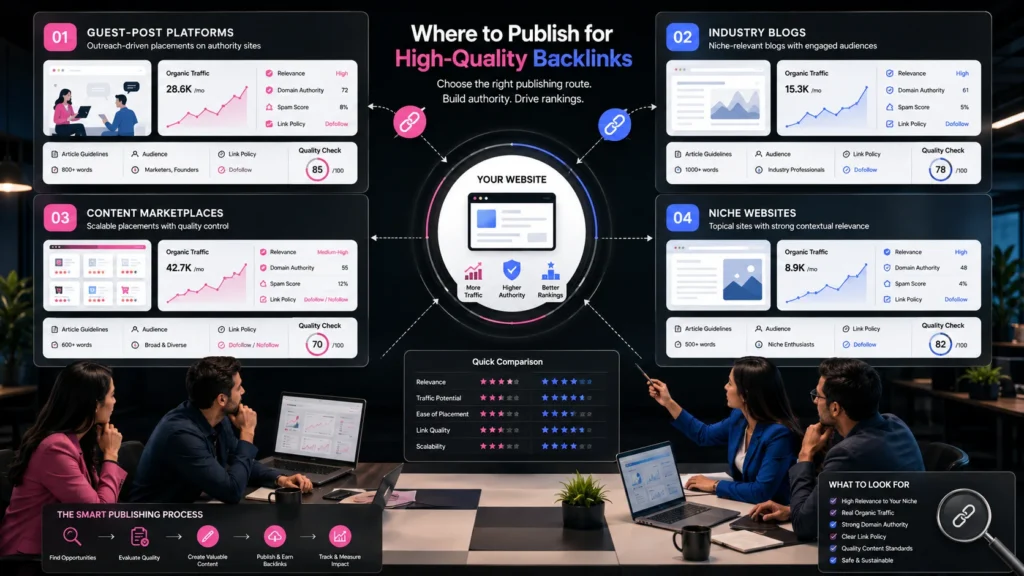
You can submit content through guest-post platforms, industry blogs, content marketplaces, publisher communities, niche directories, and relevant business listings.
What Are Guest-Post Publishing Platforms?
Guest-post publishing platforms connect writers, businesses, and publishers. Some accept article pitches, while others allow you to select publishing opportunities based on niche, audience, pricing, or editorial requirements.
When you submit website for link building through a guest-post platform, check:
- Whether the platform accepts your industry.
- Whether the publisher reviews content manually.
- Whether links are editorial, sponsored, nofollow, or UGC.
- Whether the published page remains publicly accessible.
- Whether the website attracts a relevant audience.
Do not choose a platform only because it advertises a high Domain Rating. A smaller publication with real readers may be more useful than a high-metric website that publishes unrelated articles.
Which Industry Blogs Accept Submissions?
Industry blogs often accept expert contributions, original research, case studies, product education, and practical tutorials. These sites are generally more valuable when your article directly serves their existing readers.
For example:
- A SaaS founder could pitch an article about onboarding, product analytics, or automation.
- A marketing agency could submit a practical SEO measurement framework.
- A blogger could contribute a first-hand tutorial supported by original examples.
- A startup could offer research, founder insights, or a case study.
Search using phrases such as:
- “write for us” plus your industry.
- “contributor guidelines” plus your niche.
- “guest article” plus your topic.
- “submit an article” plus your target audience.
Treat “write for us” pages as starting points, not automatic quality signals. Inspect recent articles, author profiles, outbound links, traffic indicators, and editorial consistency before pitching.
What Are Content Publishing Marketplaces?
Content publishing marketplaces allow businesses to find publishers, submit articles, or request publication opportunities in a structured environment. They may provide publisher details, categories, pricing, turnaround times, and content requirements.
These platforms can simplify the process because they centralize communication and reduce manual prospecting. However, you should still verify:
- Publisher identity.
- Website relevance.
- Content quality.
- Link placement rules.
- Replacement or removal terms.
A marketplace does not eliminate the need for due diligence. It simply makes the submission process easier to manage.
Which Niche Websites Are Worth Considering?
Niche websites are valuable when their readers closely match your audience. Examples include startup communities, software directories, professional associations, local business listings, review platforms, resource libraries, and specialist publications.
A useful submission usually includes a genuine business profile, accurate description, category selection, and a link to a relevant page. It should not use exaggerated claims or keyword-stuffed descriptions.
What Should You Check Before Submitting?
Before using a backlink submission site, check relevance, editorial quality, link policies, indexability, audience fit, and spam signals.
Is The Website Relevant?
Relevance is one of the most important checks. A website should serve an audience that could reasonably benefit from your product, service, research, or article.
Evaluate:
- Topic alignment.
- Audience location.
- Industry coverage.
- Search visibility.
- Related content quality.
A link from a relevant marketing publication may support a digital marketing brand. A link from an unrelated website with no audience overlap may offer little value, even if its authority metric appears attractive.
What Are The Content Guidelines?
Read the publisher’s instructions before writing. Common requirements include word count, formatting, author biography, image specifications, citation rules, prohibited topics, and link limits.
Following guidelines improves acceptance rates and reduces unnecessary revisions. It also signals that you respect the publisher’s editorial standards.
Prepare these materials:
- Two or three article ideas.
- A short author bio.
- Relevant writing samples.
- A clear website description.
- Original images, data, or examples.
What Are The Link Policies?
Every publisher handles links differently. Some permit one contextual link, some allow an author-bio link, and others require sponsored or nofollow attributes.
Never assume a link will be dofollow. Ask whether the link is:
- Followed.
- Nofollow.
- Sponsored.
- UGC.
- Restricted to the author profile.
A nofollow or sponsored link can still send referral traffic and create brand visibility. The correct choice depends on the publisher’s policy and the purpose of the content.
Does The Website Look Trustworthy?
Review the website manually before submission. Look for real authors, current articles, clear contact information, consistent design, editorial review, and a clean topical focus.
Avoid sites with:
- Excessive unrelated categories.
- Hundreds of thin sponsored posts.
- Casino, adult, or other spam-heavy neighborhoods.
- Repetitive AI-generated articles.
- Pages that are not indexed or publicly accessible.
Google defines link spam as creating links primarily to manipulate search rankings. Its spam policies include examples of manipulative link practices that can result in lower rankings or exclusion from Search. Google’s link-spam guidance should guide your quality checks.
How Should You Prepare An Article?
To submit website for SEO successfully, prepare an article that solves a specific reader problem and fits the publisher’s existing content.
Start with the audience rather than the backlink. Ask:
- What does this publisher’s reader need?
- What unique experience or data can I provide?
- Which page on my website genuinely supports the topic?
- Can the article stand alone without the link?
- Does the proposed headline match the publication’s style?
A strong article should include a clear introduction, useful structure, practical examples, original insight, accurate claims, and a natural conclusion.
What Should The Article Include?
Use the following preparation checklist:
- A specific, reader-focused headline.
- A concise introduction that answers the topic.
- Clear H2 and H3 sections.
- Original examples or supporting evidence.
- One or two relevant internal references.
- A natural link to a genuinely useful destination page.
Avoid inserting the same commercial anchor repeatedly. Use natural variations such as your brand name, product name, descriptive phrases, or the page title.
Example: Instead of forcing “best SEO agency” into every article, use “StartupMandi Global,” “SEO campaign planning guide,” or “link-building resources” where context supports it.
How Can You Make Content Citation-Worthy?
Content is more likely to earn additional references when it offers something useful to other writers. Consider including:
- Original survey findings.
- A practical framework.
- A comparison table.
- Screenshots or workflow examples.
- Expert commentary.
- A downloadable checklist.
- Clear definitions and data sources.
Ahrefs’ research on links from pages with organic traffic examined 44,589 search results, illustrating why the visibility and usefulness of a referring page deserve attention. A link from a page that attracts relevant visitors may offer more practical value than a link from an inactive page. Ahrefs’ referring-page study provides the methodology.
How Do You Submit Content Through A Platform?
The safest process moves from publisher research to live-link verification.
Times Needed: Days: 07, Hours: 03, Minutes: 00
Estimated Cost: INR/USD: Free to publisher-dependent pricing
Description: Find a relevant platform, prepare a compliant article, submit a clear pitch, complete editorial revisions, confirm publication, and track the live backlink.
What Are The Submission Steps?
- Create a publisher shortlist
Find five to ten relevant websites, blogs, directories, or marketplaces that serve your target audience. - Review each requirement
Check accepted topics, word count, link rules, editorial standards, pricing, and publication timelines. - Prepare a tailored pitch
Explain the article idea, reader benefit, unique perspective, and why it fits the publication. - Submit the draft or proposal
Follow the requested format and include your author details, website URL, and relevant samples. - Complete editorial revisions
Respond promptly, clarify claims, improve formatting, and remove promotional language when requested. - Confirm the published page
Check that the page is live, accessible, correctly attributed, and contains the agreed link. - Track the result
Record the publisher, article URL, target URL, anchor text, link attribute, publication date, and referral traffic.
You can maintain a simple tracking sheet:
| Publisher | Article URL | Target URL | Link Type | Live Date | Referral Visits |
|---|---|---|---|---|---|
| Example site | Published URL | Your page | Follow/nofollow | Date | Analytics data |
After publication, use Google Search Console to monitor whether your own target page is indexed and use analytics tools to measure referral activity. Google recommends submitting a sitemap for multiple URLs and using URL Inspection for individual pages. Google’s sitemap documentation explains the process.
Transition: Publication is the visible finish line, but quality control continues afterward. A live link should be reviewed, documented, and measured.
Which Submission Mistakes Should You Avoid?
The most damaging mistake is treating every submission as equally valuable. A large list of low-quality links can create activity without producing meaningful authority, traffic, or brand trust.
Avoid these common errors:
- Submitting to unrelated websites.
- Reusing the same article everywhere.
- Sending generic mass emails.
- Overusing exact-match anchor text.
- Ignoring sponsored-link disclosures.
- Paying before checking the publisher.
- Failing to verify the final live page.
Do not submit unfinished articles or pages with broken links. Publishers want content that can be published with minimal editing and that improves their site.
You should also avoid promising traffic or rankings to your own clients based solely on submissions. Backlinks are one part of SEO, alongside content quality, technical accessibility, internal linking, user experience, and search intent.
What Should You Do After Publication?
After your article goes live, verify the placement and record its details. Check the URL from an incognito browser, confirm the anchor points to the correct page, and make sure the article is accessible without a login.
Then review:
- Whether the article is indexed over time.
- Whether referral traffic appears in analytics.
- Whether the publisher keeps the article live.
- Whether the target page attracts impressions or clicks.
- Whether the publication creates additional mentions.
If the link disappears, contact the publisher politely and refer to the agreed terms. Do not immediately replace it with a low-quality submission elsewhere.
Frequently Asked Questions
1. What does “submit website for backlinks” mean?
It means presenting your website, article, business profile, or resource to another platform for possible publication with a link back to your site.
2. What is a backlink submission site?
It is a directory, publisher platform, community, marketplace, or website where users can submit business information, articles, or resources that may include a backlink.
3. Can I submit my website directly to Google for backlinks?
No. Google Search Console can help you request crawling or submit a sitemap, but it does not create backlinks from external websites.
4. How do I submit website for SEO safely?
Choose relevant platforms, follow their editorial requirements, submit original content, use natural anchor text, and avoid automated or spam-heavy directories.
5. Are free backlink submission sites useful?
Some can support discovery, referral traffic, or local visibility. Their value depends on relevance, editorial quality, audience, and the site’s overall trustworthiness.
6. Should every backlink be dofollow?
No. Followed, nofollow, sponsored, and UGC links can all have different purposes. Referral traffic, brand exposure, and editorial context also matter.
7. How many websites should I submit to?
Focus on a small, relevant group rather than mass submission. Five carefully selected publishers may be more useful than hundreds of unrelated sites.
8. How long does publication take?
It depends on the platform. Some directories publish quickly, while editorial blogs and marketplaces may require several days or multiple review rounds.
Key Takeaways
- Submit for relevance, not volume.
- A backlink is different from an indexing request.
- Check every publisher before sending content or payment.
- Prepare original, useful, publication-ready articles.
- Confirm link attributes and live URLs after publication.
- Measure referral traffic and visibility, not just link counts.
Next Steps
- Select one target page that genuinely deserves a relevant backlink.
- Build a shortlist of five niche publishers or content platforms.
- Review each site’s content and link requirements.
- Prepare a customized pitch and original article.
- Track every submission, approval, publication, and referral visit.
Conclusion
Learning how to submit website for backlinks is not about finding the longest list of free directories. It is about creating a reliable path from publisher discovery to content approval and a useful, live backlink.
If you want to explore a practical publishing opportunity, visit Become a Publisher – StartupMandi Global – the targeted StartupMandi Global landing page for relevant content publication. You can also read 10 Questions to Ask Link Building Companies Before Hiring in 2026 – a decision framework for evaluating link-building providers – and What Link Building Strategy Works for Higher Rankings and AI Search in 2026 – a guide to modern authority-building methods.