



10 Questions to Ask Link Building Companies Before Hiring in 2026
Compare link building companies with this 2026 buyer’s guide covering quality checks, pricing models, reporting standards, risks, and agency fit.
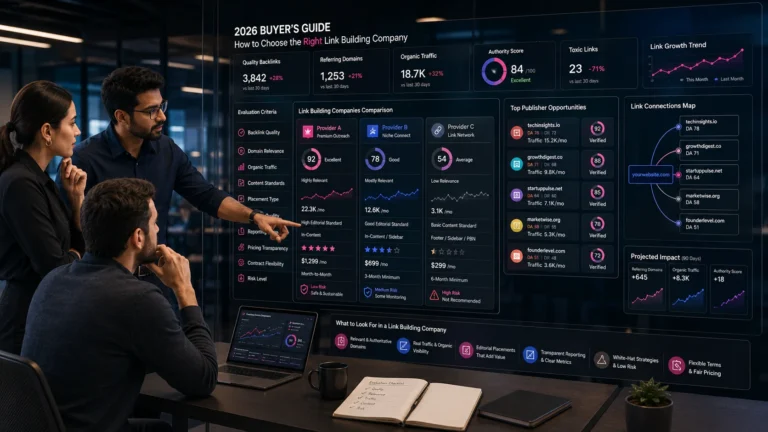
Hiring one of the many link building companies can improve organic visibility, but the wrong partner may waste your budget or damage your website’s reputation. Before signing a contract, ask about sourcing, relevance, editorial standards, pricing, reporting, and measurable outcomes. This guide provides ten practical questions for marketing managers, startup founders, and agencies comparing backlink providers in 2026.
A credible backlink building company should explain exactly how links are earned, where placements come from, and how the campaign supports your broader SEO goals. You can also review link building service strategies that still work in 2026 – a related StartupMandi Global guide covering modern authority-building tactics.
Why Do Businesses Outsource Link Building?
Businesses outsource link building to access specialist outreach skills, publisher relationships, content production, and campaign management without building a full internal team.
The right provider can help you:
Find relevant websites in competitive niches.
Create content worth publishing and referencing.
Earn editorial backlinks and brand mentions.
Scale campaigns across multiple products or locations.
Track links, rankings, referral traffic, and visibility.
Link building is difficult because quality opportunities require research, relationship management, strong content, and persistent follow-up. Agencies also need to balance relevance with authority instead of relying on a single metric such as Domain Rating or Domain Authority.
Clutch’s 2026 marketplace data shows that link-building providers vary widely by budget, team size, review history, and service model. Its listings include firms serving startups, local businesses, SaaS companies, and enterprise brands. Clutch’s link-building directory can help create an initial shortlist, but reviews should support—not replace—your own due diligence.
“A high metric does not automatically mean a high-value link. Relevance, traffic, editorial quality, and context must be evaluated together.”
Transition: Outsourcing may be sensible, but choosing a provider requires more than comparing packages. The following questions help separate a transparent partner from a risky vendor.
What Should Link Building Companies Explain?
The best link building companies can explain their process in plain language before you purchase. They should discuss prospecting, outreach, content, approvals, publishing, quality checks, and reporting.
1. What Is Your Link-Building Method?
Ask whether the provider uses digital PR, expert outreach, guest contributions, resource-page outreach, editorial partnerships, or niche-relevant content placements.
A good answer should describe a repeatable process while leaving room for campaign customization. Avoid companies that only advertise fixed quantities, such as “100 backlinks every month,” without explaining quality or relevance.
Ask these follow-up questions:
How are target websites discovered?
Who reviews the sites before outreach?
Are opportunities earned, sponsored, or paid?
Will you approve target pages and anchor text?
Can you see examples from similar industries?
2. How Do You Vet Publishing Websites?
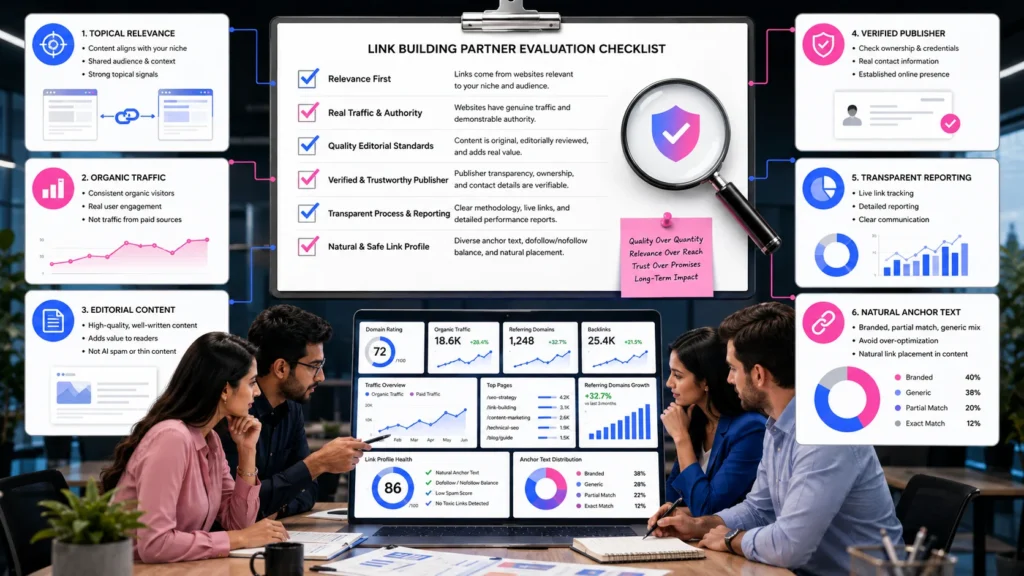
A trustworthy backlink building agency evaluates more than Domain Rating. It should review organic traffic, topical relevance, indexing, content quality, audience fit, outbound-link patterns, and the overall health of the publication.
A website with a high authority score but no meaningful organic traffic may provide limited commercial value. Similarly, a site publishing unrelated articles for every industry could indicate a shared or low-quality placement network.
Use this minimum screening framework:
| Evaluation Area | What To Check |
|---|---|
| Relevance | Does the site cover your industry or audience? |
| Organic visibility | Does it rank for real, relevant keywords? |
| Content quality | Are articles useful, original, and edited? |
| Link patterns | Does it publish excessive sponsored content? |
| Audience fit | Could its readers become customers or referrers? |
| Indexing | Are its important pages visible in search? |
Ahrefs’ link-building guidance recommends focusing on relevant, authoritative opportunities rather than pursuing links solely for numerical volume. Its resources are useful for reviewing referring domains, organic traffic, and anchor-text patterns. Ahrefs’ link-building resources provide additional context.
3. Can You Show Recent Placement Examples?
Ask for three to five recent examples relevant to your business model. Inspect each URL manually before signing.
Review the following:
- Whether the page is live and indexable.
- Whether the link appears naturally in the content.
Whether the surrounding article is useful.
Whether the site has genuine topical relevance.
- Whether the placement looks like a link farm or content warehouse.
A serious link building firm should be comfortable showing representative work, explaining the campaign objective, and identifying limitations. If every example is confidential, ask for anonymized screenshots, sample reports, or a live demonstration of the reporting process.
4. Who Creates and Reviews the Content?
Content quality affects whether a placement feels editorial or manufactured. Ask whether articles are written by subject-matter writers, reviewed by editors, fact-checked, and customized for the target publication.
You should also clarify whether the provider uses artificial intelligence. AI can help with research and workflow efficiency, but unedited, generic content can weaken brand trust and publisher acceptance.
A reliable provider should explain:
Who writes the content.
Who checks facts and claims.
Whether your team receives approval rights.
How brand tone and expertise are maintained.
How duplicate or thin content is avoided.
5. Do You Use Private Blog Networks?
The answer should be clear: a risk-conscious provider should not rely on private blog networks, link farms, automated sitewide links, or spun content.
Google’s spam policies identify manipulative link practices as a quality risk. Buying or exchanging links primarily to manipulate rankings can violate search guidelines, particularly when the placement is not editorially justified. Google Search Central’s spam policies should be part of your vendor evaluation.
Ask directly:
Do you use private blog networks?
Do you guarantee followed links?
Do you purchase links from public marketplaces?
Do you use automated outreach at scale?
Do you accept links from unrelated websites?
Red flag: “We use private networks only when appropriate” is not a transparent risk-management policy.
How Should You Compare Link Building Agencies?
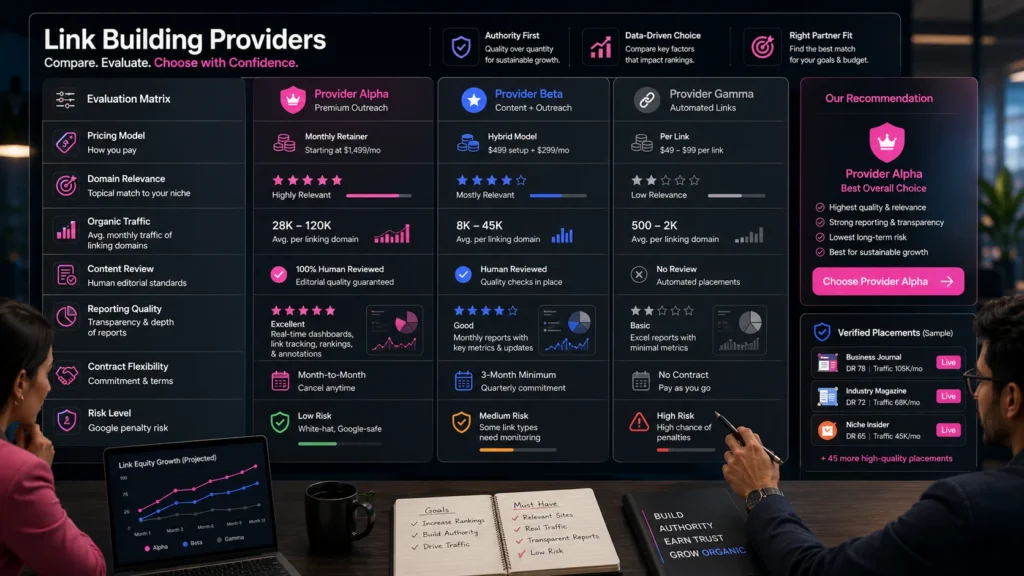
Compare link building agencies by quality, process, transparency, communication, and strategic fit—not by the number of links promised.
A helpful comparison matrix looks like this:
| Criteria | Provider A | Provider B | Provider C |
|---|---|---|---|
| Niche relevance | High / Medium / Low | High / Medium / Low | High / Medium / Low |
| Sample links provided | Yes / No | Yes / No | Yes / No |
| Manual quality review | Yes / No | Yes / No | Yes / No |
| Content approval | Yes / No | Yes / No | Yes / No |
| Detailed reporting | Yes / No | Yes / No | Yes / No |
| Digital PR capability | Yes / No | Yes / No | Yes / No |
| White-label delivery | Yes / No | Yes / No | Yes / No |
| Contract flexibility | High / Medium / Low | High / Medium / Low | High / Medium / Low |
6. Which Metrics Do You Report?
Ask for reports that show live URLs, referring domains, target pages, anchor text, link attributes, publication dates, and relevant quality metrics.
Strong reporting may also include:
Organic traffic of linking domains.
Keyword visibility of published pages.
Referral traffic from new placements.
New branded mentions.
Ranking movement for priority pages.
Do not judge the campaign only by Domain Rating increases. A provider may build links without improving rankings if your content, technical SEO, search intent, or internal linking requires attention.
G2’s review pages show why transparency and responsiveness often influence customer satisfaction alongside product or service outcomes. Its profiles include user feedback about communication, publisher access, process efficiency, and pricing. G2’s SEO services marketplace can provide useful review context.
7. How Will You Measure Business Results?
A backlink campaign should connect to business objectives. Ask whether the provider will measure qualified traffic, demo requests, leads, conversions, assisted conversions, or revenue—not simply links delivered.
Define success before the campaign begins:
| Business Goal | Useful Measurement |
|---|---|
| Improve rankings | Keyword positions and visibility |
| Increase traffic | Organic and referral sessions |
| Generate leads | Form submissions and qualified enquiries |
| Support SaaS growth | Demo requests and sign-ups |
| Build brand authority | Mentions, citations, and branded searches |
Rankings may take several months to respond, and no reputable provider can guarantee a specific position. Agree on review windows, reporting frequency, and optimization checkpoints instead.
Transition: Quality questions help you evaluate delivery. Pricing questions determine whether the proposed investment is realistic and sustainable.
What Pricing Models Do Providers Offer?
Link building companies commonly charge per link, per month, per campaign, or according to a customized retainer. Each model has advantages and limitations.
| Pricing Model | Best For | Main Risk |
|---|---|---|
| Per-link | Small tests | Encourages quantity over strategy |
| Monthly retainer | Ongoing campaigns | May hide under-delivery |
| Campaign-based | Digital PR or launches | Results can be less predictable |
| Custom project | Complex SEO programs | Requires clearer scoping |
| White-label pricing | SEO agencies | Quality may vary by package |
A very low price often indicates low-cost content, shared inventories, weak vetting, or automated outreach. However, a high price does not automatically guarantee quality. Evaluate the work, process, and evidence behind the quote.
8. What Does the Fee Actually Include?
Ask whether the proposal includes strategy, prospecting, writing, editing, outreach, revisions, placement, reporting, and link monitoring.
Clarify additional charges for:
Premium publisher fees.
Content revisions.
Digital PR assets.
Rush placements.
Link replacements or removals.
Strategy and consultation.
A written scope should state the expected number of opportunities, approvals, deliverables, timelines, and reporting format. This protects both sides from misunderstandings.
9. Is There a Minimum Contract Period?
Most meaningful authority campaigns require consistency. However, you should understand the minimum commitment before signing.
Ask:
Is there a monthly minimum?
Can you pause the campaign?
What happens if no suitable placement is found?
Are unused credits carried forward?
Is there a replacement policy for removed links?
A three-month pilot may be reasonable for testing communication, quality, and reporting. Avoid long contracts if the provider refuses to share examples or define deliverables.
Which Partner Fits Your Business?
The best link building company depends on your goals, market, risk tolerance, and internal capacity. A startup may need focused authority for a few commercial pages, while an agency may need scalable white-label delivery and client-ready reporting.
10. Can You Support My Long-Term SEO Plan?
A good partner should understand how link building connects with content strategy, technical SEO, digital PR, internal links, and conversion optimization.
Choose a provider that can explain:
Which pages should receive links first.
How anchor text will remain natural.
How content gaps affect outreach success.
How campaigns will adapt to competitors.
How AI search and brand mentions influence visibility.
A backlink building company should not operate in isolation from the rest of your marketing plan. Link acquisition is more effective when the destination page is genuinely useful and commercially aligned.
What Does Each Buyer Need?
| Buyer Type | Best-Fit Provider |
|---|---|
| Startup founder | Flexible campaign with strategic guidance |
| Marketing manager | Transparent reporting and measurable KPIs |
| SEO agency | White-label fulfillment and reliable communication |
| SaaS company | Technical and topical expertise |
| Local business | Regional relevance and local authority |
| Enterprise brand | Governance, compliance, and scalable processes |
StartupMandi Global can support this decision process through content-led authority building, publisher outreach, and practical SEO education. You can also review Publish your Content and Get quality Backlinks – a relevant resource for businesses and publishers exploring content placement opportunities.
How Can You Run a Hiring Test?
A short pilot is the safest way to assess a potential provider before committing to a larger campaign.
Times Needed: Days: 14, Hours: 02, Minutes: 00
Estimated Cost: INR/USD: Based on provider scope and placement quality
Description: Test a provider’s research, content, communication, editorial quality, and reporting before approving a longer link-building engagement.
What Steps Should You Follow?
Define one campaign objective
Select one priority page, audience, and measurable goal, such as qualified traffic or rankings for a topic cluster.Request a sample strategy
Ask each shortlisted provider to explain target websites, content angles, anchor-text preferences, and expected timelines.Review sample placements
Inspect recent links for relevance, indexing, organic visibility, editorial quality, and natural context.Run a limited pilot
Approve a small campaign with written deliverables, content review, reporting requirements, and replacement terms.Measure quality and fit
Evaluate communication, delivered placements, referral activity, rankings, and strategic recommendations before scaling.
Tools Name: Ahrefs, Semrush, Google Search Console, Google Analytics
Materials Name: SEO brief, target-page list, competitor backlink report, brand guidelines
For foundational context, read Beginner’s Guide to SEO Backlinks – a useful internal resource for understanding backlink terminology and campaign basics.
What Are the Biggest Hiring Mistakes?
The most common mistake is choosing the cheapest backlink building agency without evaluating risk. A low-cost package can create irrelevant links that generate no qualified traffic and provide little long-term value.
Avoid these errors:
Comparing link counts instead of link quality.
Treating Domain Rating as the only metric.
Accepting guaranteed rankings.
Skipping sample-link verification.
Ignoring content quality and brand fit.
Signing without clear reporting terms.
You should also avoid judging providers solely by online listicles. Rankings can be influenced by sponsorships, affiliate relationships, commercial partnerships, or self-submitted information.
Transparency note: This guide is educational and includes StartupMandi Global resources. It is not an independent ranking of vendors, and readers should verify current pricing, reviews, deliverables, and commercial relationships before purchasing.
What Should You Do Next?
Use the following sequence to turn research into a confident hiring decision:
Audit your existing backlinks and priority pages.
Define your budget, timeline, and risk tolerance.
Shortlist three to five relevant providers.
Ask all ten questions in writing.
Run a controlled pilot before scaling.
Review business outcomes, not only link counts.
A structured process helps marketing managers protect budgets, helps founders avoid unnecessary risk, and helps agencies select dependable fulfillment partners.
Frequently Asked Questions
1. What are link building companies?
Link building companies help businesses earn or acquire backlinks from external websites to support organic visibility, authority, referral traffic, and brand discovery.
2. How do I choose the best link building company?
Choose a provider that demonstrates relevant placements, transparent sourcing, strong content standards, detailed reporting, ethical methods, and measurable campaign objectives.
3. Are link building agencies worth the investment?
They can be worthwhile when your team lacks outreach expertise or publisher relationships. The investment should be judged against quality, strategic fit, qualified traffic, and business outcomes.
4. What is the difference between a link building firm and an SEO agency?
A link building firm focuses primarily on authority acquisition and outreach. A broader SEO agency may also provide technical SEO, content, local SEO, analytics, and conversion optimization.
5. How much do link building services cost?
Pricing varies based on publisher quality, content requirements, niche competitiveness, campaign scope, and whether the work is per-link, retainer-based, or campaign-based.
6. Should I hire a backlink building agency for a new website?
Possibly, but first ensure the website has useful content, clear positioning, technical accessibility, and pages capable of earning or converting traffic.
7. Can a link building company guarantee rankings?
No reputable provider can guarantee specific Google rankings. Search performance depends on competition, content, technical health, user intent, links, and algorithmic changes.
8. What metrics should I check in monthly reports?
Review live links, referring domains, topical relevance, organic traffic, target pages, anchor text, referral traffic, rankings, conversions, and any brand mentions generated.
Key Takeaways
Ask about methodology before comparing prices or link quantities.
Inspect sample placements for relevance, traffic, indexing, and editorial quality.
Reject PBNs and manipulative tactics that create unnecessary search risk.
Compare reporting and communication as carefully as the promised deliverables.
Use a pilot campaign to test quality before committing to a long contract.
Measure business outcomes instead of relying only on authority metrics.
Next Steps
Prepare a one-page SEO brief with target pages, audiences, and business goals.
Shortlist three link building companies with relevant industry experience.
Send each provider the same ten questions for an objective comparison.
Verify sample links manually and request a clear pilot proposal.
Review link building service strategies that still work in 2026 before finalizing your campaign.
Conclusion
The best link building company is not necessarily the largest, cheapest, or most visible in search results. It is the partner that understands your goals, earns relevant placements, communicates clearly, and provides evidence that its work supports sustainable SEO growth.
Use this decision framework before hiring link building agencies, backlink building agencies, or a specialized link building firm. When you are ready to explore content-led opportunities, visit Publish your Content and Get quality Backlinks and review the Beginner’s Guide to SEO Backlinks.
- link building companies
- Link Building Companies: 10 Questions to Ask Before Hiring
-
Choose link building companies confidently with 10 practical questions covering quality, pricing, reporting, risk, and measurable SEO outcomes.
- By submitting the blog, I agree to the terms & conditions of StartupMandi Global. Admin team can modify & change any section to make the UX & SEO better and comply with Guest Posting rules.