

Introduction
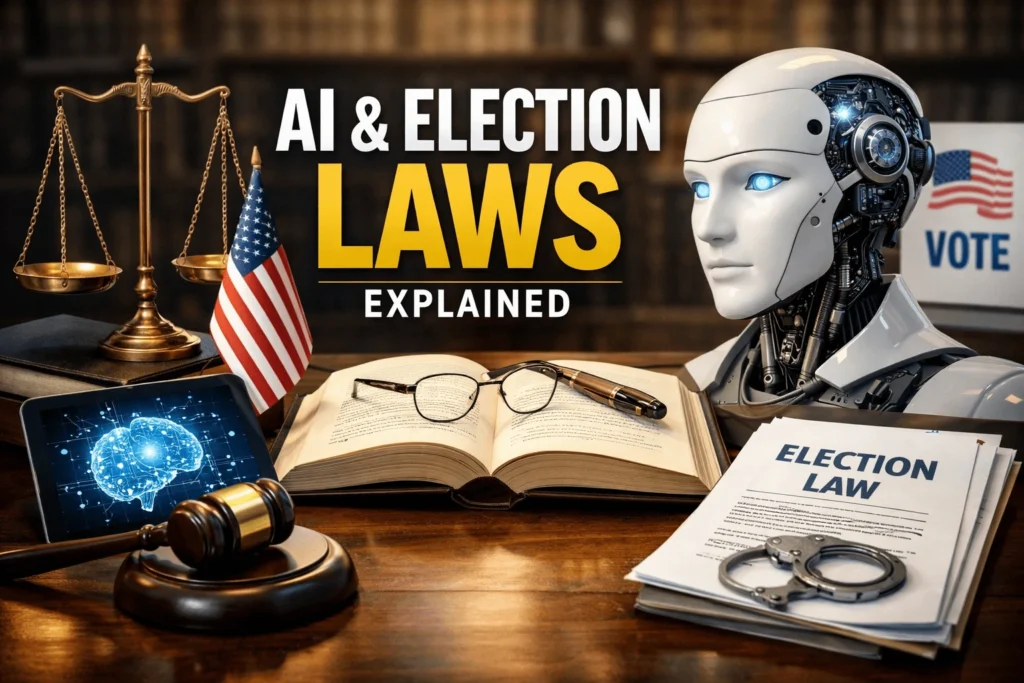
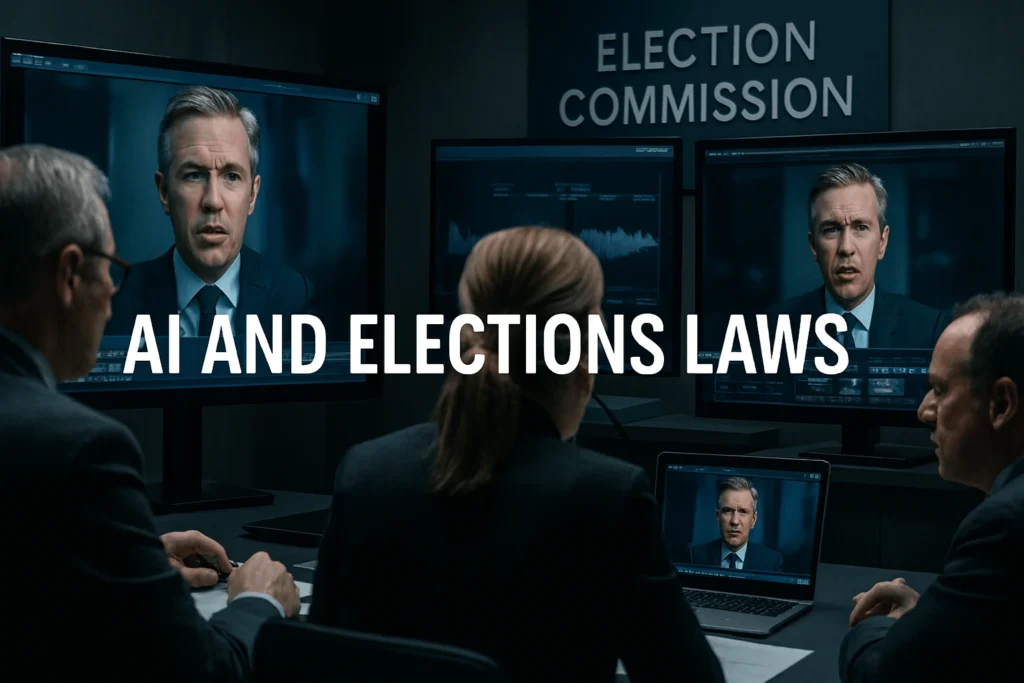
AI and elections laws emerge as democracy’s new frontline in 2025 🛡️. Moreover, deepfake videos and AI-generated speeches threaten voter trust worldwide. Additionally, India’s Election Commission issued strict AI advisories for 2025 campaigns. Therefore, candidates, parties, and tech startups must understand these rapidly evolving regulations.
Read More: Build wealth with real estate in 2026: A Beginner’s Guide to Property Investment
How AI creates election misinformation through deepfakes and voice cloning
ECI’s mandatory AI disclosure rules for political content
Global laws addressing AI election interference
Compliance strategies for political campaigns and tech firms
Startup opportunities in election integrity technology
How AI disrupts elections
Deepfakes and synthetic media threats
Deepfake technology creates realistic fake videos of candidates saying things they never said. Wikipedia documents multiple 2024 election deepfake incidents globally. Moreover, voice cloning generates convincing audio clips within seconds using just 30 seconds of real speech.
These tools spread rapidly on WhatsApp, social media, and YouTube. Voters struggle to distinguish real content from AI-generated fakes. Therefore, unchecked deepfakes erode trust in democratic processes fundamentally.
AI-powered targeted misinformation
AI analyses voter data to create personalized false narratives at scale. Machine learning identifies individual fears, aspirations, and biases, then crafts custom messages. Moreover, generative AI produces thousands of variations across languages and dialects instantly.qubit
This precision targeting amplifies division more effectively than traditional propaganda. Consequently, election authorities face unprecedented challenges verifying information authenticity.
Microtargeting and behavioral manipulation
AI microtargeting predicts voter behavior with 85-95% accuracy using social media patterns. Campaigns receive real-time advice on optimal messaging timing and channels. Moreover, sentiment analysis tracks narrative effectiveness continuously.
Such capabilities raise ethical questions about consent and manipulation. Therefore, regulators demand transparency in AI-driven voter outreach strategies.

- Subscribe Now This product has multiple variants. The options may be chosen on the product page
- USD: $ 99.98
- Subscribe Now This product has multiple variants. The options may be chosen on the product page
- Select options This product has multiple variants. The options may be chosen on the product page
- USD: $ 749.98 - $ 4,916.65
- Subscribe Now This product has multiple variants. The options may be chosen on the product page
- USD: $ 6.65
- Select options This product has multiple variants. The options may be chosen on the product page
- USD: $ 8.32 - $ 83.32
- Subscribe Now This product has multiple variants. The options may be chosen on the product page
India’s Election Commission AI advisory
Mandatory AI content disclosure rules
India’s Election Commission issued comprehensive AI guidelines in January 2025. All AI-generated campaign content must carry clear watermarks and disclaimers. Candidates must disclose AI usage to ECI within 48 hours of publication.
Key requirements:
Visible “AI-generated” labels on videos/images
Audio disclaimers stating synthetic content
Source disclosure for training data used
Retention of original content for verification
Prohibited AI practices during elections
ECI bans deepfake videos impersonating candidates or officials. Voice cloning without consent violates model code of conduct strictly. Moreover, AI chatbots soliciting voter data face immediate legal action.{source}
Parties must report all AI vendors and tools used during campaigns. Therefore, non-compliance risks disqualification and criminal prosecution under IT Act.
Real-time monitoring and enforcement
ECI established 24/7 AI monitoring cells across states. Platforms must report AI election content within 6 hours of flagging. Moreover, nodal officers coordinate with social media companies for rapid takedowns.
This proactive framework positions India among global leaders in election AI regulation. Consequently, political parties invest heavily in compliance technology.
Global AI election regulations
United States fragmented state-level laws
US lacks federal AI election law but 18 states enacted deepfake bans by 2025. California requires 30-day disclosure for AI campaign ads. Texas criminalizes deceptive election deepfakes with jail time.
Federal bills propose national watermarking standards. However, First Amendment challenges slow comprehensive legislation significantly.
Europe’s comprehensive AI Act framework
EU AI Act classifies election deepfakes as “high-risk” applications requiring strict compliance. Political parties must conduct AI impact assessments annually. Moreover, platforms face €35 million fines for non-compliance.
This harmonized approach creates clear rules across 27 countries. Therefore, global campaigns targeting Europe must meet stringent standards uniformly.
AI election regulation comparison table
| Country/Region | Deepfake Ban | Disclosure Timeline | Platform Liability | Penalties |
|---|---|---|---|---|
| India (ECI) | Yes | 48 hours | High | Disqualification |
| USA (States) | Partial | 30 days (CA) | Medium | Fines/jail |
| EU AI Act | Yes | Pre-publication | Very high | €35M fines |
| UK | Proposed | 7 days | High | Criminal |
Emerging compliance technology opportunities
Watermarking startups develop invisible AI detection markers embedded in videos. Content authenticity platforms verify election materials using blockchain timestamps. Moreover, real-time deepfake detection APIs serve political consultancies.qubit
Election integrity SaaS platforms monitor compliance across social channels automatically. Therefore, AI regulation creates substantial B2B opportunities for startups.
Google for Startups Accelerator: India – AI-First 2026 Cohort
Accelerating AI‑First Indian Startups + Google for Startups (Google LLC)
₹29,225,000.00- Prototype Stage, MVP Stage, Early Revenue Stage
- April 19, 2026

Google for Startups Accelerator: India – AI-First 2026 Cohort
Accelerating AI‑First Indian Startups + Google for Startups (Google LLC)
₹29,225,000.00- Prototype Stage, MVP Stage, Early Revenue Stage
- April 19, 2026
IHFC–ARTPARK–Siemens Healthineers MedTech Call for Proposals 2026
IHFC (I-Hub Foundation for Cobotics), ARTPARK, Siemens Healthineers
₹20,000,000.00- Prototype Stage, MVP Stage, Early Revenue Stage, Growth Stage
- April 30, 2026

Conclusion: Navigate AI and elections laws strategically ⚖️
AI and elections laws protect democracy while creating new compliance markets. ECI’s proactive framework sets global standards for responsible AI campaigning. Moreover, legitimate innovation thrives within clear boundaries.
StartupMandi connects election tech founders with ECI-compliant solutions, political consultants, and institutional investors. Build the next generation of trustworthy campaign technology responsibly.
FAQs
When must candidates disclose AI campaign content to ECI?
ECI requires disclosure within 48 hours of any AI-generated content publication. Parties must maintain original files for verification upon request. Non-compliance risks severe penalties including disqualification.
Does watermarking make deepfakes completely undetectable?
Current watermarking survives basic editing but sophisticated AI can remove markers. Therefore, ECI mandates multiple verification layers including source disclosure and blockchain timestamps for high-stakes content.
Can startups legally build AI tools for political campaigns?
Yes, but tools must comply with ECI disclosure requirements and prohibit deepfake generation. Startups serving political clients should document compliance features prominently in marketing materials.
What happens if platforms fail to remove violating AI content?
Social media platforms face content blocking orders and potential ECI blacklist status. Repeated violations trigger criminal proceedings under IT Act. Therefore, platforms invest heavily in proactive AI moderation.
How do global AI election laws affect Indian campaigns?
Candidates targeting NRIs must comply with destination country laws. EU-targeted content requires pre-publication AI assessments while US state laws vary widely. Legal review becomes essential for international outreach.
Referring Blogs / Fact Sources
- Artificial intelligence and elections – Wikipedia
- Impact of AI-Generated Misinformation on Electoral Integrity and Public Trust: Government & Law Book Chapter | IGI Global Scientific Publishing
- EC issues advisory to political parties to ensure responsible use of AI-generated content – The Hindu
- ECI AI Advisory – Election Commission of India issues advisory to political parties: Use artificial intelligence responsibly and transparently – India Today
- Using AI in Elections
Dikshant Choudhary
I’m Dikshant Choudhary, a University of Delhi student and freelance writer specializing in SEO blogs, transcription, and business analysis. I create engaging, research-driven content for academic and client projects with creativity and discipline.