



Seed funding for startups represents the foundational capital every entrepreneur needs. Essentially, this is your initial financial injection converting ideas into viable businesses. Subsequently, startup seed money separates dreamers from doers in the entrepreneurial world.
Therefore, understanding seed funding mechanisms becomes your pathway to transformation. Moreover, seed rounds democratize entrepreneurship regardless of personal wealth. Currently, India’s early-stage ecosystem distributes billions annually through diverse funding sources.
Additionally, government schemes now provide ₹20+ lakhs in grants without collateral requirements. The 2026 landscape favors founders who understand funding options strategically.
Here’s what makes seed funding essential for startup success:
₹20 Lakh Government Grants – SISFS provides completely non-dilutive capital for proof-of-concept validation through eligible incubators without equity loss.
Multiple Funding Pathways – Angel investors, venture capitalists, crowdfunding, bootstrapping, and government schemes all provide accessible seed capital options.
Average Seed Round: $500K-$5M – Median Indian seed funding rounds averaged $3.5-3.6 million, enabling substantial product development and team building.
20% Equity Dilution Standard – Founders typically surrender 20% equity during seed rounds, maintaining majority control over business direction.
Non-Dilutive Capital Available – Grants and crowdfunding offer capital without equity loss, perfect for founders prioritizing ownership retention.
Before Plan for Grant or Debt for Your Startup, Prepare Your Documents Professionally
Understanding Seed Funding Fundamentals:
What Is Seed Funding & Why It Matters for Your Startup
Basically, seed funding for startups provides initial capital transforming rough concepts into market-ready products. Specifically, this capital validates business ideas before scaling aggressively. Subsequently, entrepreneurs transition from bootstrapping to attracting institutional investors. Therefore, seed rounds bridge the gap between ideation and demonstrated market fit.
Meanwhile, seed money typically ranges from $500,000 to $5 million depending on business complexity. Additionally, investors at this stage prioritize team quality and market opportunity over financial metrics. Importantly, seed funding provides more than money—it includes mentorship, networks, and credibility.
How Seed Funding Differs from Later Rounds
Seed funding fundamentally differs from Series A, B, or C investments across multiple dimensions. Specifically, seed rounds focus on validating business concepts before aggressive scaling. Meanwhile, Series A investments emphasize rapid growth after proven product-market fit. Additionally, seed rounds average $3.5-5 million globally, while Series A rounds exceed $18+ million. Therefore, capital amounts increase as business maturity progresses.
Importantly, early-stage dilution differs too—founders typically surrender 20% at seed stages. Conversely, later rounds involve 15-30% dilution as company valuation increases substantially. Furthermore, seed investors tolerate higher risk accepting founders with limited track records. Meanwhile, Series A investors demand demonstrated revenue traction and customer validation.
Critical Uses of Startup Seed Money
Startup seed money enablers specific developmental activities validating your business concept. Firstly, founders develop minimum viable products (MVPs) or prototypes testing market demand. Meanwhile, team assembly becomes possible—hiring engineers, designers, and operations specialists. Additionally, market research consumes significant seed capital understanding target customer psychology.
Furthermore, initial marketing and customer acquisition channels launch here. Therefore, legal compliance, incorporation, and trademark registrations get funding. Importantly, operational infrastructure including software tools and office space requires capital investment. Additionally, customer validation through early-adopter programs utilizes seed funds effectively.
| Use Case | Typical Allocation % | Purpose | Timeline |
|---|---|---|---|
| Product Development | 30-40% | MVP/Prototype creation & refinement | 3-6 months |
| Team Building | 25-35% | Core team hiring & salaries | Ongoing |
| Market Research | 10-15% | Customer validation & traction | 1-3 months |
| Marketing & Sales | 10-20% | Customer acquisition & brand awareness | Ongoing |
| Operations | 10-15% | Legal, infrastructure, tools | 1-2 months |

- Subscribe Now This product has multiple variants. The options may be chosen on the product page

- USD: $ 99.98

- Subscribe Now This product has multiple variants. The options may be chosen on the product page

- Subscribe Now This product has multiple variants. The options may be chosen on the product page

- Subscribe Now This product has multiple variants. The options may be chosen on the product page

- Select options This product has multiple variants. The options may be chosen on the product page
- USD: $ 749.98 - $ 4,916.65

- Subscribe Now This product has multiple variants. The options may be chosen on the product page

- Subscribe Now This product has multiple variants. The options may be chosen on the product page

- Subscribe Now This product has multiple variants. The options may be chosen on the product page

- USD: $ 6.65
Major Seed Funding Sources Explained
Where to Source Your Startup Seed Money: Complete Breakdown
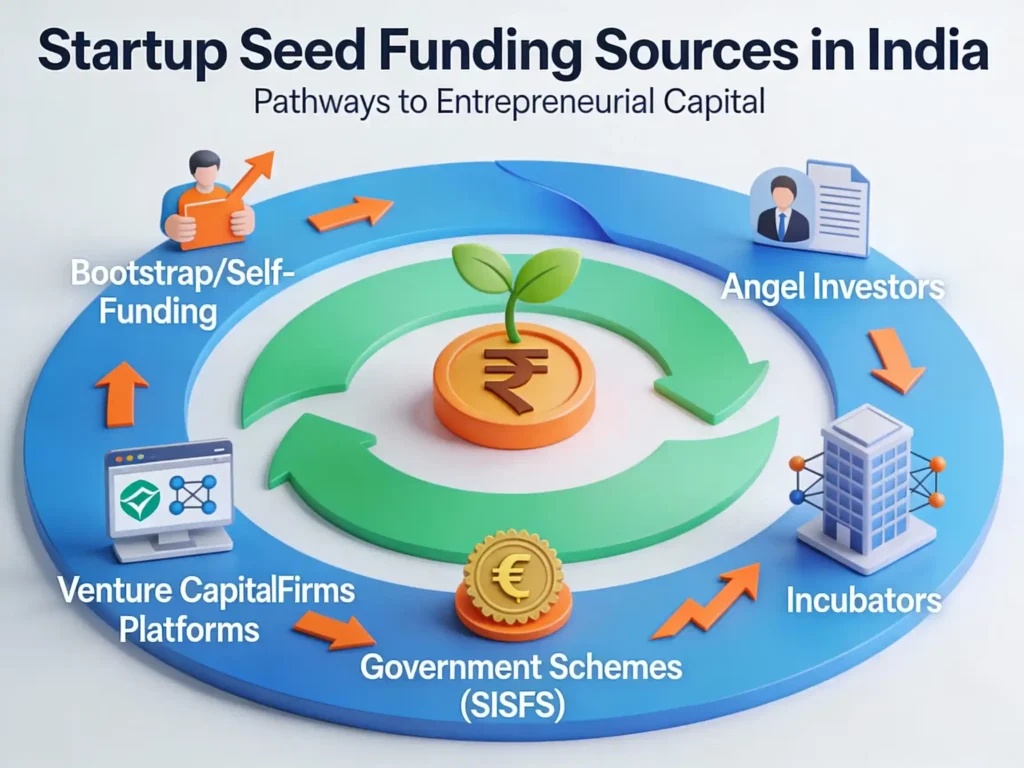
Undeniably, startup seed money flows from diverse sources each with unique characteristics. Subsequently, matching your business profile to appropriate sources maximizes approval probability. Therefore, understanding each source becomes essential pre-fundraising work. Meanwhile, India’s ecosystem now includes government schemes, angel networks, VCs, and crowdfunding platforms.
Additionally, each source offers distinct advantages and challenges. Importantly, strategic founders combine multiple sources creating optimal capital structures. Therefore, this section details every accessible seed funding pathway.
Angel Investors – Your Early Believers
Angel investors represent successful entrepreneurs or high-net-worth individuals investing personal capital. Typically, they invest ₹5 lakhs to ₹2 crores in promising startups. Meanwhile, angels bring three critical assets simultaneously: capital, mentorship, and industry networks. Additionally, they tolerate higher risk than institutional investors, backing unproven founders.
Therefore, angel backing often validates your idea to subsequent investors. Notably, Indian angel platforms like AngelList, LetsVenture, and Venture Catalysts connect thousands of investors. Furthermore, angels typically surrender 10-20% equity per investment. Importantly, personal relationships and referrals matter enormously in angel fundraising.
How to Approach Angel Investors
Firstly, identify angels passionate about your specific industry or sector. Meanwhile, leverage LinkedIn, industry events, and incubator networks for introductions. Subsequently, prepare compelling pitch decks highlighting market opportunity and team credibility.
Additionally, demonstrate early traction—customer testimonials, user signups, or pilot programs help significantly. Finally, approach angels through warm introductions rather than cold outreach for higher success rates.
Venture Capital Firms – Professional Growth Partners
Venture capitalists manage pooled institutional capital targeting high-growth startups. Specifically, seed-stage VCs invest ₹1 crore to ₹10 crores in emerging ventures. Meanwhile, VCs provide structured processes, governance expertise, and growth frameworks. Additionally, they maintain extensive networks enabling customer acquisition and partnership development.
Furthermore, Indian VCs like Blume Ventures, Accel, and Sequoia now actively lead seed rounds. However, VCs demand proven market traction and scalable business models. Importantly, VC funding involves dilution of 15-25% per round and board seat involvement.
Government Schemes – Non-Dilutive Capital Advantage
Government schemes provide remarkable non-dilutive funding through SISFS and related programs. Specifically, the Startup India Seed Fund Scheme offers ₹20 lakhs as pure grants without equity requirements. Meanwhile, this capital supports proof-of-concept, prototype development, and product trials. Additionally, up to ₹50 lakhs becomes available through convertible debentures for commercialization.
Importantly, you retain 100% ownership accepting government funding. Furthermore, SISFS has supported thousands of startups achieving significant traction. However, eligibility requires DPIIT recognition, incorporation within 2 years, and technology-driven business models. Therefore, government schemes represent highest-priority funding sources for bootstrap-friendly growth.



Google for Startups Accelerator: India – AI-First 2026 Cohort
Accelerating AI‑First Indian Startups + Google for Startups (Google LLC)
₹29,225,000.00- Prototype Stage, MVP Stage, Early Revenue Stage
- April 19, 2026
Google for Startups Accelerator: India – AI-First 2026 Cohort
Accelerating AI‑First Indian Startups + Google for Startups (Google LLC)
₹29,225,000.00- Prototype Stage, MVP Stage, Early Revenue Stage
- April 19, 2026

IHFC–ARTPARK–Siemens Healthineers MedTech Call for Proposals 2026
IHFC (I-Hub Foundation for Cobotics), ARTPARK, Siemens Healthineers
₹20,000,000.00- Prototype Stage, MVP Stage, Early Revenue Stage, Growth Stage
- April 30, 2026
Step-by-Step Guide to Raising Seed Funding:
Your Complete Roadmap for Successfully Raising Seed Capital
Clearly, raising seed funding for startups requires systematic preparation and strategic execution. Subsequently, following proven methodologies increases approval probability significantly. Therefore, we’ve condensed thousands of successful founder experiences into actionable steps. Meanwhile, each phase builds upon previous milestones creating compounding confidence. Additionally, proper sequencing prevents wasted effort and rejection cycles.
Phase 1 – Preparation & Documentation (Weeks 1-4)
First, compile comprehensive documentation before initiating investor contact. Basically, prepare incorporation certificates, GST registrations, business licenses, and founder resumes. Meanwhile, develop detailed business plans outlining market analysis, revenue models, and financial projections.
Additionally, create pitch decks highlighting your value proposition, addressable market, and competitive advantage. Importantly, develop financial models showing 3-5 year projections with realistic growth assumptions. Furthermore, build product prototypes or MVPs demonstrating concept viability. Therefore, organized documentation signals professionalism and serious execution intent.
Essential Documentation Checklist
Your preparation should include:
- Business registration documents
- GST certification
- Founder backgrounds highlighting relevant experience
- Market research supporting demand claims
- Financial projections with conservative assumptions
- Product demo or prototype
- 10-15 slide pitch deck
- Cap table showing equity distribution.
Let’s StartupMandi Prepare all of these for You – Professionally
Phase 2 – Building Networks & Getting Warm Introductions (Weeks 5-12)
Next, actively build investor relationships before formal fundraising. Essentially, attend startup pitch events, demo days, and industry conferences regularly. Meanwhile, leverage LinkedIn connecting with investors investing in your sector previously. Additionally, engage authentically through thoughtful comments and substantive conversations before pitches.
Furthermore, join incubators or accelerators providing structured investor access. Importantly, warm introductions dramatically outperform cold emails in conversion rates. Therefore, cultivate relationships with other founders, advisors, and mentors facilitating investor intros. Notably, relationship-building precedes actual fundraising by months in successful campaigns.
Phase 3 – Pitching & Negotiating (Weeks 13-24)
Finally, execute investor pitches and negotiate terms protecting founder interests. Basically, customize pitch decks for each investor based on their portfolio and interests. Meanwhile, practice extensively with mentors perfecting your narrative and handling objections. Additionally, lead with compelling problem statements demonstrating real market pain points.
Furthermore, emphasize team credentials and founder commitment levels. Importantly, negotiate term sheets carefully—valuation and control provisions significantly impact your company’s future. Therefore, involve legal advisors ensuring favorable terms aligned with long-term vision. Notably, expect 8-12 weeks from first pitch meeting to fund closure.
Conclusion:
Seed funding for startups has transformed from exclusive privilege to accessible opportunity for most entrepreneurs. Clearly, India’s ecosystem combines government support, angel networks, and institutional capital enabling diverse pathways. Subsequently, startup seed money now flows to disciplined founders with validated ideas and executable plans.
Therefore, your funding opportunity has never been better positioned. Moreover, non-dilutive capital options let founders maintain ownership while building. Additionally, mentorship and networks accompanying seed investments add immeasurable value. Importantly, 2026 favors founders emphasizing profitability, governance, and measurable impact.
Meanwhile, investors increasingly support sustainable, ethically-built companies over moonshot bets. Therefore, prepare strategically, build relationships authentically, and execute your fundraising with conviction. Ultimately, access to seed capital is now your responsibility to pursue through multiple channels.
Frequently Asked Questions:
Q1: What exactly is the difference between pre-seed and seed funding?
Pre-seed funding, typically up to ₹20 lakhs, validates raw ideas through prototypes and customer research. Meanwhile, seed funding ($500K-$5M) scales validated concepts into market-ready products. Additionally, pre-seed investors accept ideas with zero traction. Conversely, seed investors demand demonstrated user interest or pilot revenue.
Furthermore, pre-seed uses convertible notes or SAFEs mostly. Meanwhile, seed rounds employ SAFEs, convertible notes, or priced preferred stock. Importantly, pre-seed founders retain maximum flexibility in early decisions. Therefore, seed rounds involve more investor involvement and structured governance.
Q2: How much equity should I give up during seed funding?
Generally, founders surrender approximately 20% equity during seed rounds on average. However, this varies based on valuation, investor type, and company stage. Specifically, well-traction businesses negotiate lower dilution (10-15%).
Conversely, early-stage businesses accept 20-30% dilution. Meanwhile, multiple seed investors typically lead to cumulative 20-25% dilution. Importantly, avoid over-dilution in early rounds preserving founder control. Therefore, negotiate strategically using comparable startups in your sector. Additionally, consider using employee option pools (10-20%) for future hiring.
Q3: Can I raise seed funding without an MVP or product?
Yes, pre-seed rounds specifically target pre-product founders with strong teams. However, seed rounds increasingly demand some traction evidence. Basically, this might include customer interviews, waitlist signups, or pilot partnerships.
Meanwhile, strong founder track records sometimes compensate for lacking products. Importantly, narrative and vision matter tremendously at early stages. Therefore, demonstrate deep market understanding, passionate commitment, and team credibility. Additionally, clear go-to-market strategies help overcome product absence.
Q4: How long does the seed funding process typically take?
Generally, from first investor meeting to fund closure takes 8-16 weeks on average. However, expedited timelines exist for hot deals (4-8 weeks). Meanwhile, government schemes like SISFS process applications within 4-8 weeks. Additionally, crowdfunding campaigns typically run 30-45 days.
Importantly, your preparation quality directly impacts timeline speed. Therefore, organized documentation accelerates processes significantly. Additionally, parallel approaches to multiple investors compress timelines through competitive pressure.
Q5: What happens if my seed funding application gets rejected?
Rejections represent normal fundraising experiences—expect 10-20 rejections per successful raise. Specifically, gather specific rejection feedback from investors for meaningful iteration. Meanwhile, refine pitch decks, financial models, and business presentations based on criticism.
Additionally, pursue government schemes offering faster approvals and higher acceptance rates. Furthermore, bootstrap additional traction strengthening your narrative for subsequent rounds. Importantly, persistence combined with strategic adaptation drives eventual success. Therefore, view rejections as valuable feedback rather than final verdicts.
Referring Blogs & Fact Sources:
Carta: Seed Funding for Startups – How to Raise a Seed Round
Startup India Seed Fund Scheme (SISFS) – Government Official Portal
Entrepreneur India: Early-Stage Funding Dips, but Optimism Grows
StartupCity India: Funding 101 – How to Raise Seed Capital from Indian Investors
DISCLAIMER:
This blog provides general informational content regarding seed funding and startup capital raising in India. The information presented is sourced from publicly available government portals, venture capital firms’ websites, and startup ecosystem resources as of January 2026. However, funding opportunities, investment terms, eligibility criteria, and market conditions change frequently without advance notice. Therefore, we strongly recommend consulting with qualified financial advisors, legal professionals specializing in venture capital, and official government representatives before making funding decisions. Additionally, seed funding terms, valuation methodologies, and investment structures vary significantly across investors, regions, and individual business profiles. Furthermore, securing seed funding involves complex legal agreements including SAFEs, convertible notes, and preferred stock instruments requiring professional legal review. Equity dilution, liquidation preferences, board rights, and other terms significantly impact your company’s future—professional guidance is essential. Startupmandi.in and its contributors assume no responsibility for individual fundraising outcomes, application rejections, unfavorable investor terms, or equity dilution consequences experienced by readers. Entrepreneurs bear complete responsibility for their fundraising decisions and subsequent legal obligations. Please verify all government scheme details through official channels (seedfund.startupindia.gov.in and ministry websites) and conduct thorough due diligence before proceeding with any funding commitment. Additionally, past successful funding experiences do not guarantee similar outcomes for other startups or entrepreneurs. Consult professional advisors before executing any investment agreements or accepting capital commitments.
Arshia Jahan
Digital Marketing and SEO professional, focused on content strategy & optimizing content, improving search rankings, and delivering results through smart, audience-focused strategies. As a Content Strategist and SEO professional, I believe that search engines don't buy products—people do. By blending technical SEO precision with a human-first content approach. I provide readers with the strategic blueprints needed to scale in a competitive digital world.