

Startup Funding Explained: Your Complete Guide to Entrepreneur Financing Options πΌ
Startup funding explainedΒ represents the most critical decision separating successful entrepreneurs from those who fail. Rather than viewing financing as single option,Β smart founders understand that startup business funding involves strategic combinations of multiple sources. Understanding these funding mechanisms transforms funding obstacles into manageable stepping stones.
The landscape has dramatically shifted.Β In 2025, startups access diverse funding channelsβfrom bootstrapping through venture capitalβenabling founders to match financing to specific growth stages. This variety creates unprecedented opportunity but simultaneously demands sophisticated knowledge distinguishing optimal funding choices from dangerous traps.
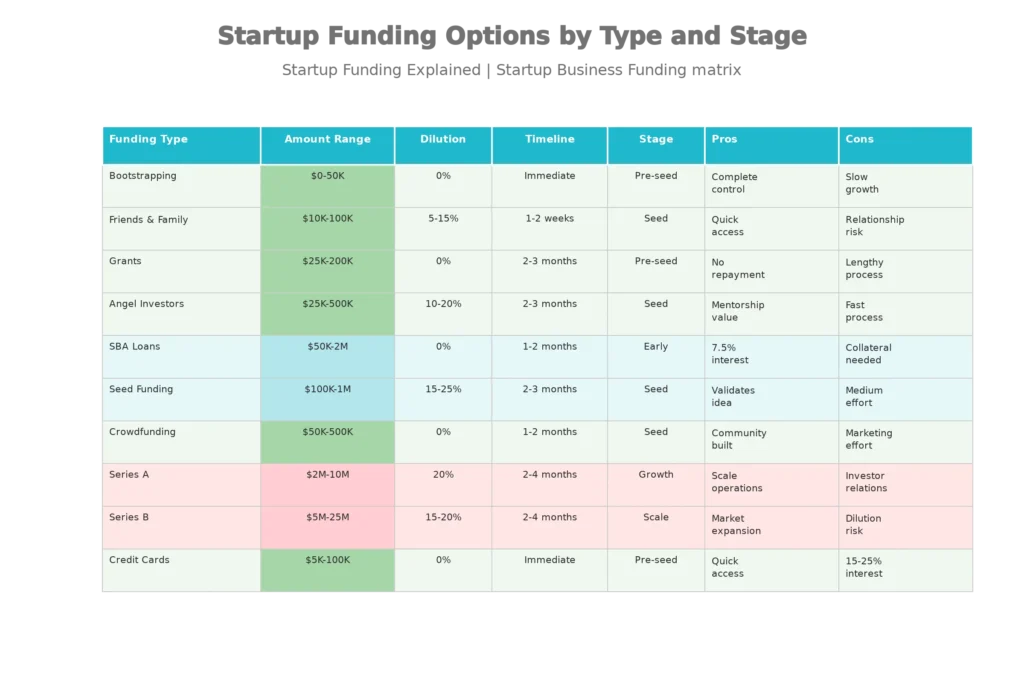
Startup Funding Explained – The Complete Picture π
Bootstrapping remains popular: Complete ownership, zero dilution, slow growth trajectory
Friends & Family rounds: $10K-100K, 5-15% dilution, relationship risks present
Angel investors provide: $50K-500K per check, mentorship value added, 10-20% dilution typical
SBA loans deliver: $50K-2M capital, 7.5% average interest, no equity dilution
Series funding escalates: Series A ($2M-10M), Series B ($5M-25M), Series C ($10M-50M+)
Understanding Startup Business Funding: The Complete Financing Landscape
Startup business funding explainedΒ requires understanding thatΒ different business stages demand different capital sources. Pre-seed entrepreneurs face vastly different options than Series B companies scaling aggressively.
Pre-Seed Stage: Building The Foundation
Bootstrapping Your Startup:Β π¨
Bootstrapping means growing your business using personal savings and revenueβeliminating external pressure while maintaining complete ownership and control. This approach demands personal financial sacrifice but develops disciplined financial habits essential for sustainable growth.
Key advantages of bootstrapping include:
Zero equity dilution: Retain 100% ownership throughout
No external pressure: Growth pace controlled entirely by founder
Genuine product-market fit validation: Only launch products customers pay for
Survival mentality: Efficiency becomes cultural imperative
However,Β bootstrapped startups grow 40-60% slower than funded competitors. Time-to-market matters significantly in competitive markets, sometimes making this path disadvantageous.
Friends & Family Rounds:Β π₯
Raising $10K-100K from personal network represents the next logical step. This source combines trust-based access with manageable capital for MVP development and market testing.
Critical best practices for friends & family:
Formalize agreements legally: Written contracts prevent relationship damage
Be transparent about risks: Help investors understand startup failure likelihood (90% fail)
Document investment terms clearly: Specify equity percentage, vesting schedules
Maintain regular communication: Quarterly updates build confidence
Seed Stage: Validating The Concept
Angel Investors & Early-Stage Capital:Β β
Angel investors typically write $25K-500K checks to startups with proven concepts. These individuals combine capital with mentorship, industry connections, and valuable experience.
Angel investor characteristics:
Check sizes: $50K-250K typical range
Dilution impact: 10-20% equity stake standard
Timeline to funding: 2-3 months average
Added value: Mentorship, connections, follow-on funding
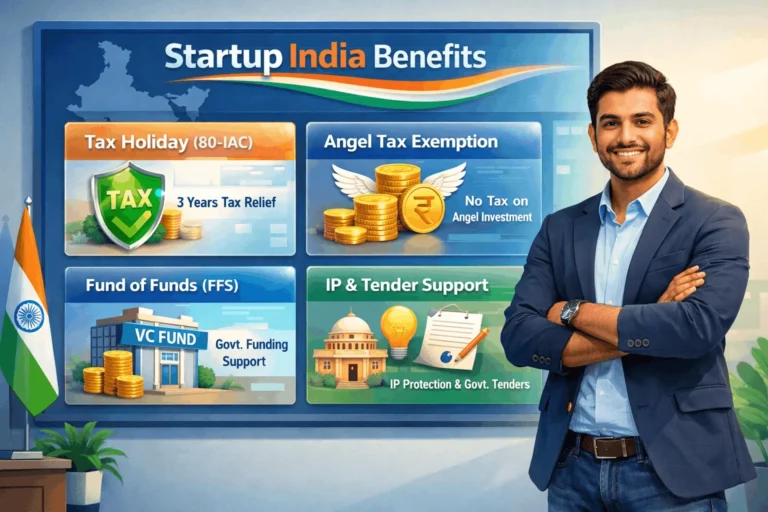
According to Startup India guidelines,Β angels represent critical bridge capital between friends & family and institutional venture investors.
Grants & Competitions:Β π
Grants provide non-dilutive capitalβfunds requiring no repayment and no equity surrender. Business plan competitions, government startup programs, and corporate grants collectively distribute hundreds of millions annually.
Funding grant characteristics:
Average amounts: $25K-200K per grant
Dilution: Zero percentβretain complete ownership
Repayment: None required (true gift)
Effort required: Extensive application and reporting
Competition: Often highly competitive (1-5% acceptance rates)
Startup India’s grant programs have investedΒ βΉ1000+ crores directly supporting early-stage entrepreneurs.

- Subscribe Now This product has multiple variants. The options may be chosen on the product page
- USD: $ 99.98
- Subscribe Now This product has multiple variants. The options may be chosen on the product page
- Select options This product has multiple variants. The options may be chosen on the product page
- USD: $ 749.98 - $ 4,916.65
- Subscribe Now This product has multiple variants. The options may be chosen on the product page
- USD: $ 6.65
- Select options This product has multiple variants. The options may be chosen on the product page
- USD: $ 8.32 - $ 83.32
- Subscribe Now This product has multiple variants. The options may be chosen on the product page
Institutional Startup Business Funding: Venture Capital & Series Rounds Explained
Venture capital represents institutional capital enabling explosive growth at cost of equity dilution. Understanding series round mechanics proves essential for entrepreneurs pursuing venture-backed growth paths.
Series A: The Professional Investor Milestone
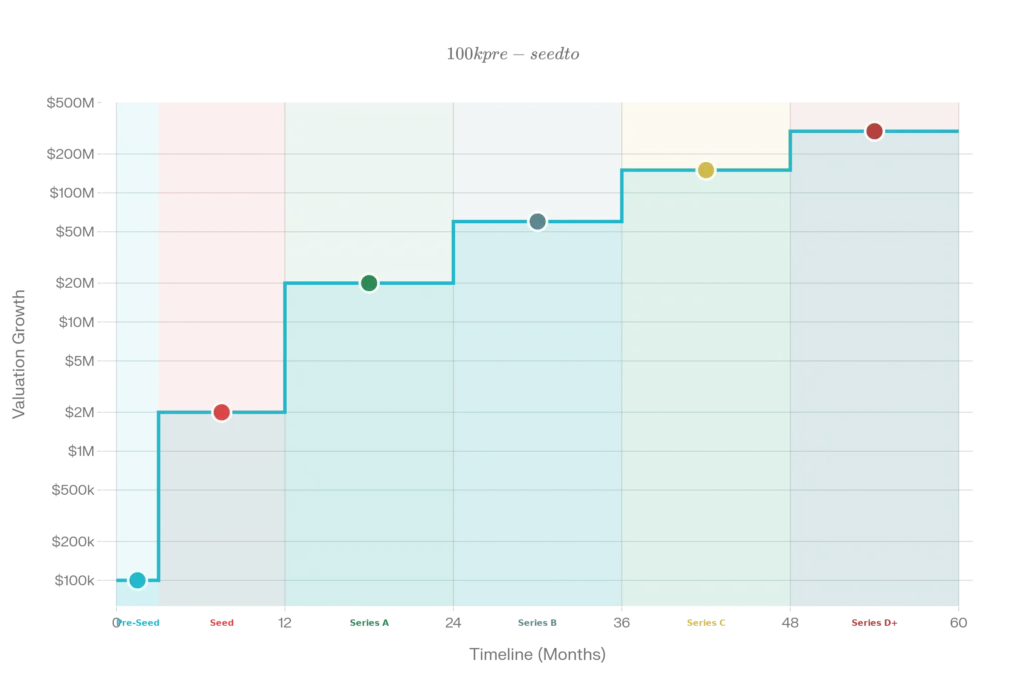
Series A funding marks transition from seed validation to serious scaling.Β Average Series A raises $9.3 million with 20% equity dilution.
Series A investment characteristics:
Capital amounts: $2M-10M typical range
Equity dilution: 15-25% common
Valuation: Often $8M-40M depending on metrics
Timeline to funding: 2-3 months from serious pitching
Required metrics: Consistent revenue growth, clear product-market fit
Series A is genuinely competitiveβonly 48% of seed-funded startups successfully raise Series A in 2025. Success requires:
$50K+ monthly recurring revenueΒ (or equivalent growth metrics)
Clear competitive advantageΒ differentiating from alternatives
Experienced founder teamΒ with relevant domain expertise
Growth trajectory demonstrating 10%+ monthly growthΒ minimum
Series B: Scaling Into New Markets
Series B focuses on expanding successful business models into new markets or customer segments.Β Average Series B raises $21 million with companies typically valued $60M-120M.
Series B investment characteristics:
Capital amounts: $5M-25M typical
Equity dilution: 15-20% additional dilution
Typical use of funds: Geographic expansion, new product lines, team scaling
Required metrics: $100K+ monthly recurring revenue, strong retention
Investor type: Growth-focused VCs with scale expertise
Notable case study:Β Brex raised $57 million in Series B (2024) specifically to expand financial product offerings and double engineering team within 12 months.
Series C & Beyond: Late-Stage Growth Capital
Series C represents final venture capital stage before IPO or strategic acquisition.Β Average Series C raises $26 million with valuations typically exceeding $100M.
Series C investment characteristics:
Capital amounts: $10M-50M+ typical
Valuation: $100M-500M+ (“unicorn” territory)
Investor type: Late-stage VCs, growth equity firms
Use of funds: International expansion, acquisitions, R&D
Timeline pressure: Clear path to profitability or IPO required
According to Crunchbase data,Β 72% of Series C startups in 2025 actively pursued global expansion.
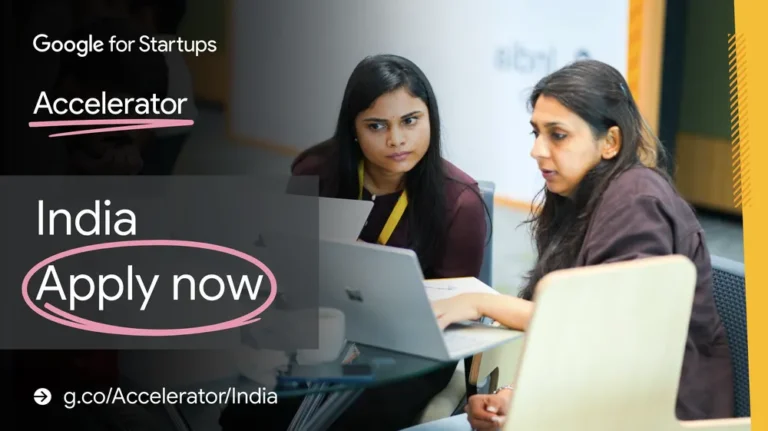
Google for Startups Accelerator: India β AI-First 2026 Cohort
Accelerating AIβFirst Indian Startups + Google for Startups (Google LLC)
₹29,225,000.00- Prototype Stage, MVP Stage, Early Revenue Stage
- April 19, 2026

Google for Startups Accelerator: India β AI-First 2026 Cohort
Accelerating AIβFirst Indian Startups + Google for Startups (Google LLC)
₹29,225,000.00- Prototype Stage, MVP Stage, Early Revenue Stage
- April 19, 2026
IHFCβARTPARKβSiemens Healthineers MedTech Call for Proposals 2026
IHFC (I-Hub Foundation for Cobotics), ARTPARK, Siemens Healthineers
₹20,000,000.00- Prototype Stage, MVP Stage, Early Revenue Stage, Growth Stage
- April 30, 2026
Alternative Startup Funding Options: Beyond Venture Capital
Startup business funding extends far beyond traditional venture capital routes. Smart founders evaluate alternative financing options that preserve equity while accessing needed capital.
Debt-Based Financing: Loans & Credit Solutions
SBA Loans: Traditional But Accessible:Β π
Small Business Administration loans provide $50K-2M capital at approximately 7.5% interest with partial government guarantees. These loans feature extended repayment periods (7-10 years typical) reducing monthly payment burden.
SBA loan characteristics:
Interest rates: Currently 7.5% average (2025)
Loan amounts: $50K-$2M typical
Approval timeline: 1-2 months standard
Equity dilution: Zero percentβmaintain complete ownership
Collateral requirements: Personal guarantee and business assets
Application complexity: Extensive documentation required
According to SBA data,Β over $30 billion in SBA 7(a) loans were disbursed in 2024, with technology and healthcare startups among top recipients.
Advantages:Β No dilution, predictable repayment schedule, government backing reduces lender risk
Disadvantages:Β Lengthy application process, requires credit history, personal guarantee needed
Equity-Light Funding: Creative Capital Solutions
Crowdfunding: Validated Products & Community Building:Β π
Crowdfunding platforms enable startups to raise $50K-500K while simultaneously validating products and building customer communities.
Crowdfunding characteristics:
Capital raised: $50K-500K typical range
Dilution: Zero percentβno equity given
Timeline: 45-60 days campaign duration
Added value: Pre-sales, market validation, community engagement
Success rates: 37-40% of campaigns reach funding targets
Notable example:Β Pebblebee (tracking device startup) raised $1.2 million on Kickstarter in 2024, validating product demand before pursuing venture capital.
Revenue-Based Financing: Growth Without Dilution:Β π΅
Revenue-based financing (RBF) provides capital repaid through percentage of monthly revenue (typically 3-10% until cap reached).
RBF characteristics:
Capital amounts: $50K-$1M typical
Repayment: 3-10% of monthly revenue until cap ($150K-$500K total)
Dilution: Zero percent equity
Timeline: 2-3 weeks funding
Best for: SaaS, subscription services, e-commerce businesses
Comparison Table: Startup Business Funding Options
| Funding Type | Capital Range | Dilution % | Timeline | Best Stage | Interest/Cost |
|---|---|---|---|---|---|
| Bootstrapping | $0-50K | 0% | Immediate | Pre-seed | 0% |
| Friends & Family | $10K-100K | 5-15% | 1-2 weeks | Seed | 0-5% |
| Angel Investors | $50K-500K | 10-20% | 2-3 months | Seed | 0% |
| SBA Loans | $50K-2M | 0% | 1-2 months | Early | 7.5% |
| Crowdfunding | $50K-500K | 0% | 45-60 days | Seed | 0% |
| Series A | $2M-10M | 15-25% | 2-4 months | Growth | 0% |
| Series B | $5M-25M | 15-20% | 2-4 months | Expansion | 0% |
| Revenue-Based | $50K-1M | 0% | 2-3 weeks | Revenue-stage | 5-10% revenue |

Conclusion: Strategic Startup Funding Requires Matching Capital to Growth Stage π―
Startup funding explainedΒ ultimately reduces to matching financing source to specific business stage and founder circumstances.Β Bootstrapping works for lifestyle businesses prioritizing independence; venture capital accelerates market dominance but demands growth obsession and dilution acceptance.
Most successful founders employ hybrid approachesβcombining bootstrapping savings with angel capital (seed), then transitioning to venture capital (Series A+) once product-market fit validates. This sequencing minimizes early dilution while preserving founder equity through early stages.
Key decision matrix for startup business funding:
Do you value speed over equity retention?Β β Choose venture capital
Do you require $500K+ immediately?Β β Pursue angels or Series A
Do you want complete ownership long-term?Β β Bootstrap or crowdfund
Is debt service manageable with current revenue?Β β Consider SBA loans
Do you have strong product-market fit proof?Β β Accelerate Series A timeline
AtΒ StartupMandi, we recognizeΒ startup funding explainedΒ requires expert navigation balancing growth ambitions with equity preservation.Β Explore our comprehensive funding strategy playbookΒ covering fundraising pitch optimization, investor targeting, and term sheet negotiation.Β Discover our detailed guide to Indian startup grants and government fundingΒ maximizing non-dilutive capital access.
For entrepreneurs ready to fund growth strategically,Β startup business fundingΒ success demands clarity about personal goals, market opportunity, and founder circumstances.Β Visit our complete fundraising roadmapΒ walking through each funding stage with specific action items.Β Connect with our startup funding advisorsΒ developing customized financing strategies aligned with your business model and growth ambitions.
Disclaimer
This blog content provides informational and educational insights about startup business funding options. It should not be considered financial or investment advice. All funding decisions involve substantial risk, including potential loss of capital. Founders should consult with qualified financial advisors, accountants, and legal professionals before making funding decisions. Past fundraising success does not guarantee future results. Due diligence on all funding sources is essential.
Frequently Asked Questions About Startup Funding Explained
Q1: Which startup funding option should I choose first as a brand-new entrepreneur?
Start with bootstrapping and friends & family ($0-100K total). This preserves equity, validates product-market fit, and creates proof points attractive to angel investors. Only pursue angel or Series A capital after demonstrating meaningful traction.
Q2: How much equity should I expect to give up in my first funding round?
Friends & family typically take 5-15% equity.Β Angel investors expect 10-20%.Β Series A typically dilutes founders 20%, meaning founders retain 80% post-investment (from personal 100%). Subsequent rounds dilute existing shareholders proportionally.
Q3: What’s the realistic timeline from startup idea to Series A funding?
Typical timeline spans 12-24 months. Six months developing MVP, validating concept; 6-12 months achieving measurable traction; 2-3 months securing Series A. Fast-track companies achieve this in 9-12 months; slower paths extend 24+ months.
Q4: Can I raise startup funding without venture capitalβstaying completely bootstrapped?
Absolutelyβmany successful startups remain bootstrapped indefinitely. Bootstrapped founders prioritize profitability over growth, typically reaching $1M+ revenue with 3-5 year timelines. However, VC-backed competitors often outpace bootstrapped companies in market capture.
Q5: What metrics do investors actually review when evaluating startup business funding requests?
Investors focus on: monthly recurring revenue (MRR) growth (target 10%+ monthly), customer acquisition cost (CAC), customer lifetime value (LTV), churn rate (target <5% monthly), burn rate, and runway remaining. Beyond metrics,Β founder experience, market size, and competitive positioning drive decisions.
Referring Blog / Fact Source
- Startup India: Official Government Funding Guide and Resources
- Startups.com: 5 Types of Startup Funding Explained Comprehensively
- Qubit Capital: Different Fundraising Options For Your Startup
- Crunchbase: Venture Capital Funding Data and Market Analysis
- Small Business Administration Loan Programs and Applications
Mariyam Bandookwala
i am a professional content writer with a strong focus on clarity, strategy, and audience engagementβhelping brands communicate smarter and grow faster.