

Search Engine Optimization (SEO) is how your website gets discovered on Google. Without it, your site remains invisible—even if your content is exceptional.
Most founders and small business owners don’t understand SEO because it seems complicated. Algorithm changes, Core Web Vitals, E-E-A-T, AI Overviews—the terminology alone confuses people.
But here’s the truth: SEO in 2026 isn’t magic. It follows clear rules that Google openly shares. This guide explains how SEO actually works, why it matters, and what changed in 2026 that beginners need to know.
By the end, you’ll understand exactly how your website ranks, how to optimize for AI and human readers, and why Core Web Vitals matter.
What Is Search Engine Optimization?
Search Engine Optimization (SEO) is the practice of improving your website’s visibility in organic (unpaid) search results.
When someone searches “best CRM software,” Google ranks websites by relevance and quality. SEO is how you make your site appear at the top.
Key difference:
- Paid search (Google Ads) = You pay per click
- Organic search (SEO) = Free traffic (but requires optimization)
Why SEO matters: Google processes 16.4 billion searches daily. That’s your potential audience. If you’re not ranking, you’re losing customers to competitors.
How Does Google Rank Websites? (Three Pillars of SEO)
Google’s ranking algorithm evaluates websites using three main categories:
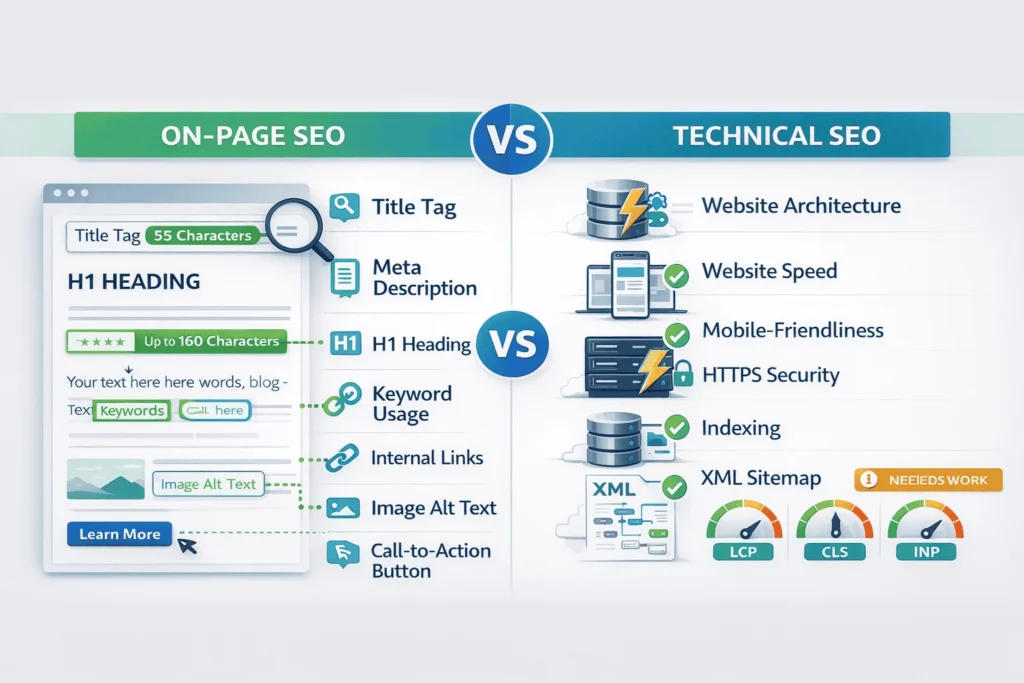
- On-page SEO (what’s on your page)
- Technical SEO (how your site is built)
- Off-page SEO (what others say about you)
What Is On-Page SEO?
On-page SEO = optimizing your content + HTML for search engines and humans.
Essential on-page elements:
- Title tags (55-60 characters, includes primary keyword)
- Meta descriptions (155 characters, natural keyword placement)
- H1 heading (one per page, matches page topic)
- Content quality (2000+ words, answers user questions completely)
- Keyword placement (natural, 1-2% keyword density)
- Internal linking (links to related pages on your site)
- Image alt text (describes images for search engines)
Example:
<title>How to Increase Website Traffic 300% [SEO Strategy]</title>
<meta name="description" content="Learn proven SEO techniques to increase website traffic by 300% in 6 months. Expert strategies used by 200+ companies.">
<h1>How to Increase Website Traffic Through SEO</h1>
Why it matters: Google uses these signals to understand what your page is about and whether it matches user intent.
What Is Technical SEO?
Technical SEO = optimizing how search engines crawl and index your website.
Critical technical elements:
- Site speed (target: <2.5 seconds load time)
- Mobile responsiveness (looks good on phones)
- Core Web Vitals (page experience metrics)
- SSL certificate (HTTPS security)
- URL structure (clean, readable URLs like
/blog/seo-guide) - XML sitemap (helps Google find all your pages)
- Robots.txt (tells Google which pages to crawl)
Core Web Vitals explained:
| Metric | What It Measures | Good Score | Why It Matters |
|---|---|---|---|
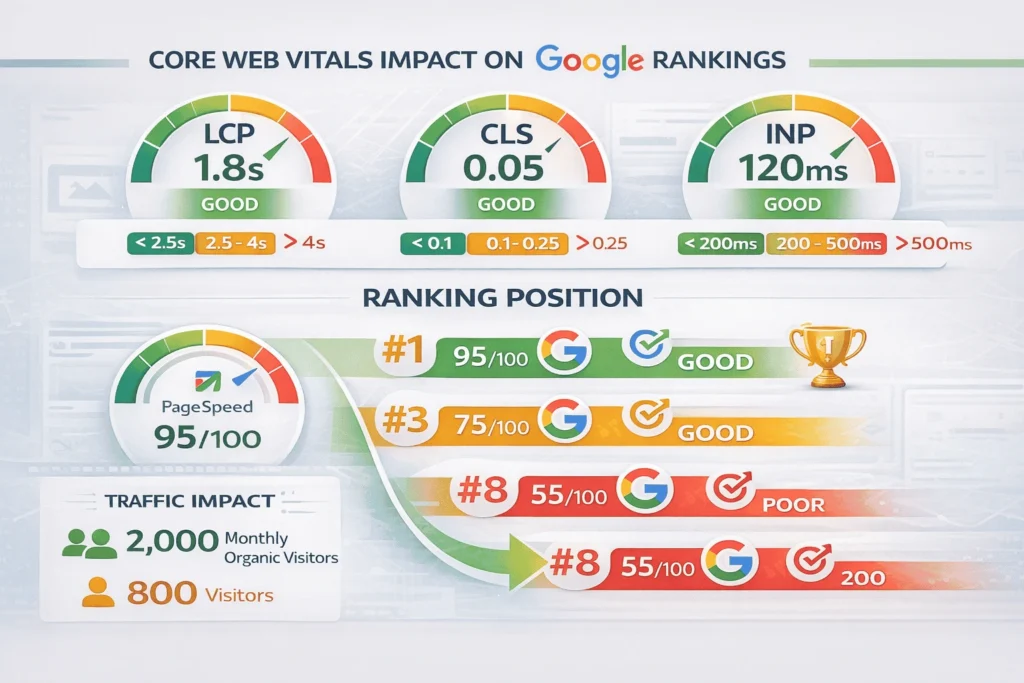
| LCP (Largest Contentful Paint) | How fast main content loads | <2.5 seconds | Page speed impacts rankings |
| CLS (Cumulative Layout Shift) | Layout stability while loading | <0.1 | Users hate pages that shift |
| INP (Interaction to Next Paint) | How responsive page is to clicks | <200ms | Measures user interaction smoothness |
“Pages ranking at position 1 are 10% more likely to pass Core Web Vitals,” according to 2026 ranking data.
What Is Off-Page SEO?
Off-page SEO = what other websites say about you (mainly backlinks and brand mentions).
Key off-page factors:
- Backlinks (links from other sites pointing to yours—vote of confidence)
- Brand mentions (websites mention your brand by name)
- Social signals (shares, likes, engagement on social media)
- Digital PR (media coverage, press releases)
- Third-party citations (reviews, directories, Wikipedia mentions)
Important in 2026: AI tools like ChatGPT rarely link directly to brand websites. Instead, they cite third-party sources and reviews. This means digital PR and third-party mentions matter more than traditional backlink building.
What Changed in SEO in 2026?
Three major shifts:
- Multi-Format Results – Google now ranks videos, images, AI Overviews, and traditional blogs. Text-only strategy fails.
- E-E-A-T Foundation – Google prioritizes Experience, Expertise, Authority, Trustworthiness. Generic AI blogs rank zero.
- AI Search Integration – ChatGPT, Perplexity, Claude pull from your site. Optimizing for AI understanding matters as much as Google ranking.
What Is E-E-A-T and Why It Matters in SEO?
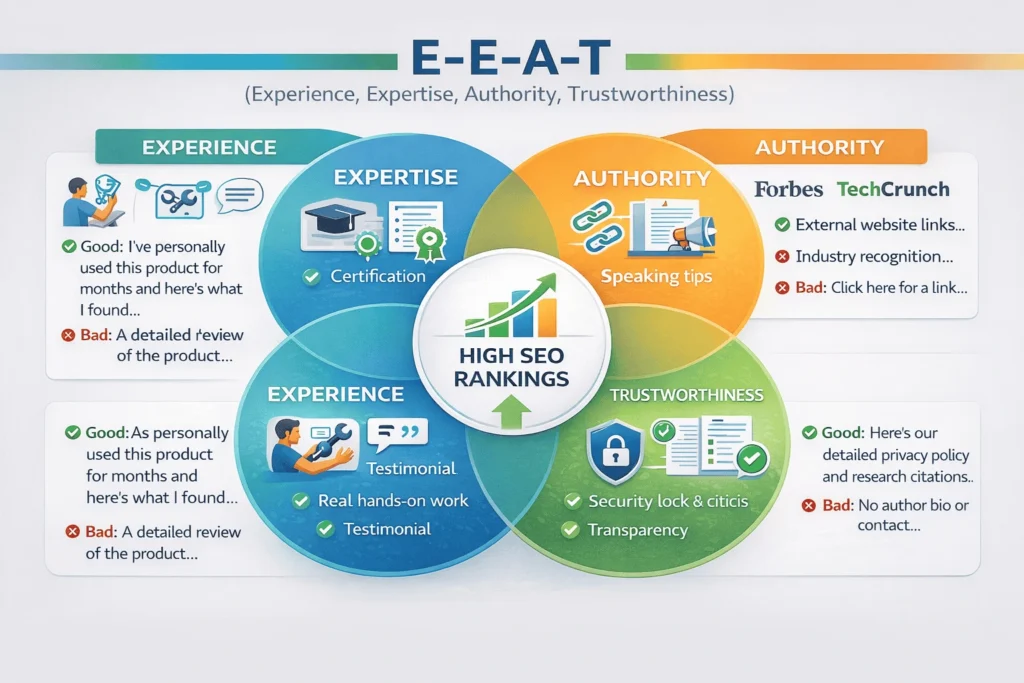
E-E-A-T = Experience, Expertise, Authority, Trustworthiness.
Google uses these signals to determine if your content deserves visibility.
Google evaluates:
- Experience – Did you actually use/do this? (Real experience beats theory)
- Expertise – Do you have credentials or deep knowledge?
- Authority – Do other respected sites recognize you as expert?
- Trustworthiness – Can users trust your content? (Transparency, citations, accuracy)
Example—Bad E-E-A-T vs. Good E-E-A-T:
| Bad E-E-A-T | Good E-E-A-T |
|---|---|
| “How to Start a Consulting Business” (written by someone who’s never consulted) | “How to Start a Consulting Business” (written by founder with 10+ years experience, published in Harvard Business Review) |
| Generic advice, no personal examples | Real client case studies, measurable results |
| No author bio or credentials | Author photo, credentials, third-party recognition |
E-E-A-T is foundational. Now let’s explain the technical ranking process.
How Does Google’s Ranking Algorithm Actually Work?
Google ranks websites through four main steps:
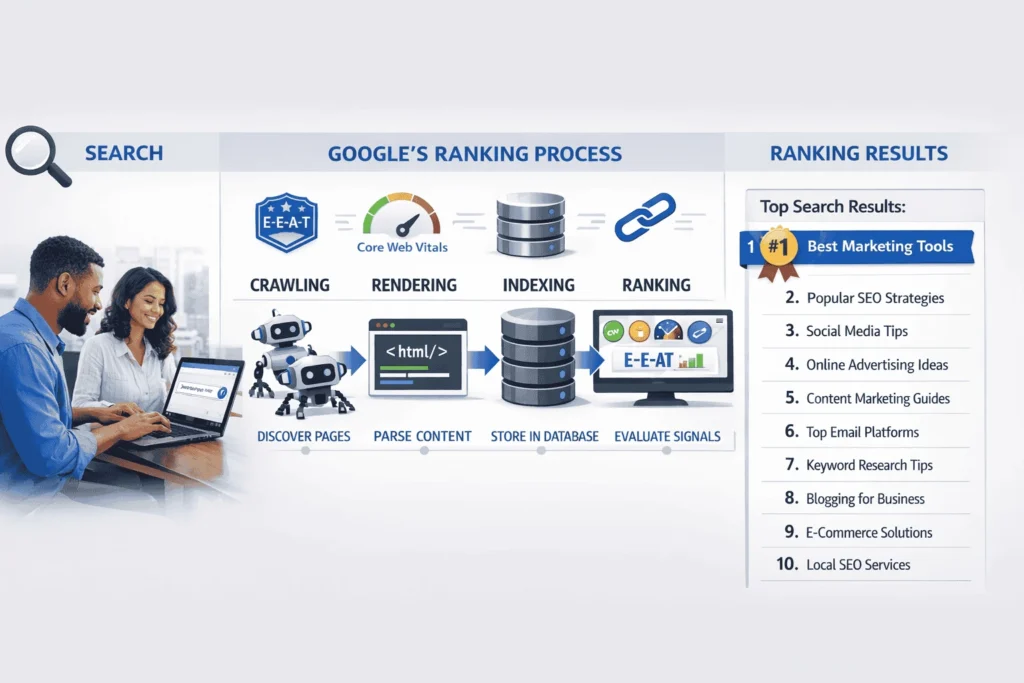
Step 1: Crawling – Google’s robots (crawlers) discover pages by following links and sitemaps.
Step 2: Rendering – Google analyzes HTML, CSS, and JavaScript to understand how the page looks.
Step 3: Indexing – Google stores the page in its database if it’s relevant and original.
Step 4: Ranking – Google’s algorithm evaluates 200+ signals to rank pages by relevance and quality.
Key ranking signals (in order of importance):
- Content relevance (does your content match search intent?)
- E-E-A-T signals (expertise, authority, trustworthiness)
- Backlinks and authority (do respected sites link to you?)
- Core Web Vitals (page speed and user experience)
- Click-through rate (CTR) (do users click your result?)
- Dwell time (do users stay on your page?)
- Mobile-friendliness (does it work on phones?)
Important: Core Web Vitals act as a “tiebreaker”. If two pages have equal content quality, the faster page ranks higher. Poor Core Web Vitals won’t destroy your rankings, but they prevent great content from reaching full potential.
What Are SEO Ranking Factors in 2026?
Complete list of factors Google considers:
Content Factors (40% of rankings):
- Relevance to search query
- Content length (2000+ words typically ranks better)
- Topic coverage depth
- Freshness (recent updates)
Authority Factors (30% of rankings):
- Backlinks from trusted sites
- Domain age and history
- Author credentials
- E-E-A-T signals
User Experience Factors (20% of rankings):
- Core Web Vitals (LCP, CLS, INP)
- Mobile-friendliness
- Bounce rate (do users leave immediately?)
- Average time on page
Technical Factors (10% of rankings):
- Site speed
- SSL certificate (HTTPS)
- Clean URL structure
- XML sitemap
How Does AI Change SEO in 2026?
AI is reshaping SEO in two critical ways:
1. Search Engines Use AI to Rank – Google now uses AI (RankBrain, Helpful Content System) to understand semantic meaning and user intent rather than just keywords.
2. AI Platforms Need Optimization – ChatGPT, Perplexity, Claude pull from your website. You must optimize for AI understanding, not just Google ranking.
What changed:
- Before: Rank high on Google, get traffic
- Now: Rank high on Google AND get cited by AI platforms = 2x traffic
How to optimize for AI:
- Clear structure (H2s, H3s, numbered lists)
- Direct answers first (not buried in paragraphs)
- Schema markup (helps AI understand your content)
- Third-party citations (AI trusts outside sources)
Real impact: AI tools often cite Wikipedia, expert sources, and authority sites instead of the original brand. This means building brand mentions on reputable sites matters more than backlinks.
How SEO Drives Business Results
SEO traffic is high-value because users are actively searching for your solution:
Comparison: SEO vs. Paid Ads
| Factor | SEO (Organic) | Paid Ads (Google Ads) |
|---|---|---|
| Cost per click | $0 | $2-$5+ per click |
| Conversion rate | 2-5% (qualified traffic) | 1-3% (less qualified) |
| Long-term ROI | Compounds over time | Stops when ads stop |
| Trust factor | Higher (organic = credible) | Lower (users skip ads) |
Real example: Rank #1 for “best project management tools” = 10,000+ monthly visitors. At 3% conversion rate = 300 qualified leads = $150,000+ revenue (assuming $500 per customer).
Step-By-Step: How to Start with SEO
Getting Started with Search Engine Optimization
Times Needed: 10 Days, 8 Hours, 15 Minutes
Estimated Cost: $0-$500 USD (free tools exist; premium tools optional)
Description: Complete beginner’s guide to implementing basic SEO on your website. Covers keyword research, on-page optimization, technical SEO setup, and first month monitoring. Designed for non-technical founders and small business owners.
Steps:
Step 1: Research Your Target Audience and Keywords (2 hours)
Understand who your customers are. Search Google for your business type + “how to” or “best” to see what people look for. Use Google Keyword Planner (free) to find monthly search volume and competition level. Select 5-10 target keywords with decent volume (100+ searches/month) and low-medium competition.
Step 2: Optimize Your Homepage for Your Primary Keyword (3 hours)
Write a compelling title tag (55-60 chars, keyword first). Write meta description (155 chars, natural keyword). Create H1 heading matching your title. Write 2000+ words answering the main user question completely. Add internal links to other relevant pages. Include schema markup (RankMath plugin adds automatically).
Step 3: Create Cornerstone Content (6-8 hours)
Write one 2500+ word guide covering your main topic comprehensively. Example: “Complete Guide to Project Management Tools 2026.” Optimize for primary keyword. Include original data, case studies, expert quotes. Build internal linking structure around this content (link 5-10 related pages to it).
Step 4: Set Up Technical SEO Foundations (2 hours)
Install WordPress (if not using it already). Choose lightweight theme (GeneratePress, Astra). Install RankMath SEO plugin. Generate XML sitemap (automatic). Enable SSL certificate (free via Let’s Encrypt). Test mobile responsiveness using Google Mobile-Friendly Test. Set up Google Search Console and Google Analytics.
Step 5: Improve Core Web Vitals (3-4 hours)
Optimize images (compress with TinyPNG, use WebP format). Enable caching (WP Rocket or free alternatives). Minimize CSS/JavaScript. Test load time with Google PageSpeed Insights. Target LCP <2.5s, CLS <0.1, INP <200ms. Fix any Core Web Vitals failures (usually image-related).
Step 6: Build Your E-E-A-T Signals (ongoing)
Add author bio with credentials. Link to your LinkedIn/professional profile. Cite authoritative sources in your content. Get featured in industry publications (digital PR). Build backlinks through guest posting. Collect customer testimonials and case studies.
Step 7: Monitor Rankings and Iterate (weekly)
Track your 5-10 target keywords in Google Search Console (free). Monitor Core Web Vitals. Measure organic traffic in Google Analytics. A/B test title tags and meta descriptions. Add new content monthly around related keywords.
Tools Name:
- RankMath (free SEO plugin)
- Google Search Console (free ranking/click monitoring)
- Google PageSpeed Insights (free speed testing)
Materials Name:
- List of target keywords (spreadsheet)
- Your expertise/credentials (for author bio)
- Industry sources and data (for citations)
FAQ: SEO Basics for Beginners
3-6 months is typical for new sites. Mature sites (6+ months old) may see results in 4-8 weeks. Google needs time to crawl, index, and rank your pages. E-E-A-T signals take longer to build (months/years).
Absolutely. DIY SEO works if you follow the framework: keyword research → on-page optimization → technical SEO → Core Web Vitals → build E-E-A-T. Tools like RankMath make it accessible. Agencies accelerate results but aren’t required for small businesses.
Yes, but differently. The traditional “build 100 backlinks” strategy is outdated. What matters: quality (do respected sites link to you?) and relevance (do they link from similar topics?). AI tools increasingly prioritize brand mentions and third-party citations over backlinks.
Less important than before, but still foundational. Google now understands intent and semantic meaning rather than just keywords. You don’t need to stuff keywords. Focus on answering the user’s actual question thoroughly, and keywords naturally follow.
SEO = organic (free) traffic. SEM = paid ads (Google Ads). SEO takes longer but compounds over time. SEM drives immediate clicks but costs money. The best strategy combines both: use paid ads while building organic SEO.
Track these metrics in Google Analytics:
Organic traffic (number of visitors from Google)
Ranking position (are your keywords ranking higher?)
Conversion rate (what % of visitors convert?)
Click-through rate (CTR) (what % click your result from Google?)
Improving any of these = working strategy.
Not if done right. AI-generated first drafts + human editing = good results. Pure AI content with no human input = zero rankings. Google detects unoriginal, generic AI. Winning formula: AI for speed + human for expertise and originality.
Same fundamentals as Google SEO. Optimize for clarity, citation, and E-E-A-T. AI tools cite third-party sources more than brand websites, so focus on getting your content mentioned in reputable sources, reviewed on authority sites, featured in publications.
Key Takeaways
- SEO = making your website discoverable on Google. Without it, great content remains invisible.
- Three pillars of SEO: On-page (content + HTML), Technical (speed + structure), Off-page (backlinks + brand mentions).
- Core Web Vitals matter as a tiebreaker. When content quality is equal, faster pages rank higher. LCP <2.5s, CLS <0.1, INP <200ms.
- E-E-A-T is the foundation. Google prioritizes Experience, Expertise, Authority, and Trustworthiness over keyword stuffing.
- Content quality > keyword density. Write 2000+ word answers to real user questions. Keywords naturally follow.
- Multi-format content is now required. Blogs + videos + images + structured data = visibility.
- AI changed the game in 2026. Optimize for both Google AND AI platforms (ChatGPT, Perplexity). Third-party mentions matter more than backlinks.
- SEO compounds over time. Month 1: no results. Month 6: 50+ visitors/day. Year 1: 1000+ visitors/day.
- Measure everything. Track organic traffic, rankings, and conversion rate in Google Analytics and Search Console.
- DIY SEO is possible. Follow the framework (keyword research → on-page → technical → E-E-A-T building), use free tools, and monitor results.
Next Steps
Ready to start your SEO journey? Here’s your immediate action plan:
- Download a list of your top 10 target keywords using Google Keyword Planner (free). Focus on keywords with 100+ monthly searches and low-medium competition.
- Optimize your homepage – Write a compelling title tag and meta description for your primary keyword. Increase content to 2000+ words addressing the full question.
- Set up Google Search Console (free) to monitor your keywords, click-through rates, and rankings. Link your sitemap.
- Test your Core Web Vitals with Google PageSpeed Insights. If scores are below 70, optimize images and enable caching.
- Read our complete guide to AI SEO tools to accelerate your SEO with automation.
- Explore pro SEO tips for unlimited clicks to optimize your click-through rate and attract more visitors.
Conclusion
Search Engine Optimization isn’t magic or mystery—it’s a systematic process with proven rules.
Google’s algorithm prioritizes relevance, authority, user experience, and trustworthiness. When you optimize for these factors, rankings follow.
In 2026, successful SEO requires understanding four things:
- How Google ranks content (content relevance + E-E-A-T + authority)
- How to optimize on-page elements (titles, descriptions, headers)
- How to improve technical performance (Core Web Vitals, speed)
- How to build authority (backlinks, brand mentions, third-party citations)
The compound effect is powerful: Rank position 1 for your primary keyword = 10,000+ monthly visitors → 300+ qualified leads → $150,000+ annual revenue (assuming $500 average customer value).
Start this week. Research keywords. Optimize your homepage. Set up Google Search Console. Improve your Core Web Vitals. Build E-E-A-T signals.
Follow StartupMandi for more SEO strategies, AI tools, and growth guides. We’re committed to helping startups and small businesses build sustainable, profitable organic growth.
Resources for SEO Learning
Keyword Research & Planning:
- Google Keyword Planner – Free keyword research tool
- AnswerThePublic – Visualize what people search for
- Google Search Console – Free ranking and click monitoring
SEO Tools:
- RankMath – Free SEO plugin (WordPress)
- Yoast SEO – Beginner-friendly SEO plugin
- Google PageSpeed Insights – Free Core Web Vitals testing
E-E-A-T & Content:
- Google’s SEO Starter Guide – Official Google SEO documentation
- Search Engine Land – SEO news and best practices
- Moz Guide to SEO – Comprehensive SEO education
Analytics & Monitoring:
- Google Analytics 4 – Free traffic analytics
- GTmetrix – Advanced performance testing
- Semrush – Rank tracking and competitive analysis
About StartupMandi
StartupMandi helps founders and small business owners master SEO and organic growth. Our resources include:
- SEO guides and strategies for startups
- AI SEO tools reviews (save time automating SEO)
- Organic growth consulting (custom strategies for your business)
- Content and technical SEO audits (identify your biggest opportunities)
Explore our AI SEO tools guide to automate your keyword research, content optimization, and performance monitoring—cutting SEO work from 40 hours/week to 5 hours.
Follow StartupMandi for weekly SEO tips, case studies, and strategies proven to drive organic growth for startups.