


Smart Ways to Evaluate Investments
How to Evaluate Investment Options is a core skill for anyone who wants returns without constant anxiety. When you follow a structured framework, you stop guessing, and you start testing every stock, mutual fund or startup pitch against clear, fact‑based criteria. Therefore, you can avoid hype, manage risk better and build a portfolio that actually matches your goals.
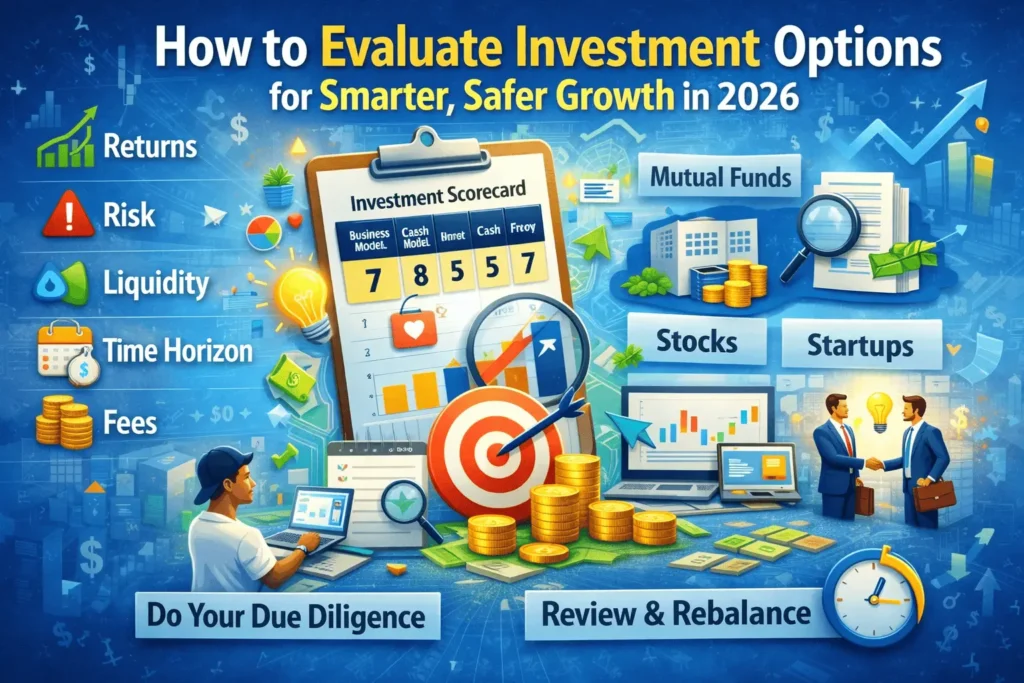
Understand return, risk, liquidity, time horizon and fees before investing.
Use simple filters: business model, cash flows, track record, management and valuation.
Compare options with a small scoring table instead of gut feeling alone.
Run basic due diligence for mutual funds, listed stocks and private deals separately.
Review investments regularly so every option still fits your plan, not just your hopes.
How to Evaluate Investment Options: first principles
Before you dive into ratios or pitch decks, you must get the foundations right. How to Evaluate Investment Options always starts with understanding what you need and what each product is designed to do.
Clarify Goals, Risk and Time horizon
Any framework on how to Evaluate Investment Options begins with three questions:
- What is the goal
- When is the money needed
- How much volatility can you tolerate?
Short‑term goals like an emergency fund demand low‑risk, highly liquid instruments such as liquid funds or bank deposits. However, long‑term goals such as retirement or a 10‑year startup fund can take more volatility through equity funds, direct stocks or alternative assets.
If you skip this step, even a “good” investment can feel wrong because it swings more than your nerves allow.
Map the option: return, risk, liquidity, cost
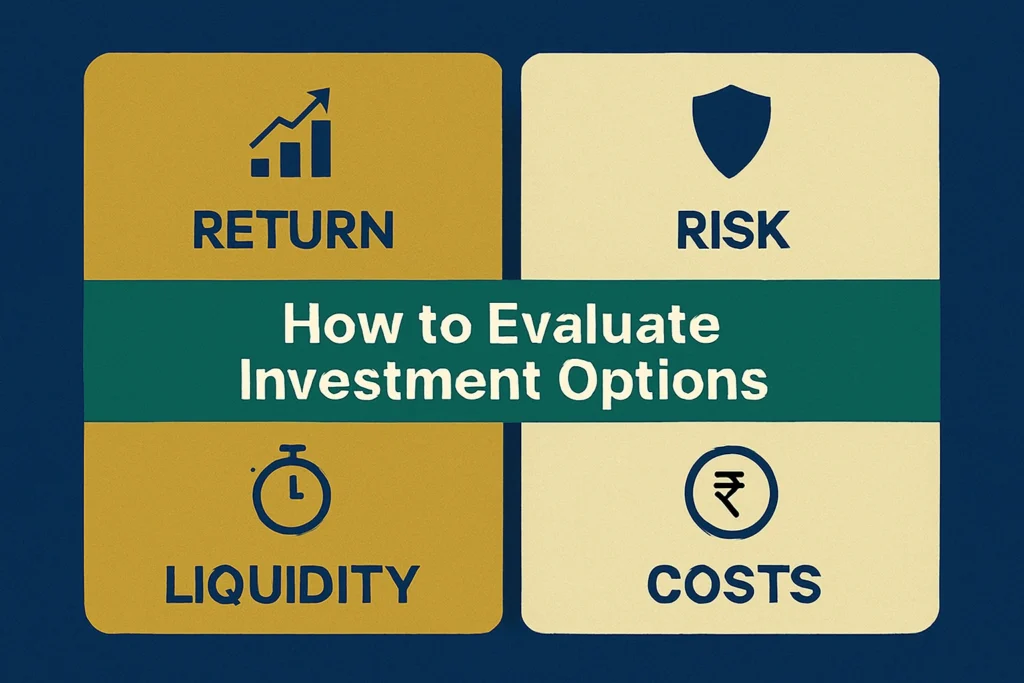
The next pillar in Smart Investment Analysis is mapping each product on four axes: expected return, risk, liquidity and cost.
Return: historical performance and realistic forward expectations, not promises.
Risk: volatility, drawdowns and probability of permanent loss.
Liquidity: how quickly and cheaply you can exit.
Cost: expense ratios, brokerage, carry, success fees and hidden charges.
Professional guides recommend writing these factors down in a simple table before committing money. This small habit upgrades Smart Investment Analysis from emotional to analytical.
A simple comparison example:
| Option type | Return potential | Risk level | Liquidity | Typical costs |
|---|---|---|---|---|
| Bank FD | Low | Low | High | Very low |
| Equity mutual fund | Medium–High | Medium–High | High (T+2) | Expense ratio 0.5–2% |
| Early‑stage startup | Very High / 0 | Very High | Very low | Fees / equity dilution |
How to Evaluate Investment Options: listed markets and mutual funds
Most investors start with mutual funds, ETFs and listed stocks. Because these markets are regulated and data‑rich, learning how to Evaluate Investment Options here is easier.
Evaluating mutual funds and ETFs
When you learn how to Evaluate Investment Options in mutual funds, focus on process, not just past return.
Key checks for funds:
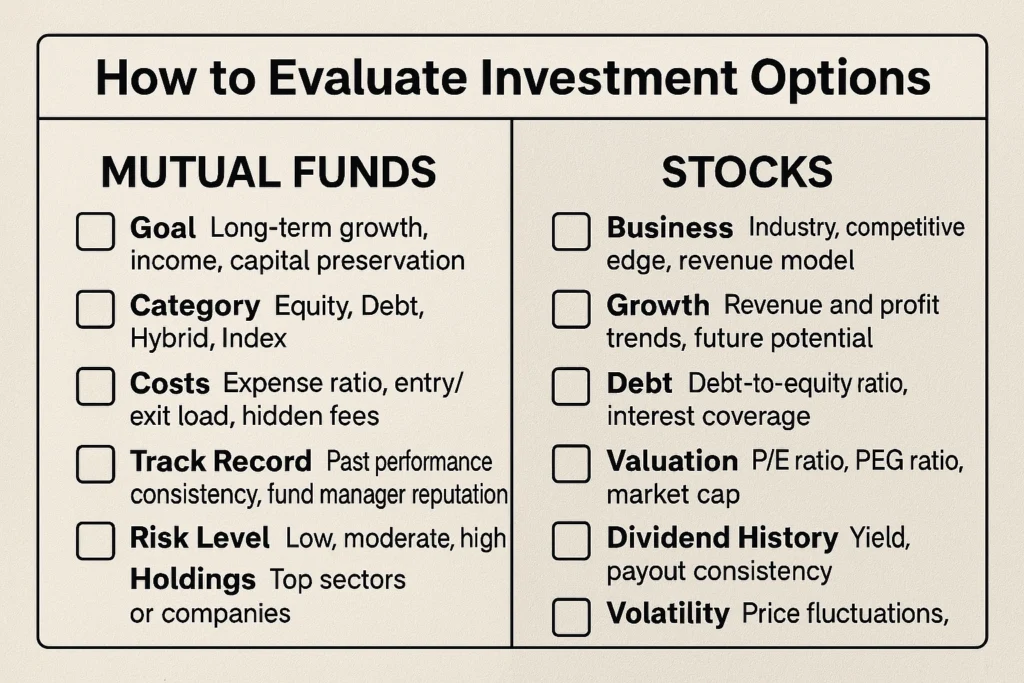
Category and benchmark: does it match your goal and risk profile?
3–5 year performance versus benchmark and peers, not just 1‑year spikes.
Expense ratio, exit load and turnover, because costs compound too.
Portfolio quality: diversification, sector concentration, credit quality in debt funds.
Because SEBI has standardised categories and disclosure norms, Indian investors can compare fund fact sheets more easily now. This transparency makes how to Evaluate Investment Options more straightforward at the fund level.
Evaluating stocks and listed businesses
For direct equity, every serious guide on how to Evaluate Investment Options suggests starting with the business, not the stock price. You can use a simple checklist:
What does the company actually do and how does it earn money?
Does it have durable competitive advantages or is it a commodity player?
Are revenues and profits growing consistently or erratically?
Is debt manageable relative to cash flows?
How does management allocate capital and treat minority shareholders?
Valuation is the last step, not the first. A “cheap” stock with weak business quality rarely stays cheap without reason. Therefore, how to Evaluate Investment Options in stocks always blends qualitative and quantitative work.
How to Evaluate Investment Options: startups, private deals and red flags
Founders and angel investors often deal with unlisted opportunities. Because these carry very high risk, your framework for how to Evaluate Investment Options must become stricter, not looser.
Framework for startup and private investments
Problem–solution fit: is the problem real and painful enough?
Market size and timing: is the addressable market large and growing now, not “someday”?
Business model and unit economics: how does each sale create profit eventually?
Team: do founders have execution track record and complementary skills?
Exit paths: what are realistic ways you could get liquidity?
Because most early‑stage deals fail, experts recommend position sizing carefully and diversifying, even if your conviction feels high.
Common red flags when you evaluate investment options
Learning how to Evaluate Investment Options also means knowing when to walk away. Finblog’s guide on evaluating opportunities lists several red flags:
Vague or unrealistic projections without assumptions.
Overly complex structures that you cannot explain in simple language.
Pressure tactics: “offer closes today”, “everyone big is already in”.
Lack of transparency about fees, lock‑ins, or use of funds.
If you cannot understand an investment clearly after reasonable effort, that itself is data. In practice, “too complicated to explain” often equals “too risky for my plan”.
To bring everything together, you can use a quick scoring grid when deciding how to Evaluate Investment Options across types:
| Factor | Weight | Public fund | Stock | Startup deal |
|---|---|---|---|---|
| Business / strategy clarity | 25% | 4 | 3 | 2 |
| Risk / downside | 25% | 4 | 3 | 1 |
| Return potential | 25% | 3 | 4 | 5 |
| Liquidity & time horizon | 15% | 4 | 3 | 1 |
| Costs & alignment | 10% | 3 | 4 | 2 |
Higher numbers are better within each column; weights reflect typical investor priorities. You can adjust them to match your own situation.
Conclusion: turning “How to Evaluate Investment Options” into a habit
How to Evaluate Investment Options becomes powerful only when it turns into a repeatable ritual, not a one‑time course.
First, you clarify your goals and risk capacity. Then you analyse return, risk, liquidity and cost for each product type. After that, you zoom deeper into business quality, cash flows, management and valuation for stocks, funds and private deals.
In an Indian context, better disclosure norms, online mutual fund platforms and structured guides mean you do not need to start from zero. You can lean on credible resources while still asking hard questions. For founders and investors in the StartupMandi community, this discipline is doubly important because business and personal money are often linked.
Disclaimer: StartupMandi is not a SEBI-registered research Analyst or Investment Advisor. This content is for educational and informational purposes only and should not be construed as financial or investment advice. Please consult a qualified financial advisor before making any investment decisions.
FAQs on How to Evaluate Investment Options
1. What is the first step in how to Evaluate Investment Options?
The first step in how to Evaluate Investment Options is defining your goal, time horizon and risk tolerance. Only then can you match the right product—from liquid funds to equities or private deals—to that specific purpose.
2. How do I compare two investments quickly?
A quick way to apply how to Evaluate Investment Options is to compare return potential, risk, liquidity and costs in a small table. You score each factor, then pick the one that fits your goal and comfort level, not just the higher return.
3. Are past returns enough to judge a mutual fund?
No. Every serious guide on how to Evaluate Investment Options says past returns are necessary but not sufficient. You must also check consistency, risk taken, costs, portfolio quality and whether the fund fits your plan.
4. How is evaluating a startup different from a stock?
When you learn how to Evaluate Investment Options in startups, you rely more on qualitative factors: team, market, business model and execution risk. Public stocks have more history and data, so you can use financial ratios and long‑term track records as well.
5. How often should I re‑evaluate my investments?
Most experts suggest reviewing at least once a year or when your life situation or goals change. The core logic of how to Evaluate Investment Options stays the same, but your answers about risk, time horizon and cash needs may evolve.
Referring Blog / Fact Source
- How to Evaluate Investment Opportunities: A Comprehensive Checklist for Investors
- Smart Investing: A Comprehensive Guide to Evaluating Investment Opportunities – Guide For Investment
- How to Evaluate an Investment Opportunity
- Evaluating Investment Opportunities for Confident Decisions – Finblog
- The Ultimate Guide to Evaluating Investment Opportunities – FasterCapital
- How to Evaluate Investment Opportunities: A Complete Guide | Fear & Greed Tracker

Dikshant Choudhary
I’m Dikshant Choudhary, a University of Delhi student and freelance writer specializing in SEO blogs, transcription, and business analysis. I create engaging, research-driven content for academic and client projects with creativity and discipline.