

GST can feel overwhelming for MSMEs and traders, but it is actually a structured system once you see how it works with real examples. In simple terms, GST is a single indirect tax on the supply of goods and services in India that replaced multiple state and central taxes. For small businesses, understanding GST rates, registration, and returns is essential to avoid penalties and build trust with B2B clients.
What Is GST for Small Businesses?
GST (Goods and Services Tax) is a destination-based indirect tax applied to most goods and services sold in India. Instead of paying multiple taxes like VAT, Service Tax, and Excise, businesses now pay one tax—GST—on value added at each stage of the supply chain.
For MSMEs and traders, GST impacts:
- How you price your products and services.
- How you manage purchase and sales invoices.
- How and when you file GST returns every month or quarter.
“For small businesses, understanding GST is not optional anymore; it is a basic survival skill for staying compliant and competitive.” – Tax Consultant, MSME Advisory Report 2025
How Does GST Work in Simple Terms?
At a basic level, GST works on an input-output tax mechanism where you get credit for the tax you pay on purchases. You charge GST on your sales, subtract GST paid on purchases (input tax credit), and pay the balance to the government.
Consider a simple example:
- A trader buys goods for ₹1,00,000 plus 18% GST (₹18,000). Total ₹1,18,000.
- The trader sells the goods for ₹1,50,000 plus 18% GST (₹27,000). Total ₹1,77,000.
- Output GST is ₹27,000, input GST is ₹18,000, so net tax payable is ₹9,000 (₹27,000 − ₹18,000).
This mechanism ensures tax is only paid on value added, not on the total turnover at every stage.
What Are Current GST Rates for MSMEs?
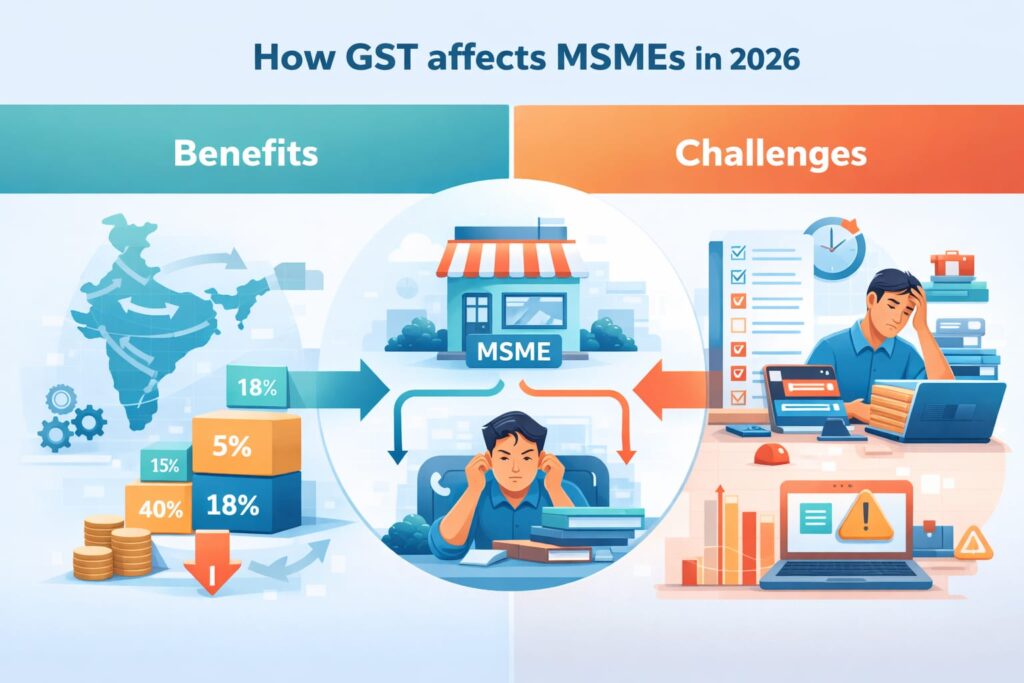
India’s GST structure has been simplified into three core slabs for most goods and services: 0%, 5%, and 18%, with 40% for select luxury or sin goods.
For MSMEs and traders, most common business transactions fall under 5% or 18% GST.
Many essential and commonly used items moved from 12–18% to 5% as part of GST reforms to ease burden on small businesses. This rate simplification reduces pricing confusion and makes invoicing more manageable for MSMEs.

When Is GST Registration Mandatory for Small Businesses?
You must register under GST if your business meets certain turnover and activity conditions.
In most cases, MSMEs need GST registration when they supply goods or services beyond the threshold, make interstate supplies, or sell online.
Key points for small businesses:
- Businesses with turnover up to ₹1.5 crore may opt for the composition scheme instead of regular GST, subject to conditions.
- Composition taxpayers pay tax at a lower fixed percentage of turnover and file simplified returns.
- Voluntary registration is popular among B2B-focused MSMEs who want input tax credit and corporate clients.
For a detailed StartupMandi guide to registration basics, you can read the PAN, TAN & GST registration for startups in India article, which explains early compliance in depth.
How Do I Register for GST Online?
The GST registration process is fully online via the official GST portal (www.gst.gov.in).[10]
You can also take professional help if you want a hassle-free experience and error-free application.
Basic steps to register:
- Visit the GST portal and click on “New Registration” under the Services tab.
- Fill in your PAN, mobile number, and email for OTP verification.
- Complete Part-B of the form with business details, bank details, and documents.
- Upload required documents like PAN, address proof, and photographs as applicable.
- Submit the application and track ARN status; registration is usually processed within 7–15 days.
StartupMandi also offers a GST Registration service where experts handle end-to-end filing so that founders can focus on operations instead of paperwork.

What GST Return Types Do Small Businesses File?
Small businesses file different types of GST returns based on their registration type and turnover.
Filing the correct returns on time is critical to avoid penalties, interest, and blocking of input tax credit.
Common returns for MSMEs and traders:
- GSTR-3B: Summary return of outward and inward supplies filed monthly or quarterly.
- GSTR-1: Statement of outward supplies with invoice-level details.
- GSTR-4 / CMP-08: For composition scheme taxpayers; CMP-08 is filed quarterly, and an annual GSTR-4 consolidates details.
- GSTR-9: Annual return for regular taxpayers summarizing the year’s activities.
A simplified GST return filing checklist can help you ensure you have invoices, purchase registers, and reconciliation ready before due dates.
How Do I File GST Returns Step by Step?
Direct answer: You log in to the GST portal, choose the correct return period, enter outward and inward supply details, pay any tax due, and submit the return with a digital signature or OTP.
Numbered filing process for a small regular taxpayer:
- Login to the GST portal using your GSTIN and password.
- Select the financial year and return period for which you are filing.
- Go to “Returns Dashboard” and choose the relevant return (e.g., GSTR‑3B, GSTR‑1).
- Enter outward supply details, inward supply details, and verify auto-populated data.
- Compute tax liability, set off with input tax credit, and pay the balance tax.
- Submit the return using DSC or EVC, and download the acknowledgement for records.
If the GST site is not working or you face portal access issues, you can refer to StartupMandi’s guide on fixing GST portal access problems for practical troubleshooting tips.
What Is the GST Composition Scheme for Small Businesses?
The GST composition scheme is a simplified tax regime for small taxpayers with turnover up to ₹1.5 crore, allowing them to pay tax at a fixed rate on turnover and file fewer returns.
It is designed to reduce compliance burden for small traders, manufacturers, and certain service providers.
Key features for MSMEs:
- Lower tax rates than regular GST, often around 1–6% depending on business type.
- Quarterly tax payment via CMP-08 and a single annual return (GSTR‑4).
- No detailed input tax credit mechanism; composition dealers usually cannot issue tax invoices with GST separately shown.
This scheme is suitable when your client base is largely end consumers and you prioritise simplicity over credits.
What Penalties Apply for Late GST Compliance?
Late filing of GST returns attracts late fees and interest, which can quickly add up for small businesses.
Non-payment or short payment of tax can also trigger percentage-based penalties and notices.
Important penalty figures:
- Late fee for GSTR-3B is typically ₹50 per day (₹25 each under CGST and SGST), capped at ₹5,000.
- For nil returns, the late fee is reduced to ₹20 per day (₹10 each under CGST and SGST).
- Interest at 18% per annum is charged on outstanding tax amounts.
- Non-payment or short payment of tax can attract a penalty of 10% of the tax due, subject to a minimum of ₹10,000.
“Delays in GST filings directly hit MSME cash flows through blocked credits and cumulative penalties.” – GST Council Analysis Note, 2025
How Does GST Impact MSMEs in 2026?
For MSMEs, GST affects working capital, pricing strategy, and market access.
Recent reforms have aimed to simplify rate structures and speed up refunds, which is especially helpful for small exporters and manufacturing units.
Recent trends relevant to MSMEs:
- Simplified GST rate slabs have reduced classification disputes for common goods.
- Policy discussions focus on reducing compliance burden and offering faster refunds to boost liquidity.
- An estimated 86% of MSMEs expect business growth in 2026, partly driven by more predictable GST rules and digital compliance tools.
How To Stay GST Compliant as a Small Business?
Direct answer: Small businesses can stay GST compliant by registering on time, issuing proper invoices, reconciling purchase and sales data, filing returns before due dates, and maintaining accurate digital records.
HowTo: Build a Simple GST Compliance Routine
Times Needed: 7 Days & 5 Hours
Estimated Cost: 50 USD
Description: Set up a weekly GST compliance routine with proper invoicing, reconciliation, and timely return filing to avoid penalties and interest.
Steps:
Step 1: Organise GST invoices and records
Collect all purchase and sales invoices weekly, label them clearly, and store them in a shared digital folder.
Step 2: Reconcile sales, purchases, and input tax
Match invoices with accounting data, confirm GSTINs, and verify that input tax credits align with supplier filings.
Step 3: Review payment and return deadlines
Check upcoming GSTR due dates, estimate tax payable, and ensure sufficient funds for timely GST payments.
Step 4: File GST returns through portal or advisor
Log in to the GST portal or share data with your consultant, then file returns and save acknowledgements.
Tools Name: Accounting software, GST portal, Spreadsheet tool
Materials Name: GST invoices, Bank statements, Vendor and customer lists
How Does GST Portal Help Small Businesses?
The GST portal (www.gst.gov.in) is the central online platform for all GST activities, from registration to returns and refunds. It enables MSMEs to manage compliance from anywhere, which is crucial for distributed teams and remote operations.
Through the portal, businesses can:
- Apply for new GST registration or amendments.
- File returns like GSTR‑1, GSTR‑3B, and CMP‑08.
- Generate payment challans and pay tax via net banking, card, or NEFT/RTGS.
- Track application status, refunds, and notices.
If you frequently face login or OTP issues, guides on how to fix GST portal access problems can help you reduce downtime and avoid missing due dates.

Key Takeaways Section
- GST is a unified indirect tax that replaced multiple earlier taxes, and it directly affects pricing, invoicing, and cash flows for MSMEs.
- Most MSME transactions fall under simplified GST rate slabs of 5% and 18%, with 40% reserved for luxury and sin goods.
- Timely GST registration and correct selection between regular and composition schemes are vital for compliance and client trust.
- Late filings can lead to daily late fees, interest, and blocked credits, which severely impact small business liquidity.
- Using the GST portal effectively and building a weekly compliance routine helps MSMEs minimise errors and avoid penalties.
Next Steps Section
- Review whether your turnover and business model require GST registration or make you eligible for the composition scheme.
- Set up basic accounting and invoice management so GST amounts and GSTINs are recorded accurately for every transaction.
- Explore StartupMandi’s PAN, TAN & GST registration guide to understand how registrations fit together for early-stage startups.
- If you want expert support, consider using StartupMandi’s GST Registration service to avoid documentation and portal errors that delay approval.
Conclusion
For Indian MSMEs and traders, understanding GST is now part of basic business literacy, not an optional tax add-on.
By mastering GST rates, choosing the right registration type, and following a simple, repeatable filing process, small businesses can avoid penalties, unlock input tax credit, and appear more credible to large clients and investors.
If you are just starting up, combining insights from this guide with StartupMandi’s detailed article on PAN, TAN & GST registration and their GST portal troubleshooting guide will help you build a robust compliance foundation from day one.
Disclaimer: This article is for general informational purposes only and does not constitute legal or tax advice. Please consult a qualified tax professional or GST practitioner for decisions specific to your business.
FAQ Section
GST is a single indirect tax on goods and services that replaces multiple old taxes; you charge GST on sales and can claim credit for GST paid on business purchases.
In many cases, you may not be mandatorily required, but interstate supply, online selling, or specific categories can still make GST registration compulsory; many MSMEs also register voluntarily for input tax credit and B2B work.
The composition scheme is generally available to eligible taxpayers with turnover up to ₹1.5 crore, subject to conditions and exclusions.
Regular taxpayers typically file GSTR‑3B and GSTR‑1 monthly or quarterly, while composition taxpayers pay via CMP‑08 quarterly and file an annual GSTR‑4.
You may face late fees per day of delay, capped limits for some returns, and interest at 18% per annum on unpaid GST, along with potential notices for persistent non-compliance.
Generally, composition dealers cannot collect tax from customers in the same way as regular taxpayers and typically issue a bill of supply instead of a standard tax invoice.
Yes, when managed properly, GST can provide input tax credit, better integration with national supply chains, and improved credibility with corporate buyers, although initial compliance can feel demanding.
You can use specialised GST consultants or digital platforms; StartupMandi, for example, offers structured GST registration services for early-stage startups and MSMEs in India.
For More Information & Facts, You can Visit …