

startupmandi-blog-background

PAN, TAN & GST Registration Guide for Startups in India (2026 Update) 🚀

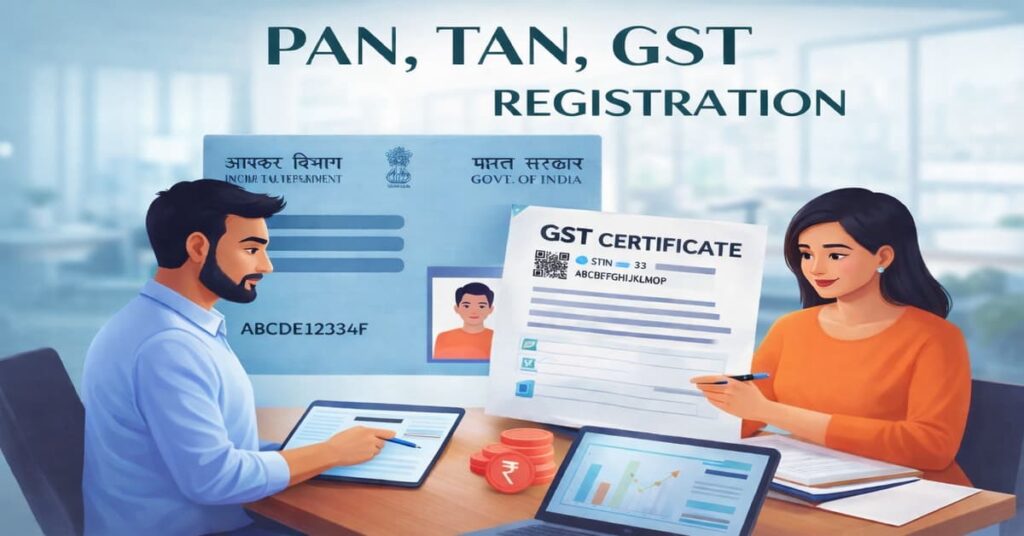
PAN TAN GST registration is one of the earliest compliance requirements every startup faces in India. However, many founders misunderstand these registrations and delay compliance. As a result, startups often face penalties, notices, or operational roadblocks later.As a result, compliance is often treated as a secondary task. Over time, this approach creates serious legal and financial issues.

Many startups receive notices simply because they missed a basic registration or filing.
In some cases, bank accounts are frozen or payments are delayed.
Therefore, founders must understand PAN, TAN, and GST clearly from day one.
This guide explains these registrations in a practical and easy-to-understand manner.

PAN Registration for Startups

PAN forms the base of all tax and financial activities for a startup. Completing PAN TAN GST registration early helps startups avoid legal risks and build long-term credibility.
Without PAN, a business cannot legally operate within India’s financial system.

PAN stands for Permanent Account Number, issued by the Income Tax Department of India.
It acts as a unique financial identity for the startup and tracks all income, expenses, and tax filings under one record.

For startups, PAN is required to:

  1. Open a current bank account

  2. File income tax returns

  3. Apply for GST registration

  4. Receive payments from clients

  5. Raise funding from investors

For example, banks will reject a current account application without PAN.
Similarly, investors conduct PAN verification during due diligence.

PAN for Different Startup Structures

The PAN requirement depends on business structure.

  1. Sole Proprietorship: Founder’s personal PAN is used

  2. Private Limited Company: Company PAN is mandatory

  3. LLP or OPC: Separate PAN is compulsory

Many founders delay applying for company PAN. However, this delay blocks GST registration and banking, Early PAN registration avoids operational delays.

Checkout Our Latest Services

TAN Registration and TDS Compliance

TAN is one of the most misunderstood registrations among startups, as many founders assume it applies only to large companies; however, this assumption is incorrect. TAN stands for Tax Deduction and Collection Account Number and is mandatory when a business deducts TDS from payments such as salaries, professional fees, or freelancer invoices. Like PAN, TAN is issued by the Income Tax Department of India and is essential for complying with TDS-related laws and filings.

When is TAN Mandatory?

A startup must apply for TAN if it:

  1. Pays salary to employees

  2. Pays freelancers or consultants

  3. Pays rent above specified limits

  4. Makes professional payments subject to TDS

For example, if a startup pays a freelancer ₹30,000 and deducts TDS, TAN becomes mandatory. Startup size does not matter here. The moment TDS is deducted, TAN is legally required.

Failure to obtain TAN or file TDS returns can lead to penalties per default.

GST registration for startups

GST Registration for Startups in India

GST registration for startups depends on turnover, business location, and the nature of operations.
However, many startups opt for voluntary GST registration to improve credibility and work with larger clients.

GST stands for Goods and Services Tax.
It is an indirect tax applied to the supply of goods and services across India.
GST replaced multiple indirect taxes and brought them under a single, unified tax system.

When is GST Registration Mandatory?

GST registration is compulsory if:

  1. Annual turnover exceeds ₹20 lakhs

  2. Services are provided outside the state

  3. Goods or services are sold online

  4. Business operates through marketplaces

For example, a digital marketing startup serving clients outside its state must register for GST. Even if turnover is low, interstate services trigger GST.

Benefits of GST Registration

GST registration provides:

  1. Input tax credit on expenses

  2. Higher trust among B2B clients

  3. Eligibility to work with corporates

  4. Legal protection from penalties

However, GST requires regular filings. Missing returns attracts interest and late fees.


PAN TAN GST Registration – Key Differences

Understanding the difference helps founders avoid confusion.

RegistrationPurposeApplicable When
PANIncome tax identityMandatory for all startups
TANTDS complianceRequired when TDS is deducted
GSTIndirect taxTurnover or activity based

Each registration serves a different legal function. Mixing them up often leads to compliance errors.


Common Compliance Mistakes Founders Make

Most compliance issues arise from lack of awareness.Initially, these mistakes seem minor. Eventually, they result in notices, penalties, and operational stress.

Frequent Mistakes:

  1. Delaying PAN application after incorporation

  2. Deducting TDS without TAN

  3. Ignoring GST threshold rules

  4. Missing filing deadlines

  5. Assuming compliance can wait

Checkout Latest Grants Listed

Conclusion

PAN TAN GST registration is not a formality. It is the backbone of a compliant startup in India. Founders who understand these registrations early avoid legal risks later. Instead of reacting to notices, proactive compliance builds confidence. A compliant startup scales faster and earns long-term trust.

FAQs

1. Is PAN mandatory for all startups?
Yes. Every registered startup requires PAN.

2. Is TAN compulsory for small startups?
Yes, if the startup deducts TDS.

3. Is GST mandatory for service startups?
It depends on turnover and interstate services.

4. Can GST registration be delayed?
Yes, but late registration causes penalties.

5. Is voluntary GST registration useful?
Yes, especially for B2B startups.


External Fact Source Links

Shwetha Dilipkumar
Shwetha Dilipkumar
Articles: 29

Leave a Reply

Your email address will not be published. Required fields are marked *