




AI automation for enterprises: 7-Step Ultimate Roadmap to Unlock Massive ROI in 2026
Learn AI automation for enterprises with a step-by-step roadmap, KPI windows, and governance checkpoints built for measurable ROI.
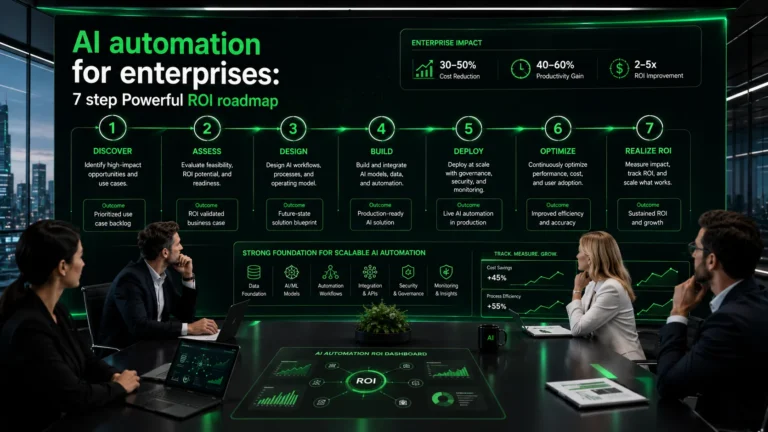
AI automation for enterprises works best when every pilot has a clear business goal, a measurable KPI window, and a governance checkpoint. This roadmap shows you how to move from experimentation to ROI without wasting time on vague AI projects.
Quick Summary
Enterprises should start with one high-value use case, define baseline metrics, and run a short pilot with strict success criteria. From there, teams can scale only what proves efficiency gains, cost savings, or faster time-to-value. A strong roadmap also includes governance, security, and executive reporting so AI stays useful, safe, and profitable. Enterprise buyers are increasingly demanding direct financial impact, not just productivity claims.millipixels+1
How Do I Start the Roadmap?
Start with business pain, not with tools. The best AI automation for enterprises roadmap begins by identifying a process that is costly, repetitive, and measurable. That gives your team a realistic pilot and a clean way to calculate ROI.
A useful rule is simple: if you cannot define the baseline, you cannot prove the improvement. According to enterprise AI strategy guidance, successful programs align use cases to revenue, cost reduction, or customer experience metrics from day one.ibm+1
“What gets measured gets managed.” — Peter Drucker
Before you build anything, decide what success means. That could be reduced processing time, fewer manual errors, or lower support workload. Then document the current state so every result can be compared later.
What Is the best pilot scope?
A good pilot is narrow enough to control but important enough to matter. Pick one team, one workflow, and one KPI window.
- Choose a process with repetitive work.
- Confirm reliable data exists.
- Define one primary business outcome.
- Set a 30, 60, or 90-day review window.
- Agree on who owns the result.
This is where many enterprise initiatives fail. They launch too broad, then struggle to show value. A focused pilot avoids that trap and creates a faster learning cycle.mymobilelyfe+1
Which Use Cases Deliver ROI?
The strongest enterprise AI automation use cases are usually tied to operations, support, finance, or internal service delivery. These areas have enough volume to generate visible savings and enough structure to automate safely.
A recent enterprise survey found that direct financial impact is now overtaking productivity as the main AI success metric, while autonomous agents and agentic AI are rising quickly in priority. That means leadership now expects AI to connect to the P&L, not just internal experimentation.futurumgroup
Which workflows should I prioritize?
Use a simple scoring model. Rate each workflow from 1 to 5 on volume, repeatability, business value, and implementation complexity.
| Workflow Area | Why It Matters | ROI Potential |
|---|---|---|
| Customer support | High ticket volume and clear response-time gains | High |
| Finance operations | Repetitive approvals and document handling | High |
| Sales ops | Lead routing, CRM updates, follow-ups | Medium to High |
| HR workflows | Hiring coordination and employee support | Medium |
| IT service desk | Ticket triage and knowledge retrieval | High |
This table helps teams choose where to begin. It also keeps the roadmap grounded in practical wins instead of abstract AI ambition. Use the highest-scoring workflow for your first pilot.forcoda+1
Why do AI agents matter here?
AI agents are useful when a workflow needs decisions, not just automation. They can route tasks, retrieve information, summarize context, or trigger actions across systems. That makes them especially valuable in enterprise environments where workflows cross tools and departments.ciklum+1
How Do I Measure ROI?
Measure ROI using baseline-versus-after data. Do not rely on broad claims like “improved productivity” unless you can convert them into time saved, capacity created, or money reduced.
A practical pilot should track three primary numbers:
- Time per task.
- Tasks completed per period.
- Error or rework rate.
Secondary metrics can include SLA compliance, customer response time, and employee capacity freed. This approach matches current ROI playbooks that focus on measurable operational gains instead of vanity metrics.
What is a simple ROI formula?
Use this formula:
textROI % = ((Annual Benefit - Annual Cost) / Annual Cost) x 100Example:
If an automation saves 1,200 labor hours per year and those hours are worth $45 each, the gross annual benefit is $54,000. If the total project cost is $18,000, then ROI is strong and easy to explain to leadership.
What KPIs should leaders see?
Leadership should see a dashboard with these five items:
| KPI | What It Shows | Why It Matters |
|---|---|---|
| Time saved | Efficiency impact | Proves operational gain |
| Error reduction | Quality improvement | Supports risk control |
| Throughput | Output increase | Shows scale potential |
| Cost avoided | Financial value | Connects to ROI |
| Adoption rate | Team usage | Proves real-world fit |
This is the kind of dashboard that turns AI from a pilot into a business program. It also helps enterprise sponsors defend budgets because the results are visible, repeatable, and easy to communicate.cxtoday+1
“Enterprises are now demanding that every AI capability connect directly to revenue growth or margin improvement.” — Futurum Group survey summary
How Should Governance Work?
Governance should begin before deployment, not after problems appear. Enterprises need guardrails for data access, approvals, human review, and model monitoring. That is especially important when AI touches customer data, financial records, or internal policy decisions.cybic+1
Good governance does not slow AI down; it makes scaling possible. A structured framework helps leaders approve pilots faster because risk is already understood.
What governance checkpoints are needed?
- Data privacy review.
- Security and access control review.
- Human-in-the-loop approval.
- Model performance monitoring.
- Escalation path for errors.
These checkpoints should be documented in the roadmap itself. That way, every pilot has a safety process and a clear owner. IBM’s enterprise AI guidance emphasizes strategy, structure, and responsible deployment as core requirements for long-term success.ibm+1
What Does The Roadmap Look Like?
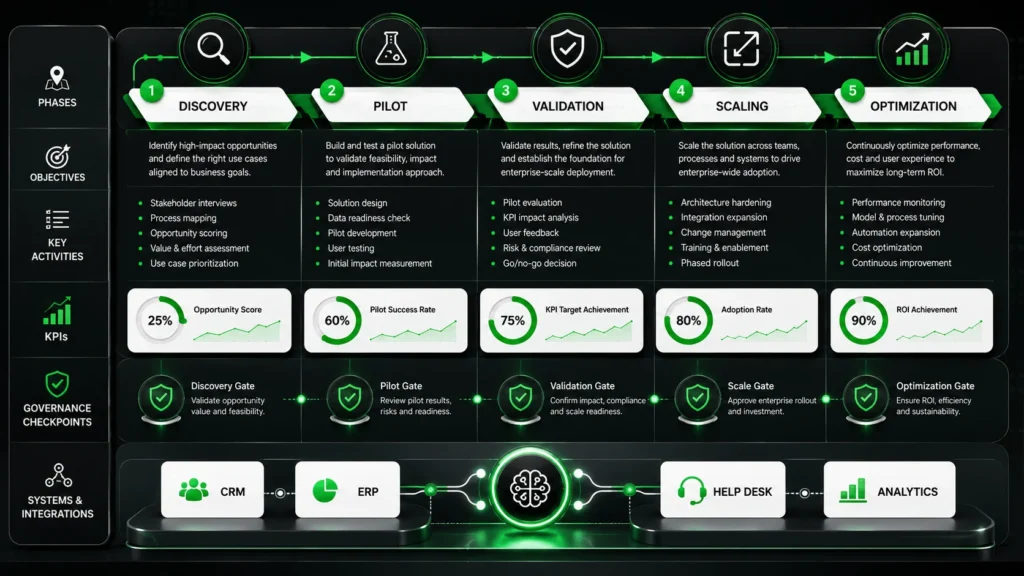
A strong enterprise AI roadmap moves through five phases: discovery, pilot, validation, scaling, and optimization. Each phase should have a measurable exit criterion.
How do I structure the phases?
- Discovery. Identify the workflow, baseline, and business objective.
- Pilot. Automate one narrow process and test it in a controlled environment.
- Validation. Compare results against the baseline and verify ROI.
- Scaling. Expand to adjacent teams or similar workflows.
- Optimization. Improve models, rules, and governance based on feedback.
This structure prevents rushed rollouts. It also helps executives approve expansion only after the pilot proves itself. Enterprise guides increasingly recommend this kind of phased execution because it reduces failure risk and improves adoption.millipixels+1
How long should each phase take?
| Phase | Typical Duration | Output |
|---|---|---|
| Discovery | 1–2 weeks | Use case selection |
| Pilot | 2–6 weeks | Working prototype |
| Validation | 1–2 weeks | ROI report |
| Scaling | 4–12 weeks | Expanded rollout |
| Optimization | Ongoing | Continuous improvement |
This is a practical timeline, not a rigid rule. Complex enterprise environments may need longer validation, especially when integrations or compliance reviews are involved.ciklum+1
What Tools And Materials Do I Need?
For a first enterprise AI automation pilot, keep the stack simple. Do not overbuild the environment before you know the use case works.
Tools Name
- Workflow automation platform.
- Secure data source or data warehouse.
- KPI dashboarding tool.
- Human review and approval workflow.
Materials Name
- Process baseline document.
- KPI definitions sheet.
- Pilot success criteria.
- Governance checklist.
How much time and cost?
Times Needed: Days: 30, 00 Hours: 00, 00 Minutes: 00.
Estimated Cost: USD 5,000.
Description: A focused enterprise AI pilot with one workflow, one KPI window, and governance review. Designed to prove ROI before scaling.
This estimate is directional, not universal. Costs vary based on data readiness, integration complexity, and whether the work is done internally or with a partner. The point is to keep the first phase small enough to prove value quickly.forcoda+1
How Can Leaders Scale Safely?
Scale only after the pilot meets its success criteria. Many enterprises fail because they expand too soon and create inconsistent results across departments.
To scale safely, standardize the workflow definition, approval process, and monitoring rules. Then reuse the same measurement structure across each new team. This keeps the program comparable and easier to govern.cybic+1
What should scaling focus on?
- Repeatability across departments.
- Standardized reporting.
- Shared governance rules.
- Better data quality.
- Executive visibility.
When scaling is done well, enterprise AI automation becomes an operating model, not a one-time project. That is where the long-term ROI appears.
Key Takeaways
- Start with one measurable workflow, not a broad AI vision.
- Use baseline metrics to prove impact.
- Track time, throughput, and error rate before and after automation.
- Add governance early so scaling is safer.
- Expand only after ROI is validated in a controlled pilot.
These principles are what separate successful enterprise AI programs from expensive experiments. They also make your strategy easier to present to executives because the logic is simple and evidence-based.
Next Steps
- Identify one workflow that wastes time every week.
- Define your baseline and KPI window.
- Build a small pilot with governance checkpoints.
- Review results after 30 to 90 days.
- Scale only if the numbers support it.
For deeper learning, explore the AI-powered content SEO premium internship program and the AI-powered digital marketing internship program from VELYON Institute.
Conclusion
The best AI implementation roadmap strategy is not the one with the most tools. It is the one that ties every pilot to a business result, a clear KPI window, and a governance checkpoint. That approach creates measurable ROI and makes scaling much easier.cxtoday+1
If your team is planning its first pilot, use the roadmap above to keep the project focused and board-ready. Start small, measure clearly, and scale only what proves value.
Resources
- IBM AI strategy guidance — useful for enterprise planning and governance.
- IBM AI Roadmap — helpful for understanding enterprise AI direction.
- Futurum enterprise AI ROI survey summary — useful for current ROI priorities.
- Enterprise AI automation guide — useful for workflows, agents, and deployment strategy.
- Enterprise AI automation strategy guide — useful for current trend framing.
FAQ
It is the use of AI to automate business workflows, decisions, and repetitive tasks across departments.
They compare baseline performance with post-automation results using time saved, throughput, error rate, and cost reduction.
What is the best first use case?
The best first use case is a repetitive, high-volume process with clean data and clear business value.
Most pilots run for 30 to 90 days, depending on process complexity and data readiness.
Governance reduces risk, protects data, and gives leadership confidence to scale AI responsibly.
Use automation rules for repetitive, fixed tasks and AI agents when decisions, context, or multi-step actions are needed.
Track three primary KPIs and a few secondary metrics to keep measurement focused and useful.
Clear goals, strong measurement, governance, and disciplined scaling are the main success factors.