




AI Overviews SEO: How to Rank in Google’s AI Summaries in 2026
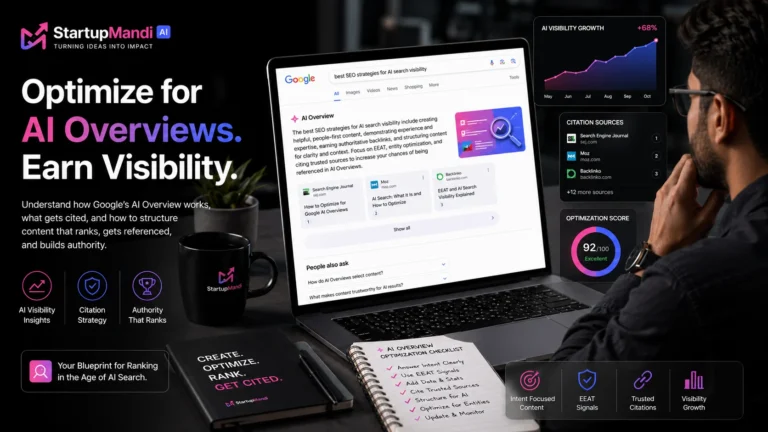
AI Overviews SEO is about making your content easier for Google’s AI to understand, trust, and cite in summary answers. If you want visibility in 2026, you need more than keywords; you need answer-ready content, clear structure, and proof that your page is worth citing.
AI Overviews are Google’s AI-generated summaries that appear at the top of some search results and synthesize information from multiple sources, so ranking in them means creating content that matches intent, answers quickly, and gives Google enough evidence to use your page as a source. For more insights on content strategy and growth, you can explore StartupMandi Global.
What Are AI Overviews SEO?
AI Overviews are short, AI-generated answer panels in Google Search that summarize a topic before the traditional results. As a result, they can reduce the need for clicks on informational queries, which makes visibility inside the overview more valuable than ever. In many cases, this means users get what they need faster, while the pages that are cited gain a stronger chance of being noticed.
For site owners, this changes the game. You are no longer only competing for blue-link rankings; instead, you are also competing to become a cited source inside the answer itself. Therefore, content needs to be clearer, more direct, and more trustworthy if it wants to stand out in this new search environment.
Why Does AI Overviews Matter?
AI Overviews matter because they can reshape how users see and interact with search results. As a result, recent SEO coverage notes that AI summaries can push organic results lower, while cited pages may gain visibility even if they are not position one.
This is especially important for bloggers and marketers. If your content is useful but not structured well, Google may still skip it. However, if your content is direct, factual, and easy to extract, it can become a source in the summary.
How Do I Rank In AI Overviews?
You rank in AI Overviews by making content easier to extract, easier to trust, and easier to connect to user intent. In other words, that means clear headings, concise answer blocks, strong topical depth, and supporting evidence.
Here is the short version :
- Target long-tail question queries.
- Put the answer first.
- Use clear H2 and H3 structure.
- Support claims with sources.
- Strengthen topical authority across related posts.
What Content Structure Works?
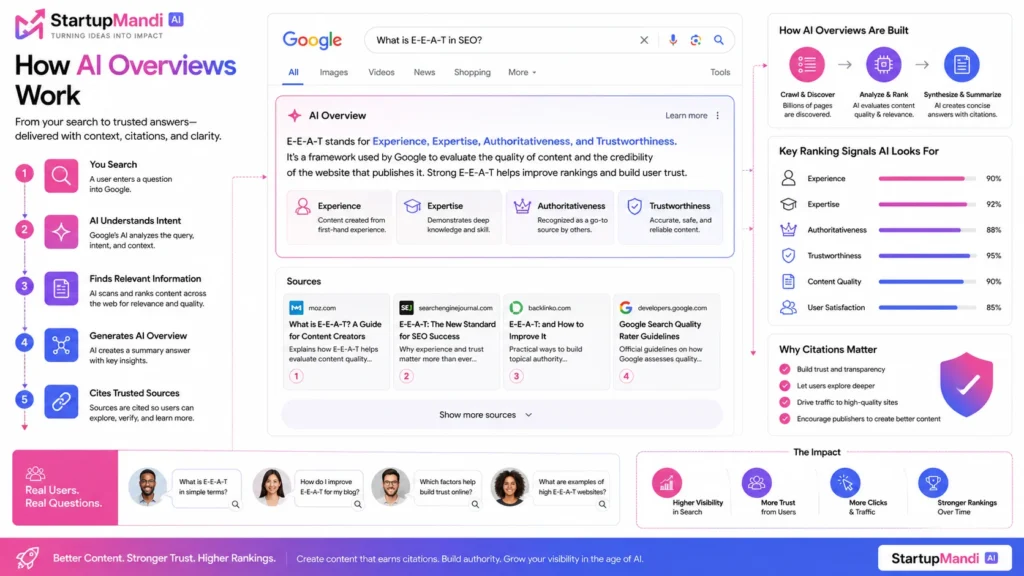
AI systems prefer structure that is easy to scan and cite. That usually means short paragraphs, direct definitions, and sections that can stand alone without extra context.
| Content Element | Why It Helps | What To Do |
|---|---|---|
| Direct answer | Improves extraction | Answer in the first 50 words |
| Clear headings | Improves parsing | Use question-based H2s |
| Short paragraphs | Easier to cite | Keep sections tight |
| Evidence | Builds trust | Add stats and sources |
| FAQ blocks | Captures more queries | Answer related questions |
A practical rule is to write for humans first, but format for machines second. That balance is what makes AI-friendly SEO work.
How Do I Build Trust in AI Overviews?
Trust comes from proof, not vague claims. In fact, in AI Overview optimization, that means accurate facts, external citations, and a visible reason why your site should be considered reliable.
Use these trust signals :
- Named author and bio.
- References to authoritative sources.
- Updated publication dates.
- Clear explanations, not fluff.
- Consistent topic coverage across the site.
This is where E-E-A-T matters too. If your page looks thin, generic, or anonymous, it becomes harder for AI systems to treat it as a dependable source.
What Keywords Should I Target?
The best keywords for AI Overviews SEO are usually question-based and informational. Additionally, they tend to be long-tail, specific, and closely tied to user intent.
High-value keyword ideas :
- How to rank in AI Overviews.
- Google AI Overviews SEO.
- AI Overviews optimization.
- How to get cited in AI Overviews.
- AI search visibility.
- Generative engine optimization.
- Citation-worthy SEO content.
These keywords work because they match the kind of questions users ask when they want direct answers, not broad theory.
What Should I Optimize First?
Start with your highest-traffic informational pages. In other words, those are the pages most likely to get visibility in summaries, especially if they already answer common search questions.
Then improve three things :
- The opening answer block.
- The supporting evidence.
- The internal links to related topics.
That combination helps Google understand both the page and the site as a whole.
What Role Does Schema Play?
Schema helps search engines read your page more clearly, especially when content is already well structured. It does not guarantee placement in AI Overviews, but it can support discoverability and context.
A simple markup example :
xml{
  "@context": "https://schema.org",
  "@type": "Article",
  "headline": "AI Overviews SEO: How to Rank in Google’s AI Summaries in 2026",
  "author": {
    "@type": "Person",
    "name": "StartupMandi Global"
  }
}
Use schema that matches visible content, and do not add anything that the page does not actually say.
How To Rank In AI Overviews?
Times Needed : 4 Days, 8 Hours, 0 Minutes
Estimated Cost : USD 0
Description : A practical workflow to improve AI Overview visibility through answer blocks, citations, structure, schema, and topical depth.
Steps :
- Find question-based keywords
Use long-tail informational queries that people ask in natural language. These are more likely to trigger AI summaries. - Answer the query immediately
Put the direct answer in the first paragraph. Keep it clear, short, and easy to quote. - Add proof and sources
Support claims with statistics, expert references, and current data. This helps Google trust your content. - Structure for extraction
Use question-based headings, short sections, and tables. Make every section understandable on its own. - Strengthen topical authority
Publish related content and link it together. This helps Google see your site as a deeper source.
Tools Name
- Google Search Console.
- Semrush.
- Ahrefs.
- Surfer SEO.
Materials Name
- Keyword list.
- Source list.
- Content brief.
- Internal link map.
What Mistakes Should I Avoid In AI Overviews?
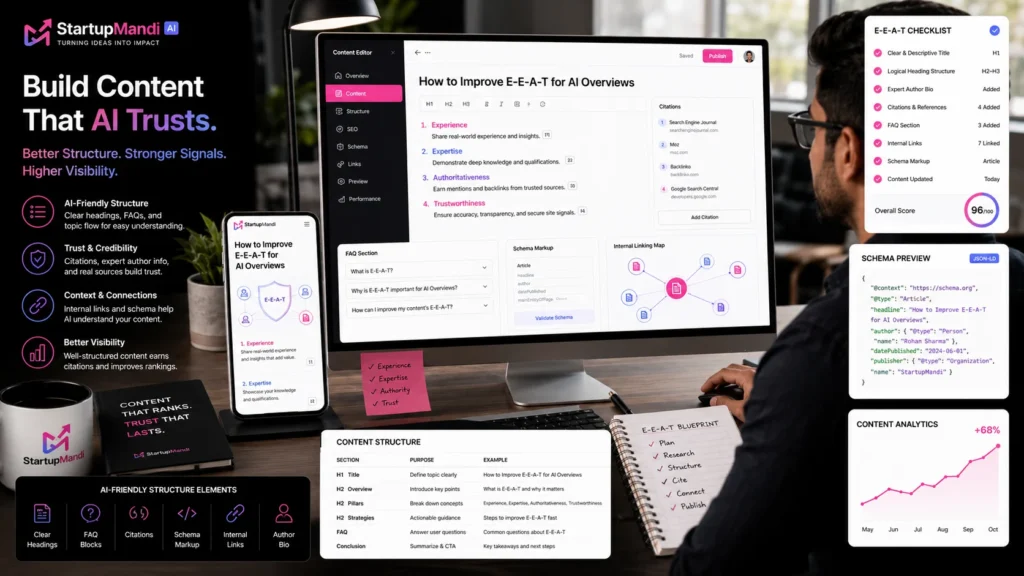
The biggest mistake is writing for rankings without writing for clarity. As a result, AI Overviews usually favor pages that are specific, useful, and easy to interpret.
Avoid these mistakes :
- Long, vague introductions.
- Thin pages with little evidence.
- Keyword stuffing.
- Missing author information.
- Weak formatting.
If a page sounds like marketing copy instead of a useful answer, it is usually less likely to be cited.
FAQ
AI Overviews are Google-generated summary answers that appear at the top of some search results.
It means your page is used as a source or citation inside the AI-generated summary.
They can reduce clicks on some informational searches because users get answers directly on the results page.
Clear, factual, well-structured content with strong topical relevance is more likely to be used.
No, but it can help search engines understand your content more clearly.
Very important. Trust signals help your page look credible and citation-worthy.
Yes. Use shorter paragraphs, direct answers, and question-based headings.
Yes, if the content is focused, useful, and better structured than competing pages.
Key Takeaways
- AI Overviews SEO is about being easy to cite, not just easy to rank.
- Direct answers and clear structure matter more than long introductions.
- Trust signals and sources improve your chance of being used.
- Long-tail questions are strong targets for AI visibility.
- Topical authority helps Google see your site as reliable.
Next Steps
- Review your top pages for answer-first formatting.
- Add better source citations to every key claim.
- Build a cluster of related AI SEO articles.
- Update old content with clearer structure and fresh facts.
Conclusion
AI Overviews SEO is now a core part of modern search strategy, not a side tactic. Therefore, if you focus on clarity, trust, and extractable structure, you improve your odds of being cited in AI summaries and staying visible as search evolves.
For the next step, connect this article to your broader SEO plan and your keyword research process and content planning framework. Meanwhile, for more brand resources, visit StartupMandi Global.
Few Links Suggestions for more Research & Facts Check
- Google AI features and websites — official guidance on AI features in Search.
- Semrush guide to AI Overviews — practical optimization ideas.
- Search Engine Land on AI Overview citations — useful for citation and click behavior.
- Google Search documentation — broader search documentation.
- Conductor AI Overviews optimization — step-by-step optimization notes.