

startupmandi-blog-background

Impact of AI on Traditional Business Models: Disruption Guide πŸ“ŠπŸ’Ό

Impact of AI on traditional business models reveals disruption across 10 industries, new profit centers, transformation roadmap. Learn adaptation strategies now. πŸš€

Impact of AI on Traditional Business Models: The Tectonic Shift Reshaping Industries 🌍

Impact of AI on traditional business modelsΒ represents the most significant economic disruption since the internet itself. Rather than gradual change,Β AI fundamentally reshapes how companies create value, compete, and serve customers.Β 60% of industries face genuine disruption risk within 24 monthsβ€”forcing urgent strategic adaptation across sectors.

The transformation transcends cost reduction.Β While AI cuts operational expenses 20-40%, it simultaneously creates entirely new business categories generating 40-60% revenue growth. Companies that frame AI as threat typically lose to competitors viewing it as historic opportunity. This distinction determines survival in the 2025-2030 era.

Impact of AI on Traditional Business Models – Transformation Snapshot πŸ“ˆ

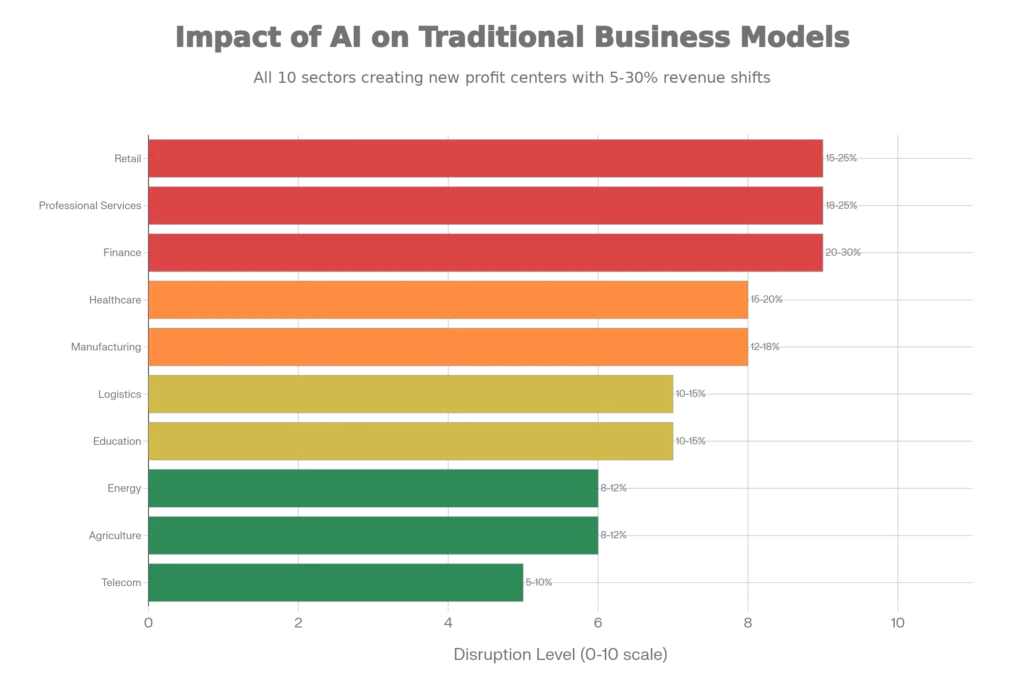
  1. 10 Industries Facing High Disruption:Β Retail, finance, professional services, manufacturing, healthcare (9/10 disruption intensity)

  2. New Profit Centers:Β Data monetization, predictive services, autonomous operations, personalization engines

  3. Cost Reduction Range: 20-40%Β through automation and process optimization

  4. Revenue Growth Potential: 40-60%Β from new AI-powered service models

  5. Timeline Pressure:Β Most transformation-critical decisions occur within 12-24 months

  6. Competitive Window:Β Early adopters gain 2-3 year advantage over late followers

  7. Worst-Case Scenario:Β Companies ignoring AI disruption face irrelevance by 2027-2030

The Vulnerable Business Models: Which Traditional Industries Face Highest Risk?

Impact of AI on traditional business modelsΒ concentrates most heavily in sectors dependent on repetitive tasks, linear scaling, or information gatekeeping. Understanding vulnerability enables strategic defensive and offensive positioning.

Highest-Risk Sectors: The Perfect AI Storm

Professional Services (Legal, Accounting, Consulting): 🏒
Document review, tax preparation, legal researchβ€”core revenue generatorsβ€”now automate through AI at fraction of human cost. A law firm billing 10,000 billable hours annually for document review now loses this revenue stream as AI completes identical work in 2% of time. Accounting firms automating tax prep face similar displacement.

However, opportunity emerges:Β firms transitioning to advisory services, strategic consulting, and continuous optimization prove more profitable than historical document-billing models.

Retail & Commerce:Β πŸ›οΈ
Amazon Go checkout-free stores, AI inventory optimization, and hyperpersonalization fundamentally challenge traditional retail economics. Traditional retailers spend 15-20% of revenue on operationsβ€”logistics, inventory, staffβ€”that AI reduces 30-50%.

Critical shift:Β Retailers who embraced AI-powered inventory and personalization demonstrateΒ 15-25% higher conversion rates and 30% inventory reduction. Those clinging to seasonal buying patterns lose market share.

Financial Services:Β πŸ’°
Robo-advisors now manage $1.4+ trillion globally, threatening traditional relationship banking. Underwriting tasks once requiring human teams now complete through AI in minutes with superior accuracy.

New opportunity:Β Advisory firms adding AI insights to human relationships create hybrid models charging premium fees forΒ superior analysis + human trust combination.

Medium-Risk Sectors: Partial Disruption, Hybrid Models

Manufacturing, healthcare administration, education, and logistics face substantial AI impact but simultaneously gain significant automation benefits.

ManufacturingΒ increasingly requires: predictive maintenance systems (preventing downtime 40-60%), AI-optimized production scheduling, quality inspection automation. Companies maintaining traditional reactive maintenance and rigid schedules lose efficiency to AI-enhanced competitors.

Healthcare administrationΒ faces displacement of: medical coding, appointment scheduling, insurance claims processingβ€”routine tasks perfectly suited to AI. However, clinical decision-making and patient care remain human-dominated.

EducationΒ transforms through: AI tutoring systems, personalized learning paths, automated grading. Traditional one-size-fits-all curricula increasingly seem prehistoric compared to AI adaptive learning.

impact-of-ai-on-traditional-business-models-disruption-guide
Impact of AI on traditional business models showing disruption levels across 10 industries with transformation status and new profit center creation potential
Checkout Our Latest Services

New Profit Centers: How AI Transforms Cost Savings Into Revenue Streams

Impact of AI on traditional business modelsΒ extends beyond cost reductionβ€”companies increasingly monetize AI capabilities themselves. This represents the difference between survival and thriving.

From Internal Efficiency to External Service Revenue

Data Monetization:Β πŸ“Š
Retailers optimizing inventory through AI now sell demand-forecasting services to suppliers and manufacturers. A grocery chain identifying regional demand patterns transforms internal advantage intoΒ $500K+ annual recurring subscription service.

Why this works:Β Manufacturers, wholesalers, and suppliers desperately want accurate demand intelligenceβ€”they’ll pay substantial fees for accurate forecasting replacing expensive failed planning.

Process Automation as Service:Β βš™οΈ
Manufacturing companies developingΒ AI quality control vision systems for production linesΒ license these identical systems to competitors in different industries.Β Initial internal cost: $50K-100K; licensing revenue: $100K-500K annually per customer.

Predictive Maintenance Services:Β πŸ”§
Construction equipment rental companies use AI predicting machinery failuresΒ preventing downtime before it occurs. They now offerΒ $50K-200K annual consulting contractsΒ to other equipment operators.

AI-Enhanced Consulting:Β πŸ’Ό
Engineering firms using AI for advanced design analysis serveΒ more clients without hiring additional staff. This enablesΒ 30-50% margin improvement on project delivery.

Creating Entirely New Business Models

Autonomous Service Delivery:Β πŸ€–
Cleaning companies deploy AI-powered robots handling routine tasks while humans manage complex jobs. This enablesΒ servicing 40% more locations with identical staffing.

AI-Powered Marketplaces: 🌐
Real-time logistics platforms using AI match shipping capacity to cargo needs, generating revenue throughΒ transaction fees while improving asset utilization 20-30%.

Dynamic Pricing Services:Β πŸ“ˆ
Restaurants, retail shops, service providers adjust prices real-time using AI based on demand, weather, competition.Β Average revenue improvement: 8-12% through optimized pricing.

Intelligent Automation Platforms:Β πŸ”„
Tax preparation firms automate routine filings, freeing experts for complex advisory workβ€”increasingΒ profitability per client 25-40% while maintaining service quality.

Real Business Model Examples: Before & After AI

Business TypeTraditional ModelAI-Enhanced ModelRevenue Impact
RetailInventory prediction by committeeAI demand forecasting+15-25% conversions
AccountingBillable hour document reviewAdvisory + AI insights+30% margins
ManufacturingReactive maintenance & downtimePredictive maintenance service+40-60% uptime
FinanceRelationship advisor modelRobo + human hybrid50% cost reduction
LogisticsScheduled routes & manual loadsAI-optimized dynamic routing+20-30% capacity
Checkout Latest Grants Listed

The Adaptation Playbook: Strategic Roadmap For Traditional Businesses

Impact of AI on traditional business modelsΒ doesn’t mandate complete reinventionβ€”strategic adaptation enables traditional firms to compete against AI-native startups. Success requires disciplined execution over 12-24 months.

Phase 1: Disruption Recognition (Month 1)

Honest assessment separates successful companies from eventual failures:

Vulnerability Audit:Β πŸ”

  1. Identify processes dependent on repetitive tasks, manual analysis, routine decisions

  2. Calculate revenue at risk if competitors implement superior AI solutions

  3. Assess technology infrastructure supporting legacy operations

  4. Evaluate competitive landscape for early AI adopters

Key Question:Β What activities consume 20-30% of operating budget doing routine work AI could automate?

Phase 2: Strategic Assessment (Months 2-3)

Prioritize transformation initiatives with highest ROI potential:

Data Inventory Assessment:

  1. Audit data assets (customer behavior, operational metrics, financial patterns)

  2. Identify clean, consistent data supporting AI training

  3. Determine where data fragmentation hinders AI implementation

ROI Calculation Framework:

  1. Quick Wins (Months 1-3):Β Cost reduction projects delivering 10-15% savings

  2. Medium-Term (Months 4-12):Β Revenue enhancement generating 15-25% improvement

  3. Transformational (Months 13+):Β New business models creating 40-60% additional revenue

Phase 3: Pilot Implementation (Months 4-6)

Choose ONE manageable, high-impact area for initial deployment:

Ideal Pilot Characteristics:Β βœ…

  1. Solves genuine business problemΒ (not technology showcase)

  2. Delivers measurable ROI within 60-90 days

  3. Requires modest investmentΒ ($50K-250K typically)

  4. Involves less than 20% of workforceΒ (minimizes disruption)

Common Successful Pilots:

  1. Customer service chatbot:Β 40-50% reduction in routine inquiry handling

  2. Sales lead scoring:Β 30-40% improvement in conversion rates

  3. Inventory optimization:Β 20-30% reduction in carrying costs

  4. Process automation:Β 50-70% time savings on repetitive tasks

Phase 4: Scale & Integrate (Months 7-12)

Expand successful pilots across organization systematically:

Critical Success Factors:

  1. Change management intensity:Β Expect 30% of workforce resistance initially

  2. Skill development:Β Invest in AI literacy for all staff, not just technical teams

  3. System integration:Β Connect AI tools to existing ERP, CRM, HR systems

  4. Measurement framework:Β Track ROI obsessivelyβ€”monthly reviews mandatory

Expected results by month 12:Β 20-35% cost reduction, 10-20% revenue improvement, 60-70% workforce AI adoption.

Phase 5: New Business Models (Months 13+)

Transition from cost reduction to growth through AI-powered services:

Revenue Creation Strategy:

  1. Productize internal AI capabilitiesΒ (data forecasting, process automation)

  2. Launch premium servicesΒ leveraging AI advantages competitors lack

  3. Establish recurring revenue streamsΒ reducing customer acquisition cost burden

Expected results:Β 40-60% revenue growth from new AI services, sustained competitive advantage, market leadership positioning.

impact-of-ai-on-traditional-business-models-disruption-guide
Impact of AI on traditional business models showing 5-phase transformation roadmap from disruption recognition through new business model creation with investment and ROI projections

Conclusion: Impact of AI on Traditional Business Models Is Non-Optional Adaptation 🎯

Impact of AI on traditional business modelsΒ no longer permits strategic delayβ€”every business must adapt within 12-24 months or face structural competitive disadvantage. This statement isn’t hyperbole; it reflects reality of rapid AI adoption reshaping industries across sectors.

The mathematics prove undeniable:Β companies implementing AI strategically achieve 20-40% cost reduction AND 40-60% revenue growth through new services. Competitors delaying adaptation face simultaneous margin compression (from automation pressure) and revenue loss (to AI-enhanced rivals), creating crisis scenarios.Β Traditional business models without AI integration become progressively uncompetitive, ultimately unsustainable.

Success requiresΒ clarity that AI isn’t a cost center but strategic imperative. Companies viewing AI as threat to current operations miss fundamental point:Β AI threatens their existing business models far more than selective AI adoption. Paradoxically, the only path preserving traditional business is embracing disruptive AI transformation.

AtΒ StartupMandi, we recognizeΒ impact of AI on traditional business modelsΒ represents the central strategic question for every business leader.Β Explore our comprehensive AI transformation playbookΒ covering assessment, pilot implementation, scaling, and new business model creation.Β Discover our detailed industry-specific guidesΒ analyzing AI disruption patterns and adaptation strategies for your sector.

For business leaders committed to thriving through transformation,Β impact of AI on traditional business modelsΒ clarifies urgency:Β act decisively within next 12 months to position your company advantageously for 2026-2030 competitive landscape. Delay guarantees strategic disadvantage.Β Visit our complete AI strategy guideΒ walking through assessment through execution.Β Connect with our AI transformation advisorsΒ developing customized adaptation roadmaps aligned with your industry and competitive position.

The era of gradual adaptation has ended. Companies must choose:Β embrace transformation now, or manage decline over subsequent years. The data, the evidence, and the competitive reality support no middle ground.


Frequently Asked Questions About Impact of AI on Traditional Business Models

Q1: How quickly will AI actually disrupt our specific industryβ€”months, years, or longer?

Timeline varies by sector.Β Retail, finance, and professional services face high disruption within 12-24 months. Manufacturing and healthcare within 24-36 months.Β Telecommunications and energy slightly longer (36+ months). However, early AI adopters already gaining 2-3 year competitive advantage.

Q2: What’s the realistic cost to transform our traditional business model for AI integration?

Typical range:Β $250K-$1M for mid-market companiesΒ covering assessment, pilots, training, integration, and initial operations. Phased approach spreads investmentβ€”$50K initial assessment, $150K pilot, $300K+ for scaling. ROI typically returns within 12-18 months through cost savings + revenue growth.

Q3: Will AI automation eliminate jobs or create new roles?

Both simultaneouslyβ€”routine tasks disappear, but new roles emerge (AI trainers, prompt engineers, automation managers, AI ethics officers)**. Companies managing transition thoughtfullyβ€”retraining staff, creating new rolesβ€”maintain workforce stability. Those forcing layoffs face talent exodus and reduced institutional knowledge.

Q4: Which comes firstβ€”cost reduction or new revenue generation through AI?

Cost reduction arrives first (3-6 months)Β through automation and efficiency improvements.Β Revenue growth emerges later (9-18 months)Β after building AI capabilities and developing new service offerings. Phased approach enables funding transformation through early savings.

Q5: How do we avoid becoming the next Blockbuster or Kodak in the AI era?

Acknowledge disruption reality immediately rather than dismissing it.Β Allocate resources to innovation competing against your own business model.Β Hire young talent and external advisors providing diverse perspectives.Β Measure AI progress obsessively through clear KPIs.Β Accept that 70% of current business model decisions will be wrong by 2028.

Mariyam Bandookwala
Mariyam Bandookwala

i am a professional content writer with a strong focus on clarity, strategy, and audience engagementβ€”helping brands communicate smarter and grow faster.

Articles: 34

Leave a Reply

Your email address will not be published. Required fields are marked *