


In 2026, the best supply chain courses can turn your interest in logistics and operations into a high‑growth career path. Whether you want to work with brands like Amazon, Flipkart, or fast‑scaling Indian startups, the right mix of courses will matter more than big names alone. This guide shows you how to compare different course types by skills, outcomes, and budgets so you do not waste time or money. You will also see a 6‑month learning roadmap you can follow to move closer to analyst, planner, or operations manager roles.
Medhavi Skills University’s partnership with Om Logistics illustrates how educational institutions are connecting students directly with 3PL employers. Their work-integrated program gives students real warehousing experience, on-the-job training, and stipends while they study.
Read more: Data Science Career Path in 2026: Roles, Skills, and Salary Growth
Why Supply Chain Courses Matter in 2026 (Especially in India)
According to Grand View Research, the Indian logistics market is projected to reach $357.3 billion by 2030. That’s not just a statistic. It’s a signal that supply chain management has become one of the most promising career paths for Indian professionals in 2026.
The global supply chain landscape has shifted dramatically since the pandemic. Companies realized that efficient logistics isn’t just about moving goods from point A to point B. It’s about resilience, agility, and competitive advantage. As KPMG’s 2026 supply chain trends report notes, supply chain disruption is now structural, not cyclical. Planning for volatility has become the baseline for business operations.
For Indian professionals, this creates a unique window of opportunity. Government initiatives like PM Gati Shakti and Make in India are accelerating infrastructure development. E-commerce giants like Amazon and Flipkart are expanding their fulfillment networks. Manufacturing clusters are emerging as global hubs. But there’s a catch: the demand for skilled supply chain professionals far exceeds the available talent pool.
Key industry sectors hiring
The demand for supply chain professionals spans multiple industries, each with its own unique requirements and growth trajectory:
E-commerce and last-mile delivery: Companies like Amazon, Flipkart, and Myntra are expanding their fulfillment networks at an unprecedented pace. Same-day delivery, real-time tracking, and reverse logistics have become competitive differentiators. This sector needs professionals who understand both traditional logistics and digital commerce operations.
Manufacturing and export-import: India’s emergence as a global manufacturing hub means more complex supply chains. Auto manufacturing in Chennai, Pune, and Gurgaon. Electronics in Noida and Bengaluru. Pharmaceuticals across multiple clusters. Each requires supply chain professionals who can manage global procurement, inventory optimization, and distribution networks.
Third-party logistics (3PL): Companies like Delhivery, Blue Dart, and Om Logistics are scaling rapidly to serve the e-commerce boom. 3PL providers need talent across warehousing, transportation management, last-mile delivery, and customer service operations.
FMCG and retail: Consumer goods companies need supply chain professionals who can manage high-volume, fast-moving inventory while maintaining availability across diverse distribution channels.
Pharmaceutical and healthcare: Cold chain logistics, regulatory compliance, and traceability requirements make this a specialized but high-growth area for supply chain careers.
Real examples: Where supply chain professionals work in India
Third-party logistics (3PL) providers
Third-party logistics companies form the backbone of India’s e-commerce and retail supply chains. Companies like Delhivery, Blue Dart, and Om Logistics manage warehousing, transportation, and last-mile delivery for businesses that prefer to outsource logistics rather than build in-house capabilities.
Working at a 3PL offers fast-paced experience across multiple supply chain functions. A typical operations role might involve coordinating inbound shipments, managing warehouse layouts, optimizing delivery routes, and handling customer escalations. The exposure is broad, and career progression can be rapid for high performers.
E-commerce warehouses and fulfillment centers
E-commerce operations represent some of the most technologically advanced supply chain environments in India. Amazon, Flipkart, and Myntra run massive fulfillment centers that combine traditional warehousing with cutting-edge automation.
Roles in e-commerce fulfillment focus on inventory management, order processing, and last-mile coordination. Unlike traditional warehousing, e-commerce operations deal with high variability (thousands of SKUs, unpredictable demand patterns) and tight delivery windows. This creates demand for professionals who can balance efficiency with flexibility.
The technology stack in e-commerce warehouses is also more advanced. Workers interact with warehouse management systems, automated sorting equipment, and real-time tracking platforms. Experience in these environments translates well to other technology-driven supply chain roles.
Manufacturing clusters
India’s manufacturing renaissance is creating supply chain opportunities across multiple sectors. Auto manufacturing hubs in Chennai, Pune, and Gurgaon need supply chain professionals to manage complex supplier networks and just-in-time production systems. Electronics manufacturing in Noida and Bengaluru requires expertise in global procurement and component sourcing.
Export-oriented manufacturing units add another dimension: international logistics. Professionals in these roles coordinate with freight forwarders, manage customs documentation, and optimize for landed costs across global supply chains.
The manufacturing sector tends to offer more structured career paths compared to the dynamic but sometimes chaotic environment of e-commerce logistics. For professionals who prefer process optimization and long-term planning over rapid-fire problem solving, manufacturing supply chains can be an excellent fit.
Types of Supply Chain Courses to Compare in 2026
Before picking individual supply chain courses, it helps to compare course types by outcomes and depth rather than brand. You will usually see four main formats in 2026.
- Short fundamentals courses
- Professional certificate programs
- University‑backed online specializations
- Full‑time degrees and executive programs
Here is a structured way to see how they differ by relevance and commitment:
| Course Type | Typical Duration | Best For | Industry Relevance |
|---|---|---|---|
| Short fundamentals course | 2–6 weeks | Testing interest, quick upskilling- linkedin | Moderate |
| Professional certificate (online) | 3–9 months | Early‑career professionals, career switchers- coursera | High |
| University online specialization | 4–9 months | MBA aspirants, future managers- coursera+1 | Very High |
| Full‑time degree / executive program | 1–2 years | Senior leadership tracks– business.purdue | Very High |
Most learners visiting platforms that list multiple supply chain paths start with fundamentals, then layer professional certificates or specializations on top for deeper expertise and signaling value.
If you are running a career‑focused platform like StartupMandi, linking out to curated program collections from major aggregators helps readers move from interest to concrete enrollment options efficiently.

Which Supply Chain Courses Build Core Industry Skills?
The best supply chain management courses build skills across planning, sourcing, production, logistics, and analytics, not just one narrow topic. When comparing options, focus on what you will actually be able to do at work after finishing the course.
Key skill areas that employers repeatedly highlight include:
- End‑to‑end supply chain fundamentals
Early courses should cover demand planning, inventory, warehousing, transportation, and distribution in an integrated way. - Supply chain analytics and data‑driven decision‑making
Modern curricula increasingly emphasize Excel, SQL, and analytics tools to drive forecast accuracy and cost optimization. - Risk management and resilience
Courses that address disruption, risk modeling, and global sourcing strategies stand out after pandemic‑era shocks. - Technology and digital supply chain
Programs that incorporate AI, automation, and digital transformation modules mirror current corporate initiatives.
Many course catalogs highlight specific skills such as demand planning, Lean Six Sigma, supplier management, and data‑driven decision‑making as core learning outcomes for beginner to intermediate tracks.
How do top supply chain courses compare by outcomes?
Instead of listing brand names, this comparison focuses on outcomes you should expect from different course archetypes available on major platforms.
| Outcome Dimension | Short Fundamentals | Professional Certificate | University Specialization | Executive / Master’s |
|---|---|---|---|---|
| Role readiness | Awareness level | Entry‑level / analyst roles | Manager / lead track | Strategic leadership |
| Technical depth | Basic concepts | Tools + projects | Advanced tools + cases | Research + strategy |
| Time investment | Low | Medium | Medium–High | High |
| Signaling value | Low–Medium | Medium–High | High | Very High |
| Typical learners | Curious beginners | Early‑career professionals | MBA aspirants, mid‑career | Senior professionals |
Career outcome reports from universities and industry surveys indicate that structured, multi‑course specializations and degrees tend to have the strongest impact on promotions and role changes, but well‑designed professional certificates often provide the fastest short‑term ROI for career switchers.
When you curate or recommend courses on StartupMandi, mapping each program to these outcome dimensions helps readers match options to their present career stage and time constraints.
Best Supply Chain Courses for Early‑Career Professionals
If you are in your first five years of work, your main question is simple: which supply chain courses will make you employable faster in real Indian companies? Instead of chasing long, expensive degrees, focus on a combination of one strong fundamentals course plus a professional certificate that includes analytics and hands‑on projects. This blend gives you end‑to‑end supply chain understanding, Excel‑based decision‑making skills, and proof of work you can show in interviews. For many early‑career professionals, this route delivers a better short‑term ROI than jumping straight into a full master’s program.
The answer usually lies in programs that combine fundamentals, analytics, and practical projects.
- Prioritize beginner‑friendly SCM fundamentals
Look for courses that introduce planning, sourcing, manufacturing, logistics, and sustainability, especially from industry‑recognized providers. - Add supply chain analytics modules
Short, project‑based analytics courses using spreadsheets and basic data tools deliver quick wins for your CV. - Target professional certificates with projects
Multi‑course certificates that include capstone projects and real‑world case studies are strong signals for recruiters.
According to employment outlook reports, supply chain roles now reward professionals who can translate data into operational decisions, making analytics‑oriented coursework especially valuable for entry‑level and analyst positions.
To explore a wide range of such programs, learners often use aggregators that list top online supply chain courses and filter them by level, duration, and skills.
Best Supply Chain Courses for MBA Aspirants and Future Leaders
MBA aspirants often care about strategic depth and alignment with leadership roles in operations and consulting. This requires courses that go beyond basic logistics and into global network design, risk, and technology.
- Seek university‑backed online specializations
Multi‑course specializations from recognized universities tend to align with MBA‑level thinking, emphasizing frameworks, cases, and strategic decisions. - Evaluate curriculum for advanced topics
Look for content on global sourcing, supply chain finance, sustainability, and AI/automation to stay ahead of trends. - Check career outcome and alumni data
Programs that publish placement statistics, alumni roles, and industry partnerships offer better clarity on ROI.
Graduate career outcome pages show that specialized master’s programs in global supply chain management often report strong placement rates in manufacturing, consulting, and retail logistics, with healthy salary growth and international mobility.
Combining such advanced programs with foundational courses or certificates creates a layered profile that appeals strongly to recruiters in operations, strategy, and transformation roles.

What skills should the best supply chain courses teach?
Whether you choose a short course or a full specialization, the best supply chain courses in 2026 teach a consistent core of skills aligned with employer demand.
Here is a skills checklist you can use while comparing syllabi:
- End‑to‑end supply chain design
- Demand forecasting and inventory optimization
- Procurement and supplier relationship management
- Logistics, warehousing, and last‑mile delivery
- Data‑driven decision‑making and basic analytics
- Risk management and resilience planning
- Digital tools such as ERP, WMS, or analytics platforms
Industry surveys and course catalogs consistently highlight these areas as essential for modern roles, with particular emphasis on analytics and digital transformation in supply chain functions.
A practical way to use this checklist is to score each course 1–5 on how strongly it addresses each skill, then choose options with high total scores rather than simply chasing popular brand names.
How Online Platforms Help You Compare Supply Chain Courses
Large learning platforms and aggregators make it easier to compare supply chain courses by skill focus, level, and duration instead of marketing alone. This is particularly valuable for StartupMandi readers who want quick, structured comparisons.
- Multi‑course catalogs
Major platforms list multiple supply chain programs—fundamentals, analytics, and advanced management—along with skill tags, time estimates, and learner reviews. - Filter by level and outcomes
You can filter for beginner, intermediate, or advanced tracks, and sometimes by career goal such as “supply chain analyst” or “operations manager.” - Third‑party comparison guides
Independent blogs and university pages often publish curated lists of top supply chain management courses, including fees, duration, and salary insights.
For Indian learners specifically, regional portals sometimes aggregate international supply chain programs and highlight fees in local currency, helping you judge affordability and ROI.
How can you shortlist the best supply chain courses for your profile?
Here is a structured, comparison‑first method to shortlist courses based on industry relevance rather than pure brand recognition.
- Define your top three career goals
Examples: supply chain analyst, operations manager, procurement specialist, logistics planner. - Map each goal to required skills
Use job descriptions to list skills like demand planning, supplier management, or Excel‑based analytics. - Evaluate course syllabi against a skills matrix
Assign each program a score on how well it covers your target skills, including projects and tools. - Consider duration, flexibility, and budget
Compare 4–6‑week fundamentals courses with 3–9‑month certificates and longer specializations based on your timeline. - Check outcomes and learner feedback
Look for published career outcomes, employer partnerships, or strong learner reviews highlighting practical usefulness.
As a transition sentence: once you have this skills‑first shortlist, the next step is to turn comparison into action by planning your learning path over the next 6–12 months.
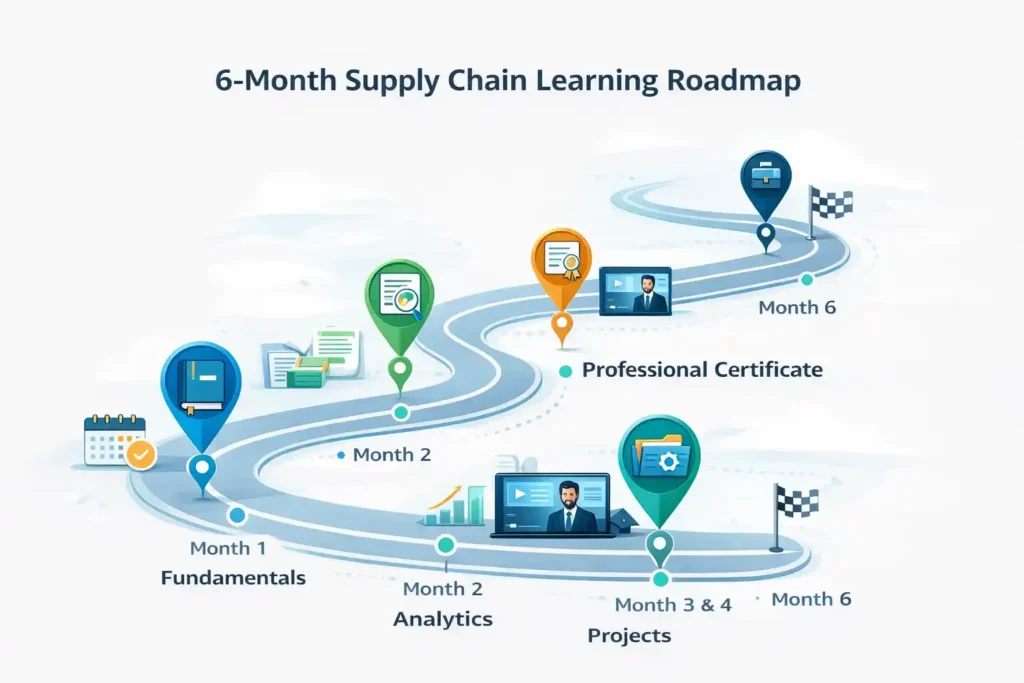
How to build a 6‑month learning path with supply chain courses?
Times Needed: 180 Days
Estimated Cost: 300 USD
Description: Design and complete a 6‑month learning path using the best supply chain courses to move toward an analyst or operations management role.
Steps:
Step 1: Clarify your target supply chain role
Choose one primary role, such as analyst or logistics planner, and note 5–7 required skills from current job descriptions.
Step 2: Select a fundamentals plus certificate combo
Enroll in a short fundamentals course first, then add one professional certificate or specialization that covers analytics, planning, and real‑world projects.
Step 3: Allocate weekly study and project time
Block 5–7 hours per week for lectures, 3–4 hours for assignments, and at least 2 hours for building a personal project portfolio.
Step 4: Build a portfolio with 2–3 SCM projects
Turn course assignments into polished projects, documenting problem statements, data used, tools applied, and measurable impact or insights.
Step 5: Connect learning to job applications
Update your resume, LinkedIn, and interview stories with course skills, certifications, and project outcomes that show business value.
Tools Name: Excel or Google Sheets, Supply chain course platforms, LinkedIn
Materials Name: Course syllabi, Public logistics datasets, Job descriptions
This structured approach mirrors how successful candidates combine learning platforms, portfolio projects, and targeted job applications to convert supply chain training into tangible career moves.
Resources and Tools for Your Supply Chain Learning Path
- Online supply chain course catalogs for comparing multiple programs and filtering by level, duration, and skills.
- University career‑outcome pages for specialized supply chain master’s programs, showing placement data and industry roles.
- Employment outlook reports and industry blogs detailing growth rates and salary trends in logistics and supply chain careers.
- Professional networking platforms listing short supply chain and operations courses for continuous upskilling.
Disclaimer: This article is for educational purposes and does not recommend any single paid course provider. Always verify current fees, curriculum, and accreditation directly on official course pages.
FAQ
Yes, supply chain courses are highly worthwhile because industry reports show strong job growth, high job security, and rising demand for skilled professionals.
Beginners should start with fundamentals courses that cover planning, sourcing, and logistics, then progress to a professional certificate that includes hands‑on projects.
An MBA is helpful but not mandatory; many professionals advance using specialized supply chain certificates, analytics skills, and strong project experience.
Short courses may take 4–6 weeks, while professional certificates and specializations typically run 3–9 months depending on pace and depth.
Reputable online programs from trusted platforms and universities are widely accepted, especially when you can show real‑world projects and measurable outcomes.
Start with end‑to‑end supply chain fundamentals, basic Excel‑based analytics, and core topics such as inventory, demand planning, and logistics operations.
Yes, structured learning paths and certificate programs are commonly used by professionals moving from finance, engineering, or general management into supply chain roles.
The supply chain field has transformed significantly. Digital technologies, automation, and AI are now central to operations rather than peripheral. Companies need professionals who understand both traditional logistics and modern digital tools. Additionally, India’s logistics market is projected to reach $357 billion by 2030, creating unprecedented demand for skilled talent that current education pipelines cannot meet.
India is experiencing a logistics boom driven by e-commerce expansion, manufacturing growth, and government initiatives like PM Gati Shakti and Make in India. The supply chain management market is expected to reach $2,328.7 million by 2030. However, there’s a significant talent gap, meaning qualified professionals have strong job prospects and competitive salaries.
While possible, it’s becoming increasingly difficult. Modern supply chain roles require proficiency with enterprise tools like ERP, WMS, and TMS systems that self-learners rarely access. Additionally, employers increasingly look for industry-recognized credentials. Structured courses provide hands-on tool experience, practical case studies, and placement support that significantly improve job prospects.
It depends on the pathway. Certificate programs take 4-6 months. Diploma courses typically run 1-2 years. Degree programs are 3-4 years. Many programs include internships that can lead directly to job offers. For working professionals, executive programs offer faster upskilling options.
Entry-level roles typically pay ₹3-6 LPA. With 3-5 years of experience, salaries rise to ₹6-15 LPA. Senior positions like Supply Chain Manager can earn ₹8-18+ LPA. Professionals with digital skills and automation experience often command 15-20% premiums, especially when changing employers.
Supply Chain Analysts, Logistics Planners, Operations Managers, and Procurement Specialists see consistent demand. Emerging roles in digital supply chain (ERP implementation, automation, AI-driven analytics) are growing rapidly. E-commerce logistics and 3PL providers are particularly active hiring sectors.
Key Takeaways: Best Supply Chain Courses 2026
- A structured 6‑month learning roadmap, combined with a project portfolio and targeted applications, turns courses into tangible career growth.
- Supply chain courses are strategically important in 2026 due to strong projected job and industry growth across logistics and operations.
- The best programs are judged by industry relevance and skills coverage—fundamentals, analytics, risk, and digital tools—not brand names alone.
- Early‑career professionals benefit most from fundamentals plus professional certificates that include real‑world projects and analytics practice.
- MBA aspirants should prioritize university‑backed specializations and advanced programs that emphasize global strategy, resilience, and technology.
Next Steps: Turn Courses into Career Growth
- Define your target supply chain role (analyst, planner, operations manager, procurement) by reviewing 5–10 current job descriptions.
- List the top 8–10 skills that appear repeatedly (e.g., demand planning, Excel, ERP, logistics) and group them into fundamentals, analytics, and leadership.
- Shortlist 3–5 of the best supply chain courses that strongly cover these skills, mixing a fundamentals course with at least one professional certificate or specialization.
- Plan a 6‑month learning schedule with weekly time blocks for lectures, assignments, and building 2–3 portfolio projects from course work.
- Update your resume and LinkedIn to highlight new skills, certifications, and projects, then apply to roles that explicitly value those capabilities.
- Continue learning every quarter with short, focused modules in analytics, digital supply chain tools, or industry‑specific topics (e‑commerce, manufacturing, logistics).
For readers of StartupMandi, this is an ideal moment to align your supply chain learning strategy with broader career plans in operations, consulting, or analytics.
Conclusion
In 2026, the best supply chain courses are the ones that match your target role, teach in‑demand skills, and fit your time and budget—not just the biggest brand names. By using a skills‑first checklist, comparing course types, and following a 6‑month learning plan, you can move confidently toward roles in analytics, planning, operations, or procurement. To go deeper, explore more StartupMandi guides on supply chain careers, MSME operations, and logistics tools, and use them to design a learning and career strategy that fits your profile. When you are ready to implement these skills in a real business, come back to StartupMandi for insights, resources, and services that support Indian startups and MSMEs at every stage.