



Introduction
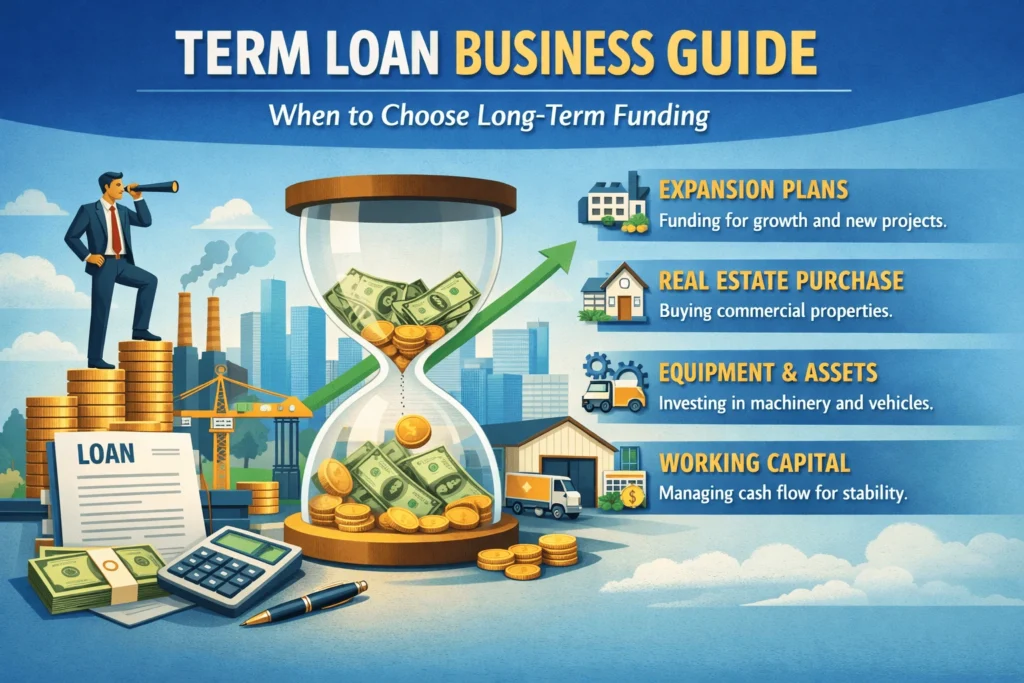
A term loan business decision can define your growth trajectory for years. Recur Club’s guide explains that term loans provide lump‑sum capital for long‑term investments like machinery, expansion, or acquisitions, with fixed EMIs over 2–15 years. Moreover, Investkraft’s 2025 term loans guide notes that they are ideal when your projected cash flows can comfortably service debt without choking working capital.
Understand what term loans actually are and when they beat other debt.
Learn key eligibility and application steps for term loans for small businesses.
See rate, tenure, and cost benchmarks for 2026.
Compare term loans vs short‑term, equity, and alternatives.
Follow a simple checklist to qualify and choose wisely.
What makes a term loan business decision right?
Core features of term loans
GeeksforGeeks defines term loans as fixed‑tenure debt for capital expenditure or growth projects, distinguishing them from working‑capital lines or overdrafts. Recur Club adds that term loans suit businesses needing large, lumpy investments that generate returns over multiple years.
Typical characteristics:
Lump sum disbursal upfront.
Fixed EMIs over 2–15 years tenure.
Interest rates ~9–16% for MSMEs, secured or unsecured depending on lender.
Collateral often required for amounts above ₹5–10 lakh.
Because repayments are predictable, they help you plan cash flows around long‑term growth.
When term loans beat short‑term debt or equity
Recur Club’s financing playbook shows term loans for small businesses shine when:
You fund machinery, factories, or branches that pay off in 3–10 years.
Your business has stable, growing revenues to service EMIs.
You want to avoid dilution from equity while keeping control.
GeeksforGeeks lists advantages like large funding availability, operational stability, and lower cost than equity. However, they also note fixed obligations and collateral risk as downsides compared to flexible lines.

- Subscribe Now This product has multiple variants. The options may be chosen on the product page
- USD: $ 99.98
- Subscribe Now This product has multiple variants. The options may be chosen on the product page
- Select options This product has multiple variants. The options may be chosen on the product page
- USD: $ 749.98 - $ 4,916.65
- Subscribe Now This product has multiple variants. The options may be chosen on the product page
- USD: $ 6.65
- Select options This product has multiple variants. The options may be chosen on the product page
- USD: $ 8.32 - $ 83.32
- Subscribe Now This product has multiple variants. The options may be chosen on the product page
Eligibility and how to qualify for term loans
Core requirements lenders check
Investkraft’s term loans guide outlines standard eligibility for term loans for small businesses in India:
Business vintage: 3+ years in operation (some NBFCs accept 2 years).
Turnover: ₹40 lakh–₹2 crore+ annually, depending on lender and loan size.
Credit score: CIBIL 700+ for good rates; 680+ minimum for many.
Financials: 2 years of ITR, audited P&L, balance sheet, and projections.
Recur Club notes that stable cash flows matter more than current profits; lenders want assurance you can service EMIs.
Documents you will need
Manba Finance and similar checklists list standard papers:
- KYC – PAN, Aadhaar, passport / voter ID.
- Business proof – Udyam / MSME registration, GST, shop act, MOA.
- Financials – 3 years ITR, 2 years audited financials, bank statements.
- Collateral details – property papers, valuation reports if applicable.
- Purpose proof – quotations, contracts, or purchase orders for the project.
Prepare these in digital format to speed up the process.
Interest rates, tenure, and application roadmap
Rate and tenure benchmarks 2026
Investkraft shows term loan rates typically range 9–16% p.a. for MSMEs, with banks at the lower end and NBFCs slightly higher for faster processing. Tenure stretches 2–15 years, depending on purpose (shorter for working capital, longer for real estate).
Recur Club’s platform compares:
Secured term loans: 9–12%, up to ₹10 crore+.
Unsecured term loans: 12–16%, up to ₹2–5 crore.
SME term loans: 10–14%, often with government subsidies.
Choose tenure based on your project payback period to avoid cash‑flow strain.
5‑step roadmap to apply
GeeksforGeeks and Recur Club outline similar flows:
Match loan to need: confirm term loan fits your long‑term CAPEX or growth.
Check eligibility: verify vintage, turnover, credit, and documents.
Shortlist lenders: compare banks, NBFCs, platforms like Recur Club for offers.
Submit application: upload financials and project details online.
Negotiate and close: review sanction letter, sign agreements, receive funds.
Recur Club claims 48‑hour approvals for qualified profiles via their lender network.
Conclusion
A term loan business choice is powerful when it matches your long‑term growth needs with predictable repayments. Recur Club, GeeksforGeeks, and Investkraft agree that term loans shine for machinery, expansion, and acquisitions, offering lower cost than equity and stability compared to short‑term debt. With 3+ years of operations, solid credit, and clean financials, you unlock rates and tenures that fuel sustainable scaling.
Disclaimer
This blog is for educational purposes only and does not provide financial, legal, or investment advice. Term loan products, interest rates, eligibility criteria, and documentation change frequently across banks and NBFCs. Always verify current terms with lenders or qualified advisors before applying. Borrowing involves fixed repayment obligations and potential collateral risk.
FAQs
Q1. What exactly is a term loan business product?
It is a lump‑sum loan with fixed EMIs over 2–15 years, typically used for CAPEX, machinery, or expansion where the investment generates returns over multiple years.
Q2. When do term loans for small businesses make more sense than short‑term loans?
Choose term loans when you fund long‑payback assets like factories or equipment, rather than short‑cycle needs like inventory, which suit working‑capital lines.
Q3. What minimum eligibility do most term loan lenders expect?
Typically 3+ years in business, ₹40 lakh+ turnover, CIBIL 700+, plus 2 years of financials and project details; some NBFCs are slightly more flexible.
Q4. Are term loans cheaper than equity for small businesses?
Yes, term loans avoid ownership dilution and often carry lower effective costs than giving away 20–30% equity, though they require repayment discipline.
Q5. How can StartupMandi help with term loan business decisions?
StartupMandi can match your project to lender types, prepare your financial story, compare term loan offers, and help you structure debt alongside equity for optimal capital mix.
Referring Blog / Fact Source Links
- Recur Club | How to Choose the Best Long-Term Sources of Finance for Your Growing Business
- Recur Club | Why Every Growing Business Needs Finance in 2025
- Long-Term Financing : Sources, Importance, Advantages & Limitations – GeeksforGeeks
- Term Loans in India: A Complete Guide for Businesses 2025
- Recur Club | Loans or Advances? Finding the Right Fit for Your Growth Stage
Dikshant Choudhary
I’m Dikshant Choudhary, a University of Delhi student and freelance writer specializing in SEO blogs, transcription, and business analysis. I create engaging, research-driven content for academic and client projects with creativity and discipline.