


Introduction: The Gateway to Startup Growth
Early-stage venture capital is the lifeblood of innovation. It transforms ambitious ideas into thriving businesses by providing founders with capital, mentorship, and market access during their most critical growth phase. Today’s startup ecosystem thrives because early-stage VC firms strategically invest in pre-revenue and early-revenue startups—companies that would otherwise struggle to survive the product-market fit journey. If you’re building a startup in India, understanding this funding landscape is no longer optional; it’s essential.
In 2024, India’s startup ecosystem continued its impressive growth trajectory, with over 125,000 registered startups and 110+ unicorns. Yet only a fraction secure meaningful venture capital funding. Why? Because most founders don’t understand the mechanics, expectations, and timelines of early-stage VC. This comprehensive guide demystifies the entire process.
What Is Early Stage Venture Capital and Why Does It Matter?
Early-stage venture capital refers to equity investments in startups at pre-seed, seed, and Series A stages, before the company reaches profitability or significant revenue. Unlike traditional bank loans, VC funding trades equity ownership for capital and strategic guidance.
Here’s why it matters:
- Accelerates product development – Capital enables faster iteration and market validation
- Attracts top talent – Funded startups offer equity packages that appeal to experienced professionals
- Builds credibility – VC backing signals market confidence to customers and partners
- Provides mentorship – Investors bring decades of operating experience
The numbers tell the story. In 2024, global early-stage VC funding reached $37 billion in Q4 alone—representing a 20% quarter-over-quarter increase. India captured its share, with seed and early-stage investments showing renewed momentum despite global macro uncertainty.
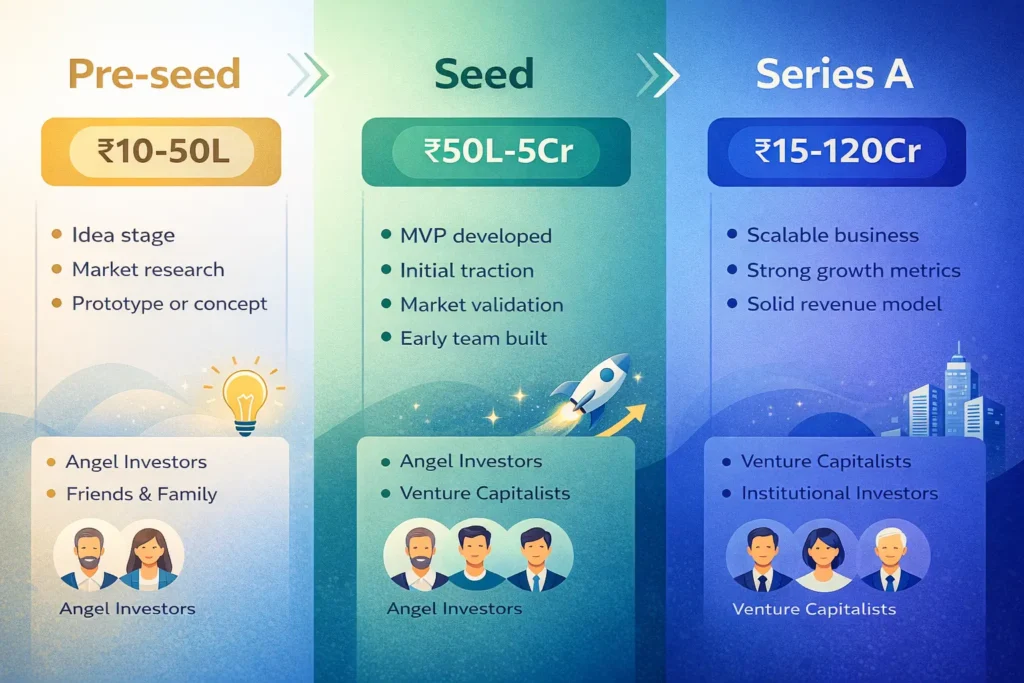
The Three Stages of Early-Stage Venture Capital Explained
Pre-Seed: The Founder’s First Bet
Pre-seed funding typically ranges from ₹10-50 lakhs in India and comes from angel investors, accelerators, and micro-VCs. At this stage, you often have:
- A validated problem statement
- A founding team with relevant expertise
- Basic MVP or proof of concept
- 100+ active users or ₹50K+ monthly revenue signals
Who funds pre-seed? Angel networks like Indian Angel Network, early-stage platforms like 100X.VC, and accelerators like Antler India.
Timeline: 3-6 months to close
Seed Funding: Proving Product-Market Fit
Seed rounds typically range from ₹50 lakhs to ₹5 crores and represent the inflection point where product-market fit begins emerging.
Investors expect to see:
- ₹5+ lakhs monthly recurring revenue (MRR)
- 10,000+ monthly active users (or equivalent engagement metrics)
- Clear product differentiation
- Experienced founding team (ideally with 1-2 founders with prior success)
Key seed stage investors in India:
- Sequoia Spark (₹2-5Cr range)
- Blume Ventures (₹1-3Cr)
- Prime Venture Partners (B2B SaaS specialist)
- Accel Atoms (fast-track initiative)
Timeline: 4-8 months to close
Series A: Scaling to Market Leadership
Series A funding typically ranges from ₹15-120 crores, with median rounds at ₹20-50 crores for Indian startups. This capital fuels rapid scaling.
Series A investors scrutinize:
- ₹2-3 crores+ annual recurring revenue (ARR)
- Unit economics and customer acquisition cost (CAC) payback
- Market size and competitive positioning
- Path to sustainability and profitability
- Product-market fit evidenced by retention metrics
Who leads Series A?
- Sequoia Capital India (₹25-100Cr)
- Matrix Partners (enterprise focus)
- Lightspeed India (consumer & B2B)
- Elevation Capital (growth specialist)
Timeline: 5-10 months to close
| Stage | Funding Range (INR) | Key Metrics | Investor Type | Timeline |
|---|---|---|---|---|
| Pre-Seed | ₹10L-50L | Idea + 100+ users | Angels, Accelerators | 3-6 months |
| Seed | ₹50L-5Cr | ₹5L MRR, 10K+ users | Seed VCs, Syndicates | 4-8 months |
| Series A | ₹15-120Cr | ₹2-3Cr ARR, Clear PMF | Tier-1 VCs | 5-10 months |
The Paradigm Shift: What Early-Stage VC Investors Want in 2026
The venture capital landscape has fundamentally changed. The “growth at any cost” era ended in 2023. Today’s investors evaluate founders through a new lens of efficiency and sustainability.
The Top 5 Investor Priorities
1. Differentiated Business Model (57% of investors prioritize this)
Generic ideas don’t attract capital. Investors ask: “Why does your solution work better than alternatives?”
- Focus on specific problem-solving rather than broad platform plays
- Demonstrate unique technology, distribution advantage, or team differentiation
- Show evidence of customer desperation for your solution
2. Strong Founding Teams with Proven Experience
43% of early-stage deals in India now involve founders with prior startup experience or domain expertise. The solo founder archetype is virtually extinct in VC conversations.
Investors evaluate:
- Industry expertise relevant to the problem
- Prior execution experience (successful exits or scaled companies)
- Complementary skills within the co-founder team
- Skin in the game – founder capital commitment demonstrates conviction
3. Early Revenue Traction
The age of zero-revenue funding rounds has passed. Only 36% of early-stage investors funded more than 20% pre-revenue companies in 2024—down sharply from 64% in 2023.
Revenue accelerates credibility. Even ₹50K monthly revenue demonstrates:
- Customer willingness to pay
- Product-market resonance
- Operational discipline
4. AI and Deep-Tech Innovation (44% of all VC funding in 2026)
AI applications captured 44% of global venture capital investment in 2026, with startups in automated coding, robotics, and autonomous systems dominating deal flow.
If your startup doesn’t have AI at its core or leverage AI for competitive advantage, it faces a steeper uphill climb in fundraising conversations.
5. Capital Efficiency and Runway Planning
Median time between Series A and Series B stretched to 28-31 months—the longest period in over a decade. Investors now fund 18-24 month runways and expect founders to reach profitability milestones before the next round.
“The era of ‘growth at any cost’ is officially over. Even at the seed stage, investors expect a credible path to sustainability, emphasizing efficiency over blitzscaling.” – Venture Capital Insights Report 2025
How to Prepare Your Startup for Early-Stage VC Funding
Before You Start Pitching
Step 1: Validate Your Problem (2-3 months)
- Conduct 50+ customer interviews
- Document pain points and willingness to pay
- Identify competitive landscape
- Size the addressable market (TAM)
Step 2: Build a Compelling MVP (3-6 months)
- Create minimum viable product with core features only
- Focus on solving the primary pain point exceptionally well
- Achieve 100+ beta users or pilot customers
- Collect customer testimonials and case studies
Step 3: Demonstrate Initial Traction (1-3 months)
- Hit ₹50K monthly revenue or 10,000+ monthly active users
- Show month-over-month growth rate (30%+ is investor-friendly)
- Calculate unit economics: CAC, LTV, payback period
- Build retention metrics proving product-market fit
Step 4: Structure Your Founding Team
- Ensure CEO has prior founder or scaling experience
- Hire CTO/technical co-founder if you’re non-technical
- Bring relevant domain expertise into the core team
- Keep equity distributed fairly (founder pool should be 50-60% post-dilution)
Step 5: Prepare Essential Documents
- Pitch deck (15-20 slides)
- Financial projections (3-year P&L, cash flow forecast)
- Cap table (clear cap table with no cloudy equity history)
- Intellectual property documentation
- Customer contracts demonstrating revenue
How to Find and Approach Early-Stage Investors
Channels for Finding Your Investors
1. Angel Networks (Best for Pre-Seed)
- Indian Angel Network
- LetsVenture
- AngelList India
- Venture Catalysts
2. Accelerator Programs
- Sequoia Spark
- Antler India
- Google for Startups Accelerator
- JioGenNext
3. VC Databases and Platforms
- Crunchbase Pro (filter by stage, sector, geography)
- PitchBook
- Tracxn
- CB Insights
4. Warm Introductions (Highest conversion)
- Seek intros through existing portfolio companies
- Leverage customer relationships
- Connect through advisors or mentors
- Use your personal network strategically
How to Approach Investors Successfully
The 10-Point Outreach Checklist:
- Research deeply – Know the investor’s portfolio companies, investment thesis, and recent activity
- Seek warm introductions – Never cold email; 15% response rate vs. 1% cold outreach
- Personalize your message – Reference specific portfolio companies and why you’re aligned
- Lead with traction – “We’ve hit $1M ARR in 18 months” is stronger than the problem statement
- Show unfair advantages – Emphasize unique positioning (team background, partnerships, technology)
- Ask for specific feedback – “Would appreciate 15 minutes on product-market fit questions”
- Respect their time – Keep initial message to 3-4 sentences
- Follow up strategically – One follow-up after 1 week, then stop (avoid aggressive persistence)
- Demonstrate investor alignment – Your use of capital should match their investment thesis
- Build relationships before asking – Share articles, invite to events, add value upfront
[Internal Link: For more actionable fundraising strategies and success stories, read our guide on SBA Loans and Alternative Funding Pathways]
Early-Stage VC Funding in India: Government Programs and Support Systems
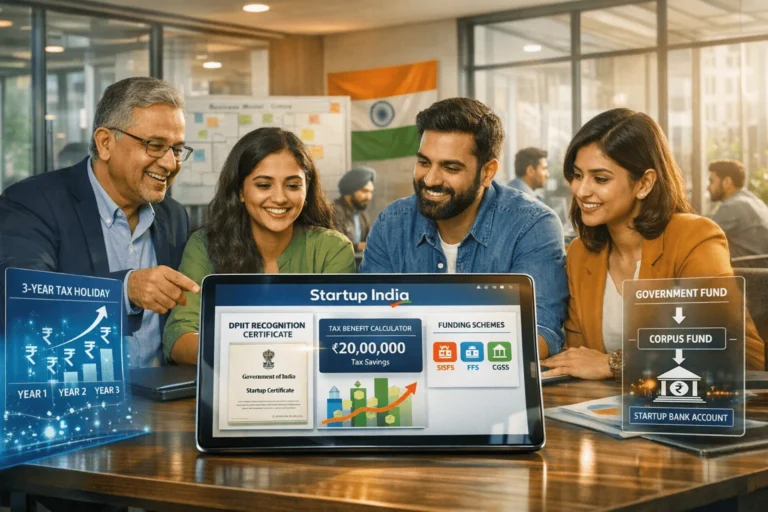
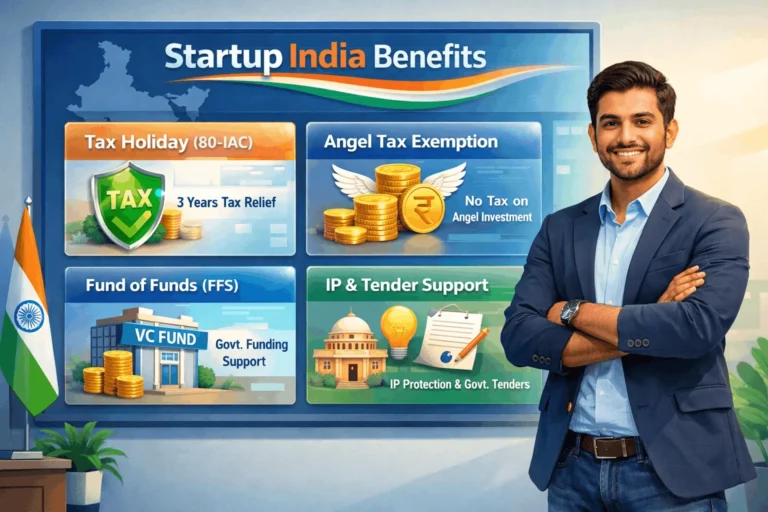
India’s government has invested heavily in supporting early-stage startups through multiple schemes. Understanding these is crucial because they often complement private VC funding.
Startup India Seed Fund Scheme (SISF)
Maximum Support: ₹70 lakhs per startup
- Grant: Up to ₹20 lakhs for prototype development and regulatory approvals
- Investment: Up to ₹50 lakhs as equity or debt instruments
- Focus: Deep tech, biotech, healthcare, agricultural innovation, social ventures
Disbursement Status: ₹604.16 crores allocated since launch
Apply at: seedfund.startupindia.gov.in
SAMRIDH Scheme (Support for Advancement in Research and Innovations)
Maximum Support: ₹40 lakhs for early-stage companies
- Financial support for deep-tech and digital innovation
- Bonus: Access to leading accelerators (Sequoia Spark, Y Combinator)
- Focus on climate tech, quantum computing, biotech
Credit Guarantee Scheme for Micro and Small Enterprises (CGSMSE)
Maximum Loan: ₹2 crores without collateral
- Term loans and working capital
- Interest rates starting from 8.5% (vs. 14%+ conventional)
- Covers 80% guarantee to lending banks
Impact: Since inception, over ₹27,000 crores in credit disbursed
The Early-Stage VC Fundraising Process: Month-by-Month Timeline
Months 1-2: Preparation Phase
- Select 20-30 target investors
- Refine pitch deck based on advisor feedback
- Gather warm introduction letters
- Prepare financial projections and cap table
Months 2-4: Outreach and Initial Meetings
- Launch targeted outreach campaign
- Attend pitch events and demo days
- Conduct first meetings (typically 20-30 minute coffee chats)
- Iterate messaging based on investor feedback
Months 4-6: Due Diligence Phase
- Select top 3-5 interested investors for deeper conversations
- Share data room with financial documents and customer references
- Participate in technical due diligence
- Address investor concerns proactively
Months 6-8: Term Sheet and Negotiation
- Negotiate valuation and investment terms
- Clarify investor rights, liquidation preferences, board seats
- Finalize legal documentation
- Prepare for closing
Months 8+: Closing and Post-Investment
- Final legal review and documentation
- Wire transfer of capital
- Board meeting kickoff
- Deployment of capital per pre-arranged milestones
Understanding Valuation and Cap Table Implications
How Early-Stage Valuations Are Determined
The SaaS Multiple Method (Most Common)
For B2B SaaS startups: Valuation = ARR × 7-10x (depending on growth rate and market conditions)
Example: SaaS startup with ₹1Cr ARR and 40% growth → Valued at ₹7-10 crores
Revenue Multiple Approach
For consumer businesses: Valuation = Revenue × 3-5x (lower multiples due to churn risk)
Venture Capital Method (VC Perspective)
VCs work backwards from exit value:
- Estimate likely exit value (5-7 years) = ₹500 crores
- Desired return on investment = 10x
- Post-money valuation for seed = ₹500Cr ÷ 10 = ₹50 crores
- Subtract current revenue/metrics to determine pre-money valuation
Cap Table Dilution Reality
| Round | Typical Dilution | Impact on Founders |
|---|---|---|
| Seed (₹1Cr) | 20-25% | Founders retain 75-80% |
| Series A (₹10Cr) | 25-30% | Founders drop to 50-60% |
| Series B (₹30Cr) | 25-30% | Founders drop to 35-45% |
| Series C (₹50Cr+) | 20-25% | Founders drop to 25-35% |
Pro tip: Maintain founder vesting schedules (4-year vesting with 1-year cliff) to demonstrate commitment to investors.
Common Early-Stage VC Mistakes and How to Avoid Them
Mistake #1: Raising Too Early Without Traction
The Problem: Pitching investors with only an idea and no revenue signals results in either rejection or heavily dilutive valuations.
The Fix: Wait until you’ve achieved ₹50K monthly revenue or 10,000+ active users. This single metric dramatically improves your negotiating position.
Mistake #2: Chasing Every Interested Investor
The Problem: Wasting time in meetings with investors who don’t align with your business model, growth stage, or sector focus wastes critical momentum.
The Fix: Create a target list of 20-30 ideal investors based on:
- Portfolio company fit (do they back companies like yours?)
- Ticket size alignment (do they invest at your stage?)
- Sector expertise (do they understand your market?)
- Geography preference (India-focused, Asia-focused, global?)
Mistake #3: Overselling and Over-Promising
The Problem: Ambitious projections (we’ll do ₹100Cr ARR in 2 years) damage credibility when reality differs.
The Fix: Build financial projections conservatively with:
- Conservative customer acquisition timelines
- Realistic churn assumptions
- 10-20% monthly growth (not 100%+)
- Clear assumptions documented for investor scrutiny
Mistake #4: Ignoring Investor Due Diligence Requirements
The Problem: Unorganized cap tables, missing customer contracts, or IP disputes discovered during due diligence kill deals at closing.
The Fix: Prepare a data room with:
- Clear, clean cap table (use Carta or Pulley)
- All customer contracts and ARR verification
- IP documentation (patents, trademarks, copyrights assigned to company)
- Financial records (last 12 months P&L and cash flow)
- Founder agreements and vesting schedules
- Board minutes and corporate resolutions
Mistake #5: Not Building Relationships Before Pitching
The Problem: First meeting = pitch meeting = low conversion. Investors invest in founders they know and trust.
The Fix: Build relationships months before official pitching:
- Attend investor events and conferences
- Share market insights with investors
- Ask for feedback on product without asking for money
- Build social proof through demo days and competitions
Early-Stage VC vs. Alternative Funding Options
Should you pursue venture capital or explore alternatives? Here’s how early-stage VC compares:
| Funding Type | Capital Range | Equity Loss | Timeline | Best For |
|---|---|---|---|---|
| Angel/VC | ₹50L-5Cr | 20-30% | 4-8 months | High growth, tech-enabled |
| Venture Debt | ₹50L-2Cr | 0% (interest-bearing) | 2-4 months | Revenue-generating, capital efficient |
| Government Grants | ₹20L-50L | 0% | 3-6 months | Deep tech, social impact, biotech |
| Crowdfunding | ₹10L-1Cr | 10-15% | 3-5 months | Consumer products, social ventures |
| Revenue-Based Financing | ₹50L-2Cr | 5-8% of revenue | 2-4 months | Profitable SaaS, recurring revenue |
Learn about alternative funding pathways and how to scale to your first sale with our guide on Dropshipping Business Models for 2026]
How-To: Launching Your Early-Stage Fundraising Campaign
Times Needed: Days: 120-180, Hours: Varies Daily, Minutes: Flexible
Estimated Cost: USD 15,000-25,000 (Accounting for: professional pitch deck design, legal due diligence preparation, travel for investor meetings, accountant support)
Description: A comprehensive 4-6 month fundraising campaign targeting ₹50-100 lakhs in seed funding. Includes investor research, outreach, meetings, and closing.
Steps:
Step 1: Foundation Setup (Week 1-4, ~20 hours)
Create your investor database by researching 50 potential investors using Crunchbase, AngelList, and Tracxn. Document their ticket size, sector focus, and portfolio companies. Identify which investors have backed competitors or adjacent companies. Use this data to filter your target list to top 25-30 investors.
Step 2: Pitch Materials Creation (Week 3-8, ~40 hours)
Develop a 15-slide pitch deck covering problem, solution, market size, business model, traction, financials, team, and funding ask. Create a 1-page executive summary and company one-pager. Have 3-5 advisors review and provide feedback. Iterate based on response patterns.
Step 3: Warm Introduction Strategy (Week 5-12, ~30 hours)
Map warm connections to each target investor through your network. Request introductions from:
- Existing portfolio founders (if any)
- Advisors and mentors with investor relationships
- Venture debt providers (often have investor connections)
- Industry conferences and events
Aim for 10-15 warm introductions in your first 8 weeks.
Step 4: Meeting Execution (Week 9-16, ~60 hours)
Conduct 20-30 investor meetings over 8 weeks. In each meeting: listen more than you speak, understand investor concerns, ask for specific feedback, request introductions to other investors. Track all feedback and iterate your pitch.
Step 5: Due Diligence Preparation (Week 12-20, ~50 hours)
Prepare your data room with all required documents. Conduct internal audit of cap table, IP, and contracts. Address any red flags proactively. Brief your founding team and key employees on potential investor questions.
Step 6: Term Sheet Negotiation and Closing (Week 16-26, ~40 hours)
Negotiate valuation, investor rights, board seats, and liquidity preferences. Engage a startup lawyer to review term sheets. Close the deal and prepare for post-investment onboarding with your new investor.
Tools Name: Crunchbase Pro, Tracxn, Carta (cap table management), Docsend (secure pitch deck sharing)
Materials Name: Pitch deck (15 slides), Financial projections (3-year model), Cap table (clean equity structure), Investor database (spreadsheet), Customer contracts, IP documentation
The Future of Early-Stage VC: 2026 and Beyond
What does the early-stage VC landscape look like as we enter late 2025 and 2026?
Key Trends Shaping Early-Stage Funding
1. Consolidation of Investor Base
Only 26% fewer unique investors participated in startup funding in 2024 compared to 2021. Capital is concentrating among proven, successful venture firms. Implication: Build relationships with top-tier investors early.
2. Deal Concentration Around Winners
Fewer startups are raising, but winners are raising larger rounds. Average venture round size jumped 28% to $15.5 million in 2024. This means you need differentiation to join the funded cohort.
3. AI Remains Dominant
AI startups attracted nearly $19 billion in 2024 alone. If your startup isn’t leveraging AI, you face steeper competition. Even non-AI startups now emphasize AI implementation in operations.
4. Sustainability Beats Hypergrowth
The 2021-2022 playbook (raise big, burn fast, achieve scale) is dead. Investors now reward:
- Unit economics discipline
- Path to profitability
- CAC payback in 12-18 months
- Retention rates above 90% (annually)
5. Venture Debt Reaches Record Highs
Venture debt hit record issuance in 2024. Many seed-stage startups now combine VC equity with venture debt to extend runway 6-12 months without excessive dilution.
FAQ: Your Early-Stage VC Questions Answered
Pre-seed typically ranges ₹10-50 lakhs for very early validation (idea + MVP + initial users). Seed funding at ₹50 lakhs-₹5 crores comes once you’ve demonstrated product-market fit signals. Think pre-seed as “does this problem exist?” and seed as “have we validated our solution works?”
No. Investors care about domain expertise relevant to your problem, execution track record, and your founding team’s ability to learn and adapt. Many successful founders come from engineering, product, or customer success backgrounds without business education.
Typical seed rounds dilute founders by 20-25%. So if you own 100% pre-seed, you’ll own ~75-80% post-seed. Ensure you reserve an additional 10-15% equity pool for employee stock option plans (ESOPs).
You’re in a strong position for seed funding. Usage metrics (daily/monthly active users, engagement rates, retention curves) can substitute for revenue if you demonstrate viral growth. Investors will ask: “What’s your monetization plan?” Have a credible answer.
4-8 months from first outreach to term sheet, then another 1-2 months for legal closing. Total timeline: 5-10 months. This assumes you have warm introductions and investor interest. Without traction signals, the process can extend indefinitely.
A down round means raising the next round at a lower valuation than the previous round. While painful, down rounds are sometimes necessary when:
Market conditions change dramatically
Initial assumptions about growth prove incorrect
Competitive dynamics shift
25% of early-stage companies in 2024 raised at flat or down valuations. It’s not ideal, but it’s survivable if used strategically to reach profitability.
For seed rounds, a good founder advisor or mentor is sufficient. For Series A and beyond, consider hiring a fundraising consultant if you’ve never raised before. Cost: ₹2-5 lakhs for advisory support. ROI justifies it if it helps you raise ₹1Cr+ at fair valuation.
Key Takeaways: Your Early-Stage VC Action Plan
- Build traction before pitching – Hit ₹50K monthly revenue or 10K+ active users. This single metric transforms your fundraising outcomes.
- Prioritize investor fit over money – Choose investors who understand your market, have backed similar companies, and can provide strategic value beyond capital.
- Prepare due diligence materials proactively – Clean cap table, customer contracts, IP documentation, and financial records prevent deal-killing surprises at closing.
- Embrace capital efficiency – The era of “grow at any cost” has ended. Investors now reward unit economics discipline and paths to sustainability.
- Leverage warm introductions – Your personal network is your most valuable fundraising asset. Spend time building relationships with advisors and mentors who can introduce you to investors.
- Understand valuation mechanics – Learn how your sector values companies (SaaS multiples, revenue multiples, or VC method). This knowledge improves your negotiating position.
- Plan for 28-31 month runways – Modern founding requires capital discipline. Budget for 24-30 months of runway post-seed, knowing Series A timelines have extended significantly.
- Explore government programs – India’s Startup India Seed Fund and SAMRIDH schemes provide non-dilutive capital up to ₹70 lakhs. These can supplement or replace part of your private VC raise.
Next Steps for Your Fundraising Journey
Immediate Actions (This Week)
- Document your current traction metrics (revenue, users, retention, growth rate)
- Create a list of 10 warm connections who might introduce you to investors
- Review your cap table for any cleanliness issues (missing documents, unclear equity history)
- Watch 3-5 pitch deck examples from successful Indian startups on YouTube or AngelList
Short-Term Actions (This Month)
- Develop a 15-slide pitch deck with feedback from 3 advisors
- Research 30 target investors using Crunchbase (filter by ticket size, sector, geography)
- Begin requesting warm introductions through your network
- Prepare financial projections for 3 years using conservative assumptions
Medium-Term Actions (Next 3 Months)
- Launch outreach campaign to 25-30 target investors
- Conduct 20+ investor meetings and iterate pitch based on feedback
- Prepare due diligence materials in organized data room
- Build relationships with 2-3 investors who might become champions for your round
Resources for Further Learning
- Startup India Portal – seedfund.startupindia.gov.in (Government schemes)
- Crunchbase – For investor research and market benchmarking
- Venture Intelligence – India-specific VC deal data and investor intelligence
- YCombinator Startup Library – Free resources on pitch, fundraising, and scaling
- Carta – Cap table management and equity administration
Conclusion: Your Pathway to Early-Stage VC Success
Early-stage venture capital represents the most transformational funding available to ambitious founders. It provides capital, strategic guidance, network access, and credibility—ingredients essential for building category-defining companies.
Yet accessing this capital requires understanding investor expectations, demonstrating real traction, and building authentic relationships with the right partners.
The founders succeeding in 2025 share three traits: They’ve built products solving real customer problems (evidenced by revenue or engagement), they’ve assembled complementary founding teams with relevant domain expertise, and they’ve approached fundraising as a long-term relationship-building process—not a sprint.
Your early-stage VC journey begins not with a pitch, but with solving a customer problem so compelling that investors become followers rather than gatekeepers.
Start building that traction today. Your funding will follow.
External Resources for Research & Fact-Checking