


startupmandi-blog-background

Investment Risks & Returns Explained: A Simple Guide for Smart Investors

Simple guide to investment risks and returns for beginners. Understand types of risk, expected returns, and how to balance both wisely.

Introduction

Simple guide to investment risks and returns is exactly what most new investors actually need 😊. Moreover, people hear phrases like ā€œhigh risk, high returnā€ without really knowing what they mean. Additionally, fear of losing money often stops them from investing at all. Therefore, this blog explains risk and return in very simple, practical language.

Summary:​

  1. What ā€œriskā€ and ā€œreturnā€ really mean in investing

  2. Why higher potential returns usually come with higher risk

  3. Main types of investment risk you should know

  4. Easy frameworks to balance risk and return for your goals

  5. How StartupMandi can support founders and professionals on this journey

Basics of investment risks and returns

What is ā€œreturnā€ in investing?

Return is the profit or gain you earn from an investment. If you invest ₹1,000 and it grows to ₹1,100, the extra ₹100 is your return, which equals 10%. Moreover, returns can come as interest, dividends, rent, or capital gains when prices rise.​

Different products target different levels of return. For example, fixed deposits aim for stable but lower returns, while equity funds aim for higher returns with more ups and downs. Therefore, understanding expected return helps you choose products aligned with your goals.

What is ā€œriskā€ in simple words?

NISM defines investment risk as the uncertainty that actual returns may differ from what you expect. In simpler terms, risk is the chance that you might earn less than planned, or even lose money. Moreover, if a return is fully guaranteed by a strong issuer, that particular part carries almost no risk.​

However, completely risk‑free assets often give returns lower than inflation. NISM notes that to beat inflation, you usually must accept at least one of these risks: price volatility, credit risk, or illiquidity. Therefore, the goal is not to avoid risk completely, but to understand and manage it.​

The risk–return trade‑off

Research from platforms like Tickertape and NISM repeatedly shows a direct relationship: higher potential returns usually come with higher risk. Safer investments generally offer lower returns. This balance is called theĀ risk–return trade‑off.​

Because of this, chasing only ā€œhigh returnā€ products without considering risk can be dangerous. Similarly, avoiding all risk and staying only in savings accounts may destroy long‑term purchasing power. Therefore, smart investors aim for returns that match their goals and risk tolerance.

Simple view of risk vs return

Product typeRisk levelReturn potentialTypical use case
Savings accountVery lowVery lowCash, emergency buffer
Bank FD / Govt schemesLowLow–moderateCapital protection
Debt mutual fundsLow–mediumModerateStability + some growth
Equity mutual fundsMedium–highHighLong‑term wealth building
Direct stocks, startupsHighVery highAggressive growth
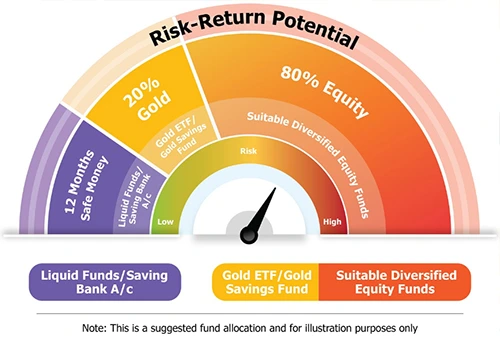
risk vs-return-12%-safe-20%-gold-80%-equity
Checkout Our Latest Services

Main types of investment risk you should know

Market and price volatility risk

Market risk is the chance that your investment’s price will move up and down with market conditions. NISM explains that volatile assets often have higher return potential but show bigger short‑term swings. Moreover, global events, interest rates, and sentiment can all trigger temporary price drops.​

However, for long‑term investors, this volatility can matter less if the underlying fundamentals remain strong. Staying invested through cycles, instead of reacting to every headline, often improves actual outcomes. Therefore, time in the market becomes a powerful risk‑management tool.​

Credit and default risk

Credit risk is the possibility that a borrower will not repay interest or principal on time. Debt mutual funds, corporate bonds, and some fixed‑income instruments carry this risk. If the issuer’s financial position weakens, your returns may be delayed or reduced.nism+1​

Because of this, many educators recommend checking credit ratings and diversification across issuers. Government securities usually carry lower default risk than corporate issuers, yet they may also offer lower yields. Therefore, you must balance safety with desired return.

Liquidity and inflation risk

Liquidity risk is the difficulty of selling an investment quickly at a fair price. For example, some small‑cap stocks, real estate, or complex products may take time to exit. Moreover, if you suddenly need cash, illiquid assets can create stress.​

Inflation risk means your money’s real value falls over time if returns are too low. NISM notes that assets avoiding market, credit, and liquidity risk often deliver returns lower than inflation. Therefore, to truly grow wealth, you generally accept some controlled level of risk.

Checkout Latest Grants Listed

How to balance investment risks and returns

Know your risk tolerance and time horizon

Risk tolerance is your emotional and financial ability to handle ups and downs. A long‑term investor with a stable income may accept more volatility than someone nearing retirement. Moreover, your time horizon strongly shapes acceptable risk.

If your goal is 10–15 years away, you may afford more equity exposure. If your goal is 2–3 years away, capital protection becomes more important. Therefore, start by writing down each goal with its time frame and then match products accordingly.

Use diversification as your safety net

Diversification means spreading money across asset classes, sectors, and even countries. NISM and Tickertape both emphasise that diversification can significantly reduceĀ security‑specific risk, even though it cannot eliminate market‑wide risk.

For example, instead of buying one stock, you may use an equity mutual fund or index fund holding 30–50 companies. Additionally, mixing equity with some debt and cash helps smooth portfolio swings. Therefore, diversification becomes your main tool for managing risk while still targeting reasonable returns.

Simple framework: match product to purpose

One practical approach is to create three buckets:

  1. Safety bucket:Ā Cash, FDs, liquid funds for emergencies

  2. Growth bucket:Ā Equity mutual funds, index funds, selected stocks for long‑term goals

  3. Opportunity bucket:Ā Small portion for higher‑risk ideas like sector funds or startup equity

This framework, inspired by many beginner guides, prevents you from risking emergency money in aggressive assets. Moreover, it keeps your high‑risk experiments limited to what you can genuinely afford to lose.

Disclaimer: This framework is for education only. It isĀ notĀ personal financial advice. Always consider your own situation or consult a SEBI‑registered advisor.

Conclusion, FAQs and references

Conclusion: simplify, don’t avoid, investment risks and returns

The simple guide to investment risks and returns shows that risk is not your enemy. Instead, unmanaged and misunderstood risk is the real problem. Moreover, every meaningful return above inflation demands accepting some level of uncertainty.​

By learning basic concepts, diversifying thoughtfully, and matching products to goals, you can invest with more confidence. StartupMandi supports this journey by connecting founders and professionals with educational content, tools, and experts who respect both ambition and safety.

FAQsĀ 

What is the safest type of investment risk?

No investment is completely risk‑free, yet government‑backed securities and insured deposits often carry very low default risk. However, NISM warns that such products may still lose value against inflation in the long run.​

Does higher risk always mean higher return?

Higher risk means a wider range of possible outcomes, not a guaranteed higher return. Historical data shows that assets with higher expected return also suffer deeper drawdowns. Therefore, you should only take risk you can handle emotionally and financially.​

How can a beginner start managing risk?

Beginners can start by understanding goal timelines, using diversified mutual funds, and avoiding concentration in any single stock or theme. Guides from NISM and IfG recommend small, steady investments and regular reviews instead of big, emotional bets.

Should I stop investing when markets fall?

Many long‑term investors continue SIPs during market declines because lower prices mean more units for the same amount. Tickertape notes that maintaining discipline through cycles can improve long‑term results, provided your asset allocation is appropriate.​

When should I take professional advice?

If you feel confused by product choices, have multiple goals, or manage large sums, professional help can be valuable. NISM and other educators encourage investors to consult qualified, fee‑based, or SEBI‑registered advisors instead of relying on tips or social media.​

Referring blogs / fact sources

Dikshant Choudhary
Dikshant Choudhary

I’m Dikshant Choudhary, a University of Delhi student and freelance writer specializing in SEO blogs, transcription, and business analysis. I create engaging, research-driven content for academic and client projects with creativity and discipline.

Articles: 46

Leave a Reply

Your email address will not be published. Required fields are marked *