


Physics Wallah Share Price: From YouTube to Stock Market Success — Lessons for Startups
On November 18, 2025, Physics Wallah made history as India’s first edtech unicorn to debut on public stock markets, with shares listing at ₹145 on the NSE —a remarkable 33% premium over the issue price of ₹109. By the end of the trading day, Physics Wallah’s share price closed at ₹156.49, delivering a 44% gain to IPO investors and valuing the company at approximately ₹44,382 crore ($5.3 billion).
This unprecedented listing represents far more than a successful IPO; it validates a revolutionary business model built on affordability, accessibility, and sustainable growth in India’s volatile edtech landscape. As of November 19, 2025, Physics Wallah shares trade around ₹142-143, reflecting initial market volatility but maintaining substantial gains over the listing price.
For startups aspiring to replicate this success, Physics Wallah’s journey from a ₹30,000 YouTube channel to a publicly-listed unicorn offers invaluable lessons in market positioning, financial discipline, customer-centricity, and strategic scaling.
The Genesis: From Struggling Teacher to YouTube Sensation
The Physics Wallah story begins not in a boardroom or tech incubator, but in the modest classrooms of Allahabad (now Prayagraj), where Alakh Pandey—a college dropout with an unfinished B.Tech degree—taught physics for ₹125 per lecture. Born on October 2, 1991, to a middle-class family, Alakh experienced firsthand the stark divide between affordable and premium education when he tutored the children of wealthy families as a young student.
This experience planted the seed of a revolutionary idea: what if quality education could be accessible to everyone, not just those who could afford expensive coaching institutes?

Alakh Pandey with awards recognizing Physics Wallah’s educational entrepreneurship achievements
In 2016, with just ₹30,000 in capital, Alakh launched a YouTube channel called “Physics Wallah” to share free physics lessons. His teaching style—conversational, relatable, and free of academic jargon—resonated immediately with students preparing for competitive exams like JEE and NEET. What distinguished Alakh from countless other educators on YouTube was his genuine commitment to affordability and his authentic connection with students from Tier 2 and Tier 3 cities who couldn’t access premium coaching. Within months, his channel attracted millions of subscribers, creating a massive organic audience that would become the foundation of a billion-dollar business.
The turning point came in 2020 during the COVID-19 pandemic, when traditional coaching institutes shuttered and students desperately sought online alternatives. Recognizing this watershed moment, Alakh partnered with his childhood friend Prateek Maheshwari (also known as Prateek Boob) to formally register PhysicsWallah Private Limited and launch a mobile application.
Within days, the app attracted over 35,000 users—validating that the free YouTube content had created a ready-made customer base willing to pay for structured courses. This organic growth model, built on trust and brand equity rather than expensive marketing campaigns, would become Physics Wallah’s defining competitive advantage.
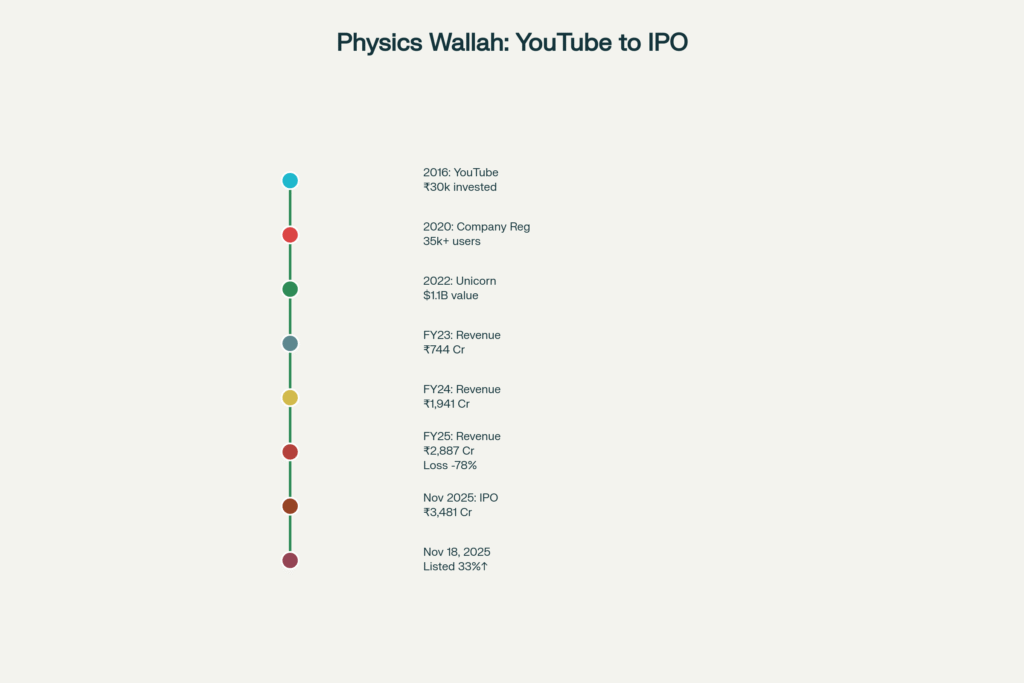
Physics Wallah’s remarkable 9-year journey from a ₹30,000 YouTube channel in 2016 to a successful IPO listing in November 2025, becoming India’s first edtech unicorn to go public
The Business Model: Hybrid Innovation in Edtech
Physics Wallah’s business model represents a fundamental departure from the venture capital-fueled “growth at any cost” approach that destroyed competitors like Byju’s and Unacademy. At its core, PW operates a freemium hybrid learning platform that combines free YouTube content, affordable paid online courses, and rapidly expanding offline coaching centers. This three-pronged approach addresses different customer segments while maintaining the company’s core value proposition of accessibility and affordability. [Source]
The online channel generates approximately ₹1,404 crore annually (48.6% of total revenue), offering structured courses priced dramatically lower than competitors—typically ₹1,008 for courses that rivals charge ₹20,000-50,000 for. This pricing strategy, enabled by high volumes and low customer acquisition costs (CAC), allows PW to capture price-sensitive students in Tier 2/3 cities while maintaining healthy unit economics. As of June 2025, the company managed 888 social media handles with 119.27 million subscribers and followers, making it one of the largest digital education networks globally. [Source]
The offline channel has emerged as a powerful growth driver, contributing ₹1,352 crore (46.8% of revenue) in FY25. Physics Wallah operates 198 offline and hybrid centers across 152 cities in India and the Middle East as of March 2025, up from just 126 centers the previous year—a 57% expansion. These centers, branded as PW Vidyapeeth and PW Pathshala, employ a innovative “two-teacher model” where one instructor delivers live classes from a studio while another is physically present for in-class engagement and doubt resolution. This structure enables simultaneous delivery across multiple centers while keeping costs significantly lower than traditional coaching institutes. [Source]
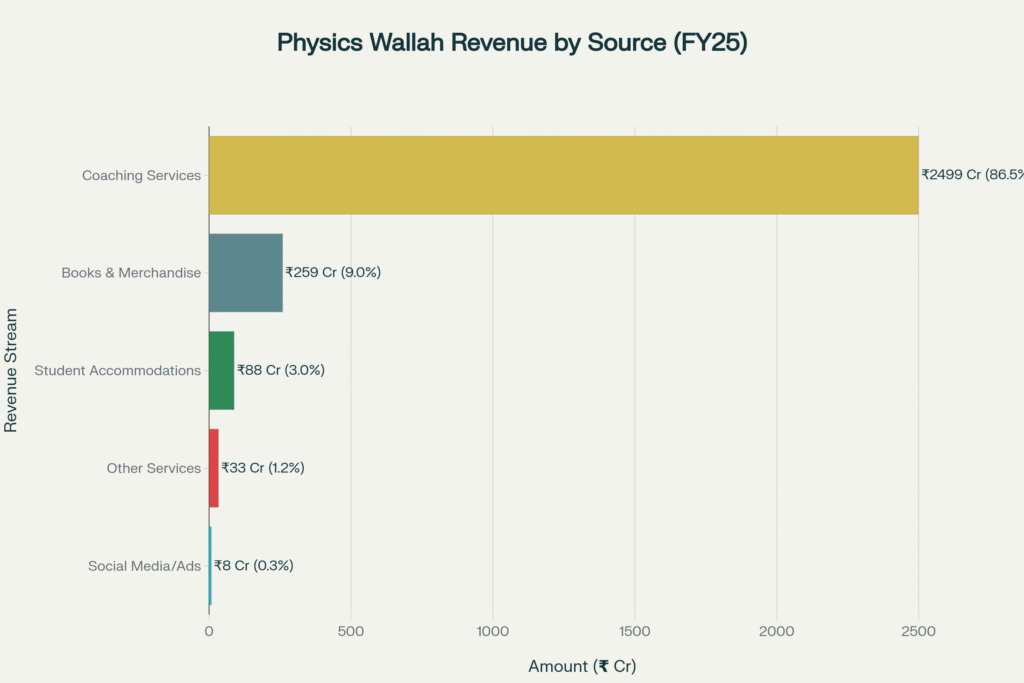
Physics Wallah’s diversified revenue model showing coaching services as the dominant revenue driver at 86.5% (₹2,499 crore), complemented by books, accommodations, and other educational services
Beyond coaching, Physics Wallah has diversified into complementary revenue streams that strengthen its ecosystem. Student accommodations generated ₹88 crore in FY25 (28% growth), providing hostels near coaching centers. Traded goods—primarily books, study materials, and merchandise sold through the PW Store and Amazon—contributed ₹259 crore (74% growth). Social media advertising adds another ₹8 crore annually from the company’s massive YouTube presence. This diversification reduces dependence on any single revenue source while creating multiple touchpoints that deepen customer relationships.
The company has also launched PW Skills, an upskilling platform offering affordable courses in coding, digital marketing, and data science, moving beyond traditional test preparation into the broader employment market. Additionally, PW has begun offering school-integrated programs where its content is bundled with schools for Class 6-12 students, creating an earlier entry point into the customer lifecycle.
Financial Performance: The Path to Profitability
Physics Wallah’s financial trajectory demonstrates that sustainable growth and profitability are achievable in edtech—contradicting the narrative established by unprofitable competitors. The company’s consolidated revenue surged 49% to ₹2,887 crore in FY25 from ₹1,941 crore in FY24, reflecting strong demand across both online and offline channels. Including other income of ₹152 crore, total income for FY25 stood at ₹3,039 crore.
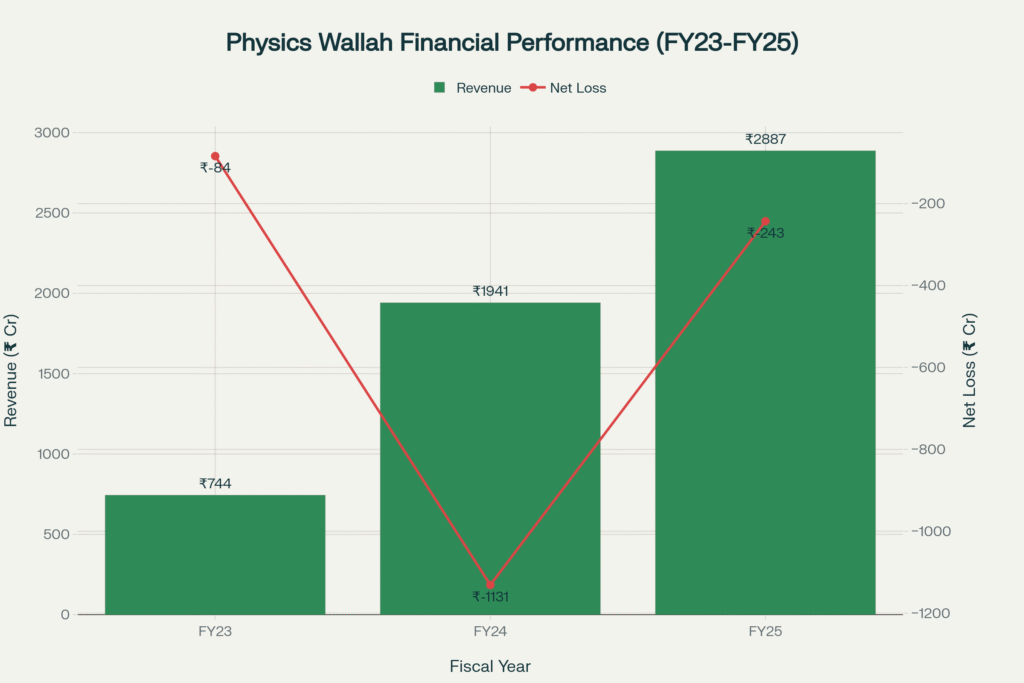
Physics Wallah’s impressive revenue growth from ₹744 crore to ₹2,887 crore over three years, alongside a 78% reduction in losses from FY24 to FY25, demonstrating strong financial trajectory toward profitability
More impressively, Physics Wallah achieved EBITDA profitability in FY25, posting positive EBITDA of ₹193 crore compared to an EBITDA loss of ₹829 crore in FY24. The company’s EBITDA margin improved dramatically to 6.7% from -42.7% the previous year, demonstrating operational efficiency gains as the business scales. This turnaround reflects management’s focus on unit economics and financial discipline rather than unsustainable growth.
While the company remains net loss-making, it narrowed consolidated losses by 78% to ₹243 crore in FY25 from ₹1,131 crore in FY24. Critically, the FY24 losses included a one-time non-cash charge of ₹756 crore for fair value loss on compulsorily convertible preference shares (CCPS), meaning the underlying operating performance was stronger than headline numbers suggested. The company reported positive operating cash flow of ₹507 crore and free cash flow of ₹340 crore in FY25, indicating the business generates actual cash rather than merely accounting profits.
This financial discipline extends to expense management. Despite 49% revenue growth, PW reduced total expenses by 0.4% to ₹3,265 crore in FY25 through careful cost control. Employee expenses rose only 21% to ₹1,401 crore despite headcount growing to 5,096 employees, suggesting improved productivity. Marketing expenses increased 41% to ₹276 crore—far more modest than the marketing burn rates at competitors who spent billions on celebrity endorsements and television advertising.
The company’s paid user base expanded to 4.46 million in FY25 from 3.63 million in FY24, with average revenue per offline user increasing to ₹40,405. This combination of growing user numbers and rising revenue per user creates powerful operating leverage as fixed costs are spread across a larger revenue base.
However, challenges remain. In Q1 FY26 (April-June 2025), revenue grew 33% to ₹847 crore but net losses widened to ₹127 crore from ₹72 crore in the same quarter last year, as total expenses rose 39% due to offline expansion costs. This quarterly deterioration highlights the ongoing tension between growth investments and profitability that management must carefully balance.
The Historic IPO: Validation and Market Reception
Physics Wallah’s IPO journey began in July 2025 when SEBI cleared the company’s confidential filing, followed by the updated Draft Red Herring Prospectus (DRHP) in September 2025. The final IPO, sized at ₹3,481 crore, comprised a fresh issue of ₹3,100 crore and an offer-for-sale (OFS) of ₹380 crore by founders Alakh Pandey and Prateek Maheshwari. The price band was set at ₹103-109 per share, with a minimum investment of ₹14,111 for a lot of 137 shares.
The IPO opened for bidding on November 11 and closed on November 13, 2025, receiving a subscription of 1.81 times overall. The response varied by investor category: Qualified Institutional Buyers (QIBs) oversubscribed 2.70 times, retail investors 1.01 times, employees 3.34 times, but non-institutional investors subscribed only 0.48 times. This mixed reception reflected caution among some investor segments about edtech sector risks and the company’s path to full profitability.
The grey market premium (GMP) for Physics Wallah shares fluctuated in the days before listing, initially remaining flat before recovering to ₹14 (approximately 13% premium), suggesting moderate investor enthusiasm. Some analysts attributed the muted pre-listing buzz to concerns about intense competition, the company’s still-negative net income, and memories of spectacular failures by edtech peers.
However, the actual listing on November 18, 2025 dramatically exceeded expectations. The stock debuted at ₹145 on NSE and ₹143.90 on BSE —representing a 33% listing premium. By 12:42 PM, shares climbed to ₹150.40, and the stock touched an intraday high of ₹162.05 before closing at ₹156.49—a remarkable 44% gain from the issue price. The company’s market capitalization at listing exceeded ₹44,000 crore, making it one of the most valuable edtech companies in India.
The strong debut reflected multiple factors: institutional investor confidence in PW’s hybrid model, the company’s improving financial trajectory toward profitability, founder Alakh Pandey’s strong brand equity among students, and Physics Wallah’s positioning as the “anti-Byju’s”—a profitable, sustainable alternative to the failed growth-at-all-costs model. As the first major Indian edtech IPO following Byju’s spectacular collapse, Physics Wallah’s listing sends a powerful signal that disciplined edtech companies can successfully access public markets.
Notably, early institutional investors including WestBridge Capital, Hornbill Orchid, and GSV Ventures did not sell shares in the IPO, retaining their stakes and signaling long-term confidence in the company’s prospects. The funds raised will support offline expansion (₹548 crore for lease payments, ₹461 crore for center fit-outs), marketing (₹710 crore), technology infrastructure (₹200 crore), and investment in subsidiary Xylem Learning (₹471 crore).
Key Success Factors: Why Physics Wallah Thrived While Competitors Failed
Physics Wallah’s success while competitors like Byju’s, Unacademy, and Vedantu struggled or collapsed reflects several critical strategic advantages:
1. Affordability-First Pricing Strategy
While competitors charged ₹20,000-50,000 for courses, Physics Wallah maintained pricing at ₹1,008 for online courses and ₹25,000-50,000 for comprehensive offline programs—dramatically undercutting rivals. This affordability wasn’t a marketing gimmick but a core philosophical commitment that resonated with the company’s target demographic of middle-class families in Tier 2/3 cities. By keeping prices low while maintaining quality, PW captured enormous market share among price-sensitive customers who couldn’t afford premium alternatives.
2. Organic Growth and Low Customer Acquisition Costs
Physics Wallah built a massive YouTube following of 119 million subscribers organically, creating a zero-cost marketing funnel that continuously generates awareness and trust. While competitors spent billions on celebrity endorsements and television advertising (Byju’s alone spent over ₹2,000 crore annually on marketing), PW’s marketing expenses remained modest at ₹276 crore in FY25. This fundamental difference in customer acquisition strategy meant PW could achieve profitability while competitors drowned in marketing expenses that produced unsustainable growth.
3. Founder-Driven Trust and Authenticity
Alakh Pandey’s personal brand and teaching style created deep emotional connections with students who saw him as a relatable mentor rather than a distant celebrity. His visibility on YouTube, authentic teaching approach, and commitment to affordability built a loyal community that defended the brand during challenges. This trust proved far more valuable than expensive marketing campaigns featuring Bollywood celebrities that competitors relied on.
4. Early Adoption of Hybrid Learning Model
Physics Wallah recognized earlier than competitors that the future of edtech lay in hybrid models combining online and offline elements. While competitors doubled down on pure online models during COVID-19, PW began building offline infrastructure in FY22, positioning itself perfectly for the post-pandemic return to physical learning. By FY25, offline and online channels contributed nearly equally to revenue (48.6% online, 46.8% offline), creating a balanced business less vulnerable to shifts in student preferences.
5. Financial Discipline and Unit Economics Focus
Unlike venture-backed competitors that prioritized growth at any cost, Physics Wallah maintained strict financial discipline, focusing on unit economics and sustainable growth. The company delayed raising institutional capital until 2022, achieving near-unicorn valuation in its first funding round and filtering out early-stage investors who might have pushed for aggressive unprofitable expansion. This patient approach allowed the company to build a sustainable business model before scaling aggressively.
6. Market Timing and Strategic Positioning
Physics Wallah entered the market at an opportune moment, leveraging the COVID-19 pandemic’s forced digitalization while avoiding the excessive valuations and competition that characterized the 2020-2021 edtech bubble. By the time competitors began collapsing in 2022-2023, PW had established a strong market position with differentiated brand identity as the “affordable, profitable edtech”.
Lessons for Startups: The Physics Wallah Playbook
Physics Wallah’s journey from YouTube channel to publicly-listed unicorn provides invaluable lessons for aspiring entrepreneurs:
Lesson 1: Build Organic Trust Before Scaling
Alakh Pandey spent four years building trust and brand equity through free YouTube content before monetizing through paid courses. This patient approach created a ready-made customer base that trusted the brand and willingly paid for premium offerings. Startups should prioritize building genuine trust and demonstrating value before aggressively pursuing revenue.
Lesson 2: Know Your Customer and Stay True to Your Mission
Physics Wallah succeeded by deeply understanding and serving Tier 2/3 city students who couldn’t afford expensive coaching. The company resisted the temptation to chase premium urban customers with higher willingness to pay, instead building massive scale by serving underserved markets. Startups must identify their core customer, understand their needs deeply, and resist mission drift even when competitors pursue different strategies.
Lesson 3: Unit Economics Matter More Than Valuation
While competitors raised massive funding at sky-high valuations, Physics Wallah focused on building sustainable unit economics before scaling. The company’s low customer acquisition costs, reasonable pricing, and efficient operations created a profitable business model that could scale sustainably. Startups should prioritize profitability and unit economics over vanity metrics like user growth or valuation.
Lesson 4: Diversify Revenue Streams and Reduce Risk
Physics Wallah didn’t rely solely on online courses but built a diversified revenue model including offline coaching, books, accommodations, and upskilling. This diversification reduced dependence on any single channel and created multiple growth vectors. Startups should identify adjacent revenue opportunities that leverage existing assets and customer relationships.
Lesson 5: Capital Efficiency and Financial Discipline
By delaying institutional funding and bootstrapping initially, Physics Wallah maintained control and avoided the pressure to pursue unsustainable growth. When the company did raise capital, it did so at a near-unicorn valuation, minimizing dilution. Startups should view capital as a tool to accelerate proven models, not as validation to experiment with unproven strategies.
Lesson 6: Adapt to Market Realities
Physics Wallah’s pivot to hybrid learning demonstrated willingness to adapt to changing customer preferences rather than dogmatically adhering to an online-only model. This flexibility allowed the company to capture post-pandemic demand for in-person learning while competitors struggled with pure online models. Startups must remain flexible and responsive to market signals, adjusting strategies when customer behavior shifts.
Lesson 7: Founder-Led Growth and Authentic Leadership
Alakh Pandey’s visible, authentic leadership created powerful brand differentiation and customer loyalty. His personal story of struggle and success resonated with students facing similar challenges. Founders should leverage their personal narratives and authentic connections with customers to build emotional brand equity that competitors cannot easily replicate.
Challenges and the Road Ahead
Despite its impressive IPO, Physics Wallah faces significant challenges. The company remains net loss-making, with profitability dependent on continued revenue growth and expense control. Competition from established coaching institutes, emerging edtech players, and free online resources remains intense. The offline expansion strategy requires substantial capital investment with uncertain returns, as evidenced by Q1 FY26’s widening losses despite revenue growth.
Additionally, Physics Wallah operates in a sector that has seen spectacular failures, creating lingering investor skepticism about long-term sustainability. The company must demonstrate consistent quarterly profitability to validate its business model and justify its public market valuation. Regulatory changes affecting edtech, shifts in education policy, or changes in examination systems could materially impact the business.
However, the company’s strong fundamentals—positive cash flow, improving margins, growing user base, and diversified revenue—position it well to navigate these challenges. Management’s track record of financial discipline and strategic decision-making provides confidence that Physics Wallah can sustain its growth trajectory while moving toward full profitability.
Conclusion: Redefining Edtech Success
Physics Wallah’s journey from a ₹30,000 YouTube channel to a ₹44,000+ crore publicly-listed company represents more than a successful startup exit—it demonstrates a fundamentally different approach to building sustainable edtech businesses. While competitors pursued aggressive growth funded by billions in venture capital, Physics Wallah built a profitable, customer-centric business grounded in affordability, authenticity, and financial discipline.
The company’s successful IPO on November 18, 2025, with Physics Wallah share price listing at a 33% premium and closing 44% above issue price, validates this approach and sends a powerful signal to the Indian startup ecosystem: sustainable businesses built on solid unit economics can successfully access public markets even in challenging sectors. For entrepreneurs aspiring to build the next unicorn, Physics Wallah’s playbook—prioritizing customer trust over growth metrics, maintaining financial discipline over valuation maximization, and staying true to mission over chasing trends—offers a proven alternative to the failed “blitzscaling” strategies that destroyed competitors.
As Physics Wallah continues its journey as a publicly-traded company, its success will ultimately be measured not by listing gains but by its ability to sustain growth, achieve consistent profitability, and deliver on its founding mission of making quality education accessible to millions of Indian students. The company’s story reminds us that sometimes the most revolutionary approach is simply to do the basics well: understand your customers, deliver genuine value, manage finances prudently, and build for the long term.
The company has also launched PW Skills, an upskilling platform offering affordable courses in coding, digital marketing, and data science, moving beyond traditional test preparation into the broader employment market. Additionally, PW has begun offering school-integrated programs where its content is bundled with schools for Class 6-12 students, creating an earlier entry point into the customer lifecycle.
Financial Performance: The Path to Profitability
Physics Wallah’s financial trajectory demonstrates that sustainable growth and profitability are achievable in edtech—contradicting the narrative established by unprofitable competitors. The company’s consolidated revenue surged 49% to ₹2,887 crore in FY25 from ₹1,941 crore in FY24, reflecting strong demand across both online and offline channels. Including other income of ₹152 crore, the total income for FY25 stood at ₹3,039 crore.