

A certified online course only matters if hiring managers actually recognize and trust the credential. Within the next few minutes, you will learn how to separate employer‑valued certificates from flashy but weak badges, using data on microcredential acceptance, respected providers, and real hiring outcomes.
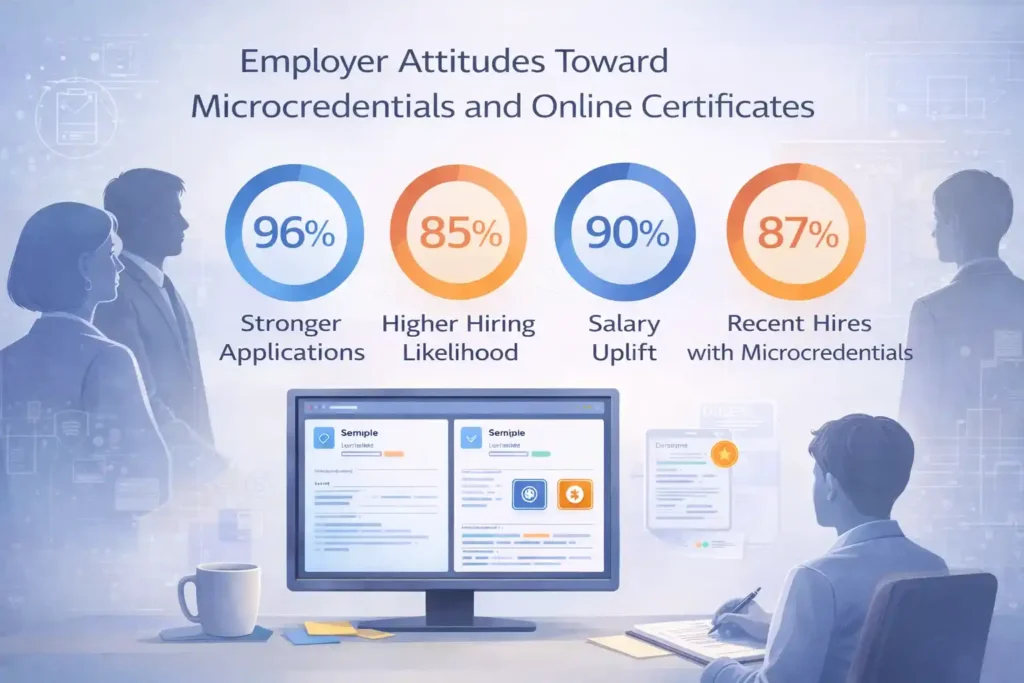
Recent employer surveys show that 96% of hiring managers believe microcredentials strengthen a candidate’s application, and 85% are more likely to hire candidates who hold recognized, credit‑bearing certificates. This makes the quality and issuer of your certification a real competitive advantage in crowded job markets.
What Makes Online Courses Employers Value in 2026?
An employer‑valued certified online course is one where the certificate signals real skills, not just course completion. Employers increasingly care about who issued the credential, how rigorous the learning was, and whether it aligns with in‑demand roles.
- Recognized issuer
- Skills closely mapped to real job tasks
- Practical projects or labs
- Transparent assessments and exams
- Verifiable, shareable certificate link
A recent microcredential report found that 90% of employers are willing to offer higher starting salaries to candidates with recognized, credit‑bearing microcredentials, especially when those credentials come from reputable platforms or universities. That is why a “certificate of completion” from an unknown site rarely carries the same weight as a curated professional certificate from a trusted provider.
How do employers view microcredentials and certificates?
Employer attitudes have shifted significantly in favor of online microcredentials. Today, well‑structured certificates are seen as evidence of current skills and initiative, not a shortcut around traditional degrees.
Key findings from a major survey on microcredentials include:
| Employer Perception Metric | Percentage |
|---|---|
| Say microcredentials help a candidate’s application | 96% |
| More likely to hire candidates with microcredentials | 85% |
| Willing to pay higher starting salaries | 90% |
| Hired at least one candidate with a microcredential | 87% |
“Most employers in our survey felt that recognized microcredentials reduced first‑year training costs and improved new‑hire proficiency.” – Coursera employer insights
For job seekers and upskilling professionals, this means that adding one or two well‑chosen certificates can meaningfully change how your resume is perceived in the screening process.
Which certified online course providers do employers actually respect?
Instead of chasing whichever platform is trending, focus on issuers whose credentials repeatedly show up in hiring discussions and respected comparison lists.
- Global MOOC platforms partnered with universities
Providers offering university‑backed certificates and professional programs, sometimes in partnership with brands like Google, IBM, or Amazon, consistently appear in “most respected certifications” round‑ups. - Big‑tech or industry‑backed programs
Career certificates from technology leaders (for IT, data, cloud, or marketing) are widely referenced in employer‑facing materials and salary analyses. - Established certification bodies
For fields like cybersecurity or project management, long‑standing credentialing bodies still dominate employer expectations.
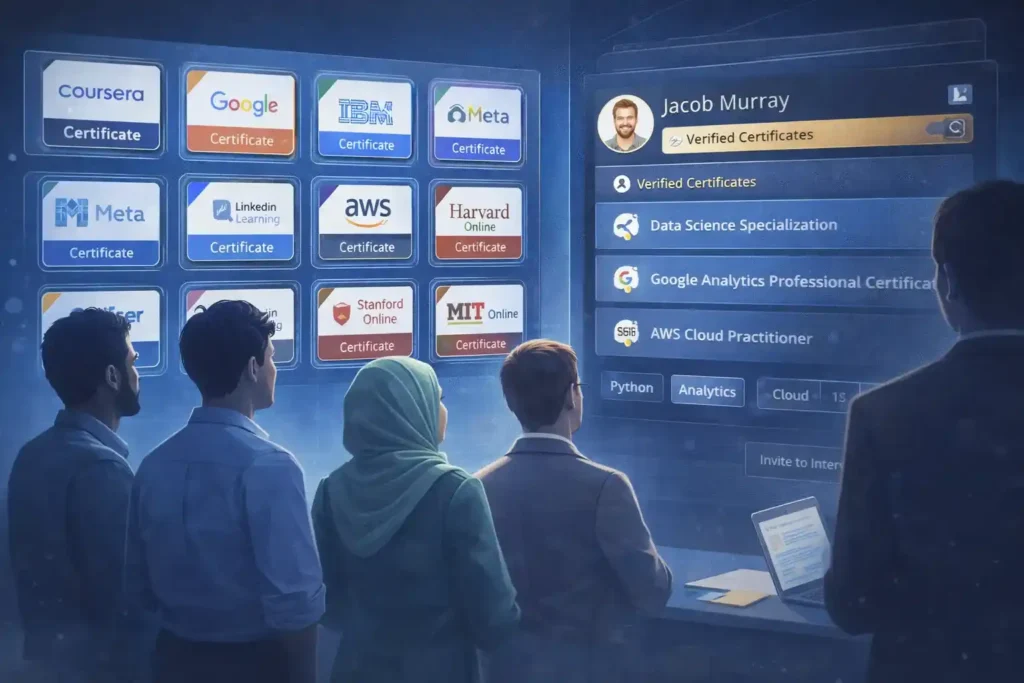
An in‑depth review of respected credentials highlights Google Career Certificates, IBM Professional Certificates, AWS certifications, and CISSP among those that consistently align with employer demand and higher salary potential.
What are examples of certified online courses employers value?
While this article focuses on recognition factors, seeing concrete examples helps you understand what “valued” looks like in practice.
| Credential Type | Example Area | Why Employers Value It |
|---|---|---|
| IT support certificate | Entry‑level IT support | Hands‑on labs, ticketing tools, troubleshooting workflowscoursecorrect |
| Data analytics cert | Analytics / BI | Practical projects, SQL/Excel dashboards, portfolio piecesverifyed+1 |
| Cloud certification | Cloud / DevOps | Aligns with in‑demand AWS/Azure roles, clear exam standardsverifyed+1 |
| Cybersecurity cert | Security | Standardized body of knowledge, recognized exam rigorverifyed+1 |
Well‑researched lists of respected online certifications frequently feature the Google IT Support Professional Certificate, IBM Data Science, AWS Solutions Architect, and CISSP as standout signals in IT, cloud, and security hiring.
At the same time, curated resources on free certifications show that shorter credentials—like inbound marketing, project management basics, or introductory programming—can still strengthen your resume when combined with experience or larger certificates.
How can you evaluate if a certified online course is credible?
To decide whether a certified online course is credible, you need a simple framework you can repeat across domains.
- Check issuer and partners
- Review syllabus for depth and tools
- Look for projects, labs, or capstones
- Confirm assessment rigor
- Verify certificate format and sharing options
You can implement this logic programmatically as a checklist in your notes or task manager:
If issuer is a recognized university, big-tech company, or established body
AND syllabus maps clearly to common job skills
AND course includes graded projects or labs
AND certificate is verifiable and shareable on LinkedIn
THEN mark as “employer-credible”
ELSE treat as low-signal credential.
Over time, this framework helps you build a portfolio of employer‑credible certifications instead of a scattered collection of low‑impact badges.
How do free certified online courses fit into your strategy?
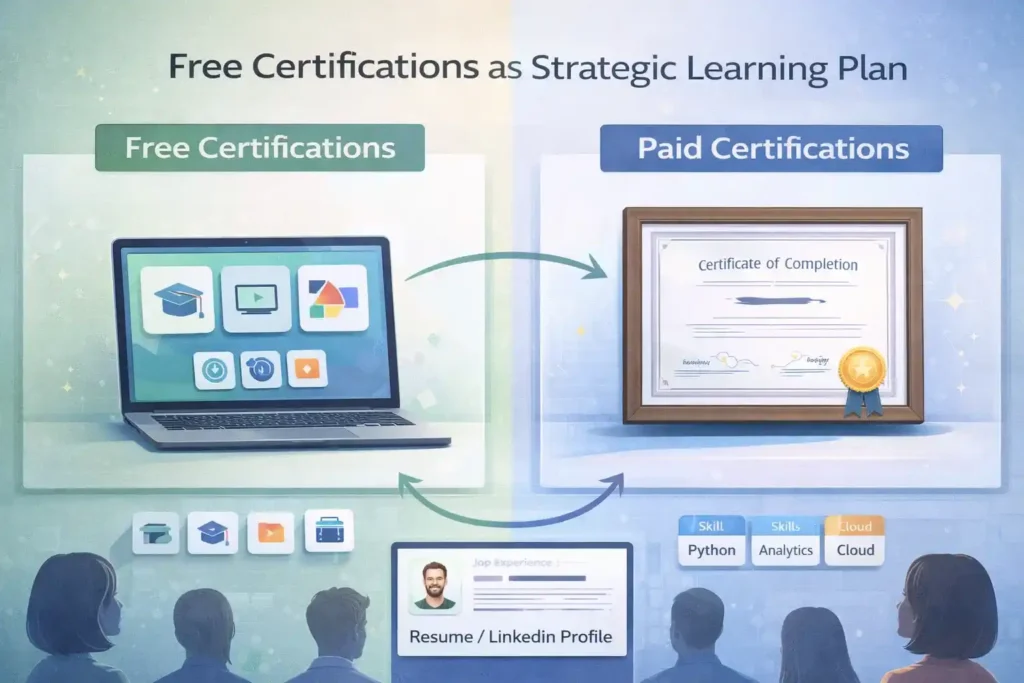
Free courses with certificates will not replace a degree or a flagship professional program, but they are still valuable strategic tools. They signal initiative, fill skill gaps, and make your resume more keyword‑rich for ATS systems.
Recent guides list more than 75 free certifications across technology, marketing, finance, and AI, including short modules from universities, major platforms, and specialized providers. Examples include:
- Short Python and programming introductions from well‑known institutions
- Brief inbound marketing or digital marketing certifications
- Introductory AI and machine learning crash courses
- Role‑specific badges like basic data analytics or cloud fundamentals
“Earning certifications is a great way to demonstrate your knowledge and skills, and it can make your resume more competitive in the job market.” – Jobscan free certifications guide
For StartupMandi readers, these free options work best when used to test interest in a field or to complement a larger, employer‑recognized certification path.
How should job seekers choose a certified online course?
Job seekers should choose a certified online course by working backward from target roles, not forward from marketing pages.
- Identify your target role and skills
- Match certification skills to job descriptions
- Prioritize issuer reputation and employer recognition
- Consider duration, cost, and flexibility
- Check alumni stories and outcome data
Career‑oriented certification round‑ups highlight that credentials tied directly to job roles (like IT support, data analytics, or cloud engineering) often provide measurable outcomes within 6–12 months, from interviews to promotions. That is why reading both official course pages and independent reviews gives a more balanced picture than relying on marketing alone.
How to build a 6–12 month certification strategy?
Times Needed: 365 Days
Estimated Cost: 500 USD
Description: Design a 6–12 month roadmap that combines free and paid certified online courses to improve your resume, skills, and interview success.
Steps:
Step 1: Define one primary and one backup career path
Choose your main target role and a related backup role, then list 8–10 skills each role requires based on current job postings.
Step 2: Select one flagship employer-recognized certificate
Pick a professional or microcredential program from a respected issuer that directly matches your main target role and runs for 3–9 months.
Step 3: Add 2–3 short free certificates for breadth
Choose free certifications in complementary skills—like Python, marketing, or AI—to support your flagship credential and diversify your profile.
Step 4: Convert assignments into portfolio case studies
Turn at least three graded projects or labs into publicly shareable case studies, emphasizing business impact, tools used, and key results.
Step 5: Integrate credentials into resume and LinkedIn
After each certificate, update your resume and LinkedIn with the issuer, skills gained, and portfolio links, then start targeted job applications.
Tools Name: Learning platforms, Jobscan resume tools, LinkedIn
Materials Name: Job descriptions, Course syllabi, Project artifacts
This structure mirrors how many professionals stack microcredentials and larger certificates into a coherent, job‑ready profile rather than collecting random badges.
Resources
- Guides listing the most respected online certifications employers truly value, with detailed descriptions, durations, and student reviews.
- Lists of free certifications across tech, business, and marketing, with instructions on how to add them to your resume and LinkedIn.
- Employer surveys on microcredentials and online certificates, including statistics on hiring preferences and salary uplift.
- Platform‑level statistics on learner numbers, new certificates launched, and fast‑growing skill areas in data, cloud, and AI.
- Resume and ATS‑optimization tools that help you showcase certifications and project work effectively to recruiters.
Disclaimer: This article is for educational purposes only and does not contain affiliate links. Always confirm current pricing, accreditation, and recognition directly from official course providers before enrolling.
FAQ: Online Courses Employers Value
Yes, surveys show that 96% of employers believe microcredentials improve a candidate’s application, and 85% are more likely to hire candidates who hold them.
Start with a flagship professional or career certificate aligned with your target role, then layer in free or short certificates for supporting skills.
Yes, free certifications from reputable providers signal initiative, fill skill gaps, and help your resume pass ATS filters when combined with stronger flagship credentials.
Focus on depth instead of quantity—2–4 high‑quality, employer‑recognized certifications plus a few targeted free badges are usually more effective than 20 low‑signal courses.
In most fields, they complement rather than replace degrees; however, in IT, data, and some digital roles, strong certificates plus projects can open doors without a traditional degree.
Check issuer reputation, partnerships, alumni outcomes, and whether the credential appears frequently in respected certification lists and employer surveys.
List major certifications and a selection of relevant free courses; avoid clutter by summarizing smaller ones under a single “Additional training” section if needed.
Many learners report seeing results—from interviews to promotions—within 3–12 months after completing focused, role‑aligned certifications and updating their profiles.
Key Takeaways
- An employer‑valued certified online course comes from a recognized issuer, maps directly to job skills, and includes rigorous projects and assessments.
- Employer surveys show that 96% of hiring managers see microcredentials as helpful and 85% are more likely to hire candidates who hold them.
- Respected credential lists repeatedly highlight career certificates in IT support, data analytics, cloud computing, and cybersecurity as strong signals in today’s job market.
- Free certifications are powerful supporting tools when they come from reputable providers and are aligned with your main certification strategy.
- A 6–12 month roadmap that stacks one flagship certificate with a few targeted free courses and strong portfolio projects can significantly improve career outcomes.
Next Steps
- Choose your target role and list the top ten skills employers mention most often in current job descriptions.
- Shortlist 3–5 certified online course options from respected issuers that directly cover those skills, reading both official details and independent reviews.
- Build a simple 6–12 month calendar combining one flagship certificate, a set of free supporting badges, and 3–4 portfolio‑ready projects you can showcase to employers.
For StartupMandi readers, this structured, employer‑first approach helps you spend less time guessing about “which course is best” and more time stacking credentials that recruiters immediately recognize.
Conclusion: Turn Certificates into Real Career Outcomes
In a crowded certification market, not every certified online course deserves a line on your resume. The credentials that truly move careers forward are those backed by trusted issuers, rigorous assessments, and clear alignment with in‑demand roles and skills.
By focusing on employer recognition, leveraging data on microcredential impact, and designing a 6–12 month learning strategy, job seekers and upskilling professionals can turn online certificates into real interviews, promotions, and salary growth rather than just digital badges.
As you plan your next move, use this framework alongside StartupMandi’s other guides on careers, skills, and professional courses to build a focused, employer‑ready learning roadmap.