

Why Ecommerce Business India Offers Massive Opportunities in 2026
Ecommerce business India is experiencing unprecedented growth. Moreover, India’s e-commerce market is projected to become a trillion-dollar economy within the next few years. Meanwhile, millions of entrepreneurs are capitalizing on this digital revolution. However, launching a successful venture requires careful planning and strategic execution.
Specifically, India’s digital ecosystem is stronger than ever before. Additionally, over 500 million online shoppers now engage with e-commerce platforms regularly. Furthermore, this massive consumer base creates exceptional opportunities for new entrepreneurs. Therefore, understanding the market landscape becomes essential for your success.
Key growth drivers include increased internet penetration, affordable data plans, and digital payment infrastructure. As a result, setting up an ecommerce business India venture has become more accessible than ever. Consequently, both aspiring entrepreneurs and established businesses are expanding their online presence. In conclusion, the timing for starting your e-commerce journey is perfect.
Step 1: Choose Your Business Structure & Register
Selecting the right business structure is crucial. Specifically, India offers three primary options: sole proprietorship, limited liability partnership (LLP), and private limited company. Additionally, each structure has distinct advantages for your ecommerce business India operations.
Therefore, sole proprietorships are ideal for quick launches with minimal regulatory overhead. Meanwhile, LLPs provide better credibility and liability protection. Simultaneously, private limited companies offer the most flexibility for raising capital and scaling operations. As a result, choose
based on your growth projections and funding needs.
Furthermore, registration involves filing incorporation documents with the Ministry of Corporate Affairs (MCA). Subsequently, you’ll need a Director Identification Number (DIN) and Digital Signature Certificate (DSC). In addition, the business name must receive MCA approval. Therefore, complete these steps before moving forward with your ecommerce business India venture.
Step 2: Secure Legal Compliance & Obtain GST Registration
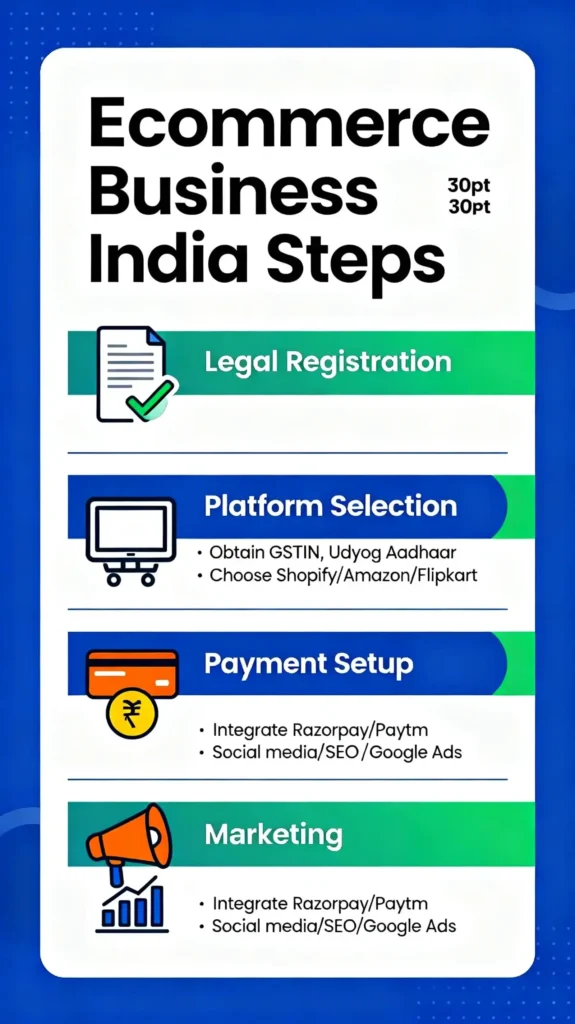
Legal compliance forms the foundation of your ecommerce business India operation. Consequently, understanding government requirements protects your business from penalties. Additionally, mandatory registrations cannot be overlooked.
Goods and Services Tax (GST) registration is essential for all online sellers. Moreover, if your business turnover exceeds Rs. 20 lakhs annually, GST registration becomes mandatory. Therefore, apply immediately to avoid legal complications. Subsequently, you’ll receive a unique GST Identification Number (GSTIN).
Also, obtain a Shop and Establishment License within 30 days of launching. Additionally, open a current bank account in your business name. Furthermore, specific industries require sector-based licenses: FSSAI for food products, Import-Export Code for international sales. In addition, draft comprehensive legal documents including Terms of Service and Privacy Policy. Thus, your ecommerce business India foundation becomes legally secure and compliant.
Step 3: Select the Right Ecommerce Platform
Your platform choice significantly impacts operational efficiency. Therefore, comparing major options helps ensure the best fit. Additionally, three dominant platforms serve Indian entrepreneurs effectively.
Shopify excels with comprehensive e-commerce features and excellent scalability. In addition, it offers robust inventory management and extensive payment gateway integrations. Moreover, Shopify provides 24/7 customer support, making it ideal for growing ecommerce business India ventures. However, monthly costs range from ₹2,500 onwards, which demands budget consideration.
WooCommerce offers unlimited customization through WordPress integration. Furthermore, it’s ideal for technically skilled entrepreneurs wanting complete control. Additionally, costs remain flexible, starting with just WordPress hosting expenses. However, you’ll manage technical aspects independently, requiring more expertise.
Wix provides an intuitive drag-and-drop builder perfect for beginners. Moreover, ecommerce plans start around ₹2,000 monthly. Nevertheless, Wix may have limitations for high-volume sellers with complex inventory requirements.
Ultimately, evaluate features, scalability, pricing, and support before deciding. Therefore, select a platform matching your current needs and growth trajectory. Consequently, this decision shapes your entire ecommerce business India journey.
Step 4: Set Up Secure Payment Gateways
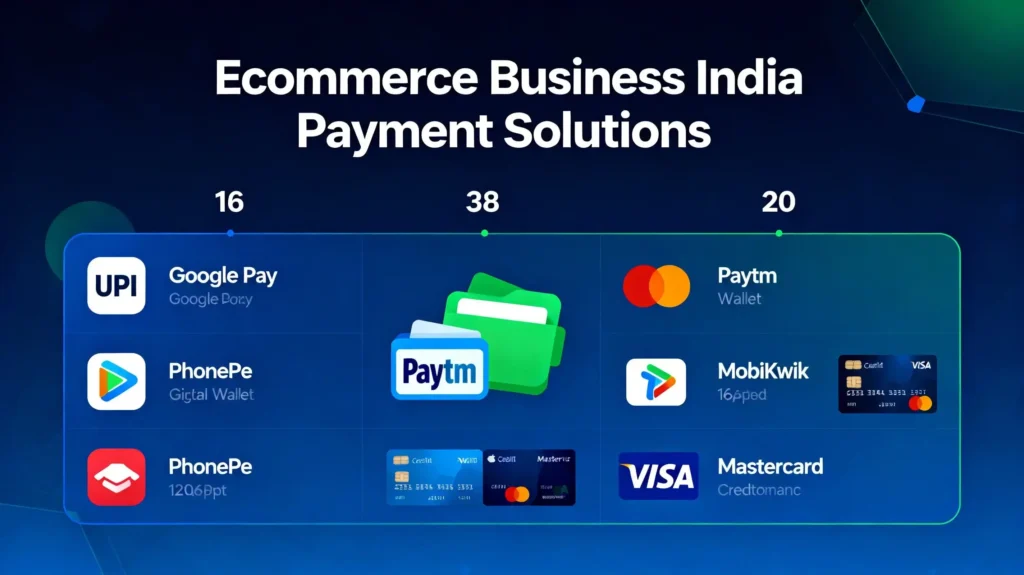
Payment processing is critical for customer trust. Therefore, integrating reliable payment solutions becomes non-negotiable. Additionally, Indian customers prefer diverse payment options.
Popular payment gateways for ecommerce business India include Razorpay, PayU, and Instamojo. Moreover, UPI (Unified Payments Interface) has revolutionized digital transactions. Furthermore, digital wallets like Google Pay and PhonePe are increasingly popular. As a result, offering multiple payment methods increases conversion rates significantly.
Additionally, implement SSL certificates for data security. In addition, comply with Payment Card Industry (PCI) standards. Furthermore, establish transparent refund policies to build customer confidence. Therefore, secure payment infrastructure protects both your business and customers.
Step 5: Master Your Inventory & Fulfillment Strategy
Efficient inventory management drives profitability. Therefore, tracking stock levels prevents overselling and stockouts. Additionally, fulfillment logistics require careful planning for your ecommerce business India operations.
Consider three fulfillment models: self-fulfillment, partnering with third-party logistics providers (3PLs), or using drop-shipping. Moreover, self-fulfillment offers maximum control but demands significant infrastructure investment. Meanwhile, 3PL partnerships reduce operational burden while maintaining quality standards. Additionally, drop-shipping minimizes upfront costs, though it limits control over product quality.
Consequently, analyze your business size and growth projections. Furthermore, evaluate logistics costs and delivery timelines. In addition, calculate warehouse space requirements and staff needs. Therefore, select a fulfillment strategy optimizing cost-efficiency and customer satisfaction for your ecommerce business India venture.
Step 6: Develop Your Marketing & Customer Acquisition Strategy
Building awareness drives sales momentum. Therefore, comprehensive marketing attracts your ideal customers. Additionally, successful ecommerce business India ventures combine multiple strategies.
Digital marketing channels include SEO, social media marketing, email campaigns, and paid advertising. Moreover, content marketing through blogs establishes industry authority. Furthermore, influencer collaborations reach younger demographics effectively. In addition, customer reviews and testimonials build credibility and trust.
Subsequently, leverage platforms like Instagram, YouTube, and Facebook for brand visibility. Additionally, implement email marketing to nurture customer relationships. Furthermore, use analytics tools to measure campaign performance. Therefore, allocate resources to high-performing channels maximizing return on investment.
Step 7: Focus on Customer Experience & Retention
Customer satisfaction determines long-term success. Therefore, exceptional service builds brand loyalty. Additionally, repeat customers reduce acquisition costs significantly.
Prioritize rapid response times to customer inquiries. Moreover, offer hassle-free return policies to reduce purchase hesitation. Furthermore, personalize shopping experiences using data analytics. In addition, implement loyalty programs rewarding repeat purchases. Subsequently, gather customer feedback actively and improve accordingly.
Therefore, create a seamless buying experience from browsing to post-purchase support. Consequently, satisfied customers become your best brand ambassadors for ecommerce business India growth.
Conclusion
Building a successful ecommerce business India venture requires strategic planning, legal compliance, and customer-focused execution. Therefore, follow these seven essential steps methodically. Moreover, select appropriate platforms matching your business needs. Additionally, invest in secure payment infrastructure and reliable fulfillment systems. Furthermore, execute data-driven marketing strategies to attract customers. Importantly, prioritize customer satisfaction to drive sustainable growth. Thus, your ecommerce business India journey becomes a pathway to entrepreneurial success and financial independence.
Frequently Asked Questions
Initial investments vary significantly based on your chosen model. Sole proprietorships demand minimal registration costs (₹500-2,000). Additionally, platform subscriptions cost ₹2,000-5,000 monthly. Furthermore, initial inventory investment depends entirely on your product category and supplier arrangements. Therefore, budget realistically between ₹50,000 to ₹3,00,000 for comprehensive setup.
2. Do I need GST registration immediately for my ecommerce business India operation?
GST registration becomes mandatory once your annual turnover exceeds ₹20 lakhs. However, registering earlier provides several advantages including input tax credit benefits. Therefore, consult a CA to determine the optimal registration timing for your specific situation.
3. Which ecommerce platform is best for beginners launching ecommerce business India?
Shopify and Wix both suit beginners perfectly. Shopify excels with e-commerce-specific features and support. Alternatively, Wix offers exceptional ease of use through its drag-and-drop builder. Therefore, evaluate both platforms and choose based on your technical comfort level.
4. How long does it take to build a profitable ecommerce business India business?
Profitability timelines vary significantly. However, most ventures achieve profitability within 6-18 months with dedicated effort. Additionally, factors like product selection, marketing effectiveness, and operational efficiency influence timelines substantially. Therefore, set realistic expectations and focus on consistent execution.
5. What legal documents are essential for an ecommerce business India startup?
Essential documents include Terms of Service, Privacy Policy, Vendor Agreements, Refund Policies, and Shipping Terms. Additionally, GST registration and shop establishment licenses are mandatory. Furthermore, intellectual property protections through trademark registration add credibility. Therefore, consult legal professionals ensuring comprehensive compliance coverage.
Related Reading & Resources
Internal Links:
- How to Write Effective Product Descriptions for Your Online Store – Essential for conversion optimization
- Digital Marketing Strategies for Indian Startups – Drive traffic to your store
- Customer Service Excellence in E-Commerce – Build lasting relationships
External Resources:
- Shopify’s Complete E-Commerce Guide – Platform setup and best practices
- WooCommerce Documentation – WordPress-based platform guidance
- GST Registration Guide – Government of India – Official government compliance information
- MCA Business Registration Portal – Business structure registration
- Reserve Bank of India – Payment Systems – Payment gateway regulations