

Simple Guide to Creating a Will: Understanding estate planning
A Simple Guide to Creating a Will is essential for anyone seeking to protect their assets and ensure their wishes are honored after death. Estate planning through a properly executed will is one of the most important financial decisions you can make. Therefore, understanding how to draft a legally valid will in India becomes crucial for securing your family’s financial future.{source}
The Simple Guide to Creating a Will starts with recognizing that a will is a legal document expressing your intentions regarding property distribution after your demise. In India, wills are governed primarily by the Indian Succession Act, 1925, which provides a comprehensive framework for testamentary succession. Consequently, following this framework ensures your will is legally binding and enforceable in court.
Creating a Simple Guide to Creating a Will requires understanding several key components and legal requirements. Many people neglect this crucial aspect of estate planning due to lack of awareness or misconceptions about the complexity involved. However, with the right knowledge and guidance, anyone can create a valid will that protects their interests.

Legal requirements for a Simple Guide to Creating a Will
Eligibility and capacity requirements
According to the Simple Guide to Creating a Will, the testator (person making the will) must meet specific eligibility criteria. First, you must be at least 18 years old to create a legally valid will in India. Additionally, you must be of sound mind when drafting the will, meaning you fully understand the implications of your decisions and the nature of your assets.
The Simple Guide to Creating a Will acknowledges exceptions for persons with disabilities such as deaf, dumb, or blind individuals, provided they consciously understand their actions while drafting. Your testamentary capacity is crucial; if the document’s contents are lost on the maker, it cannot constitute a valid will.
Furthermore, the Simple Guide to Creating a Will emphasizes that the will must be made voluntarily, without coercion, fraud, or undue influence from other family members. This ensures your will truly reflects your genuine wishes and intentions regarding asset distribution.
Signature and witness requirements
The Simple Guide to Creating a Will requires specific execution formalities under Section 63 of the Indian Succession Act. Your will must be signed by you in the presence of at least two witnesses who also sign the document. These witnesses must not be beneficiaries of the will to avoid conflicts of interest.
A Simple Guide to Creating a Will emphasizes that the witnesses should be competent individuals capable of understanding the document’s significance. The order of signing is important: the testator signs first, followed by the witnesses signing in the testator’s presence and in each other’s presence. This triple presence requirement ensures document authenticity and prevents disputes later. [source]
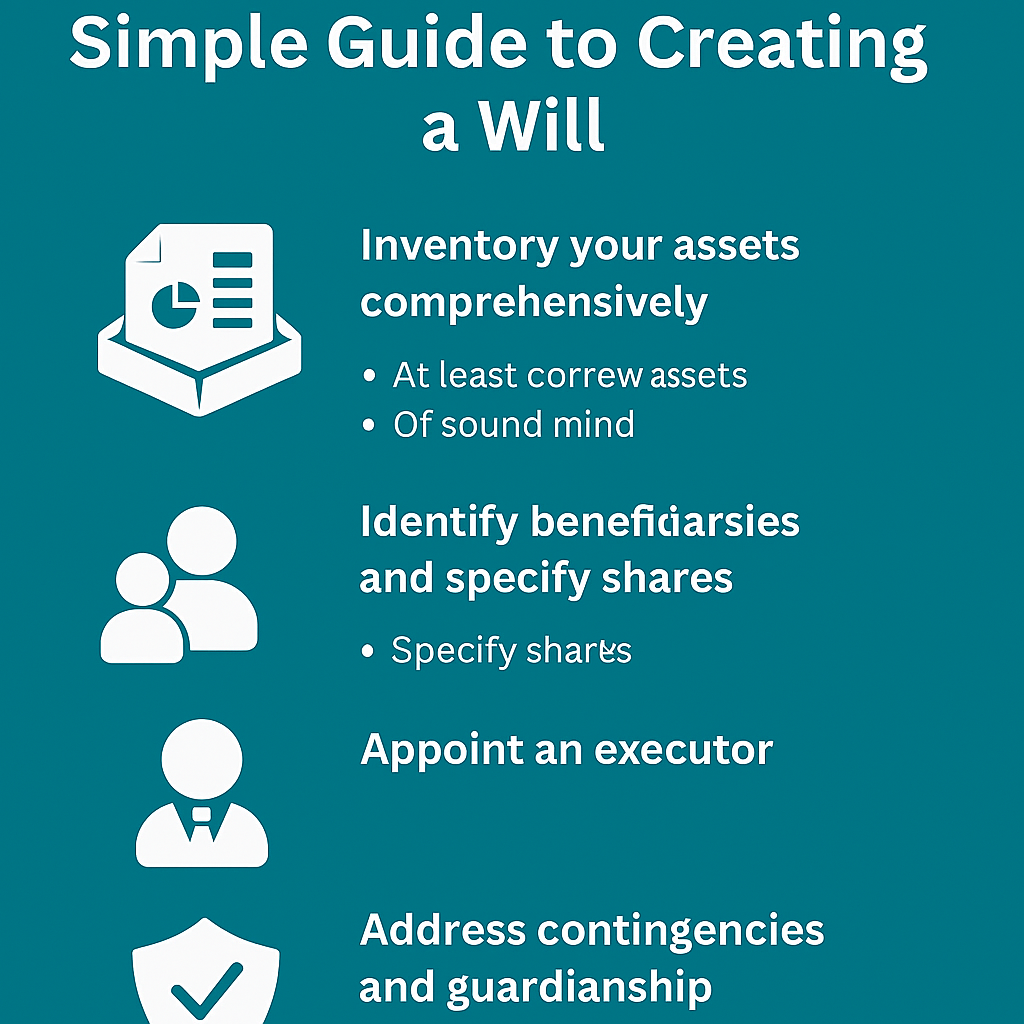
Step-by-step process: Simple Guide to Creating a Will
Step 1: Inventory your assets comprehensively
The Simple Guide to Creating a Will begins with creating a detailed list of all your assets. Include movable assets like bank accounts, investments, jewelry, and vehicles. Additionally, catalog immovable assets such as real estate, land, and houses with precise locations and ownership details.
A Simple Guide to Creating a Will also recommends including digital assets like online accounts and intellectual property in your inventory. Specify details like location, value, and ownership status to avoid ambiguity when distributing these assets among beneficiaries.
Step 2: Identify beneficiaries and specify shares
Through the Simple Guide to Creating a Will, clearly identify all beneficiaries who will inherit your assets. Include their full names, addresses, and relationships to you. The Simple Guide to Creating a Will requires you to specify the exact share each beneficiary receives, preventing confusion and potential disputes.
For example, a Simple Guide to Creating a Will might state: “I bequeath my house located at [specific address] to my son [name]” or “I leave my gold jewelry to my daughter [name].” Precise language removes ambiguity and strengthens the will’s legal validity.
Step 3: Appoint an executor
The Simple Guide to Creating a Will emphasizes appointing a trustworthy person as your executor. The executor is responsible for ensuring your wishes are executed precisely as stated in the will. Choose someone reliable, preferably someone who understands your financial situation and family dynamics.
The Simple Guide to Creating a Will suggests that the executor should be willing and capable of handling the probate process and asset distribution. You may also appoint an alternate executor in case your first choice cannot serve.
Step 4: Address contingencies and guardianship
A Simple Guide to Creating a Will must address unforeseen circumstances. For instance, specify what happens if a beneficiary predeceases you. If you have minor children, the Simple Guide to Creating a Will requires appointing a legal guardian to care for them.
Furthermore, the Simple Guide to Creating a Will should include provisions for residual assets—those not explicitly mentioned in specific bequests. State clearly how these remaining assets should be distributed among your heirs.
Registration and legal compliance: Simple Guide to Creating a Will
The registration process
While registration is not mandatory, a Simple Guide to Creating a Will highly recommends registering your will with the local sub-registrar’s office. Registration adds authenticity and ensures the will is not easily contested, as the government acts as a witness.
To register under the Simple Guide to Creating a Will framework, visit your sub-registrar’s office with the original will and necessary identification documents such as PAN card or Aadhaar. The registration process typically involves minimal fees and takes a few days.
Ensuring legal compliance
The Simple Guide to Creating a Will requires strict adherence to the Indian Succession Act, 1925. Use clear, unambiguous language in your will to avoid interpretation disputes. Avoid complex legal jargon unless necessary; simplicity ensures your will is easy to interpret and less vulnerable to challenges.getyellow+1
The Simple Guide to Creating a Will also recommends using proper will templates or consulting legal professionals to ensure all legal requirements are met. This precaution prevents technical errors that could invalidate your will after your death.
Conclusion
A Simple Guide to Creating a Will ensures that your wishes regarding asset distribution are legally honored after your lifetime. By following the steps outlined—inventorying assets, identifying beneficiaries, appointing an executor, addressing contingencies, and ensuring legal compliance—you create a robust estate plan that protects your family’s financial future.
Estate planning through a valid will is not just a legal formality; it’s an act of love toward your family, preventing unnecessary disputes and ensuring smooth asset transfer.
5 FAQs on Simple Guide to Creating a Will
1. What is the minimum age to create a will in India?
You must be at least 18 years old and of sound mind to create a legally valid will under the Indian Succession Act, 1925.
2. How many witnesses are required for a valid will?
At least two witnesses who are not beneficiaries must sign your will in your presence and in each other’s presence.
3. Is will registration mandatory in India?
While not mandatory, registration with the local sub-registrar’s office is highly recommended as it adds legal authenticity and prevents easy contestation.
4. What assets should be included in a will?
Include all assets: movable (bank accounts, jewelry, vehicles), immovable (property, land), and digital assets (online accounts, intellectual property).
5. Can I appoint anyone as my executor?
Yes, you can appoint any trustworthy, competent person as your executor, though they should understand financial matters and be willing to manage the probate process.
Referring Blog / Page Links
- How To Write A Will In India: A Complete Guide To Estate Planning
- How to Make a Will in India Step by Step
- How to Write a Will in India: Estate Planning Guide
- Estate Planning in India: Meaning, Benefits, Components and How to Get Started
- ITR Refund Delays: Why You’re Waiting Longer in 2025
- 10 Best AI Image Generators 2026: Features & Pricing
- Website Development (WordPress)
- Startup India DPIIT Registration + DSC