
Sam Altman Memo: OpenAI’s Crisis Moment — Candid Admission of AI Competition
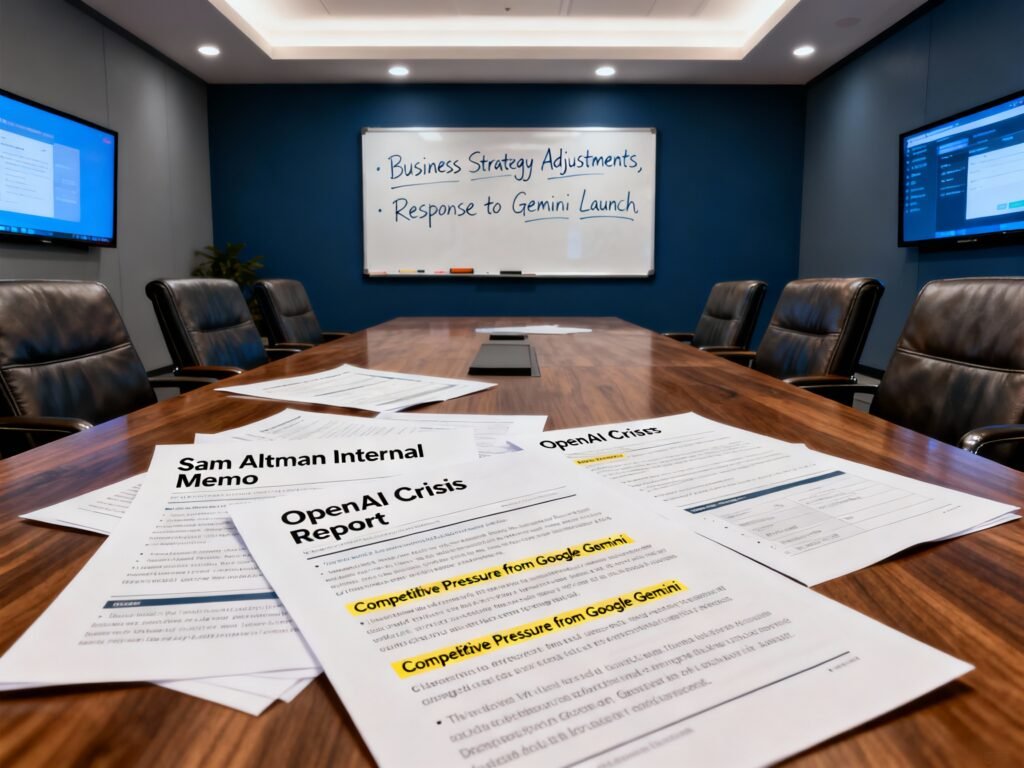
In a revealing internal Sam Altman memo to OpenAI employees, CEO Sam Altman delivered an unusually candid assessment of the company’s competitive challenges. Therefore, he acknowledged that Google’s Gemini 3 and Anthropic’s Claude advancements could create “temporary economic headwinds” for the artificial intelligence pioneer[timesofindia]. Moreover, this frank admission represents a dramatic shift from OpenAI’s previous confident public posturing about market dominance. Additionally, the memo reveals internal anxieties about technological leadership, financial sustainability, and the rapidly consolidating AI market structure that threatens OpenAI’s once-unshakeable position.
Sam Altman Memo: OpenAI’s Candid Assessment of AI Competition and Financial Challenges
The Crisis Acknowledgment: What Altman Actually Said
Altman didn’t sugarcoat the situation when addressing his workforce. Specifically, he stated: “We have built enough strength as a company to weather great models shipping elsewhere competition”—a statement that ironically concedes OpenAI’s vulnerability despite attempting to project confidence[timesofindia]. Furthermore, he explicitly acknowledged that competitors including Google and Anthropic are “narrowing the gap in the AI race”[economictimes].
However, Altman attempted to reframe the challenge as temporary. Therefore, he reassured employees that OpenAI is “catching up fast” and ultimately “will emerge as the leader”[timesofindia]. In addition, he emphasized that the company should maintain focus on superintelligence development rather than fixating on quarterly model releases. Consequently, his message oscillated between genuine concern and strategic resolve.
Most tellingly, Altman concluded with an admission about the company’s complexity: “It sucks that we have to do so many hard things at the same time — the best research lab, the best AI infrastructure company, and the best AI platform/product company — but such is our lot in life”[timesofindia]. This statement reveals the immense operational burden OpenAI carries while competitors specialize in narrower niches.
Financial Reality: The Unsustainable Burn Rate
Beyond competitive concerns, the memo implicitly addresses OpenAI’s catastrophic financial structure. Specifically, the company burns approximately $100 billion annually while projecting only $13 billion in 2025 revenue—a devastating 7.7x burn-to-revenue ratio[economictimes]. Additionally, the company spent $2.5 billion in just the first half of 2025 on research and development alone. [Source]
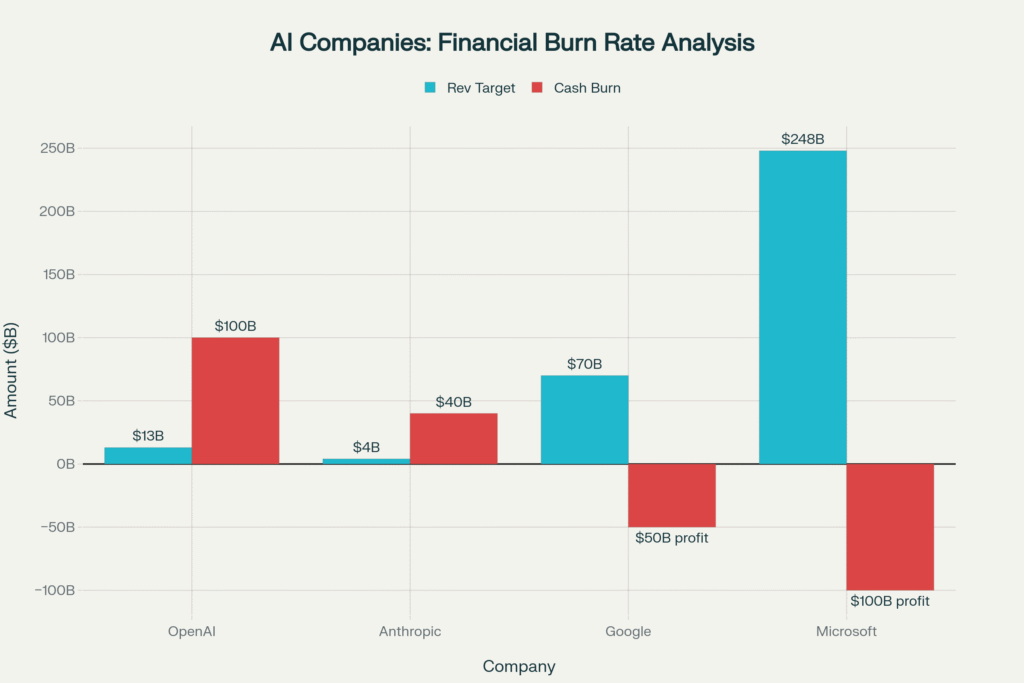 OpenAI faces unsustainable 7.7x burn-to-revenue ratio at $100B annual burn versus $13B revenue, while competitors Google and Microsoft operate profitably with positive cash flow Checkout Our Latest Services
For context, compare this to Google, which maintains positive cash flow exceeding $70 billion annually while simultaneously providing cloud infrastructure services to OpenAI and its competitors—effectively profiting from OpenAI’s research through infrastructure fees[timesofindia]. Furthermore, Microsoft, OpenAI’s strategic backer, generates $248 billion in annual revenue while maintaining profitability across its entire operation.
The financial mathematics become starkly sobering when examined holistically. Therefore, industry analysts calculate that OpenAI and Anthropic combined would require $300+ billion annual revenue by 2030 merely to justify their current valuations—a threshold that appears increasingly unlikely given intensifying competition from Google, Microsoft, Meta, and numerous other players. Consequently, current valuations may represent the AI market equivalent of the Dotcom bubble.
The Gemini 3 Threat: Technical Parity Undermines Moat
Google’s November 2025 release of Gemini 3 directly invalidated OpenAI’s core competitive assumption: technological superiority. Therefore, this launch marks the moment when technical parity erodes the “moat” protecting OpenAI’s market position. Moreover, independent testing reveals that Gemini 3 outperformed ChatGPT-5.1 in six of nine comparative tests, including creative constraint-following, UX design thinking, critical analysis, and cross-domain integration[tomsguide].
The competitive advantage extends beyond raw capability to distribution supremacy. Specifically, Google integrated Gemini 3 directly into Google Search on launch day—enabling instant access for 8.5 billion monthly Google Search users without app downloads or sign-ups[timesofindia]. In contrast, OpenAI remains dependent on users deliberately choosing ChatGPT over Google, despite Google owning the default search experience for most internet users globally. Consequently, distribution asymmetry represents a structural disadvantage that technological superiority cannot overcome.
Furthermore, Gemini 3 dominates in specialized domains critical to lucrative revenue streams. For instance, it demonstrates exceptional performance in code generation and software engineering tasks—precisely where OpenAI built profitable business models through GitHub Copilot and developer-focused products[xpert.digital].
Anthropic’s Claude: The Third-Force Threat
Beyond Google, Anthropic’s Claude family—particularly Sonnet 4.5—represents an unexpected competitive threat. Therefore, Claude achieved 77.2% accuracy on SWE-bench Verified Benchmark for real-world software engineering problems, where it outperforms both Gemini 3 and ChatGPT-5.1[xpert.digital]. Additionally, with parallel test-time compute, Claude reaches 82% accuracy—performance levels neither Google nor OpenAI has matched.
Claude’s strategic positioning differs fundamentally from OpenAI’s mass-market approach. Therefore, Anthropic targets enterprise buyers in regulated sectors (finance, healthcare, cybersecurity) through superior safety, security, and alignment capabilities[xpert.digital]. Moreover, Claude achieves 98.7% security benchmarks demonstrating reduced sycophancy, deception, and delusional reasoning—attributes commanding premium pricing from security-conscious enterprises[xpert.digital].
At just $170 billion valuation versus OpenAI’s $500 billion, Anthropic pursues a more sustainable strategy positioning itself as an eventual acquisition target or oligopoly participant rather than market dominator[xpert.digital]. Consequently, this modest ambition may prove paradoxically more achievable than OpenAI’s all-or-nothing superintelligence bet.
The User Engagement Cooling: Hidden Crisis
A crucial detail underlying Altman’s memo concerns user engagement stagnation. Therefore, OpenAI CFO Sarah Friar confirmed during earnings calls that ChatGPT user engagement “cooled” despite otherwise positive financial results”[economictimes]. Additionally, conversion rates from free users to paid subscribers remain pathetically low at just 4-10% despite 700-800 million weekly active users[xpert.digital].
This dynamic reveals OpenAI’s fundamental vulnerability: massive user numbers without corresponding monetization. Therefore, the business model depends critically on continuously expanding users (doubling from 400 million to 800 million in 2025) to generate revenue growth—an exponential growth rate increasingly difficult to sustain as user penetration approaches saturation in developed markets.
Moreover, technical parity with Gemini 3 destroys the assumption that users remain “locked in” to ChatGPT through superior capability. Consequently, if users perceive Gemini 3 as equal or superior, switching costs collapse and OpenAI’s moat evaporates entirely.
Strategic Response: Altman’s Bet on Superintelligence
Altman’s memo pivots OpenAI’s strategy from quarterly model competition toward superintelligence development—an existential bet with unclear probability of success. Therefore, he advocates aggressive focus on Shallotpeat, an internal project aiming to automate AI research itself through meta-learning[xpert.digital]. The theory posits that if AI systems accelerate their own evolution, OpenAI could differentiate despite resource disadvantages versus competitors with superior capital reserves.
Additionally, OpenAI is pursuing compute resource diversification. Therefore, the January 2025 partnership adjustment with Microsoft now permits OpenAI to utilize computing resources from Oracle and other providers—ending Microsoft’s exclusive compute monopoly that previously ensured strategic alignment[xpert.digital]. Consequently, this signals OpenAI’s desire to reduce dependence on a single backer as hedging against future strategic conflicts.
Market Structure Evolution: Oligopoly Formation
The AI market rapidly consolidates into three-to-five dominant player oligopoly with prohibitive barriers to entry. Specifically, training state-of-the-art models costs $500+ million, requires thousands of cutting-edge GPUs, and demands top-tier research talent that commands premium compensation[xpert.digital].
This structure eliminates room for competitive newcomers or specialty players disrupting incumbents. Therefore, OpenAI, Google, Anthropic, Microsoft, and Meta occupy the oligopoly’s internal constellation. Moreover, each increasingly occupies distinct strategic niches: Google as vertically-integrated generalist, Microsoft as enterprise integrator, Anthropic as security specialist, Meta as open-source champion. Consequently, OpenAI’s future position within this oligopoly structure remains profoundly uncertain.
Historical Precedent: Netscape and Yahoo Redux
Technology history provides sobering precedent for OpenAI’s trajectory. Therefore, Netscape dominated web browser markets through innovation before Internet Explorer’s bundled integration into Windows destroyed competitive advantage through distribution monopoly[xpert.digital]. Similarly, Yahoo pioneered search before Google’s superior algorithm combined with better monetization eliminated Yahoo’s dominance[xpert.digital].
OpenAI currently occupies Netscape’s position: innovative pioneer facing distribution-advantaged incumbent. Therefore, the critical question becomes whether OpenAI’s Shallotpeat superintelligence bet provides sufficient differentiation to prevent Google’s search monopoly integration from repeating Internet Explorer’s victory pattern. Consequently, the answer remains radically uncertain.
Conclusion: The Turning Point
Altman’s internal memo represents a critical turning point for OpenAI. Therefore, the company’s admission of “temporary economic headwinds” and competitor progress signals recognition that the era of unchallenged AI leadership has ended[economictimes]. Moreover, unsustainable financial metrics, user engagement cooling, and technical parity with Gemini 3 create a genuine existential crisis beneath superficial business-as-usual operations.
The coming months prove crucial—whether Shallotpeat advances superintelligence sufficiently to justify current valuations, whether user engagement recovers, and whether financial burn moderates. Furthermore, OpenAI must navigate this transition while managing operational complexity that rivals can’t easily replicate.
For employees, investors, and industry observers, Altman’s candid memo signals profound uncertainty despite public reassurance. Consequently, the AI market’s future landscape may look dramatically different from 2023-2024 assumptions of OpenAI’s permanent supremacy.
Read Full Analysis: The Information Coverage
Financial Context: Economist Report
Competitive Breakdown: India Today Report