
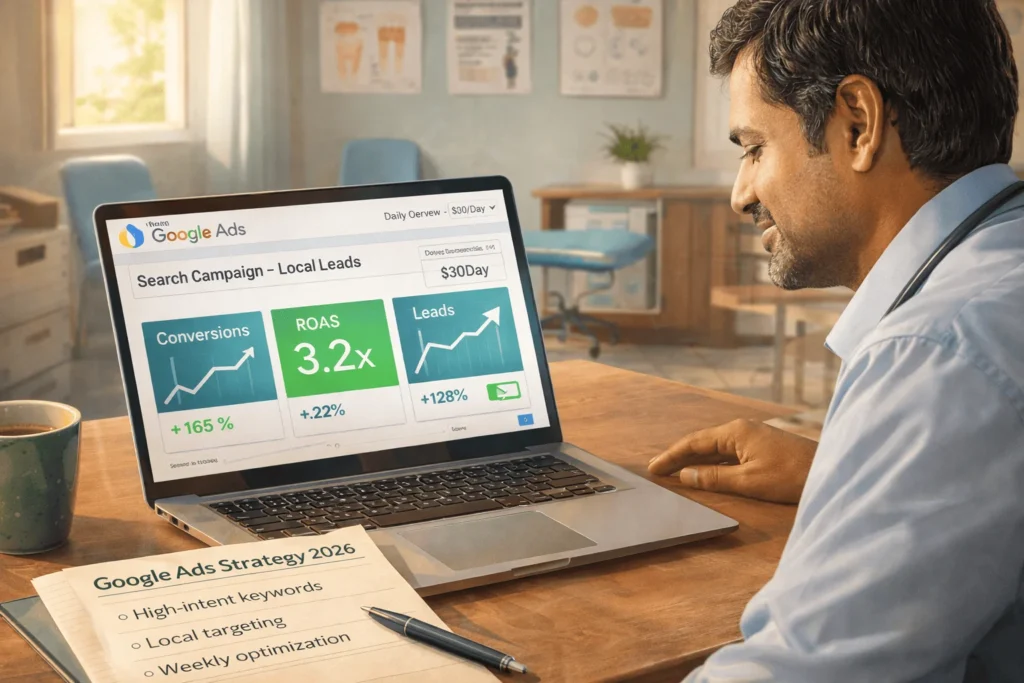
If you want the best Google Ads strategy for small business, start simple: run focused Search campaigns on high‑intent keywords, limit targeting to your real service area, send traffic to a strong landing page, and track every lead so you can cut what’s wasting money. On average, businesses earn about ₹2 (or $2) for every ₹1 spent on Google Ads, and small businesses often see 2x–4x ROAS when campaigns are set up properly.

Quick Summary
- Google Ads still delivers strong ROI for small businesses—studies show average 2x–4x return on ad spend, with many accounts around 7–8% conversion rates when optimized.
- The best Google Ads strategy for small business in 2026 is a lean, search‑first approach: high‑intent keywords, tight locations, simple structure, and relentless tracking.
- Start with one or two Search campaigns, avoid over‑segmentation, and let Google’s smart bidding learn before you add complexity.
- Use benchmarks: average search CTR around 3–7%, conversion rates around 7.5%, and CPL around $70; beat these and you’re doing well.
- Follow a 30‑day setup and optimization plan to move from “boost post and pray” to a structured, ROI‑driven Google Ads machine.
What Makes the Best Google Ads Strategy for Small Business?
The best Google Ads strategy for small business is intent‑first, data‑driven, and ruthlessly focused on profitability, not vanity metrics like clicks. That means you start with people already searching for what you sell, then build campaigns around those searches instead of broad, generic keywords.
Strong strategies share a few common traits:
- Search‑first, not “everything‑at‑once”
You begin with Search campaigns because they capture ready‑to‑buy users, then layer Display, Video, or Performance Max later once you know what works. - Tight structure instead of dozens of campaigns
Simple, consolidated campaigns give Google’s algorithm enough data to optimize and stop you from spreading budget too thin. - Clear tracking and ROAS goals
You define what a lead or sale is worth and use that to decide your bids and budgets.
“Google Ads is still the #1 ROI channel for many small businesses, but only when campaigns are disciplined and tied to clear business goals.” — SMB Search Advertising Report, 2025
Why Should Small Businesses Use Google Ads in 2026?
Small businesses should use Google Ads because it remains the fastest way to appear in front of high‑intent customers who are actively searching for your product or service.
Key reasons:
- Massive reach and market share
Google Ads holds around 39–80% of the global PPC market, reaching over 4.7 billion internet users. - High commercial intent
About 63% of internet users have clicked on a Google ad, and users who click ads are up to 50% more likely to convert compared to organic visitors. - Strong ROI benchmarks
Across industries, businesses see around $2 revenue per $1 spent and average conversion rates of 7.52% on search campaigns. - Ideal for local and service‑based businesses
Local services and SMBs often hit 2x+ ROAS when they stick to high‑intent, local keywords and good landing pages.
How Much Budget Is Best for Small Business Google Ads?
Many small businesses in 2025–2026 run effective Google Ads with a monthly budget between $1,000 and $3,000 (roughly ₹80,000–₹2,50,000), depending on industry and city.
Realistic Budget Benchmarks
| Business Type | Typical Monthly Budget | Why This Range Works |
|---|---|---|
| Local services (salons, gyms) | $500–$1,500 | Test a few service keywords and remarketing. |
| Clinics, dentists, high‑value | $1,000–$3,000 | Higher CPC but higher lead value. |
| E‑commerce beginners | $1,500–$5,000 | Need volume to test products and audiences. |
| B2B / professional services | $1,000–$4,000 | Fewer searches, higher deal size. |
Rather than asking “What’s the minimum budget?”, ask:
- What is one customer worth over 12–24 months?
- How many customers per month do I need from Google Ads?
- What cost per lead (CPL) and cost per acquisition (CPA) make sense for my margins?
How Should I Structure My Google Ads Campaigns?
Use a simple, goal‑based structure—one Search campaign per main goal, a few tightly themed ad groups, and 5–15 intent‑aligned keywords per ad group.
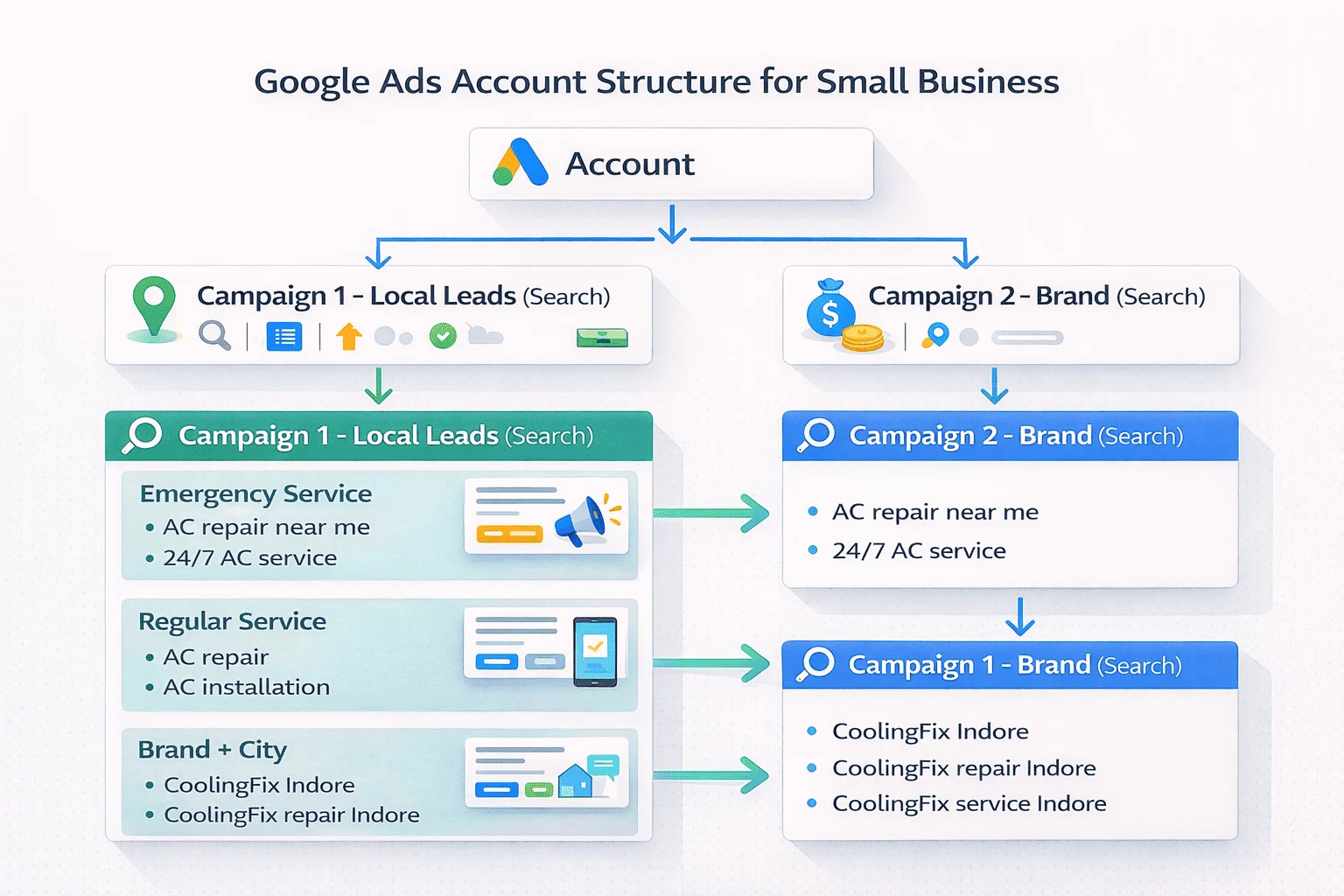
Recommended Campaign Structure (2026)
- Start with Search campaigns only
- Campaign 1: “Leads – Core Service” (e.g., “Dental Implants Delhi”)
- Campaign 2: “Brand – Business Name”
- Split campaigns only when necessary
- Different goals (sales vs leads)
- Different locations or languages
- Very different product or service lines
- Use focused ad groups (STAGs)
Each ad group focuses on a single theme or intent, such as “emergency plumber” versus “bathroom renovation”. - Let Smart Bidding do its job
Start with Maximize Conversions or Maximize Conversion Value, then move to Target CPA or ROAS once you have enough data.
Avoid creating too many campaigns and tiny ad groups; this starves Google’s algorithm of data and makes optimization painful.
Which Keywords Work Best in a Small Business Google Ads Strategy?
Focus on high‑intent, long‑tail keywords that show clear buying intent (e.g., “best dentist near me”, “AC repair in Indore 24/7”), instead of broad, research‑only queries.
Keyword Principles for Small Businesses
- Prioritize high‑intent terms
- “Service + near me”
- “Service + city name”
- “Best [service] in [location]”
- Mix match types strategically
- Broad match: good with Smart Bidding for discovery.
- Phrase/Exact: use for brand, competitors, or expensive legal terms.
- Start with 5–15 keywords per ad group
All keywords should be close variants of the same intent. - Build and maintain a negative keyword list
Regularly exclude irrelevant searches, such as “free”, “jobs”, “how to become”, or student queries.
This keeps your budget focused on people who are truly ready to call, visit, or buy.
What Are Good Benchmarks for CTR, Conversion Rate, and ROI?
Across many industries in 2025, average search CTR is around 3–7%, average conversion rate is ~7.5%, and average CPL is about $70, though local services and niche industries can beat these numbers.
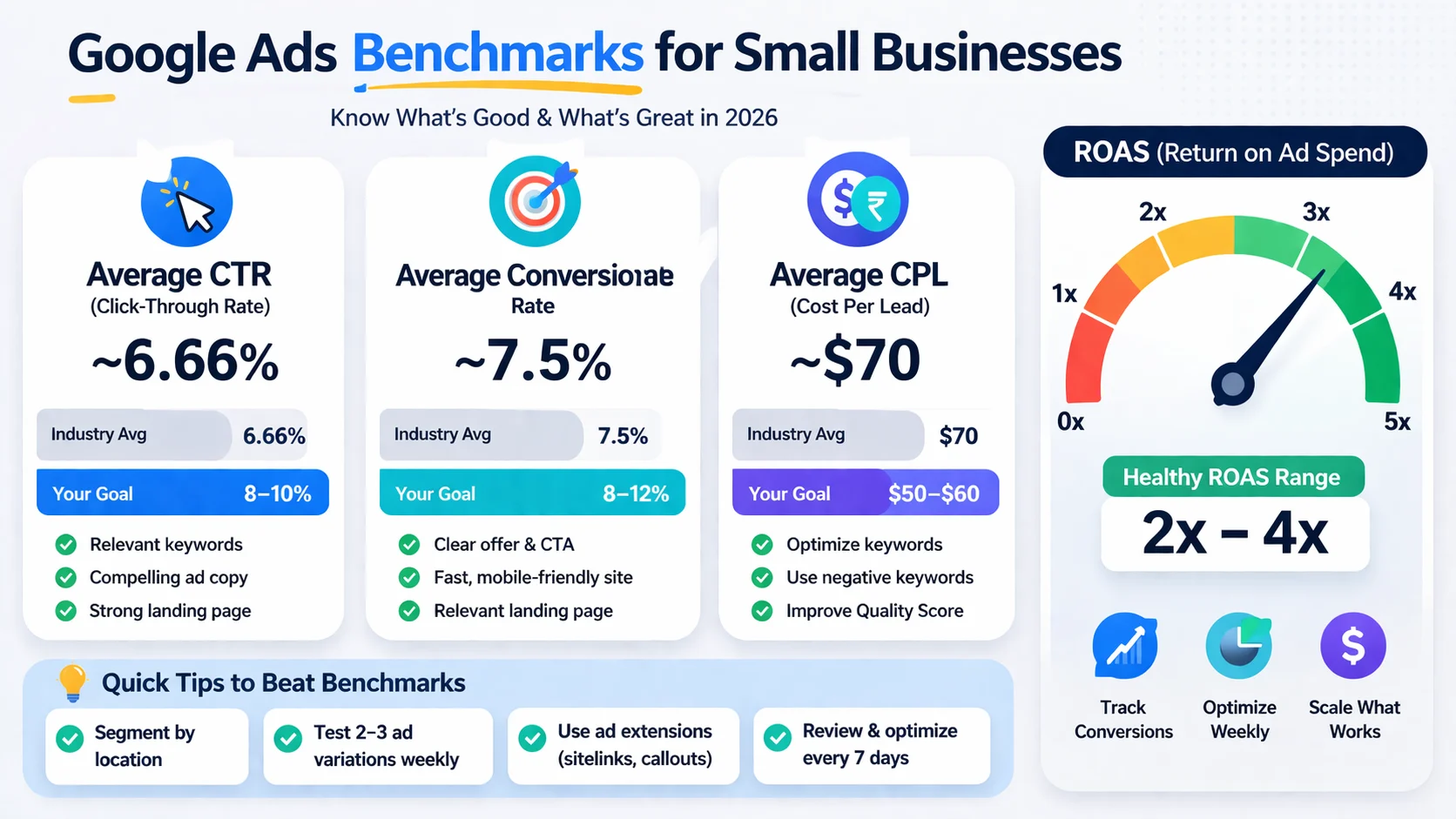
Google Ads Performance Benchmarks (Search, 2025)
Use these as guidelines, not rigid targets. If your business has high margins or long lifetime value, you can tolerate higher CPL or lower short‑term ROAS.
How Do I Write High‑Converting Google Ads?
Use Responsive Search Ads (RSAs) with multiple benefit‑driven headlines, clear keywords, strong proof, and a direct call‑to‑action, all tightly matched to your landing page.
Simple Ad Copy Formula
- Mention the main keyword and location
“Dental Implants in Indore – EMI Available” - Highlight 1–2 key benefits
“Painless procedure, 10+ years experience, EMI options.” - Add proof or trust signals
“4.8★ Google rating, 500+ patients treated.” - End with a clear call‑to‑action
“Book Free Consultation Today.”
In each ad group, create at least one strong RSA with:
- 8–10 different headlines.
- 3–4 distinct descriptions.
- Pinning only when necessary to keep flexibility.
Remember, ad relevance and landing page experience are key parts of Quality Score—which directly affect both position and cost per click.
How Do I Track ROI and Optimize Google Ads Campaigns?
Track conversions (calls, forms, purchases) using Google Ads and Analytics, compare against costs, and optimize weekly based on keywords, search terms, and device performance.
Optimization Priorities
- Set up conversion tracking first
- Calls from ads and call extensions.
- Form submissions and purchases.
- Key actions on your website (e.g., WhatsApp click, appointment click).
- Check search terms weekly
- Pause or exclude irrelevant queries.
- Promote search terms that convert.
- Adjust bids and budgets
- Shift budget towards high‑ROAS campaigns.
- Lower bids on expensive, low‑performing keywords.
- Test landing pages
Even a small uplift in conversion rate (e.g., from 6% to 9%) can increase ROAS by 50% without increasing spend.
If this feels overwhelming, Startup Mandi’s Google Ads PPC Management Service by AI Agents can handle structure, bidding, and optimization while you focus on running the business.
How To Set Up the Best Google Ads Strategy for Small Business (Step‑by‑Step)
Times Needed: 30 Days, 12 hours
Estimated Cost: 500–3000 USD (ad spend range)
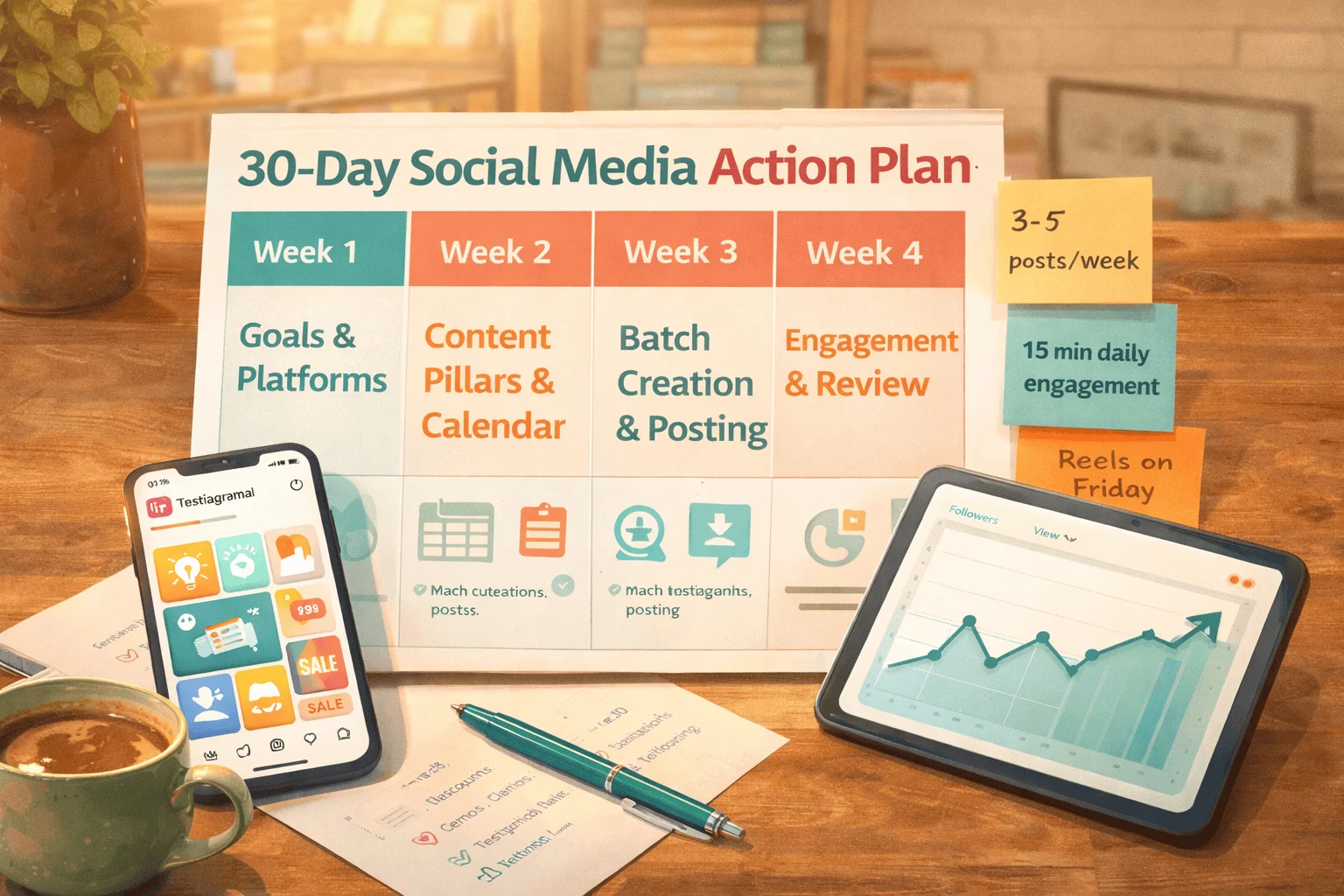
Steps:
1. Calculate your customer value and target CPA
Estimate how much an average customer is worth over 6–12 months and decide a maximum cost per acquisition you can afford. This becomes your anchor for deciding budgets and judging results.
2. Define one clear goal for your first campaign
Decide whether you want leads (calls/forms), online sales, or foot traffic. Build your first campaign around a single objective like “get 30 new leads per month” instead of chasing all goals at once.
3. Choose campaign type and basic structure
Create a Search campaign with one core “Leads/Sales” campaign and one “Brand” campaign. Use Smart Bidding like Maximize Conversions and focus on your primary service area location targeting.
4. Build tightly themed ad groups and keywords
Create 2–4 ad groups for your main services (e.g., “AC repair”, “AC installation”). Add 5–15 related keywords per ad group using a mix of phrase, exact, and broad with strong negative keyword filters.
5. Write compelling RSAs and select strong landing pages
For each ad group, write one Responsive Search Ad with 8–10 headlines and 3–4 descriptions. Make sure the landing page repeats the main keyword, shows benefits, social proof, and a clear way to contact you.
6. Set realistic daily budgets and launch
Start with a daily budget roughly equal to 10x your average CPC (e.g., if CPC is $2, use $20/day). Launch campaigns and let them gather at least 200–300 clicks before making drastic decisions.
7. Review performance weekly and optimize
Each week, review search terms, pause low‑performing keywords, add negatives, adjust bids, and shift budget to what’s converting. After 30 days, compare spend vs leads/sales to refine your target CPA and ROAS.
Tools Name: Google Ads, Google Analytics / GA4, Google Tag Manager, basic call tracking tool
Materials Name: Keyword list, landing page copy, negative keyword list, simple performance tracking sheet
Key Takeaways Section
- The best Google Ads strategy for small business is search‑first, intent‑driven, and profit‑focused, not built around vanity clicks.
- Average benchmarks: CTR ~3–7%, conversion rate ~7.5%, CPL around $70, and 2–4x ROAS when campaigns are structured and optimized.
- Most small businesses do well starting with $500–$3,000 per month, tight locations, focused keywords, and simple campaign structures.
- High‑intent, local keywords and strong landing pages make the biggest difference in real ROI.
- You don’t need an agency to start; you need clarity, structure, and consistent weekly optimization—and you can always bring in AI‑assisted experts later to scale.
Next Steps Section
- Calculate your customer value and target CPA this week so you know what “profitable” means for you.
- Create one Search campaign focused on your highest‑value service or product in your primary city.
- Build 2–4 tightly themed ad groups with 5–15 related keywords each and high‑quality RSAs.
- Set up conversion tracking for calls, forms, and purchases before increasing budgets.
- Run campaigns for 30 days, then review your CTR, conversion rate, CPL, and ROAS against the benchmarks in this guide.
- If you’re stuck or don’t have the time, explore Google Ads PPC management by AI agents to get expert help without a full‑time in‑house hire
Conclusion
Google Ads is still one of the fastest, most controllable ways for small businesses to generate leads and sales, but only when you treat it like a pipeline—not a casino. With average 7.5% conversion rates and 2–4x ROAS available for well‑run accounts, small businesses that follow a disciplined strategy can compete even against bigger brands.
The best Google Ads strategy for small business in 2026 is surprisingly simple: start with Search, target high‑intent local keywords, keep your structure lean, invest in strong landing pages, and optimize weekly based on real numbers. Over time, this beats random boosts, broad targeting, and “set and forget” campaigns.
If you want to skip the guesswork and combine this strategy with automation, Startup Mandi’s Google Ads PPC Management Service by AI Agents can help you run smarter, data‑driven campaigns that focus on actual results instead of just clicks
Frequently Asked Questions
Yes, Google Ads still delivers strong ROI. Benchmarks show average 2x–4x return, ~7.5% conversion rates, and many SMBs report high satisfaction with search advertising performance
Across campaigns, average search CTR is around 3–7%, with top performers above 9–10%. If you’re consistently below 3%, your keywords or ads likely need work.
Many small businesses see meaningful data and results at $500–$3,000 per month, depending on industry and location. The key is matching budget to customer value and goals, not copying others.
Performance Max can work well but is harder to control and troubleshoot. Most experts recommend starting with Search campaigns, then testing PMax once you’ve learned which keywords and assets actually convert.
You can see clicks and leads within days, but meaningful optimization usually takes 30–90 days, depending on your budget and volume. Google’s smart bidding needs data to learn.
You’ll usually get better results with dedicated landing pages that match the keyword and ad promise. This improves Quality Score and conversion rate, lowering your cost per lead.
You can absolutely manage your own campaigns using a simple structure like this guide. When you need to scale or lack time, partnering with a specialized service (like AI‑powered campaign management) can help.
The biggest mistakes are broad, unfocused targeting, no negative keywords, poor tracking, and sending clicks to slow or irrelevant pages. All of these burn budget without clear learning.
Few Links Suggestions for more Research & Facts Check
- Google Ads For Beginners: Step-By-Step Campaign Setup Guide
- Google Ads cost India: CPC ranges and key drivers (2026)
- Startup Mandi’s Google Ads PPC Management Service by AI Agents
- Google Ads Optimization Techniques to Reduce Cost per Lead
- Digital Marketing for Small Businesses in 2026: What Actually Works