



If you are building a startup in India, GST registration decisions can impact your cash flow, funding conversations, and future scale from day one. In simple terms, you must register once you cross prescribed turnover limits, but many startups choose to register earlier for strategic advantages like input tax credit and credibility. This guide breaks down exactly when GST becomes mandatory, when it is smart to register voluntarily, and how to decide what is right for your stage.
What is GST registration for a startup?
GST registration is the process of enrolling your startup under India’s Goods and Services Tax system so that you can collect GST on sales, claim credits on purchases, and comply with national indirect tax rules. Once registered, your business receives a unique GSTIN linked to your PAN, and you must issue GST invoices, file returns, and maintain proper records.
From a founder’s perspective, GST registration is not just a tax formality; it is a regulatory identity that signals you are a serious, compliant business. It also changes how you price your product, negotiate with B2B clients, and manage your working capital.
“Early tax compliance sends a strong signal that a startup is built for scale, not just survival.” – Adapted from common investor due‑diligence practices
What is the GST registration threshold in India?
The GST registration threshold is the minimum annual turnover at which your startup must register under GST. As of 2026, the general thresholds are:
| Type of supply | Normal states turnover | Special category states turnover | Source |
|---|---|---|---|
| Goods | ₹40 lakh | ₹20 lakh | |
| Services | ₹20 lakh | ₹10 lakh |
These limits apply to aggregate turnover across all India, not just one state or one GSTIN. For many digital‑first startups offering services, the ₹20 lakh threshold becomes the first hard trigger for mandatory registration.
Founders must also track special situations where GST registration is mandatory irrespective of turnover. Common examples include interstate supply of goods, e‑commerce operators, and certain notified services.
When does GST registration become mandatory for startups?
In practice, GST registration becomes mandatory for your startup in three main situations:
- Your annual turnover crosses the threshold.
- You are engaged in activities where GST is compulsory regardless of turnover.
- You are required to pay tax under reverse charge or act as an e‑commerce operator.
A simplified decision table:
Because thresholds are calculated on aggregate turnover, even parallel side businesses under the same PAN can push you over the limit. This is why founders should maintain a simple monthly dashboard to track GST‑relevant turnover before it becomes a last‑minute crisis.
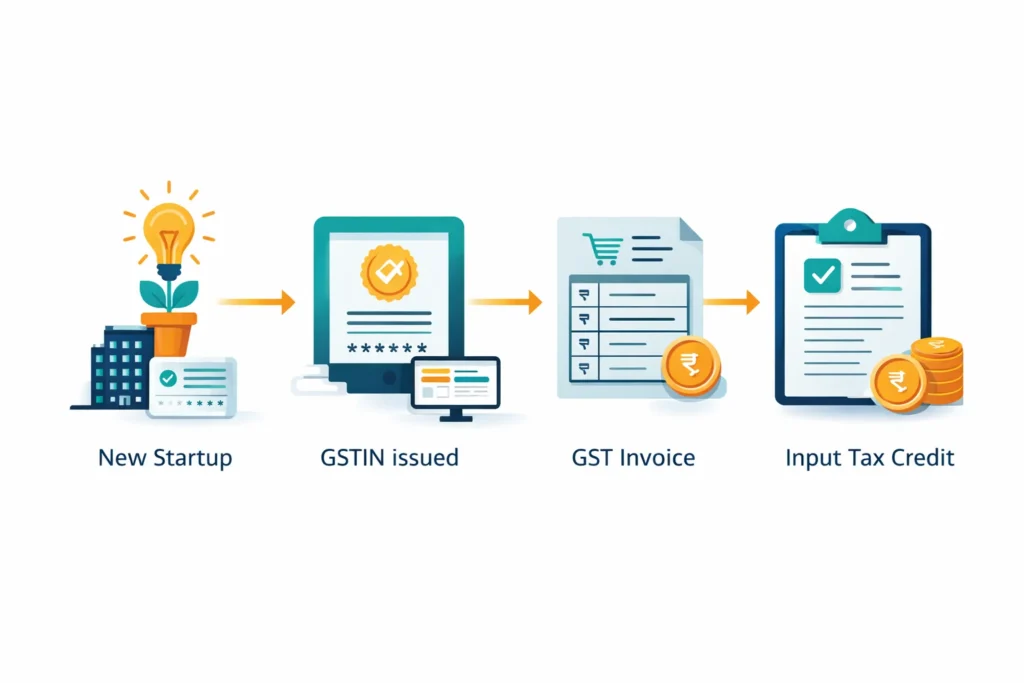
Why should a startup register for GST early (even before hitting the limit)?
Even when GST registration is not legally mandatory, many high‑growth startups benefit from registering voluntarily. The main early‑stage advantages include:
- Access to input tax credit (ITC)
If you are spending heavily on software tools, advertising, logistics, or vendor services that include GST, registration allows you to claim ITC and reduce your net tax cost. - Better credibility with investors and enterprise clients
A GST‑registered entity with clean filings looks more mature during due diligence and is often preferred by B2B customers and corporates. - Nationwide scalability from day one
If you plan to sell pan‑India, registering early ensures you can enter new states without last‑minute compliance scramble. - Fewer bottlenecks in future funding rounds
Unresolved tax issues or delayed GST registrations can slow down fundraising, especially when investors review your statutory compliance. - Smoother vendor and marketplace onboarding
Many marketplaces, payment gateways, and large vendors simply expect a GSTIN during onboarding.
A study by India’s Controller General of Accounts showed that GST collections crossed ₹1.8 lakh crore in several recent months, reflecting deeper digitisation and scrutiny in the tax system. In such an environment, proactive compliance is often cheaper than firefighting notices later.
To understand the basic mechanics of GST before deciding, you can also review general GST explainer content similar to what StartupMandi publishes for small businesses, covering rates, returns, and compliance concepts.
How should founders decide the right time to register?
Founders can use a simple three‑question framework to decide when to apply for GST registration:
- Are you within 3–6 months of crossing the turnover threshold?
If your revenue trajectory suggests you will hit ₹20–40 lakh soon, it is safer to register early and build compliance habits before volume grows. - Is your customer base primarily B2B or enterprise?
B2B clients usually want GST invoices to claim ITC themselves, so early registration becomes a competitive advantage. - Are you already incurring large GST‑paid expenses?
If you are spending significantly on GST‑charged inputs, you are leaving money on the table by not claiming ITC.
You can then choose between waiting until mandatory, registering at a planned revenue milestone, or registering immediately if you are already B2B‑heavy and ITC‑positive. StartupMandi’s GST registration service is designed to help founders evaluate these options and file smoothly when they decide to move ahead.
What documents and details are needed for GST registration?
For most startups, GST registration requires a predictable set of documents and data points. In general, you will need:
- Business identity and PAN for the company, LLP, or proprietor.
- Promoter/Founder KYC such as PAN, Aadhaar, and photos.
- Proof of principal place of business like electricity bill, property tax receipt, or rent agreement.
- Bank account proof such as a cancelled cheque or statement.
- Authorisation documents like board resolution or authorisation letter for the signatory.
Having these ready in advance significantly reduces back‑and‑forth with the GST department and cuts approval timelines. If you are unsure about any document type or format, using a specialised compliance partner like StartupMandi can reduce rejection risk.

How do startups apply for GST registration online?
Here is a streamlined, founder‑friendly overview of the online GST registration process.
- Go to the official GST portal and start a New Registration under Services → Registration.
- Fill Part A with your legal name, PAN, mobile, and email, then generate a Temporary Reference Number (TRN) after OTP validation.
- Log in using the TRN and complete Part B, providing business details, promoters’ details, principal place of business, bank details, and additional information.
- Upload scanned copies of required documents and submit the application with digital signature or EVC.
- Track application status; respond to any queries or additional information requests within the specified timelines.
High-level GST registration flow for startups:
GST Portal → New Registration → TRN generation → Detailed Form & Document Upload → Verification → GSTIN allotment
Central Board of Indirect Taxes and Customs (CBIC) guidelines issued in 2025 strengthened physical and risk‑based verification of business premises, so accurate addresses and accessible locations are critical to avoid delays.
If you face technical issues on the GST portal, resources similar to “GST site not working – how to fix portal access issues” are useful to debug login and system errors without derailing filing timelines.
What are the key benefits of GST registration for startups?
From a startup compliance lens, the benefits of timely and strategic GST registration go beyond pure tax obligations.
One article on benefits for startups and MSMEs notes that ITC and better market access together create a genuine competitive edge over unregistered competitors. For early‑stage startups chasing enterprise contracts, this edge can directly translate into larger deal sizes and repeat business.
“GST compliance is no longer optional hygiene; it is a growth enabler for startups.” – Adapted from multiple startup compliance case studies
What GST mistakes do early‑stage founders often make?
Many founders delay thinking about GST until it becomes urgent, which can create avoidable risk. Common mistakes include:
- Ignoring aggregate turnover across multiple projects
Treating each business line separately rather than checking combined turnover under the same PAN can lead to accidental non‑registration. - Onboarding B2B clients without GST capability
If you are not registered, corporate customers cannot claim ITC, which may push them to choose a different vendor. - Poor record‑keeping and invoice hygiene
Missing GST components, wrong HSN/SAC codes, or inconsistent invoices complicate returns and can trigger mismatches. - Under‑estimating portal and technical issues
Waiting until the last week of a filing deadline can backfire if the GST site experiences downtime or errors. - Not taking professional support when scaling
As transaction volume grows, handling everything manually increases the chance of compliance gaps.
A survey‑style analysis of small businesses found that many compliance issues stem from understanding gaps rather than intent, which means the right guidance early can save both money and focus.
How can StartupMandi help with GST registration?
For busy founders, partnering with a specialist like StartupMandi can convert a complex compliance task into a predictable checklist. While you focus on product and growth, a service partner can:
- Validate whether GST registration is mandatory or strategically beneficial at your stage.
- Help you choose between regular, composition, or other applicable schemes based on your model.
- Prepare and submit your GST registration application end‑to‑end, ensuring documents and details are in the correct format.
- Guide you on invoice formats, ITC planning, and basic filing routines after registration.
If you already know you want to proceed, you can review StartupMandi’s dedicated GST registration service page, which typically outlines scope, timelines, and pricing so you can plan accordingly.
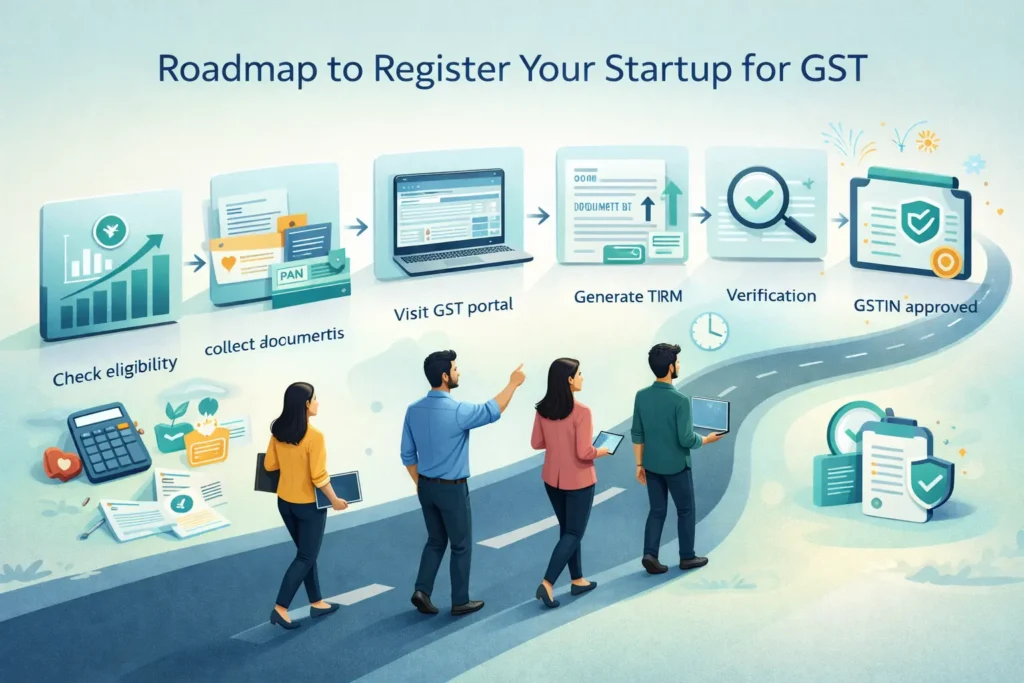
Roadmap to register your startup for GST step‑by‑step?
Times Needed: 2 DAYS
Estimated Cost: Currency: 50 USD
Register your Indian startup for GST through the official portal using a structured, founder‑friendly process that minimises errors, speeds up approval, and prepares you for ongoing compliance.
- STEP1: Assess your GST readiness
Estimate your annual turnover, customer mix, and ITC needs to confirm whether GST is mandatory or strategically beneficial right now. - STEP2: Collect all required documents
Gather PAN, incorporation documents, address proof, bank proof, and promoter KYC in clear, scannable formats before you start the online form. - STEP3: Create your TRN on the GST portal
Visit the GST portal, choose New Registration, and complete Part A details to generate your Temporary Reference Number via OTP validation. - STEP4: Complete Part B registration form
Log in with your TRN, fill business, promoter, place of business, and bank details carefully, and upload all supporting documents. - STEP5: Submit application and track status
Sign with DSC or EVC, submit the form, respond promptly to any queries, and monitor status until your GSTIN is allotted.
Tools Name: GST portal, DSC/e‑sign service, scanning app, compliance advisor
Materials Name: PAN card, incorporation certificate, address proof, bank proof
What are your next steps if you are considering GST registration?
If you suspect you are anywhere near the turnover threshold, then your logical next steps are:
- Map your last 12 months’ turnover and growth trajectory to estimate when you will cross GST limits.
- Review a detailed GST explainer guide similar to StartupMandi’s content on GST rates, returns, and compliance so the entire founding team shares a basic understanding.
- Schedule a short consultation with a GST expert or a compliance platform to decide whether to register now or at a specific milestone.
- Once you are ready, move ahead with your GST registration application using a service like StartupMandi’s GST registration offering so the process is handled end‑to‑end.
A soft but important step is to bake compliance milestones into your fundraising and scaling roadmap, so GST registration is not treated as an afterthought once money or customers start flowing in.
Conclusion:
Why deciding on GST early sets your startup up for scale
Early, clear decisions on GST registration help your startup avoid penalties, reduce tax leakage through ITC, and present a professional, compliant image to investors and enterprise clients. Instead of treating GST as a last‑minute paperwork hurdle, you can turn it into a foundation for pan‑India growth and financial discipline.
If you are ready to move from confusion to clarity, explore StartupMandi‑style GST registration services for founders, and complement that with deeper learning on GST compliance through articles on GST rules, rates, and portal troubleshooting. When done right, GST registration becomes a small but powerful step toward building a scalable, fundable company.
If you are a founder who wants to stop worrying about compliance and focus on building, now is a good time to apply for GST registration with a trusted startup‑focused partner.
What are some practical FAQs on GST registration for startups?
No. It becomes compulsory only when your aggregate turnover crosses the threshold (₹40 lakh for goods, ₹20 lakh for services in most states) or when you fall into special mandatory categories like e‑commerce operators or certain interstate suppliers.
Yes. Voluntary registration is allowed and often beneficial if you have B2B customers or significant GST‑paid expenses that you want to claim as ITC.
Approval time varies, but many applications are processed within 7–10 working days if documents are complete and physical or online verification is smooth.
You may face tax liability from the date you became liable, along with interest and penalties for non‑registration and non‑payment.
If your service turnover crosses ₹20 lakh in regular states (₹10 lakh in special category states), you must register, even as an individual.
Yes. You can apply for cancellation if your business closes or your turnover drops below limits, subject to rules on pending returns and liabilities.
Yes. Small suppliers of goods and some service providers with lower turnover can opt for composition schemes with reduced compliance, subject to specific eligibility conditions.
Yes. GST registration is state‑specific, so you must register in every state from where you supply goods or services as per GST rules.
A Few suggested links For Further Research And Facts check
- Official GST Portal – GST registration and services overview
- CBIC – GST law, rules, and notifications for deeper legal reference.
- Razorpay GST registration limits guide – updated threshold explanations for small businesses.
- LegalWiz GST threshold limits guide – detailed breakdown for goods and services.
- Taxtmi article on GST benefits for startups and MSMEs – practical insights on advantages.
Disclaimer: This article is for general informational purposes only and does not constitute legal or tax advice. Please consult a qualified professional for advice specific to your startup.






Thanks for breaking down the GST registration timeline and considerations for startups. It’s helpful to know that while new registrations are currently paused, understanding the triggers and benefits—like input tax credit—can help us plan ahead for when the process resumes. The timing of registration can indeed make a big difference in cash flow and credibility, especially for early-stage businesses.
Thanks for breaking down the GST registration timeline and considerations for startups—especially helpful to know about the registration hold until March 15th. It’s great to see a focus on strategic registration timing, not just compliance, since that can really impact cash flow and credibility early on. Would love to hear more on how startups can prepare for the resumption of registrations and what documents might be needed in advance.
Thank you for your comment. To use your site link & generate backlink on our platform, 1st go through a paid plan: https://startupmandi.in/services/digital-services/premium-brand-promotion-on-startupmandi/
Thanks for breaking down the GST registration timeline and considerations for startups—especially helpful to know about the registration freeze and the estimated restart on March 15th. It’s great to see a focus on strategic registration timing rather than just compliance, especially for early-stage businesses trying to balance cash flow and credibility. The insight on voluntary registration for ITC benefits is particularly valuable for founders planning ahead.
Thank you for your comment. To use your site link & generate backlink on our platform, 1st go through a paid plan: https://startupmandi.in/services/digital-services/premium-brand-promotion-on-startupmandi/
Thanks for breaking down the GST registration timeline and strategic benefits for startups. As a founder navigating the early stages, it’s helpful to know that registering early can unlock input tax credits and build credibility with vendors and investors. The reminder about avoiding penalties by staying compliant is a key takeaway that many of us might overlook.
Thank you for your comment. To use your site link & generate backlink on our platform, 1st go through a paid plan: https://startupmandi.in/services/digital-services/premium-brand-promotion-on-startupmandi/