

startupmandi-blog-background

How to Use AI Tools for Productivity: Save 20+ Hours ⚡💼

How to use AI tools for productivity saves 20+ hours weekly. Master ChatGPT, Copilot, Asana AI, Zapier, Clockwise. Complete implementation guide. 📊

How to Use AI Tools for Productivity: The 20+ Hour Weekly Opportunity 🚀

How to use AI tools for productivity represents the single most impactful professional development investment available to modern workers. Recent data confirms that professionals deploying AI tools strategically save 20+ hours weekly while improving work quality simultaneously. This breakthrough achieves something previously impossible—creating more time while raising output standards.

The evidence is overwhelming. 63% of employees now use AI at work, with 51% reporting measurable productivity improvements. Moreover, AI automation can increase overall productivity by 40% across entire organizations, with some knowledge workers experiencing 55.8% faster task completion. Yet most professionals remain unaware of how to use AI tools for productivity systematically—they dabble rather than strategize.

How to Use AI Tools for Productivity – Breakthrough Metrics 📈

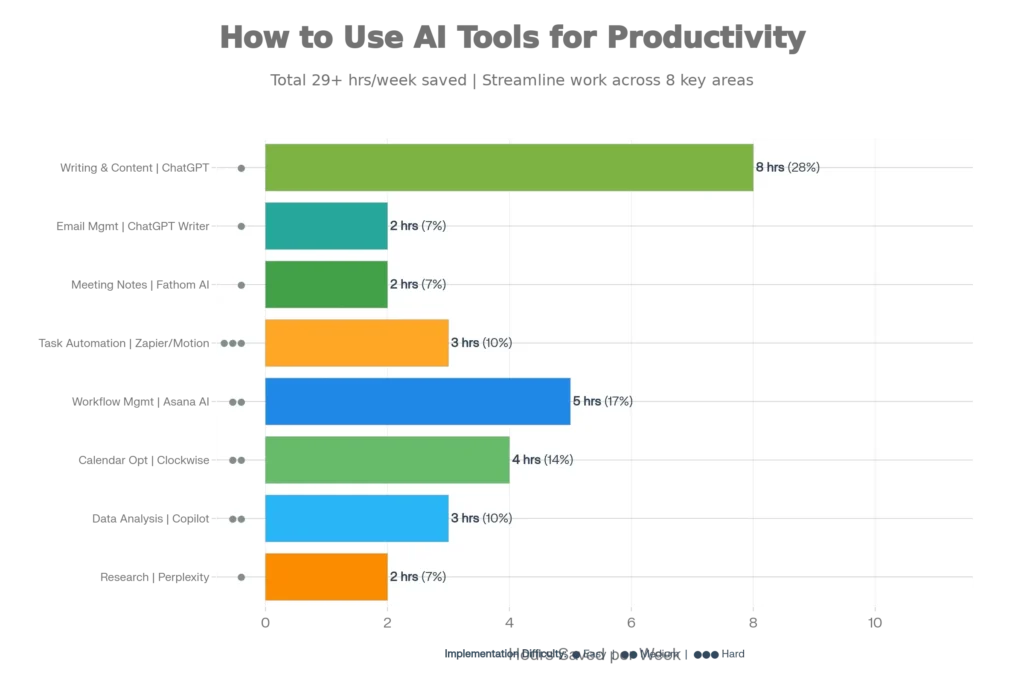
  1. Total Weekly Time Savings: 20+ hours across writing, meetings, automation, scheduling

  2. Writing & Content: 8 hours/week via ChatGPT (brainstorming, drafting, editing)

  3. Workflow Automation: 5 hours/week through Asana AI (project management, reporting)

  4. Calendar Optimization: 4 hours/week with Clockwise (meeting scheduling, focus time)

  5. Task Automation: 3 hours/week using Zapier (email, scheduling, data entry)

  6. Productivity Boost: 40% improvement in overall work output and quality

Also Read: Best AI Tools 2026 For Work And Business

Understanding AI Tools: The Foundation For Strategic Productivity Gains

How to use AI tools for productivity begins with understanding that different tools solve different problems—there’s no single “best” tool. Success requires matching tools to specific workflow bottlenecks, then orchestrating them into a cohesive productivity system.

The AI Tool Ecosystem: Purpose-Built Solutions

How to use AI tools for productivity effectively means deploying specialized tools addressing distinct categories:

Generative Writing & Brainstorming: 💭
ChatGPT dominates this category, saving ~8 hours weekly through content generation, planning, analysis, and creative brainstorming. From email drafting to proposal writing, ChatGPT handles diverse writing tasks while preserving your voice and perspective.

Microsoft Copilot excels specifically for professionals already embedded in Microsoft 365 (Word, Excel, Outlook, Teams). It integrates seamlessly rather than requiring context-switching to external tools.

Claude specializes in deep analysis and complex reasoning, ideal for nuanced writing and strategic problem-solving.

Meeting & Communication Intelligence

Meeting transcription and note-taking represent enormous time-waste opportunitiesFathom AI automatically transcribes meetings, highlights action items, generates follow-ups, saving 1-2 hours weekly on post-meeting administrative work.

Why This Matters: 📊

  1. 90%+ transcription accuracy with speaker identification

  2. Clickable timestamps enabling instant navigation

  3. AI-generated summaries eliminating manual note-taking

  4. Shareable clips for team communication

Workflow & Project Automation

Asana AI transforms project management by automating status updates, predicting bottlenecks, and generating insights saving ~5 hours weekly. Teams using Asana AI’s automation features experience 25,000+ monthly automations replacing manual work.

Why Projects Benefit: 📋

  1. Automated status reporting (no more manual updates)

  2. Smart task prioritization based on dependencies

  3. Predictive analytics identifying risks before they materialize

  4. Custom workflow building without coding

Schedule & Calendar Intelligence

Clockwise uses AI to optimize calendars automatically, creating 4+ hours of uninterrupted deep work time weekly. Rather than constant calendar management, Clockwise intelligently rearranges meetings around focus blocks.

How Calendar AI Works: ⏰

  1. Finds optimal meeting times across complex team schedules

  2. Automatically rearranges non-critical meetings to preserve focus time

  3. Respects individual preferences and working hours

  4. Integrates with Slack, Asana, Google Calendar

 
how-to-use-ai-tools-for-productivity-save-20-hours
How to use AI tools for productivity showing 20+ hours weekly time savings across writing, automation, meetings, calendar, workflows, analytics and research
Checkout Our Latest Services

Specialized AI Tools: Maximizing Productivity In Specific Workflows

How to use AI tools for productivity requires deploying specialized solutions targeting your specific bottlenecks. One-size-fits-all approaches fail; customized combinations succeed.

Email & Communication Acceleration

ChatGPT Writer drafts professional emails, responses, and communications saving 1-2 hours weekly. The tool maintains appropriate tone while capturing your intent from brief prompts.

Practical Example: Instead of crafting lengthy client responses manually, provide ChatGPT Writer: “Politely explain project delay, highlight mitigation steps, request patience.” The tool generates professional copy instantly.

Research & Information Synthesis

Perplexity AI conducts AI-powered research with cited sources, eliminating hours of manual source compilation. Unlike ChatGPT’s training data cutoffs, Perplexity accesses real-time information with transparent source attribution.

NotebookLM transforms content into audio summaries, study guides, and interactive Q&A, saving 1-2 hours on knowledge synthesis.

Data Analysis & Business Intelligence

Microsoft Copilot embedded in Excel, Power BI, and Outlook analyzes data, generates visualizations, saving 2-3 hours weekly on analytical work.

Real Impact: 📊

  1. Transform raw data into actionable insights automatically

  2. Create professional reports without manual formatting

  3. Identify trends competitors might miss

Workflow Automation Platform

Zapier connects 8,000+ applications, automating multi-step workflows saving 2-3 hours weekly through intelligent automation. Its AI-powered Copilot generates automation sequences from natural language prompts.

Automation Examples:

  1. New email from client → Auto-save to CRM → Slack notification → Calendar reminder

  2. Form submission → Create task → Assign team member → Send confirmation

  3. Database update → Generate report → Email stakeholders → Archive completed items

These automations run 24/7 without human intervention.

Checkout Latest Grants Listed

Implementation Mastery: The Roadmap From Strategy To 20+ Hour Savings

How to use AI tools for productivity requires disciplined implementation rather than random tool adoption. Following a structured rollout prevents overwhelm while ensuring sustainable behavior change.

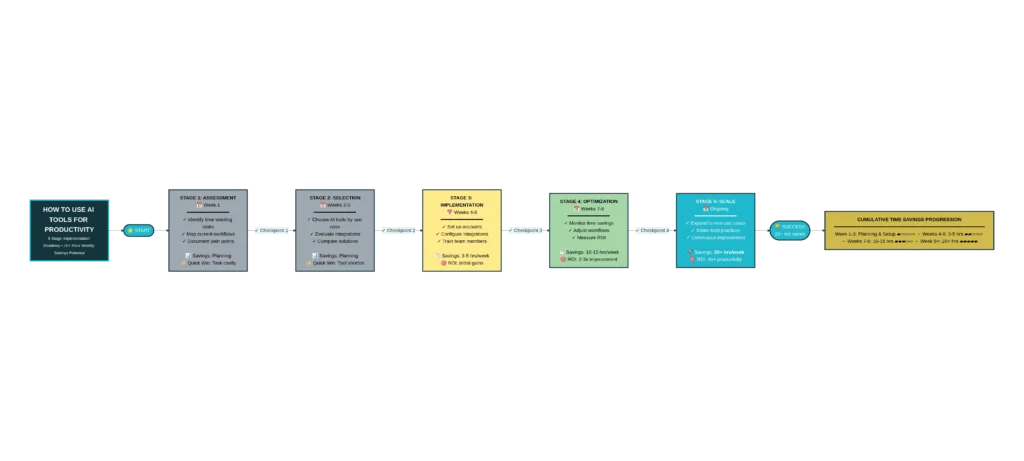
Stage 1: Assessment & Opportunity Identification (Week 1)

Begin How to use AI tools for productivity by auditing your actual workflow, not imagined workflows:

Audit Process:

  1. Track time spent on specific tasks (writing, meetings, scheduling, analysis)

  2. Identify your biggest time-wasters (likely: email, scheduling, status updates)

  3. Document tasks causing frustration or mental load

  4. Prioritize 3-5 highest-impact opportunities

Key Insight: Most professionals spend 50%+ time on low-value administrative work replaceable by AI.

Stage 2: Tool Selection & Integration Planning (Weeks 2-3)

Match tools to your identified bottlenecks, not to hype:

Productivity GapBest ToolTime SavedIntegration
Writing/DraftingChatGPT Plus8 hrs/weekBrowser, API, plugins
Meeting NotesFathom AI2 hrs/weekZoom, Teams, Google Meet
SchedulingClockwise4 hrs/weekGoogle Calendar, Slack, Asana
Workflow AutomationZapier3 hrs/week8,000+ app connections
Project ManagementAsana AI5 hrs/weekExisting Asana setup
 
Selection Criteria: 🎯
  1. Integration compatibility with existing tools

  2. Learning curve vs. time savings ROI

  3. Team adoption likelihood (easy tools spread faster)

  4. Cost efficiency (many tools offer free tiers)

Stage 3: Implementation & Team Training (Weeks 4-6)

Roll out tools systematically, not all at once:

Recommended Sequence:

  1. Week 4: ChatGPT for individual writing tasks (lowest friction, immediate value)

  2. Week 5: Zapier for 1-2 critical automations (meeting scheduling, email routing)

  3. Week 6: Clockwise for calendar optimization (team-wide impact, measurable focus time)

Training Approach:

  1. Video walkthroughs showing real use cases specific to your role

  2. Weekly implementation challenges (e.g., “automate your email sorting this week”)

  3. Success sharing (celebrate early wins to motivate adoption)

Stage 4: Optimization & Measurement (Weeks 7-8)

How to use AI tools for productivity requires continuous refinement based on actual results:

Measurement Framework: 📊

  1. Track time spent on specific tasks before/after AI implementation

  2. Monitor work quality metrics (error reduction, output improvement)

  3. Assess team satisfaction and tool adoption rates

  4. Calculate ROI comparing tool costs to time savings value

Expected Results: Most professionals see 3-5 hours savings by week 4, 10-15 hours by week 8.

Stage 5: Scaling & Continuous Improvement (Ongoing)

Success with initial tools enables expanded implementation:

Expansion Opportunities:

  1. Train team members on proven workflows

  2. Identify additional automation opportunities

  3. Evaluate emerging tools solving new problems

  4. Build institutional knowledge (document workflows, create playbooks)

Advanced Pattern: Some professionals build custom automations combining multiple tools—ChatGPT output → Zapier processing → Database storage → Asana project updates—creating sophisticated workflows.

how-to-use-ai-tools-for-productivity-save-20-hours
How to use AI tools for productivity implementation roadmap showing 5-stage rollout from assessment through scaling with increasing time savings

Conclusion: How to Use AI Tools for Productivity Is Non-Negotiable Skill 🎯

How to use AI tools for productivity transitions from “nice-to-have” skill to foundational professional competency. The professionals who master AI productivity tools gain 5-10 year time advantages over peers—equivalent to the output of 1-2 full-time employees. This compounding advantage determines career trajectory, entrepreneurial success, and professional relevance.

The path is clear: assess workflows → select specialized tools → implement systematically → measure results → scale successful patterns. Following this roadmap enables even modest users to achieve 20+ hours weekly productivity gains within 8 weeks. The mathematical reality: **saving 20 hours weekly × 50 working weeks = 1,000 hours annually—equivalent to 6 months of additional productivity from single career.

At StartupMandi, we recognize that how to use AI tools for productivity represents the ultimate competitive advantage for modern entrepreneurs. Explore our comprehensive AI productivity implementation guide covering tool selection, integration strategies, and team adoption frameworks. Discover our detailed workflow optimization playbook helping professionals systematically eliminate time-wasting activities.

For professionals serious about career acceleration, how to use AI tools for productivity isn’t optional—it’s essential. Visit our complete AI tools masterclass covering 15+ productivity tools and their optimal use cases. Connect with our productivity advisors developing customized implementation strategies aligned with your specific workflows and goals.


Frequently Asked Questions About How to Use AI Tools for Productivity

Q1: Which AI tool should I start with if I’m new to productivity AI?

Begin with ChatGPT Plus ($20/month). It addresses writing and brainstorming—the most universal pain point—and delivers immediate value without complex setup. After 2-3 weeks, add Zapier for your most repetitive automation, then Clockwise for calendar optimization. This sequence maximizes early wins while building momentum.

Q2: How long does implementation realistically take before seeing results?

Early results appear within 7-14 days (ChatGPT implementations), but meaningful time savings (5+ hours weekly) require 4-6 weeks of consistent usage. Full ecosystem optimization (20+ hour savings) typically takes 8-12 weeks as behaviors solidify and expanded integrations develop.

Q3: Will AI tools eventually make my skills obsolete?

No—AI tools amplify existing skills rather than replace them. Writers using ChatGPT produce more content, not fewer jobs. Strategists using data AI gain better insights. The professionals who succeed combine human judgment, creativity, and strategic thinking WITH AI’s speed and analytical power.

Q4: What’s the total monthly cost for a complete AI productivity stack?

Realistic starter cost: ChatGPT Plus ($20) + Zapier free tier ($0) + Clockwise free tier ($0) = $20/month. Professional tier: ChatGPT Plus ($20) + Zapier ($30) + Clockwise ($18) + Asana AI ($13) = $81/month. Enterprise: $150-300/month covering advanced features across tools.

Q5: How do I convince my team to adopt AI productivity tools?

Start with volunteers willing to pilot specific tools. Share their time savings publicly (e.g., “Sarah’s automations save 3 hours weekly”). Provide easy implementation instructions and weekly support. Show team-wide benefits (meetings schedule faster, reports generate automatically). Celebrate early adopters. Peer adoption spreads faster than mandates.

Mariyam Bandookwala
Mariyam Bandookwala

i am a professional content writer with a strong focus on clarity, strategy, and audience engagement—helping brands communicate smarter and grow faster.

Articles: 34

Leave a Reply

Your email address will not be published. Required fields are marked *