



startupmandi-blog-background

Gold Rate Hits Historic High: What’s Going to Happen in 2026?

Gold hits historic high 2026 forecast driven by rate cuts, geopolitics, rupee weakness. Expert forecasts $4,900/oz in 2026. Investment guide.

Gold hits historic highs as unprecedented macroeconomic forces converge globally. International prices surged to record levels throughout 2025. Moreover, India experienced even more dramatic gains reaching ₹1.33 lakh per 10 grams. Additionally, global demand touched record 1,313 tonnes in Q3 2025. Consequently, investors worldwide scramble to understand what’s happening.

In short, this rally represents more than speculative excess. Furthermore, structural factors suggest momentum may continue into 2026. Most importantly, understanding drivers helps predict future price direction. Beyond doubt, savvy investors must grasp these dynamics. Thus, this comprehensive analysis reveals everything you need to know.

This authoritative guide covers critical gold market insights:

  1. Historic rally drivers including Federal Reserve rate cuts, geopolitical tensions, and safe-haven demand surge

  2. India-specific factors like rupee depreciation, import duties, wedding season, and record ETF inflows

  3. Expert forecasts revealing Goldman Sachs predicts $4,900/ounce by December 2026

  4. Central bank accumulation as official-sector purchases remain historically elevated continuously

  5. 2026 outlook scenarios outlining bullish base case, upside risks, and potential downside catalysts

THE PERFECT STORM—WHY GLOBAL GOLD PRICES SOARED

Understanding the Historic 2025 Rally 

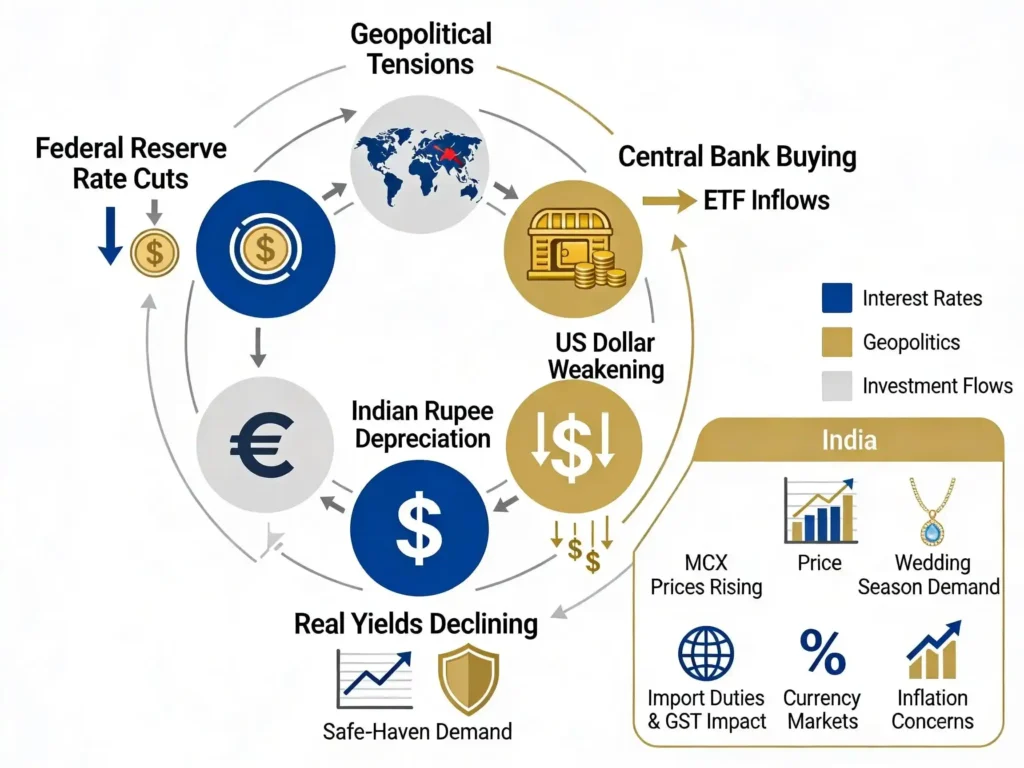
Global gold prices reached unprecedented levels capping 2025 explosively. The surge wasn’t accidental—it reflected a convergence of powerful macroeconomic forces. The Federal Reserve delivered multiple 25-basis-point rate cuts aggressively. These reductions lowered the funds rate to 3.50%–3.75% territory. Consequently, real yields compressed, reducing gold’s opportunity cost dramatically. This easing cycle reignited investor flows into precious metals. Moreover, the Fed offered limited forward guidance for 2026, amplifying uncertainty.

Central banks continued aggressive buying spree for reserve diversification. Official-sector purchases remained historically high throughout 2025. Additionally, Western investors returned through ETFs, driving consecutive months of inflows. Furthermore, this structural demand floor protected prices during volatility. Therefore, institutional buying provided consistent support underneath.

Geopolitical Uncertainty as a Safe-Haven Catalyst

Geopolitical tensions amplified the rally consistently throughout 2025. Middle East flare-ups, Russia-Ukraine tensions, and trade friction surged constantly. These shocks prompted investors to seek safety in gold immediately. Moreover, analysts consistently linked sharp price spikes to geopolitical news. Consequently, fear premium components pushed valuations higher persistently. Additionally, investors viewed gold as portfolio insurance against systemic risks. Therefore, uncertainty became gold’s greatest ally in 2025.

The Dollar’s Weakness and Real Yields Collapse

A weaker U.S. dollar significantly reduced the opportunity cost of holding gold. Lower real yields made non-yielding gold more attractive comparatively. Furthermore, investors fleeing U.S. equities rotated into precious metals defensively. Consequently, these macro shifts created a powerful tailwind underneath. Most importantly, the combination of weak dollar plus low real yields proved unbeatable.

gold-hits-historic-highs-whats-next-in-2026
Key factors driving gold's historic rally: geopolitics, monetary policy, and central bank demand
Checkout Our Latest Services


INDIA-SPECIFIC DYNAMICS AMPLIFYING DOMESTIC GOLD PRICES

The Rupee’s Impact on Indian Gold Valuations 

India experienced even more pronounced gold price increases than global markets. Gold prices breached ₹1.33 lakh per 10 grams on MCX. The Indian rupee’s sharp depreciation toward ₹86–₹90 per USD amplified prices. Even when global spot prices eased, domestic rates climbed purely on currency pass-through. This multi-year depreciation inflated import bills substantially. Moreover, combined with import duties and GST, the wedge widened considerably. Consequently, Indian consumers faced the perfect storm of rising prices domestically.

India has recorded record gold ETF inflows this year. Investment demand surged in value terms despite jewelry volumes moderating. Furthermore, bars, coins, and ETFs attracted investors seeking diversification. Therefore, the investment-to-jewelry demand shift accelerated notably throughout 2025.

Seasonal Demand and the Wedding Season Effect

Wedding seasons traditionally drive Indian gold demand significantly. However, 2025 witnessed a notable shift toward investment vehicles. High price anchors prompted households to reallocate toward bars and coins. Jewelry demand moderated despite seasonal strength. Additionally, jewelry consumption may weaken further if prices stabilize lower. Therefore, this structural shift toward investment demand appears here to stay.

Import Duties, GST, and the Domestic-Global Price Wedge

India’s complex tax and duty framework creates substantial price wedges. Despite adjustments earlier in 2025, combined import duty and GST impacts remained significant. This substantial wedge separates Indian prices from overseas rates persistently. Therefore, Indian consumers pay considerably more than global equivalents. Consequently, any global price pullback transmits slowly to India. Moreover, the wedge actually incentivizes smuggling, creating supply concerns.

EXPERT FORECASTS AND 2026 OUTLOOK SCENARIOS

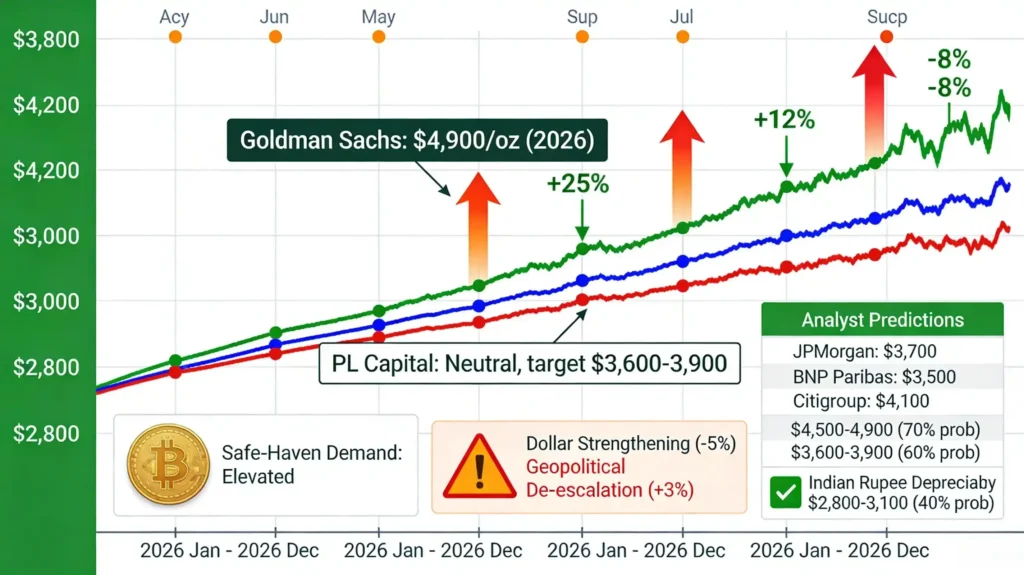
Goldman Sachs Predicts $4,900 Per Ounce by December 2026

Goldman Sachs made a bold prediction about gold’s future trajectory. The investment bank forecasts gold could reach $4,900 per ounce by December 2026. This target represents approximately 30% upside from current levels. Moreover, such forecasts command respect due to Goldman’s market influence. Furthermore, the prediction implies continued structural strength ahead. Consequently, investors view this as a credible upside scenario. However, multiple risks could prevent reaching this ambitious target.

PL Capital’s “Moderately to Strongly Positive” Baseline Outlook

PL Capital expects gold to remain “moderately to strongly positive” in 2026. Rather than explosive gains, they anticipate steady appreciation with intermittent corrections. Furthermore, underlying macro backdrop continues favoring safe-haven assets. Additionally, persistent geopolitical unease provides ongoing support. This baseline assumes global conditions remain broadly similar throughout 2026. Consequently, expect elevation with volatility rather than smooth trajectories.

Upside Scenarios: What Could Push Prices Higher?

Several catalysts could push gold substantially higher in 2026. Renewed global shocks like Middle East escalations would amplify safe-haven flows. Prolonged trade frictions or unexpected growth concerns would increase flight-to-quality demand. Furthermore, strong central bank buying by the RBI and Asian authorities would maintain physical tightness. Additionally, persistent ETF inflows combined with China’s growing appetite could reinforce strength. Most importantly, geopolitical escalation represents the primary bull case for 2026. Therefore, monitoring global tensions becomes crucial for gold investors.

Downside Risks: What Could Trigger Corrections?

A faster-than-expected reversal of Fed easing would pressure gold significantly. A stronger U.S. dollar would raise the opportunity cost of holding gold. Furthermore, geopolitical de-escalation would compress the fear premium rapidly. Additionally, weakening ETF flows or pivot back toward jewelry could weigh demand. Most concerningly, if inflation proves persistent, rate hikes could resume. Therefore, investors must monitor Fed communications religiously throughout 2026.

MetricGold 2025Silver 2025Outlook 2026Key Driver
Annual Gain+60%+100%Gold: Steady, Silver: VolatilityMonetary policy
Current PriceHistoric Highs$60+ per ounceGold: $4,900 targetSafe-haven demand
Demand TypeInvestment + JewelryIndustrial + InvestmentSilver: Industrial cycleTech sector strength
Central Bank BuyingHistorically HighMinimalGold: SustainedReserve diversification
Supply SituationBalancedStructural DeficitSilver: TightSolar & EV growth
India ETF InflowsRecord HighGrowingBoth: PositiveInvestor shift
Gold price forecasts for 2026: Expert predictions and market scenarios
Checkout Latest Grants Listed

Conclusion: 

Gold’s historic 2025 rally represents far more than irrational exuberance. Powerful structural forces—monetary easing, geopolitical uncertainty, and central bank buying—remain intact. Furthermore, Goldman Sachs targets $4,900/ounce suggesting substantial upside potential remains. Most importantly, the macro environment still favors gold considerably heading into 2026. However, risks exist if Fed policy reverses or geopolitical tensions ease. Therefore, investors should maintain diversified precious metal exposure while monitoring key catalysts. Your 2026 gold strategy should balance conviction with risk management carefully.

Frequently Asked Questions:

Why did gold prices hit historic highs specifically in 2025?

Multiple converging factors created a “perfect storm” for gold in 2025. Federal Reserve rate cuts lowered real yields, reducing gold’s opportunity cost significantly. Additionally, geopolitical tensions in Middle East and Ukraine amplified safe-haven demand. Furthermore, central banks continued aggressive accumulation for reserves. Most importantly, the weak U.S. dollar made gold more attractive to international investors. Therefore, this confluence of positive factors proved irresistible.

Can gold prices reach $4,900 per ounce by December 2026?

Goldman Sachs forecasts suggest $4,900/ounce is achievable but requires continued support. The prediction assumes persistent monetary accommodation and geopolitical uncertainty. However, unexpected Fed policy reversal or geopolitical de-escalation could prevent reaching this target. Furthermore, stronger U.S. dollar would create headwinds. Most importantly, markets often diverge from forecasts, so consider this aspirational rather than guaranteed. Therefore, maintain diversification and don’t bet exclusively on reaching this target.

Why are Indian gold prices higher than global prices despite same global markets?

India’s unique combination of rupee depreciation, import duties, and GST creates substantial price wedges. The Indian rupee weakened toward ₹86–₹90 per USD throughout 2025. Furthermore, import duty and GST combined create additional 10-15% premiums. Additionally, local supply-demand dynamics affect pricing. Most importantly, Indian consumers effectively pay the weighted average of global price plus all taxes and currency impact. Therefore, expect Indian prices to remain elevated relative to global benchmarks consistently.

Should investors allocate to gold given current historic price levels?

Allocation decisions depend on your portfolio objectives and risk tolerance. Gold’s structural support from central bank buying and geopolitical uncertainty remains intact. However, valuation concerns exist given historically elevated prices. Furthermore, diversification through ETFs or bars proves more efficient than physical. Additionally, time-dollar-cost averaging into positions smooths entry prices. Most importantly, allocate based on your long-term wealth preservation objectives rather than short-term forecasts. Therefore, consider 5-10% precious metal allocation as portfolio insurance.

What’s the difference between investing in gold ETFs versus physical gold?

Gold ETFs offer convenience, liquidity, and transparent pricing. They provide instant exit options and minimal storage concerns. Furthermore, expense ratios prove minimal compared to physical costs. Additionally, ETFs eliminate counterfeiting risks inherent in physical ownership. Most importantly, ETFs suit investors prioritizing liquidity and ease over physical possession. However, physical gold provides psychological comfort and true ownership feeling. Therefore, choose based on your lifestyle preferences and investment horizon. Both provide exposure to gold’s price appreciation similarly.

Fact Sources & Further Reading 

  1. Economic Times — Gold Hits Historic Highs: What’s Driving the Rally and 2026 Forecast

  2. Investing.com Analysis — Goldman Sachs Forecasts Gold Could Reach $4,900 Per Ounce by December 2026

  3. Times of India Business — Bullion Outlook: Gold and Silver to Retain Momentum in 2026 with Strong Demand

  4. StartupMandi — Commodity Market and Investment Strategy Resources

  5. World Gold Council — Gold Demand Trends and Global Market Analysis

Arshia Jahan
Arshia Jahan

Digital Marketing and SEO professional, focused on content strategy & optimizing content, improving search rankings, and delivering results through smart, audience-focused strategies. As a Content Strategist and SEO professional, I believe that search engines don't buy products—people do. By blending technical SEO precision with a human-first content approach. I provide readers with the strategic blueprints needed to scale in a competitive digital world.

Articles: 42

Leave a Reply

Your email address will not be published. Required fields are marked *