

How to Invest in ESG and green finance
How to Invest in ESG is now a core question for investors who care about both returns and impact. Because climate risk, social issues and governance failures hit portfolios directly, ESG and green finance are rapidly moving from “nice to have” to “must have”. With the right approach, you can align your money with cleaner energy, fairer companies and long‑term resilience, without blindly chasing hype.
ESG investing blends environmental, social and governance analysis with traditional finance.
Green finance channels money into climate‑positive projects like clean energy and green infrastructure.
India is emerging as a major ESG and green finance hub, backed by regulation and Net Zero goals.
You can start small with ESG funds, green bonds and curated platforms instead of stock picking alone.
A clear process—screen, diversify, measure impact, avoid greenwashing—reduces risk and noise.
How to Invest in ESG: core concepts and options
ESG and green finance can feel jargon‑heavy at first. However, once you break the ideas into simple buckets—ESG, green, and impact—the landscape becomes surprisingly practical. Before choosing products, you need clarity on what you want to support and how much risk you can handle.
ESG basics: what you are actually buying
ESG stands for Environmental, Social and Governance. It adds non‑financial factors to the usual profit and growth metrics. Environmental covers emissions, pollution and resource use. Social looks at labour standards, diversity and community impact. Governance checks board structure, ethics and shareholder rights.
When you think about how to Invest in ESG, you are not buying “perfect” companies. Instead, you tilt toward businesses that manage these risks better than peers. Over time, this often reduces blow‑ups from scandals, fines or stranded fossil assets and can support more stable performance.
Green finance: where the money flows
Green finance is narrower than ESG. It focuses directly on climate and environmental projects.
Green bonds funding solar parks, wind farms or metro systems.
Green loans for energy‑efficient buildings, EV fleets or factory retrofits.
Green equity stakes in clean‑tech and renewable energy companies.
In India, green finance increasingly backs renewable energy, green hydrogen, waste‑to‑energy and sustainable mobility. Therefore, when you learn how to Invest in ESG, you are also learning where future growth and policy tailwinds are strongest.
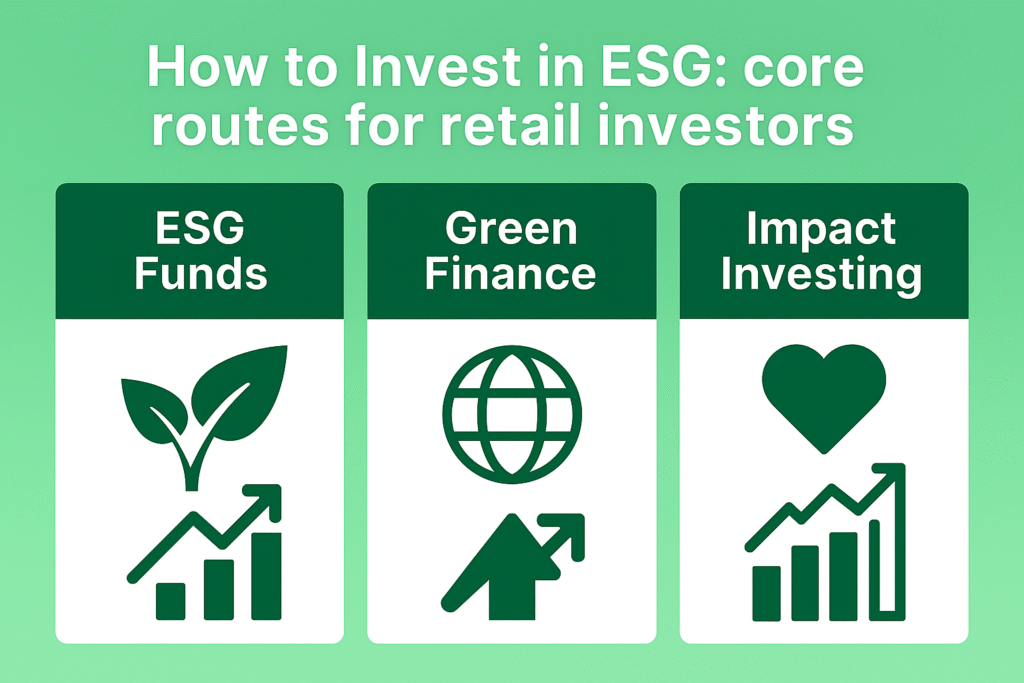
Impact, thematic and ESG funds
Most retail investors start ESG investing through pooled vehicles, not direct project finance.
ESG mutual funds / ETFs that select stocks with stronger ESG scores.
Thematic funds focusing on clean energy, water, or circular economy.
Impact funds that target measurable outcomes (like CO₂ avoided) alongside returns.
In India, ESG mutual funds fall under thematic categories and must disclose their sustainability lens more clearly than before. This transparency helps retail investors who are still learning how to Invest in ESG but want regulated, diversified exposure.
Building a simple roadmap for how to Invest in ESG
Once you understand the building blocks, the next step is a practical roadmap. You do not need a finance degree. However, you do need a repeatable process so that ESG remains more than marketing.
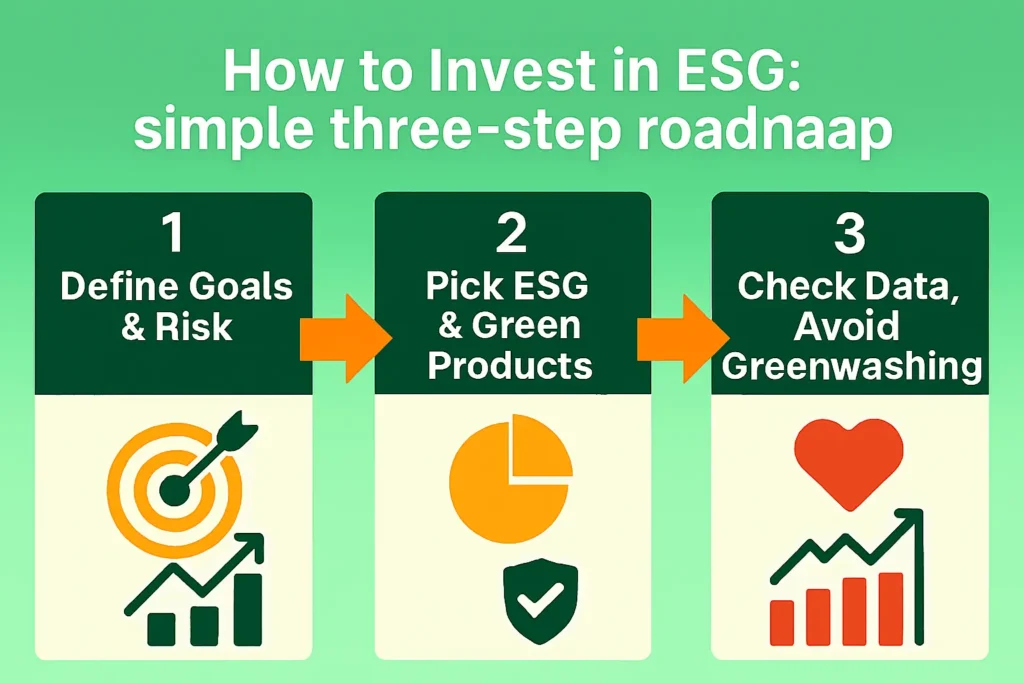
Step 1: Define your “Why” and risk profile
First, clarify why you care about how to Invest in ESG. Do you want to cut portfolio carbon, avoid harmful sectors, or back specific themes like EVs or clean energy? Your “why” guides which products you choose and which compromises you accept.
Next, match this “why” with risk and time horizon. Green equity and climate‑tech startups can be volatile. Green bonds and ESG debt funds tend to be more stable. Because of this, experts suggest mixing safer and growth‑oriented exposures rather than going all‑in on one green story.
Step 2: Choose entry products and diversify
For most people, the easiest way to start with how to Invest in ESG is:
1–2 ESG mutual funds or ETFs as the core.
A smaller “satellite” allocation to a green theme or impact strategy.
This structure mirrors many professional “core‑satellite” portfolios: broad ESG exposure plus targeted high‑conviction bets. In India, several ESG funds and sustainable strategies now exist, and regulators like SEBI are tightening disclosure norms through frameworks like BRSR. That shift makes diversified ESG investing more accessible and less opaque.
Here is a simple high‑level allocation illustration (for learning only, not advice):
| Portfolio pocket | Typical tools (examples) |
|---|---|
| Core ESG allocation | Broad ESG equity fund, ESG index ETF |
| Green income / stability | Green bond fund, sustainable debt fund |
| High‑impact or thematic sleeve | Clean‑energy fund, climate‑tech, impact fund |
Step 3: Check data, labels and greenwashing risk
The biggest practical risk in how to Invest in ESG is greenwashing. Some products use ESG language without meaningful changes to portfolios. Therefore, always:
Read fund fact sheets and look at top holdings.
Check whether impact metrics or emissions data are reported.
Look for credible third‑party ESG data or labels where available.
Globally and in India, regulators now push for clearer sustainability disclosures. SEBI’s BRSR framework and international ESG data standards aim to reduce greenwashing and improve comparability. Nevertheless, a little scepticism is healthy when you learn how to Invest in ESG.
Advanced ways to use green finance once you know how to Invest in ESG
As comfort grows, you can move beyond vanilla ESG funds. Green finance offers tools that directly fund climate solutions and sometimes unlock tax or policy advantages.
Direct green instruments: bonds, loans and platforms
A more advanced layer of how to Invest in ESG involves specific instruments:
Green bonds issued by governments, banks or utilities to fund projects like solar, wind, or low‑carbon transport.
Sustainability‑linked bonds or loans, where interest costs change if climate targets are met or missed.
Curated platforms that bundle verified renewable, waste‑to‑energy or afforestation projects, often with transparent impact dashboards.
In India, initiatives like Net Zero India’s “Invest in Sustainability” show how retail money can reach real climate projects with mapped outcomes per rupee invested. Because of such models, investors who know how to Invest in ESG can now see where their capital actually works.
Using ESG and green finance for startup and SME investing
ESG and green finance are no longer just listed‑market stories. Many angels, family offices and alternative platforms now apply ESG lenses when backing startups or private debt. Climate‑tech, agritech, clean mobility, water management and waste‑to‑resource ventures are attracting capital at scale.
If you invest in private deals, “how to Invest in ESG” becomes a due‑diligence checklist. You can ask founders:
How do you measure carbon, resource and social impact?
Do you follow any ESG reporting frameworks?
How will regulations or carbon pricing change your economics?
For founders reading StartupMandi, understanding how investors think about ESG helps you raise aligned capital and access green finance pools.
Conclusion: turning “how to Invest in ESG” into daily practice
Learning how to Invest in ESG is not a one‑time decision; it is an evolving habit. You start by understanding ESG basics, then you pick simple funds, and later you add green bonds, thematic pockets and perhaps direct impact exposure. Because regulation, technology and climate science keep shifting, you also review holdings periodically and refine your approach.
For Indian investors and founders, the timing is powerful. National net‑zero goals, renewable growth and ESG‑focused regulation are aligning capital with climate priorities. If you pair a thoughtful “how to Invest in ESG” roadmap with strong business fundamentals, you can pursue returns while backing a cleaner, fairer economy.
Disclaimer: StartupMandi is not a SEBI-registered research Analyst or Investment Advisor. This content is for educational and informational purposes only and should not be construed as financial or investment advice. Please consult a qualified financial advisor before making any investment decisions.
FAQs on how to Invest in ESG
1. Is ESG investing really different from traditional investing?
ESG investing still aims for returns, but it adds environmental, social and governance checks to reduce long‑term risk. Traditional approaches often ignore these non‑financial factors until problems appear.
2. Do ESG or green funds always outperform regular funds?
No strategy can always outperform. However, several studies and platforms note that sustainable portfolios can hold up better during shocks, because they often avoid the most exposed, high‑risk sectors. Over time, better governance and climate resilience can support competitive performance.
3. How much of my portfolio should go into ESG and green finance?
There is no universal number. Many investors start by putting a small portion into ESG funds, then increasing allocation as they gain comfort. A core‑satellite structure with ESG at the core and green themes as satellites is increasingly common.
4. How can I avoid greenwashing when I invest?
To reduce greenwashing risk, read fund documents, check top holdings, and look for clear metrics like emissions, impact reports and recognised ESG data sources. Products that only use vague language without numbers deserve extra caution.
5. Is ESG and green finance only for large investors?
No. Today, retail investors can access ESG mutual funds, ETFs, green bond funds and curated sustainable platforms with relatively small ticket sizes. As long as you follow a basic process about how to Invest in ESG, you can start with modest amounts.
Referring Blog / Fact Source
- Sustainable Investment 2025: How Ethical Finance is Powering the Green Economy – NetZero India
- Green Finance: Strategies and Insights for 2025 | EDHEC Online
- ESG Investing in India: Navigating Key Factors | IBEF
- ESG Mutual Funds: A Guide to Ethical Investing in 2025
- ESG insights for 2025 and beyond I Rothschild & Co | Rothschild & Co
- Green Investing in 2025: How to Grow Your Money Without Harming the Earth – Sustainable Living

Dikshant Choudhary
I’m Dikshant Choudhary, a University of Delhi student and freelance writer specializing in SEO blogs, transcription, and business analysis. I create engaging, research-driven content for academic and client projects with creativity and discipline.