


If you need a business loan for starting a business, lenders will look at your personal finances, business plan, and risk profile before saying yes. In most cases, banks and NBFCs do lend to first-time founders, but only when you show clear purpose, repayment capacity, and basic documentation discipline. This guide breaks down what actually matters so you avoid the classic beginner mistakes that kill applications.
What Is a Business Loan for Starting a Business?
A business loan for starting a business is a loan you take in your personal or business name to fund early expenses like setup, inventory, marketing, or equipment. Unlike grants or equity, this is debt you must repay with interest, usually via fixed EMIs over a defined tenure.
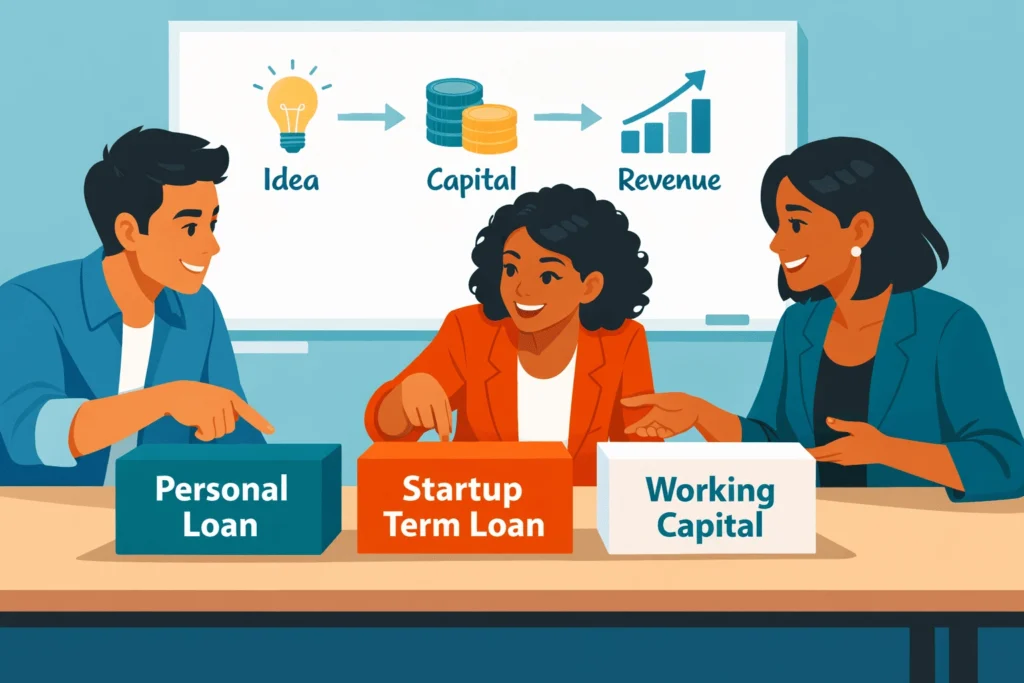
Most lenders treat true “zero-revenue” startups as higher risk, so they focus more on your personal income, credit score, and collateral in the beginning. For some founders, this first facility is technically a personal loan used for business, while others qualify for dedicated term loans for small businesses or MSME loans once operations start.
How Do Term Loans for Small Businesses Work?
- Banks and NBFCs disburse a lump sum (for example, ₹10–₹50 lakh) to your account.
- You repay through equated monthly instalments (EMIs) over 2–7 years.
- Interest rates are usually risk-based, often in the ~11–20% range for smaller firms.
Investkraft’s term-loan guide notes that these loans are best suited for larger, long-term needs like machinery or fit-outs, where the asset will generate revenue for several years. For everyday startup cash-flow gaps, working-capital lines or same-day business loans are often more flexible.
When Is It Better to Use Personal Credit First?
Recur Club and other long-term finance playbooks explain that if your business has no financial history yet, lenders may rely almost entirely on your personal track record. That is why many first-time founders:
- Start with a small personal or consumer loan to test the model.
- Move to term loans for small businesses or MSME loans after 6–12 months of revenue.
This staged approach reduces risk and improves your approval chances later.
What Are Lenders Really Looking At in 2026?
Lenders do not mostly care about your pitch deck; they care about risk and repayment. Guides on long-term financing and MSME loans highlight a few consistent approval levers.
Which Eligibility Criteria Matter Most?
- Personal credit score:
Most banks and NBFCs want CIBIL scores of 700+ for new-business term loans; some fintechs accept ~650 with higher pricing. - Age and stability:
Typical age bands are 21–65 years, with extra comfort when applicants show stable employment or multiple income sources. - Business existence and turnover (if any):
- For fully new entities, lenders lean on personal income and collateral.
- For operational MSMEs, many want at least 1–2 years of existence and ₹6–₹10 lakh+ annual turnover.
- Collateral and security (for larger tickets):
Term loans above a certain size often demand property, equipment, or other security, although there are collateral-free options under credit-guarantee schemes.
What Documents Should You Prepare in Advance?
Most loan checklists include a similar set of basics:
- KYC: PAN, Aadhaar, and one address proof.
- Business proof (if registered): GST, Udyam/MSME registration, shop and establishment licence, partnership deed or MOA.
- Income proof: Salary slips or bank statements, plus ITRs for 2–3 years if available.
- Basic business plan: Projected revenue, cost assumptions, and how the loan will be used.
If you can assemble this into a single digital folder, you are already ahead of most first-time applicants.
Table: Typical Approval Profile for First-Time Founders
| Factor | Strong Profile (Higher Approval Odds) |
|---|---|
| Personal CIBIL score | 700+ |
| Age | 25–55, with stable employment history |
| Existing obligations | EMIs below 40% of net monthly income |
| Business stage | Early, but with clear plan or pilot revenue |
| Documentation | KYC, income proof, basic projections ready |
(Data synthesized from Investkraft and long-term finance overviews.)
How Do You Choose the Right Loan Type?
Picking the wrong product is one of the biggest beginner mistakes. Long-term financing resources stress matching loan tenure to the life of the asset you fund.
Should You Use Term Loans for Small Businesses or Short-Term Credit?
- Use term loans for small businesses when you are:
- Funding machinery, fit-outs, vehicles, or franchise fees.
- Comfortable with multi-year EMI commitments.
- Use short-term or same-day loans when you are:
- Plugging inventory cycles or receivable delays.
- Running short, test campaigns in marketing or sales.
Investkraft also reminds founders that term loans tend to have lower monthly cost per lakh thanks to longer tenure, but you pay interest over a longer period overall.YouTube
How Do Bank Loans Compare with Alternative Funding?
According to long-term finance comparisons:
- Bank term loans:
- Lower interest, stricter eligibility.
- Best for founders with clean credit and some track record.
- NBFC / fintech loans:
- Faster approvals, slightly higher cost.
- Better for thin-file founders and smaller tickets.
- Revenue-based or recurring-revenue finance:
- Repayment linked to revenue share instead of fixed EMI.
- Suits online, subscription, or D2C models with predictable cash flows.
How Do You Actually Apply for a Business Loan Step-by-Step?
Most lenders follow a similar application pipeline, even if the UI looks different. High-performing founders treat this like a sales process.
What Is the Step-by-Step Approval Checklist?
- Clarify the ask:
Decide the exact amount, purpose, and tenure you want; vague answers hurt credibility. - Check your credit health:
Get your credit report, fix errors, and reduce utilisation before applying. - Choose the right lender:
Shortlist 2–3 banks or NBFCs whose products match your ticket size and profile, rather than applying everywhere. - Prepare documents in one folder:
Keep scanned KYC, income proofs, and business plan ready; this drastically speeds up underwriting. - Submit application (online or through a relationship manager):
Fill forms accurately; inconsistent numbers between form and documents are a common rejection trigger. - Respond fast to queries:
Underwriting teams often ask follow-up questions; founders who respond in hours, not days, get funded quicker.
“Treat your loan application as seriously as a VC pitch. Lenders don’t invest in ideas; they invest in repayment probability.”
— Adapted from long-term financing best practices
What Beginner Mistakes Kill Loan Applications?
Lenders and finance guides repeatedly warn about a few avoidable errors.
Which Red Flags Do Lenders Hate?
- Multiple hard enquiries in a short span
Applying everywhere at once signals desperation and drags your score. - Unclear or inconsistent income documentation
Bank statements, ITRs, and declared income must tell the same story. - Unrealistic projections
Projections should be ambitious yet grounded; wildly optimistic claims erode trust. - Using term loans to cover chronic operating losses
Long-term debt funding ongoing losses is a major risk sign and can trigger rejections.
How Can You De-Risk Yourself as a New Founder?
- Start with smaller limits, repay well, and then upsize.
- Offer partial collateral or co-applicant support if possible.
- Combine a modest term loan with small grant or equity rather than overleveraging on debt alone.
How to Apply for Your First Business Loan – Step by Step Process
Times Needed: 7 Days: 07 & 5 Hours
Estimated Cost: 0 USD
Description: A simple, repeatable process for first-time founders to apply for a small business loan with higher approval odds and fewer surprises.
Steps:
Step 1: Define your funding requirement clearly
Write down how much you need, what it funds, and how it grows revenue. Use conservative assumptions and ensure EMIs fit worst-case cash flow.
Step 2: Check and improve your credit profile
Download your credit report, clear small overdues, and reduce card utilisation. Aim for a score above 700 before approaching mainstream lenders.
Step 3: Prepare a lean financial and business pack
Compile KYC, bank statements, ITRs, and a 1–2 page plan summarising model, revenue logic, and use of funds. Keep all files scanned and properly named.
Step 4: Shortlist and approach the right lenders
Pick 2–3 banks or NBFCs aligned with your ticket size and risk, then apply sequentially instead of everywhere at once, adjusting based on early feedback.
Tools Name: spreadsheet tool, credit report app, PDF scanner
Materials Name: bank statements, identity documents, basic business plan
FAQ Section
Yes, but lenders will lean heavily on your personal credit, income, and collateral. Many first-time founders start with small loans or personal credit before graduating to term loans for small businesses.
Most experts suggest starting with an amount your worst-case cash flow can still service, often 3–6 months of projected operating expenses, rather than the maximum you qualify for.
Debt avoids ownership dilution but requires fixed repayments. Equity is more flexible but gives up control. Many founders combine a modest loan with small equity instead of relying on only one source.
Match tenure to the life of the asset funded. Equipment or fit-outs may justify 3–5-year terms; short-term marketing tests should use shorter or revolving credit, not long-term EMIs.
For small, unsecured loans, typical rates fall roughly between 11–24% p.a., depending on your credit, collateral, and lender type. Secured term loans for small businesses often sit at the lower end.
Many NBFCs and platforms use cash-flow and alternative data instead of only collateral, so approvals may be faster. However, you must check the total cost of capital carefully.
If your documents and credit are in order, smaller loans may be approved within 2–7 working days. Larger, secured term loans can still take a few weeks due to valuation and legal checks.
One rejection will not ruin you, but multiple hard inquiries in a short period hurt your score. Learn why you were rejected, fix issues, then try again with a stronger profile.
Key Takeaways
- A business loan for starting a business is debt, not free money; you must show repayment capacity from day one.
- Lenders care most about personal credit, basic financial discipline, and a clear funding purpose.
- Term loans for small businesses suit long-term assets; short-term cash gaps need different tools.
- Preparing a lean documentation pack and realistic plan dramatically improves approval odds.
- Combining small debt with smart equity or grants often creates a safer capital stack for first-time founders.
Next Steps
- Review your eligibility and credit readiness; fix quick issues before applying.
- Study collateral-free options like small-business loans without security to understand your choices (see StartupMandi’s guide on small business loans without collateral in 2026).
- If you aim to build in or expand to the US, explore SBA loan strategies to complement local financing.
- For urgent cash-flow needs, learn how same-day business loans and instant funding compare with classic term loans.
Helpful internal reads on StartupMandi:
- Use the small business loan without collateral in 2026 eligibility guide to benchmark your profile.
- Read the SBA loans 2026 playbook for faster, cheaper approvals if you plan to tap US-backed programs.
- Understand how to get same-day business loans and instant approval before committing to higher-cost emergency products.
Conclusion
Getting a business loan for starting a business is fully possible as a first-time founder if you think like a risk manager instead of a dreamer. Long-term finance guides all emphasise the same pattern: start small, document everything, and align loan structure with how your business actually earns money. If you combine that discipline with StartupMandi’s finance resources and a clear plan, your first loan can become a launchpad rather than a liability.