


startupmandi-blog-background

Why AI Startups Will Dominate This Decade šŸš€: Don’t Miss It

Why AI startups will dominate the next decade. Explore funding, AI-native moats, enterprise demand, and what it means for founders.

Introduction

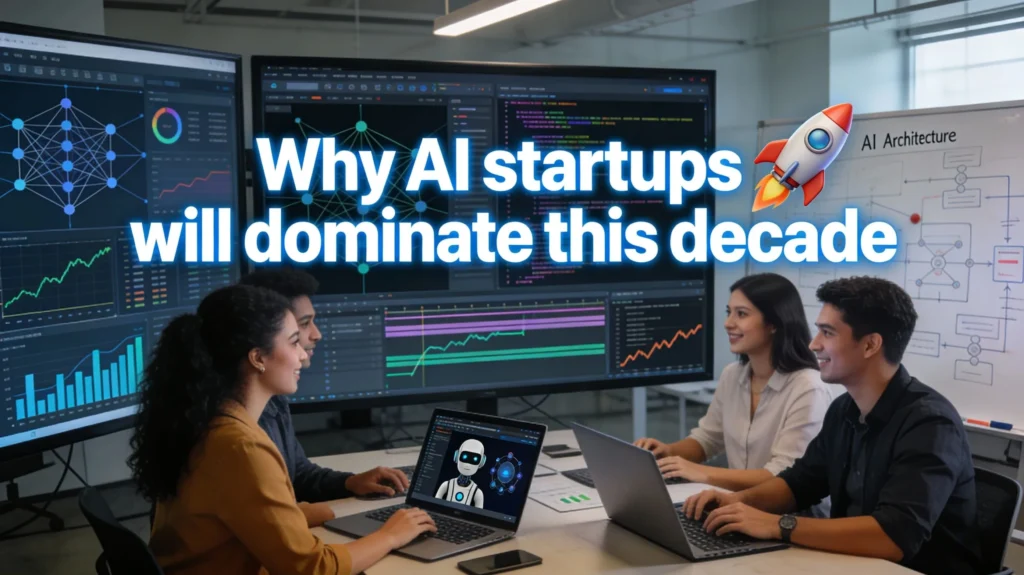
Why AI startups will dominate the next decade is not just a catchy headline; it reflects where global capital, talent, and demand are converging fast. Moreover, AI spending is projected to hit hundreds of billions of dollars annually across infrastructure, models, and applications. Additionally, AI-native companies already rewrite rules in cybersecurity, SaaS, fintech, and health. Therefore, founders who understand this shift early can build category-defining businesses.

Massive AI funding and enterprise adoption signals for 2026 and beyond
  1. Why AI-native startups beat incumbents on speed, product, and margins

  2. ā€œFat AI startupā€ blueprint: software + data + humans-in-the-loop

  3. Key sectors where AI startups will dominate first

  4. Practical lessons and strategies for founders in India and globally

Also Read:Ā How to Use AI Tools for Productivity: Save 20+ Hours āš”šŸ’¼

Market signals: why AI startups will dominate

Funding, spending, and adoption curves all point one way

Signals.ai-style analyses show more than 40% of US venture funding now flows into AI-related companies, crossing $100 billion annually. Moreover, 78% of enterprises already use some form of AI in production systems. Generative AI spending alone is expected to reach around $644 billion in 2025, growing 76% year-on-year, mainly on hardware and infrastructure.{source}​

These numbers suggest AI is not a passing hype cycle but a foundational technology shift. Therefore, startups deeply aligned with AI trends will enjoy tailwinds similar to internet-native companies in the 2000s and mobile-native players in the 2010s.

AI becomes the ā€œoperating systemā€ of the enterprise

SC Media notes that by 2026, AI will move from being a sidekick to becoming the operating layer for cybersecurity, IT, and workflows. Instead of using AI as one feature, AI-native companies design products where intelligent agents plan, act, and improve continuously across the stack.​

Consequently, incumbents with bolt‑on AI features will struggle to match the speed and adaptability of AI-native competitors. Startups that build around this reality from day one will dominate new categories.

The ā€œFat AI startupā€ blueprint

HackerNoon’s ā€œFat AI Startupsā€ thesis argues that winners will combine three assets: proprietary software, unique data, and humans-in-the-loop operations. Lean AI startups that rely only on public APIs may get commoditised quickly.{source}​

Fat AI startups, by contrast, own:

  • Their own orchestration and agent layer

  • Domain-specific datasets that improve models over time

  • Operational teams that guide and correct AI in complex workflows

Therefore, they build compounding moats rather than temporary feature advantages.

reading-the-market-signals-that-explain-why-ai-startups-will-dominate-the-next-decade
Checkout Our Latest Services

Why AI-native startups beat incumbents

Speed of experimentation and shipping

AI startups iterate product features weekly, sometimes daily. Because their core stack is already automated, they can test new prompts, agents, and workflows faster than legacy firms shipping quarterly releases. Moreover, cloud-native infrastructure eliminates procurement delays that slow incumbents.

This speed compounds. Each release generates user data, which improves models, which unlocks better features. Therefore, AI-native startups accelerate away from slower competitors over time.

Structural cost advantages and operating leverage

Well-designed AI products replace repetitive knowledge work with agents that never sleep. This reduces marginal cost per customer dramatically once the system is trained and stable. Additionally, usage-based pricing aligns revenue with value delivered.

For example, an AI-powered customer support tool can handle thousands of tickets simultaneously, enabling a startup to serve enterprise clients without hiring hundreds of agents. Consequently, gross margins and scalability improve compared to traditional service-heavy businesses.

New moats: data, workflows, and trust

Traditional moats like physical distribution shrink in importance when AI can reach users digitally everywhere. Instead, AI-native moats form around:

  1. Proprietary labeled data from real customers

  2. Deeply embedded workflows inside enterprise systems

  3. Trust built via safety, security, and reliability tooling

SC Media highlights how AI-native cybersecurity firms detect patterns legacy tools miss completely. Therefore, customers gradually shift critical workloads to AI-native vendors.

visualising-why-ai-native-startups-outrun-legacy-players-on-speed-cost-and-product-quality.
Checkout Latest Grants Listed

Where AI startups will dominate first

Sector hotspots with clear demand

Analytics Insight and other trackers list fast-growing AI startups in cybersecurity, fintech, healthcare, retail, and developer tools. Moreover, AI-native companies attack problems where:{source}​

  1. Data is abundant but underused

  2. Decisions repeat frequently

  3. Mistakes are expensive

Key 2026 hotspots:

  1. Cybersecurity: AI agents detect threats and respond autonomously​

  2. Healthcare: diagnostics, triage, and risk prediction​

  3. Finance: fraud detection, risk scoring, and algorithmic underwriting​

  4. Dev tools: AI pair programming, test generation, and observability​

  5. Operations: AI agents orchestrating supply chains and service desks​

Because these sectors already allocate big budgets to software, startups plugging AI into existing spend can scale quickly.

Macro tailwinds: regulation, compute, and skills

Governments worldwide move toward mandatory AI content labelling, safety, and traceability. While this introduces compliance work, it also legitimises AI use in highly regulated industries.​

Meanwhile, cloud and chip providers invest hundreds of billions in AI infrastructure. They court startups aggressively with credits and co‑marketing programs. Additionally, universities and bootcamps now produce AI‑literate talent at scale.​

Therefore, the input conditions—policy, compute, and skills—support AI startup expansion rather than constraining it.

Simple comparison table: AI-native vs traditional SaaS

DimensionAI-native startupTraditional SaaS
Core valueAutonomous decisions/actionsDashboards + manual action
Data flywheelStrong, improves modelsModerate, reporting-focused
Marginal costVery low after trainingHigher (more seats/services)
Release cadenceWeekly/dailyMonthly/quarterly
Competitive moatData + workflows + agentsBrand + integrations

Conclusion: Why AI startups will dominate for founders and investors

Why AI startups will dominate the next decade becomes obvious when you combine market demand, technology leverage, and structural moats. Enterprises need automation, not just analytics; AI-native startups provide that in a way legacy vendors struggle to match. Moreover, funding, infrastructure, and talent markets all tilt toward AI-heavy models.​

For founders on StartupMandi, this decade offers a rare window where smart, fast-moving teams can build enduring companies around AI. The challenge isn’t ā€œwhetherā€ to use AI; it’sĀ how deeply and whereĀ to embed it in your product and business model.

FAQsĀ 

Why will AI startups dominate instead of big tech companies?

Big tech has scale but also bureaucracy, legacy stacks, and product conflicts. AI startups move faster, focus on specific problems, and iterate more aggressively. Additionally, many large enterprises prefer multi‑vendor ecosystems rather than relying entirely on a few mega‑platforms.​

Won’t most AI startups die by 2026?

Yes, many will. Some investors argue 90%+ of AI startups may fail. However, this pattern matches every major technology wave. The remaining AI-native winners can become extremely large, because AI can touch almost every workflow in every industry.​

Where should early-stage founders focus in 2026?

Focus on narrow, painful problems with clear ROI rather than generic chatbots. B2B AI agents for operations, security, finance, healthcare, and developer productivity show strong budget readiness. Deep domain expertise plus AI is more powerful than AI alone.​

How can nontechnical founders build AI startups?

Nontechnical founders should partner with strong technical co‑founders or studios. Their advantage lies in domain knowledge, distribution, and customer empathy. Off‑the‑shelf models lower the barrier, but moats still require proprietary data and workflows over time.​

What risks could slow AI startup dominance?

Key risks include regulatory overreach, misuse of AI leading to public backlash, model commoditisation, and infrastructure concentration among a few hyperscalers. Startups that invest early in safety, compliance, and multi‑cloud strategies will handle these headwinds better.​

Referring Blogs / Fact Sources

Dikshant Choudhary
Dikshant Choudhary

I’m Dikshant Choudhary, a University of Delhi student and freelance writer specializing in SEO blogs, transcription, and business analysis. I create engaging, research-driven content for academic and client projects with creativity and discipline.

Articles: 46

Leave a Reply

Your email address will not be published. Required fields are marked *