




startupmandi-blog-background

Blockchain and CBDCs – Expert Guide for 2026 šŸ”— Don’t Miss

Blockchain and CBDCs guide reveals digital money's future. Learn e-rupee, global pilots, and startup opportunities in simple terms.

Blockchain technology behind CBDCs

Blockchain and CBDCs guide unlocks the future of money for entrepreneurs and investors alike 🌐. Moreover, central banks worldwide launch digital currencies using blockchain technology rapidly. Additionally, India’s RBI e-rupee pilots already process millions of transactions. Therefore, understanding blockchain and CBDCs becomes essential for business leaders.

Summery:

  1. Blockchain fundamentals and how it secures digital money

  2. CBDC vs cryptocurrency differences explained clearly

  3. India’s e-rupee journey from pilot to potential mainstream

  4. Startup opportunities created by CBDC infrastructure

  5. Global CBDC race and India’s competitive position

Blockchain creates unbreakable digital records

Blockchain works like a shared digital notebook that nobody can erase or alter secretly. Every transaction gets recorded permanently across thousands of computers worldwide. Moreover, cryptography links each new entry to previous ones, creating an immutable chain.

Central banks use this technology to track every digital rupee from creation to spending. Therefore, blockchain eliminates counterfeiting while providing complete transaction transparency to regulators.

Permissioned blockchain powers government money

Blockchain and CBDCs shows that Public blockchains like Bitcoin allow anyone to participate freely. Permissioned blockchains require central bank approval before joining. India chose a permissioned blockchain for the e-rupee to maintain complete control over the money supply.

This design combines blockchain security with government authority. Moreover, the RBI can issue new e-rupees or remove excess supply instantly. Therefore, permissioned blockchain perfectly balances innovation with monetary sovereignty.

Smart contracts automate money rules

Smart contracts execute automatically when conditions are met. For CBDCs, they can restrict spending to approved merchants or expire funds after deadlines. Moreover, governments could program stimulus payments that must be spent within months.

This programmability creates powerful tools for economic policy. Therefore, blockchain enables features impossible with physical cash while preserving central control completely.

rbi-officials-strategize-india's-digital-rupee-future-through-blockchain-and-cbdc-insights
Checkout Our Latest Services

Understanding Central Bank Digital Currencies (CBDCs)

CBDCs differ completely from cryptocurrencies

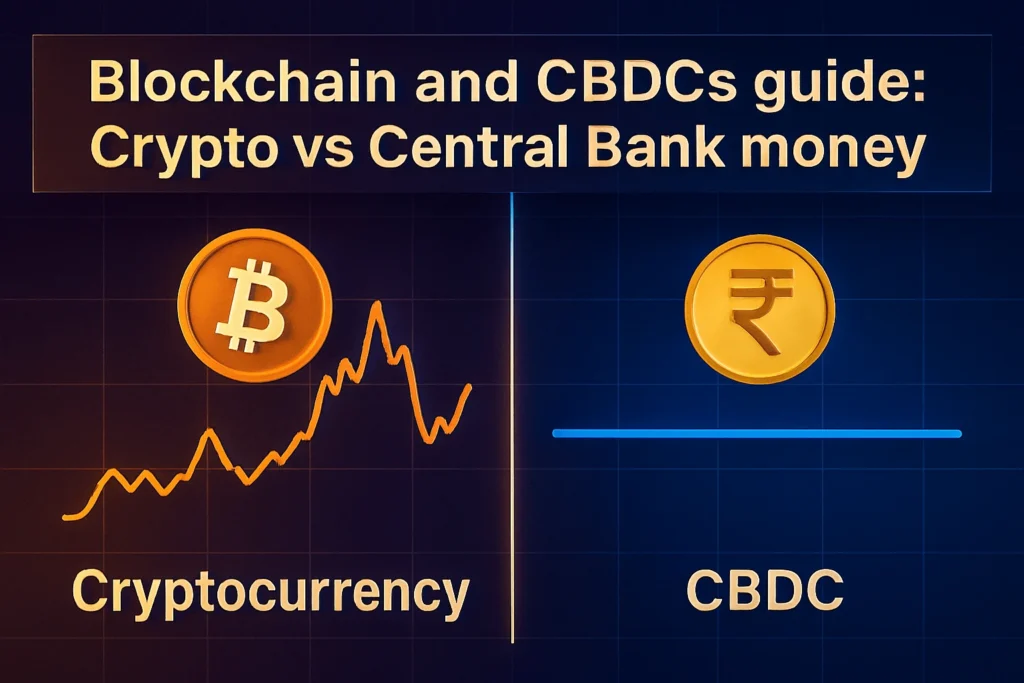
CBDCs represent government-issued digital fiat money with a 1:1 value to physical currency. Bitcoin and other cryptocurrencies fluctuate wildly based on market demand. Moreover, central banks control CBDC supply completely unlike decentralized crypto networks.

India’s e-rupee maintains exact parity with physical rupees always. Therefore, citizens face no currency risk when using digital or physical money interchangeably.

Retail CBDCs serve everyday consumers

Retail CBDCs target individual users for daily payments, shopping, and transfers. RBI’s e-rupee pilots focus on retail use cases with millions of transactions already processed. Users hold e-rupee in digital wallets through partner banks.

These wallets work alongside UPI for peer-to-peer payments and merchant transactions. Moreover, offline functionality supports rural areas with poor connectivity. Therefore, retail CBDCs extend financial inclusion dramatically.

Wholesale CBDCs streamline big payments

Wholesale CBDCs serve banks and institutions for interbank settlements. They reduce cross-border payment times from days to seconds using blockchain efficiency. India’s wholesale pilots test large-value settlements between scheduled banks.

Global projects like mBridge connect CBDCs across borders already. Therefore, wholesale CBDCs could transform international trade finance completely.

crypto-vs-cbdc-india's-digital-currency-debate-visualized-with-volatility-and-stability-in-focus
Checkout Latest Grants Listed

India’s e-rupee leadership and opportunities

RBI e-rupee pilots achieve major milestones

India launched e-rupee pilots in December 2022 with select banks and customers. By 2025, RBI expanded to 20+ banks processing over 10 million transactions. Moreover, merchant acceptance grows through partnerships with payment aggregators.

Government subsidies now flow through e-rupee channels successfully. Farmers receive direct payments instantly during pilots. Therefore, e-rupee demonstrates practical real-world utility beyond theory.

Startup opportunities explode with CBDCs

Payment infrastructure innovation.Ā Blockchain-based settlement layers for e-rupee create new rails for startups. Entrepreneurs build value-added services around core CBDC infrastructure.

Programmable money applications.Ā Smart contracts enable automated escrow, milestone payments, and conditional subsidies. Supply chain startups gain efficiency through instant conditional payments.

Financial inclusion platforms.Ā Rural fintechs create e-rupee wallets for unbanked populations. Offline transaction capabilities unlock massive new markets completely.

Cross-border fintech.Ā Indian exporters receive payments instantly through CBDC corridors. Import finance becomes cheaper and faster dramatically.

Global CBDC race positions India strongly

China leads with e-CNY used by 260 million people. Europe prepares digital euro launch by 2026. USA studies digital dollar feasibility carefully. Meanwhile, India’s e-rupee pilots position RBI among global leaders.

Global CBDC Status Table

CountryCBDC NameStatusUsers/Scale
Indiae-RupeeExpanded pilots10M+ transactions
Chinae-CNYNationwide260M+ users
EuropeDigital EuroPreparation phaseTesting
BahamasSand DollarFully operationalNationwide
NigeriaeNairaLiveLimited adoption
Ā 
Ā 
Ā 

Ā 

Disclaimer:Ā CBDC developments evolve rapidly. Transaction volumes and pilot statuses reflect available data as of late 2025. Always verify latest RBI announcements for current status.

Conclusion: Blockchain + CBDCs transform business forever šŸš€

Blockchain and CBDCs guide reveals money’s complete reinvention underway globally. Central banks gain digital control while citizens enjoy instant, cheap payments. Moreover, programmable features unlock unprecedented business models for entrepreneurs.

India’s e-rupee leadership creates massive opportunities for fintech startups. Blockchain infrastructure demands new payment layers, compliance tools, and inclusion platforms.Ā StartupMandi connects CBDC innovators with mentors, investors, and regulatory experts to capture this transformation.

FAQsĀ 

Will CBDCs replace UPI or physical cash completely?

No plans exist to eliminate UPI or cash immediately. RBI confirms e-rupee complements existing systems perfectly. Cash serves privacy and offline needs while UPI dominates digital payments. Therefore, coexistence remains the strategy.

Can individuals hold e-rupee directly from RBI?

Current pilots distribute e-rupee through commercial banks as technology partners. Direct RBI wallets may emerge later. Therefore, banks earn distribution fees while RBI maintains policy control completely.

Are CBDCs vulnerable to hacking attacks?

CBDCs use enterprise-grade permissioned blockchains with multi-layer security. Unlike cryptocurrencies, central banks can freeze and reverse fraudulent transactions instantly. User wallet security remains individual responsibility.

How do CBDCs create startup business opportunities?

Programmable money enables automated payments, supply chain finance, and conditional subsidies through smart contracts. Cross-border settlements become instant. Rural inclusion platforms gain massive markets. Therefore, infrastructure layers explode with opportunity.

When will e-rupee become available to everyone?

RBI targets wider rollout post-2026 after completing pilots successfully. Merchant networks must expand first. Early adopters gain advantages while mass adoption follows infrastructure maturity.

Referring blogs / fact sourcesĀ 

Dikshant Choudhary
Dikshant Choudhary

I’m Dikshant Choudhary, a University of Delhi student and freelance writer specializing in SEO blogs, transcription, and business analysis. I create engaging, research-driven content for academic and client projects with creativity and discipline.

Articles: 46

Leave a Reply

Your email address will not be published. Required fields are marked *