


startupmandi-blog-background

Ola Share Price Crashes 80%: What Investors Must Know Now 

Ola Share Price: The Catastrophic 80% Collapse That Shattered Investor Dreams 📉

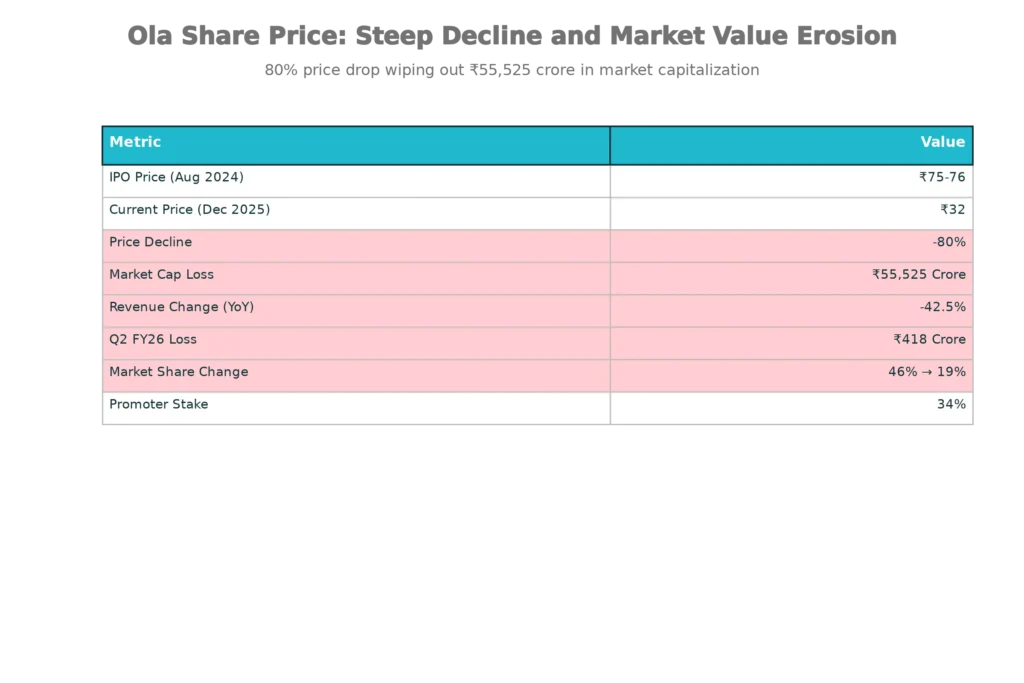
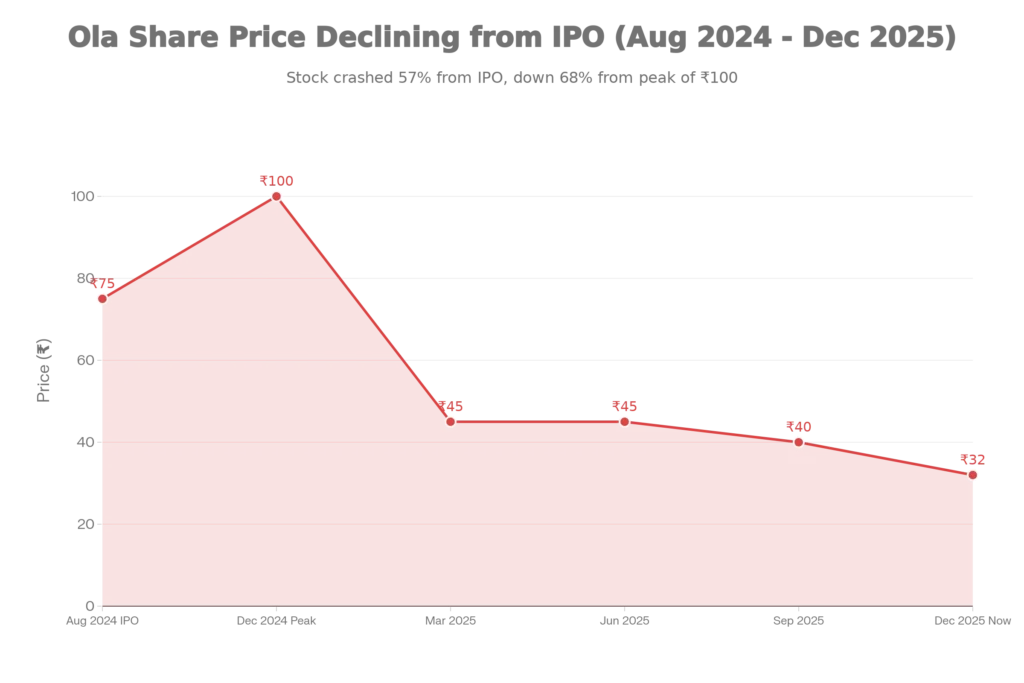
Ola share price represents one of India’s most dramatic stock market crashes—a cautionary tale of inflated IPO valuations meeting harsh operational realities. From a glorious IPO debut at ₹75-76 in August 2024 to a devastating ₹32 in December 2025, Ola share price crashed 80% in just 16 months, obliterating ₹55,525 crore in investor wealth. This collapse transformed Ola Electric from India’s “next Tesla” into a symbol of startup overvaluation and execution failure.

The story of Ola share price decline reveals systemic issues: aggressive expansion without profitability, mounting losses, plummeting market share, and mounting quality concerns. Meanwhile, founder and promoter Bhavish Aggarwal’s recent stake sales intensified panic selling, signaling potential loss of founder conviction

Quick Summary – Ola Share Price Crisis:

  • Catastrophic Collapse: 🔴 80% crash from IPO high (₹157) to current lows (₹32)

  • Wealth Destruction: 💸 ₹55,525 crore erased from investor portfolios in just 16 months

  • Revenue Collapse: 📉 59% revenue decline year-over-year in Q4 FY25, alarming all stakeholders

  • Promoter Concern: ⚠️ CEO sold 2.6 crore shares to repay ₹260 crore loan, triggering fresh panic

  • Market Share Erosion: 🏍️ Market share crashed from 46% to 19% as competitors like Bajaj and TVS surged ahead

The IPO Bubble That Never Should Have Happened: Ola Share Price Reality Check

Ola share price began its downward spiral from IPO day itself—not fundamentally, but psychologically. While the stock opened strong, underlying financial realities were deteriorating rapidly. The IPO was floated at astronomical valuations disconnected from actual business metrics.

Critical Reality Check:

  • IPO Valuation: Ola Electric valued at ~$3 billion at IPO with zero profitability

  • Actual Financials: Company burning ₹418 crore quarterly in losses with declining revenues

  • Market Expectations: Investors expected Tesla-style profitability trajectory—never materialized

  • Competitive Reality: Established players like Bajaj and TVS possessed superior distribution networks

The Disconnect Between Hype And Reality

Ola share price soared initially on narrative enthusiasm rather than fundamentals. Founder Bhavish Aggarwal’s bold vision and aggressive expansion plans created excitement, but execution proved catastrophically disappointing. The company promised scale without demonstrating sustainable unit economics.

The electric two-wheeler market proved far more competitive than Ola anticipated. Market share collapsed from 46% (June 2024) to 19% (June 2025) as legacy manufacturers entered the space with superior reliability and service networks.

Quality And Safety Concerns Destroying Consumer Trust

Ola share price suffered additional pressure from mounting quality and safety concerns. Videos surfaced showing Ola scooters experiencing battery fires, suspension failures, and component breakdowns. Customer complaints on social media multiplied exponentially, creating a trust crisis.

The direct-to-customer model, initially an advantage, became a liability when service issues emerged. Lack of widespread service infrastructure meant frustrated customers couldn’t access timely repairs. This eroded brand value far faster than Ola’s marketing could rebuild it.

ola-share-price-crashes-80-what-investors-must-know-now
Ola share price showing dramatic decline of 80% from IPO peak to current levels in December 2025
Checkout Our Latest Services

Operational Deterioration And Financial Free Fall: Ola Share Price Breakdown

Ola share price collapsed not suddenly but through a consistent pattern of deteriorating operational metrics. Each quarterly result delivered progressively worse news, crushing investor confidence incrementally.

Revenue Collapse And Inventory Crisis

Latest Financial Metrics Explain Ola Share Price Destruction:

QuarterRevenue (₹ Cr)YoY ChangeLoss (₹ Cr)Market Situation
Q1 FY251,214+113%-495Growth phase
Q4 FY25611-50%-870Deterioration begins
Q2 FY26690-43%-418Declining volumes
 
Ola share price reflects this revenue destruction perfectly. From ₹1,214 crore in Q1 FY25 to just ₹690 crore in Q2 FY26 represents catastrophic demand destruction. Monthly vehicle registrations plummeted 45% year-over-year, signaling collapsing consumer demand.

Mounting Losses And Burn Rate Crisis

The burn rate accelerated dangerously despite falling revenues. Q2 FY26 losses reached ₹418 crore quarterly—an unsustainable pace burning through cash reserves. EBITDA losses of ₹203 crore compound the pain.

Ola Electric required an emergency ₹1,700 crore loan to stay solvent. This desperation financing signal directly triggered Ola share price decline as investors recognized survival challenges.

Shareholder Wealth Destruction Summary

The numbers tell a devastating story for Ola share price holders:

  • Peak market cap: ~₹69,250 crore (December 2024)

  • Current market cap: ~₹13,805 crore (December 2025)

  • Wealth erasure: ₹55,525 crore in 12 months 📊

  • Per-share impact: 80% decline from ₹157 to ₹32


ola-share-price-crashes-80-what-investors-must-know-now
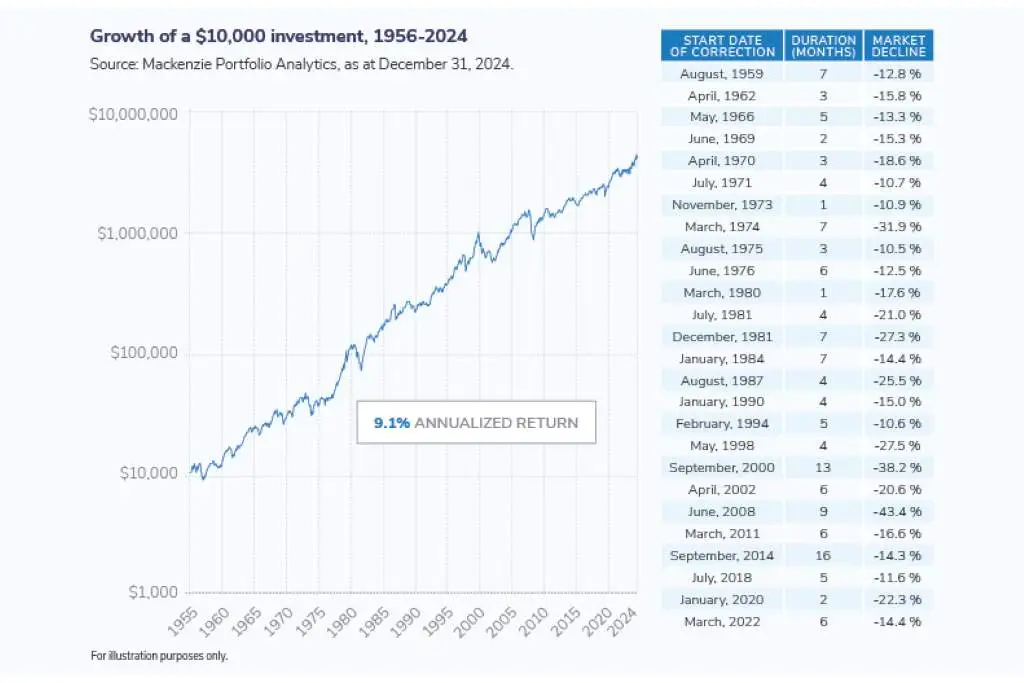
How long does it take the markets to recover from a downturn?
Checkout Latest Grants Listed

Bhavish Aggarwal’s Stake Sales And The Confidence Crisis: Ola Share Price Signal

Ola share price received its final psychological blow when CEO Bhavish Aggarwal sold 2.6 crore shares to repay ₹260 crore personal loans. This single action screamed volumes about founder confidence.

The Psychology Of Founder Stake Sales

When founders sell massive stakes, market psychology turns bearish instantly. Investors interpret this as lack of conviction in company turnaround prospects. Aggarwal’s decision to liquidate personal holdings, regardless of stated justifications, created irreversible confidence damage.

Company statements claimed the sale was merely to “eliminate pledged share overhang” and release previously pledged 3.93% shares. However, market participants viewed this as a founder scrambling for liquidity.

Competitive Positioning And Investor Reassurance Failures

Simultaneously, Ola’s market share erosion accelerated without corresponding investor reassurance. Bajaj and TVS, traditional two-wheeler players, captured Ola’s high-margin customer segments. The company’s vaunted manufacturing capability proved non-competitive against experienced players.

Ola share price reflected this competitive reality—investors abandoned the stock recognizing leadership loss.

Regulatory Scrutiny Compounding Problems

Government investigations into showroom licensing, sales data discrepancies, and safety concerns created additional headwinds for Ola share price. These regulatory risks remain unresolved, creating ongoing uncertainty.

The government’s scrutiny of Ola’s claimed 4,000 service centers proved problematic when actual infrastructure remained unverified.

ola-share-price-crashes-80-what-investors-must-know-now
Ola share price impact analysis showing 80% crash, ₹55,525 crore wealth destruction, and operational challenges

Conclusion:  

Ola share price crash from ₹157 to ₹32 represents a brutal lesson in startup IPO valuations: growth without profitability is eventually catastrophic. The company’s aggressive expansion destroyed more value than it created.

Key Takeaways For Investors Analyzing Ola Share Price:
  • ✅ Avoid IPO hype without proven unit economics

  • ✅ Monitor founder stake movements closely

  • ✅ Evaluate competitive moats carefully—Ola had none

  • ✅ Quality concerns should trigger immediate sells

  • ✅ Execution matters more than vision alone


At StartupMandi, we recognize that Ola share price destruction provides invaluable lessons for evaluating investment quality. Explore our comprehensive IPO investment guide separating legitimate growth opportunities from overvalued hype. Discover our stock market risk assessment framework protecting capital from similar disasters.

For entrepreneurs and investors, Ola’s journey demonstrates why operational excellence matters more than compelling narrativesVisit our detailed startup scaling blueprint highlighting critical execution factors that separate sustainable companies from cautionary tales.

Disclaimer: StartupMandi is not a SEBI-registered research Analyst or Investment Advisor. This content is for educational and informational purposes only and should not be construed as financial or investment advice. Please consult a qualified financial advisor before making any investment decisions.


Frequently Asked Questions About Ola Share Price

Q1: Will Ola share price recover to IPO levels?

Ola share price recovery to ₹75-76 IPO levels appears unlikely in foreseeable future without dramatic operational turnarounds. The company requires achieving profitability first, stabilizing market share second, and rebuilding customer trust third. Each represents multi-year challenges. Recovery to ₹50 levels requires successful product launches (motorcycles), sustained market share stabilization, and demonstrated path to profitability. Current trajectory suggests these milestones remain 2+ years away.

Q2: Why did Bhavish Aggarwal sell shares if company has bright future?

Aggarwal’s share sale signaled several concerns despite official justifications about “pledge elimination.” When founders liquidate significant holdings, market psychology interprets this as lack of conviction about turnaround success. Regardless of explanations, the message was clear: founder capital was needed elsewhere. This psychological damage to Ola share price proved irreversible.

Q3: Is Ola share price a buy for long-term investors?

Current Ola share price levels remain speculative rather than investment-grade opportunities for conservative investors. The company must demonstrate: (1) Monthly deliveries exceeding 50,000 units, (2) Gross margins approaching 36%, (3) Reduced quarterly losses below ₹100 crore. Until these milestones appear certain, Ola share price carries execution risk unsuitable for conservative portfolios.

Q4: What would turn around Ola share price momentum?

Ola share price reversal requires multiple positive catalysts: successful electric motorcycle launches (early 2026), quarterly profitability achievements, market share stabilization near 25-30%, and strong customer satisfaction improvements. Any single positive development insufficient—investors demand comprehensive operational turnarounds.

Q5: How does Ola share price compare to other EV startups?

Ola share price represents worst-case EV startup execution alongside Charge+ and others. Successful EV plays like Tata Motors and Mahindra benefited from existing distribution networks and brand heritage. Ola attempted direct-to-consumer disruption without adequate service infrastructure, leading to customer trust destruction. Ola share price collapse reflects this strategic mistake.

Mariyam Bandookwala
Mariyam Bandookwala

i am a professional content writer with a strong focus on clarity, strategy, and audience engagement—helping brands communicate smarter and grow faster.

Articles: 34

Leave a Reply

Your email address will not be published. Required fields are marked *