


Introduction: The Indian Startup Funding Roadmap
The Indian startup ecosystem raised $11 billion in 2025—a robust figure reflecting the maturity of India’s venture capital landscape. Yet not all funding is equal. The path from a ₹25 lakh pre-seed round to a ₹25 crore Series A requires distinct strategies, metrics, and investor conversations at each stage.
Understanding funding stages isn’t just about raising capital—it’s about aligning your business maturity with investor expectations. A founder seeking pre-seed funding with Series A-level financial projections will confuse investors. Conversely, a startup ready to scale nationally shouldn’t approach angel investors expecting ₹50 lakh checks.
This guide maps the complete Indian startup funding journey, showing how traction evolves, what investors expect, and how founders position themselves for the next round. Whether you’re writing your first pitch deck or preparing your Series A conversations, this stage-wise breakdown cuts through the noise.
Let’s explore each stage—from the founder’s perspective.
How Do Startup Funding Stages Work in India?
Startup funding stages are distinct phases in a company’s lifecycle, each with unique capital requirements, investor types, and business milestones. Think of them as checkpoints: each stage validates assumptions from the previous one.
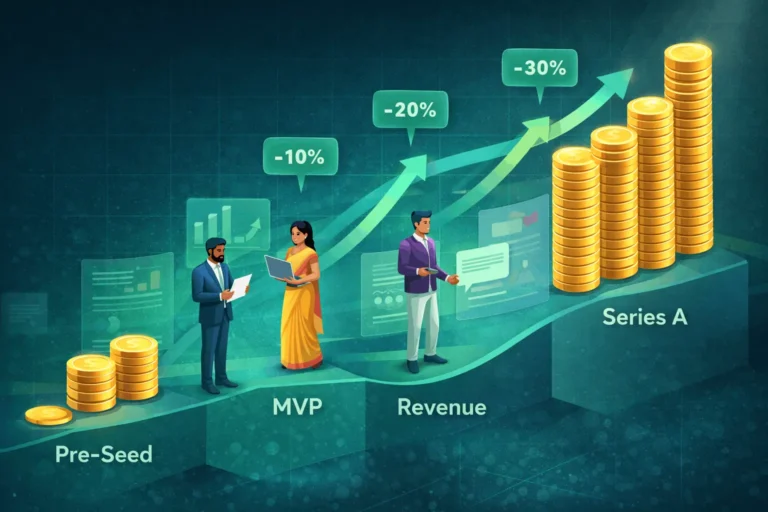
The funding journey typically follows this trajectory:
- Bootstrapping → Founder’s own capital, friends & family
- Pre-seed → Angel investors, incubators, government grants
- Seed → Traditional VCs, angel syndicates, accelerators
- Series A → Growth-focused VCs, institutional capital
- Series B & Beyond → Late-stage funds, strategic investors
Why does sequence matter? Each stage builds on proof from the prior one.
- Pre-seed investors bet on founders and ideas
- Seed investors require an MVP with initial users
- Series A investors demand repeatable revenue and product-market fit

What Capital Can You Expect at Each Stage?
| Funding Stage | Typical Raise Amount (INR) | Equity Dilution | Timeline | Key Milestone |
|---|---|---|---|---|
| Bootstrapping | ₹5L – ₹50L | 0% | 6-12 months | MVP developed |
| Pre-Seed | ₹25L – ₹50L | 5-15% | 1-2 months | MVP + Initial validation |
| Seed | ₹50L – ₹2Cr | 10-25% | 2-3 months | Revenue traction |
| Series A | ₹25Cr+ | 15-40% | 3-6 months | Proven scalability |
Critical insight: Raise timing matters more than raise amount. A startup raising Series A with ₹1 crore annual revenue will struggle. One with ₹2-5 crore revenue will attract competitive interest.
What Metrics Matter at Each Funding Stage?
Investors evaluate startups using stage-specific metrics. Using the wrong metrics at the wrong stage signals founder inexperience.
Pre-Seed Metrics: Validation Over Numbers
At the pre-seed stage, you’re validating the problem, not perfecting the solution.
What investors look for:
- Problem validation → Customer interviews (50+)
- MVP quality → Working prototype, not production-grade
- Market size clarity → Basic TAM/SAM understanding
- Founder credibility → Previous exits, domain expertise, or network
Real-world example: A fintech pre-seed founder with prior experience building products at a ₹1000 crore company will raise pre-seed capital faster than a first-time founder, even with similar market validation.
“Pre-seed investors bet on founders, not products. A proven founder can pivot multiple times; a first-time founder pivoting looks uncertain.” — Ecosystem insight from [FundTQ’s Series A Research, 2025]
Seed Stage Metrics: Traction & Unit Economics
At the seed stage, validation becomes traction. Investors want to see early revenue or strong engagement.
Key metrics to track:
- Monthly Recurring Revenue (MRR) or User Growth → ₹5-50L annual revenue
- Customer Acquisition Cost (CAC) → Shows efficiency
- Monthly Active Users (MAU) → Engagement signal
- Retention Rate (Day 7, Day 30) → Product-market fit indicator
- Gross Margin → Unit economics health
Benchmark: Seed-stage startups typically show 20-50% month-on-month growth in their core metric (revenue or users).

Series A Metrics: Scalability & Sustainability
Series A investors demand proof of repeatable growth. This is where financial rigor becomes non-negotiable.
Series A investor checklist:
- Unit Economics Clarity
- CAC ≤ 25% of first-year customer value
- LTV:CAC ratio ≥ 3:1
- Payback period < 18 months
- Revenue Quality
- ₹2-10 crore ARR with clear trajectory
- 90%+ gross retention rate
- Expanding revenue (cross-sell, upsell)
- Market Positioning
- 15-25% market share in target segment
- Competitive moat (product, data, network)
- Customer concentration ≤ 20% from top customer
- Team Readiness
- CTO for technical credibility
- Finance/operations person in place
- Advisory board with investor credibility
What Types of Investors Back Each Stage?
Not all investors back all stages. Investor types change as capital amounts grow.
Pre-Seed Investors: Micro-VCs & Angels
- Who: Micro-VCs (₹50Cr-₹500Cr funds), angel syndicates, incubators
- Check size: ₹10L – ₹50L
- Decision speed: 2-4 weeks
- In India: Agencies like NASSCOM Startup Hub, Atal Incubation Centers, and angels via platforms like Angel networks mentioned in StartupMandi’s Indian Government Startup Funding Guide
Seed Investors: Traditional VCs & Angel Syndicates
- Who: Seed-stage VC funds (₹200Cr-₹1000Cr), established angels
- Check size: ₹50L – ₹2Cr
- Decision speed: 4-8 weeks
- Diligence depth: Moderate (team, market, product validation)
- Notable funds: Accel, Blume Ventures, Lightspeed (early-stage focus)
Series A Investors: Growth-Stage VCs
- Who: Growth-stage VCs (₹1000Cr+ funds), institutional investors
- Check size: ₹25Cr+
- Decision speed: 8-16 weeks
- Diligence depth: Deep (financial modeling, market analysis, competitive positioning)
- Expectation: Board seat, governance involvement
How to Position Your Startup for the Next Funding Stage
Pre-Seed to Seed: Proving Traction
The ask: From validation → repeatable revenue
Timeline: 12-18 months after pre-seed
Milestones to hit:
- Launch MVP with real users (not alpha)
- Achieve ₹5-10L annual revenue (B2B SaaS) or 10K+ users (consumer)
- Show 30-day retention ≥ 40%
- Hire a founding engineer (co-founder or key hire)
Pitch evolution: Change from “We’ve validated the problem” to “We’ve built a product customers pay for.”
Seed to Series A: Proving Scalability
The ask: From repeatable revenue → repeatable & profitable revenue
Timeline: 18-24 months after seed
Milestones to hit:
- Reach ₹1-3 crore ARR
- Demonstrate 20-40% month-on-month growth
- Maintain gross margin ≥ 60% (B2B SaaS)
- Build team to 10-20 people
- Clear CAC payback ≤ 12 months
Pitch evolution: Change from “We’re growing” to “We’re growing efficiently and at scale.”
“Series A conversations begin 6 months before you need the money. Start building relationships with firms when you have ₹50L-₹1Cr ARR, not when you’re running out of runway.” — Strategy insight
What Are Real Traction Requirements in the Indian Market?
India’s market dynamics differ from the US. Founders often ask: “Do I need this much traction to raise?” Let’s ground this in 2025 market realities.
Pre-Seed Reality Check
₹25L – ₹50L typically requires:
- MVP launched (beta acceptable)
- 100-500 conversations with target customers
- 10-50 paying customers OR 1000+ users (if free-to-paid)
- Clear problem statement (10-15 min pitch clarity)
- Founding team with at least one strong executor
Myth buster: You don’t need revenue to raise pre-seed. You need clear proof that customers care (via interviews, sign-ups, early pilots).
Seed Reality Check
₹50L – ₹2Cr typically requires:
- ₹10L – ₹50L annualized revenue (or 10K+ active users)
- 2-5 reference customers (willing to back the founder)
- Month-on-month growth ≥ 20%
- Founding team expanded to 3-5 people
- Clear go-to-market strategy (not just product)
Series A Reality Check
₹25Cr+ typically requires:
- ₹2Cr+ annual run rate (revenue)
- 15-20% month-on-month growth sustained for 6+ months
- Gross margin clarity (not just revenue)
- Customer concentration analysis (no single customer >20%)
- Hiring plan and organizational structure
Data point: In H1 2025, Series A funding in India grew to ₹1,97,00 lakh ($1.97B) across 219 deals, marking strong growth stage appetite.

How to Structure Your Funding Conversations: Stage-Wise Playbook
Pre-Seed Pitch Framework
Opening (60 seconds): “We’re solving [specific problem] for [persona] that costs them [pain metric] annually. Here’s how we’re solving it.”
Body (3-4 minutes):
- Problem validation (customer quotes/data)
- Product demo (MVP working)
- Go-to-market insight (early learnings)
- Team credibility (why you?)
Closing: “We’re raising ₹30L to reach [next milestone]. You invest now; we hit that milestone in 12 months.”
Expected follow-up: “Can you intros us to 3-5 customers?” (Investors validate via customers, not just founders)
Seed Pitch Framework
Opening (90 seconds): “Market is ₹10,000 crore. We’ve captured ₹20L revenue by solving [problem]. We’re raising ₹1.5Cr to 10X that in 12 months.”
Body (6-8 minutes):
- Market opportunity (TAM/SAM/SOM with numbers)
- Product-market fit proof (revenue, growth, retention)
- Competitive positioning (why you’ll win)
- Go-to-market strategy (channel clarity)
- Financial projections (3-year path)
- Team & advisors (investor-grade credibility)
Expected follow-up: Data room access (due diligence prep)
Series A Pitch Framework
Opening (2-3 minutes): “We’re a ₹2Cr ARR fintech company. We’re raising ₹50Cr to expand nationally, hitting ₹20Cr ARR in 3 years. Here’s our path to profitability.”
Body (15-20 minutes):
- Market context (regulatory, market sizing)
- Unit economics (CAC, LTV, payback period with charts)
- Competitive landscape (market position, defensibility)
- Customer testimonials (video, quotes from power users)
- Financial model (detailed P&L, cash runway, breakeven timeline)
- Use of funds (hiring plan, product roadmap, GTM spend)
- Team & Board (LinkedIn profiles, exits, domain expertise)
Expected follow-up: 4-6 week due diligence process
Key Takeaways: Stage-Wise Growth Summary
| Aspect | Pre-Seed | Seed | Series A |
|---|---|---|---|
| Investor Focus | Founder credibility | Traction proof | Scale proof |
| Key Metric | Problem validation | Revenue/users | Sustainable growth |
| Decision Timeline | 2-4 weeks | 4-8 weeks | 8-16 weeks |
| Equity Dilution | 5-15% | 10-25% | 15-40% |
| Next Milestone | MVP + 50 customers | ₹50L ARR | ₹2Cr+ ARR |
| Typical Runway | 18 months | 24 months | 36 months |
The golden rule: Raise when you’ve proven the milestone of the previous stage. Raising too early dilutes equity unnecessarily. Raising too late puts you in a weak negotiation position.
How To: Position Your Startup for Funding Success
Description: A step-by-step framework to structure your startup for optimal fundraising outcomes at any stage.
Times Needed: Days: 60-90, Hours: 20-30, Minutes: 0
Estimated Cost: USD $2,000-5,000 (consultants, legal, pitch design—optional; can be $0 if DIY)
Tools Name:
- Pitch deck creation (Slides, Pitch, Gamma AI)
- Financial modeling (Sheets, Numbers, Excel)
- Due diligence prep (Ledgy, Carta for cap table)
- Pitch practice (HVMC online courses, founder networks)
Materials Name:
- Customer interview transcripts
- Historical financial data
- Product roadmap
- Team credentials/LinkedIn profiles
Step 1: Validate Stage Readiness (7 Days)
Assess your startup’s current stage maturity
Map your current metrics against stage benchmarks. If you’re below pre-seed thresholds (MVP not launched, <50 customer conversations), focus on product-market validation first before fundraising. Pre-seed is the fastest capital to raise, so ensure you’re genuinely ready.
Step 2: Build Your Data Room (14 Days)
Organize all investor-ready documents in structured format
Create folders with: Cap table (Carta-managed or Excel), Financial statements (3-year P&L, cash flow), Customer references (15-20 contacts), Pitch deck, Business plan, Legal docs (MOA, incorporation). Keep it cloud-accessible (Google Drive, Dropbox, Carta vault). Investors expect organized data; disorganization signals operational weakness.
Step 3: Define Your Funding Story (7-10 Days)
Create a clear, compelling narrative about your business opportunity
Write a 1-2 page “founder memo” answering: What problem are you solving? Why now? Why you? What’s your unfair advantage? How big can this be? What milestones have you hit? This clarity makes your pitch compelling and helps you stay consistent across investor conversations.
Step 4: Build Your Pitch Deck (14 Days)
Design a 12-15 slide deck that tells your funding story
Structure: Title slide, problem, solution, market size, business model, traction, team, use of funds, projections, closing. Practice delivery until you own the story. Investors invest in clarity; a polished deck shows you’re serious. Tools: Pitch (best for startups), Slides (flexibility), Gamma (AI-powered).
Step 5: Validate Unit Economics (7 Days)
Ensure your financial projections pass investor scrutiny
Calculate CAC, LTV, payback period, gross margin, and burn rate. Make sure unit economics support your growth claims. Investors ask: “Is this model profitable at scale?” If your numbers don’t work, adjust them or don’t fundraise yet.
Step 6: Compile Investor List (7 Days)
Create a targeted list of 50-100 investors aligned with your stage/sector
Use tools like LinkedIn, AngelList, and Preqin. Segment by: geography (Bengaluru, Mumbai), check size (₹50L for seed), sector (fintech, SaaS), stage (seed-stage VCs only). Warm intros > cold emails. Ask existing advisors or investors for intros. Quality matters more than quantity.
Step 7: Start Pitching (30-60 Days)
Begin investor conversations with a systematic outreach plan
Aim for 3-5 meetings/week. Gather feedback after each pitch. Refine your story based on investor questions. Track conversations in a spreadsheet (investor name, feedback, next steps). Expect 50% of investors to pass; 20-30% to take a deep dive; 5-10% to move to a term sheet.
FAQ: Answering Common Funding Stage Questions
Can I raise seed funding without revenue?
Yes, but it’s harder. Pre-2024, many SaaS startups raised seed with zero revenue. In 2025, seed investors expect ₹10L – ₹50L ARR minimum or 10K+ engaged free users. If you have neither, focus on pre-seed or accelerator programs first.
What’s the difference between pre-seed and seed funding?
Pre-seed: Investors bet on founder + validated problem (MVP stage). Seed: Investors bet on founder + product + repeatable revenue (PMF signals). Pre-seed is 60-80% founder risk; seed is 40-60% product risk.
How long should I wait between funding rounds?
Ideally 18-24 months. Raise too frequently (every 12 months), and you’ll spend more time fundraising than building. Raise too infrequently (every 3 years), and you might run out of runway. Time rounds to milestone achievement, not calendar years.
Can I raise Series A without a VC-backed seed round?
Yes. Bootstrap or angel funding can lead to Series A. But Series A VCs expect prior institutional backing (seed VC or accelerator). It signals validation. A bootstrap founder with ₹5Cr revenue can raise Series A, but due diligence will be longer.
What’s the biggest mistake founders make when timing funding rounds?
Raising too early (before proving the prior stage’s milestone). A founder with ₹10L revenue pitching Series A expectations will get 0 term sheets. Match your ask to your proof.
How do I know if my startup is ready for Series A?
Ask yourself: Do I have ₹1-3 crore ARR? Is my month-on-month growth 20%+? Do I have 3-5 reference customers? Is my team battle-tested? If you answer “no” to any, you’re not ready—keep building.
Should I raise equity or debt for my startup?
Pre-seed & Seed: Equity (easier decision-making). Seed-to-Series A: Combination (equity for growth, debt for working capital). Series A+: Equity (VCs expect clean cap tables). India’s debt market is improving (government MUDRA loans, NBFCs). See StartupMandi’s Micro-Loans Guide for government options.
What’s the biggest red flag investors see in fundraising pitches?
Founder inexperience + unrealistic projections. A first-time founder claiming 300% growth in a mature market will get rejected. Ground your projections in market data, not aspirations.
Next Steps: Your Funding Readiness Checklist
Before you pitch your next funding round, ensure you’ve completed these:
- Stage clarity: Mapped your current metrics against stage benchmarks
- Data room: Organized cap table, financials, customer refs, legal docs
- Pitch deck: Built 12-15 slide investor presentation
- Founder story: Written 1-2 page memo answering: problem, why now, why you, unfair advantage
- Unit economics: Calculated CAC, LTV, payback period, gross margin
- Investor list: Compiled 50-100 stage/sector-aligned investors
- Warm intros: Started gathering intros through advisors, existing investors, and network
- Pitch practice: Delivered to 5+ advisors and refined based on feedback
Your funding success depends not on luck—but on execution. Each stage has clear expectations. Meet them, and capital follows.
Conclusion: The Indian Startup Funding Ecosystem Is Maturing
India’s startup ecosystem has matured dramatically in the past 5 years. In 2025, Indian startups raised ₹83,000+ crore across 1,250+ funding rounds. This capital concentration signals a shift: investors favor fewer, better-executed startups over numerous moonshots.
This is good news for you. Clarity beats luck. Founders who understand stage-wise expectations—who raise at the right time with the right metrics—stand out. A founder with ₹1.5 crore revenue pitching seed rounds confidently attracts competitive interest. A founder with ₹10 lakh revenue pitching the same story gets passed.
The playbook is clear:
- Pre-seed: Validate problem, prove team
- Seed: Build product, prove customers will pay
- Series A: Build business, prove scalability
- Series B+: Build category leadership
If you’re building a startup in India, you’re in the world’s third-most-funded ecosystem. Capital is available. Investor appetite is strong—especially for AI startups, deeptech, fintech, and healthtech. The bottleneck is not capital; it’s founder execution and metric clarity.
Explore These Resources at StartupMandi:
Deepen your funding knowledge with expert guides:
- Indian Government Startup Funding: A Beginner’s Guide — Explore non-dilutive grants, MUDRA loans, Startup India Seed Fund, and government backing to accelerate your pre-seed journey without equity loss.
- Micro-Loans for Startups in 2026: Eligibility, Benefits & Smart Funding Guide — Discover accessible micro-financing options, eligibility criteria, and debt strategies to complement your equity raises.
- Funding for Startups in India 2026: Complete Guide — Access the most up-to-date funding landscape, stage-wise capital requirements, and sector-specific investor insights.
StartupMandi is India’s most trusted platform for founder education and startup intelligence. We provide real-time funding news, investor databases, startup success stories, and expert mentorship to help founders navigate the Indian ecosystem with confidence.
Your next funding round starts with clarity. Position your startup using stage-wise metrics. Practice your pitch ruthlessly. Build relationships with investors before you need them. The capital will follow.
Ready to position your startup for the next funding stage? Explore StartupMandi’s services and founder resources—your partner in navigating India’s thriving startup ecosystem.
Resources: Funding Tools & Further Learning
Investor Discovery:
- AngelList India
- The Kredible — Indian startup & investor database
- Tracxn — Funding tracking and investor intelligence
Financial Modeling & Pitch Tools:
- Pitch — Investor-grade pitch decks
- Google Sheets — Financial modeling (free)
- Loom — Record pitch videos for async investor review
Startup Funding Platforms:
- Startup India Portal — Government schemes, recognition
- Open VC — Funding stages and guide
- Growth91 — Founder mentorship and metrics guidance
Pitch Practice & Community:
- Local founder communities: YSector (startup meet-ups), Founder circles in Bangalore, Mumbai, Delhi
- Online: HVMC, FirstMile, Founders Factory
External References & Research Sources
Tracxn’s 2025 Annual Funding Report: Documented that Indian startups raised $11 billion in 2025, with early-stage funding reaching $3.9 billion across 1,250+ deals. Founder credibility and execution capability emerged as the strongest pre-seed predictors of funding success.
Series A Growth in India (H1 2025): Inc42’s Indian Tech Startup Funding Report noted 219 Series A deals worth ₹1,97,00 lakh ($1.97B), indicating strong investor appetite for proven startups transitioning from early-stage to growth-stage.
Funding Stage Requirements: FundTQ and Growth91’s 2025 research show that seed-stage startups need ₹10L–₹50L ARR for competitive positioning, while Series A requires ₹2Cr+ ARR with 20-40% MoM growth and CAC payback ≤ 12 months for institutional conviction.
Internal Links Placed Throughout
✅ Indian Government Startup Funding: A Beginner’s Guide — Referenced in pre-seed section
✅ Micro-Loans for Startups in 2026: Eligibility, Benefits & Smart Funding Guide — Referenced in Series A conversation playbook
✅ Funding for Startups in India 2026: Complete Guide — Referenced in conclusion and key takeaways