


Digital marketing in 2026 centers on three converging forces: AI-driven hyper-personalization, stricter global privacy regulations, and autonomous campaign optimization that works at enterprise scale. The global digital advertising market is projected to reach $786.2–$807 billion by 2026, driven by businesses that master privacy-compliant automation rather than outdated third-party tracking.
What Is Driving Digital Marketing Evolution in 2026?
Digital marketing in 2026 operates under fundamentally different rules than even 18 months ago. The shift isn’t gradual—it’s a complete structural transformation triggered by AI maturity, regulatory enforcement, and changing consumer expectations around data privacy.
Three primary drivers define this transformation:
AI reaches marketing copilot status
AI moved from experimental tool to essential infrastructure. Meta Platforms aims to fully automate advertising with AI by end of 2026, where brands supply a product image and budget, then AI builds, targets, and optimizes the entire campaign. Marketing teams report AI copilots now accelerate flow building, test variations, and personalize messages at scale without human intervention.
Privacy regulations reshape data collection fundamentally
GDPR fines exceeded €1.2 billion in 2025, while new U.S. state laws (Indiana, Kentucky, Rhode Island) activate January 2026, joining California, Virginia, and nine others. India’s DPDP Act transforms digital marketing operations across Asia’s largest consumer market. Over 65% of consumers worry about brand data practices, and half stop buying from brands due to privacy concerns.
First-party data becomes competitive moat
Third-party cookie tracking effectiveness dropped over 60% compared to pre-regulation benchmarks. Retargeting and lookalike audiences face the steepest decline, forcing marketers toward contextual targeting and zero-party data strategies.
“Data privacy laws transform digital marketing operations without eliminating them. Organizations that invest in first-party data, privacy-first analytics, contextual relevance, and trust-based engagement outperform competitors using outdated models.” — Reverbico Digital Marketing Analysis, 2026
How Is AI Transforming Digital Marketing in 2026?
Direct answer: AI now functions as a marketing copilot that analyzes customer data, builds campaigns, optimizes budgets, and predicts customer behavior automatically—moving from assistant to autonomous operator.
AI-Powered Hyper-Personalization at Scale
Traditional segmentation (demographics, behavior) is being replaced by predictive, real-time personalization analyzing thousands of data points simultaneously.
What this looks like in practice:
Dynamic content adaptation
Websites automatically adjust messaging, layout, and product recommendations based on browsing history, purchase patterns, and real-time behavior. Email campaigns adapt not just subject lines but entire content and visuals for each subscriber.
Predictive customer journey mapping
AI forecasts customer intent using historical data plus real-time behaviors, automatically identifying high-value opportunities and churn risks. Marketers segment audiences based on predicted lifetime value, not just past purchases.
Privacy-compliant personalization signals
Modern AI personalizes using behavioral signals (page views, time on site, content engagement) rather than invasive identifiers, allowing personalization without third-party cookies.
Impact metric: Brands using AI-driven personalization report engagement increases of 20–35% while maintaining privacy compliance.
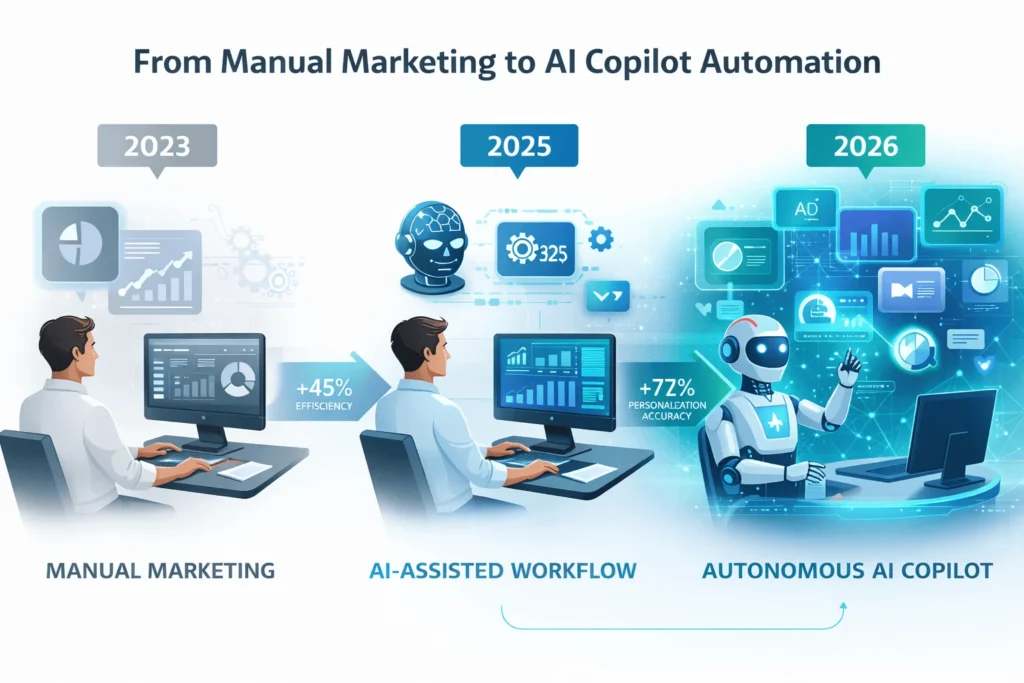
Marketing Automation Reaches Autonomous Operations
Marketing automation in 2026 isn’t just scheduling posts—it’s end-to-end campaign orchestration with minimal human oversight.
Key insight: AI won’t just trigger messages—it will generate and evolve them. Winners will be brands that train AI on their tone, not just prompt it.
Predictive Analytics and Intent Forecasting
The shift from reactive to predictive marketing represents the biggest operational change.
How predictive analytics works now:
Churn prediction
AI identifies customers likely to cancel subscriptions 30–90 days before they churn, triggering automated retention campaigns.
Next-best-action recommendations
Systems analyze customer lifecycle stage and automatically determine optimal next touchpoint—whether educational content, product demo, or promotional offer.
Revenue forecasting
Predictive models estimate campaign ROI before launch, helping CMOs allocate budgets to highest-probability opportunities.
Business impact: High-growth companies are 2.5x more likely to use AI for market research and campaign planning compared to slower-growth competitors.
What Privacy Regulations Mean for Digital Marketing Strategy?
Direct answer: Privacy laws (GDPR, CCPA/CPRA, DPDP Act, state laws) fundamentally restrict third-party tracking, require explicit consent, and force marketers toward first-party data strategies and contextual targeting.
The Privacy Enforcement Reality
Privacy isn’t theoretical anymore—enforcement is aggressive and expensive.
2025–2026 enforcement landscape:
GDPR fines exceeded €1.2 billion in 2025 due to increased breach reporting and intensified monitoring.
Three new U.S. state laws activate January 1, 2026 (Indiana, Kentucky, Rhode Island), joining 10 existing comprehensive state privacy frameworks.
India’s DPDP Act reshapes digital marketing across Asia’s largest market, requiring consent for every data collection point.
EU 2026 privacy rules expand requirements for advanced reporting, data interoperability, and AI risk assessments.
Consumer sentiment shift: Over 65% of people worry about brand data practices, and approximately 50% stop buying from brands due to privacy issues.
How Privacy Laws Change Marketing Operations
Critical mistake to avoid: Many organizations treat consent as a one-time action. GDPR and CPRA require revocable, contextual consent. High-performing brands implement preference centers allowing users to update permissions continuously.
First-Party Data as Competitive Advantage
With third-party tracking 60% less effective, first-party data becomes the primary competitive moat.
First-party data strategies that work:
Value exchange models
Offer gated content, tools, or exclusive access in exchange for email, preferences, and behavioral data.
Progressive profiling
Collect data over time through multiple touchpoints rather than demanding everything upfront.
Zero-party data collection
Ask customers directly about preferences, interests, and purchase intent through surveys, quizzes, and preference centers.
Behavioral signal analysis
Track on-site behavior (page views, time on site, content engagement) using privacy-preserving analytics.
Compliance requirement: Maintain detailed data logs, conduct internal audits, and assign accountable data protection roles. Documentation isn’t optional—it’s legal defense.
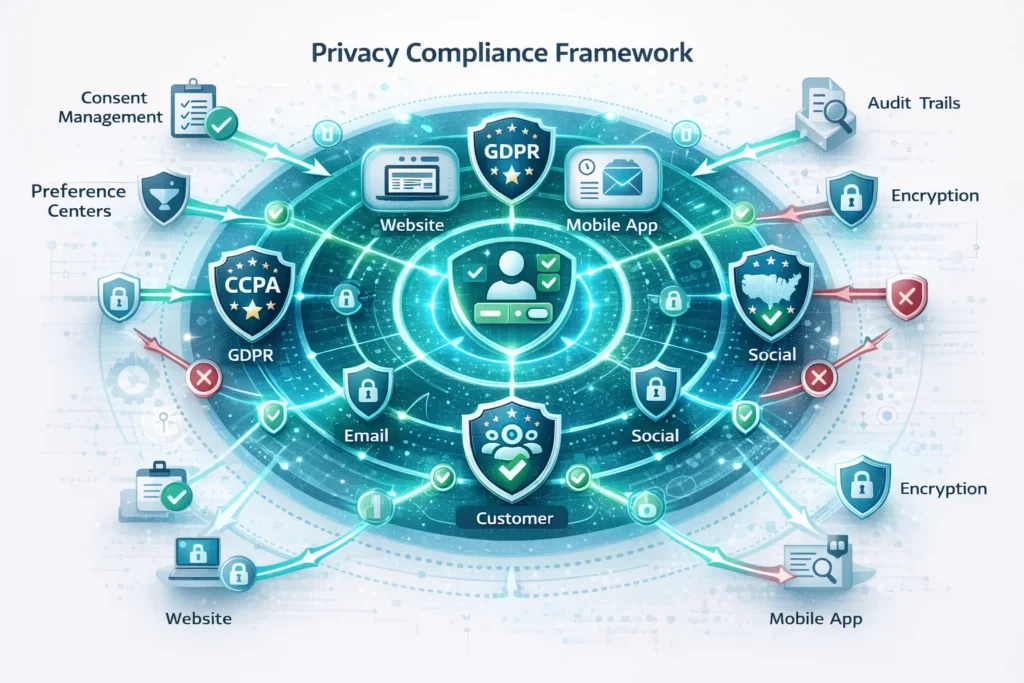
How Should Businesses Adapt Their Digital Marketing Strategy for 2026?
Direct answer: Transition to privacy-first automation combining AI copilots, first-party data infrastructure, and contextual targeting while maintaining transparent consent and preference management.
The Privacy-First Automation Framework
Modern digital marketing requires combining AI capability with privacy compliance—not choosing between them.
Core framework components:
AI-powered marketing automation
Deploy AI copilots for flow building, content generation, and campaign optimization while feeding them only privacy-compliant, consented data.
Robust first-party data platform
Build a unified customer data infrastructure capturing behavioral signals, transactional data, and zero-party preferences with proper consent tracking.
Contextual targeting at scale
Replace behavioral retargeting with contextual ad placement analyzing content, keywords, and page context rather than user tracking.
Preference centers and consent UX
Implement granular consent management allowing customers to control data usage, with clear value propositions for data sharing.
Privacy-preserving analytics
Use aggregated insights, cohort analysis, and modeled attribution rather than individual user tracking.
Critical mindset shift: Privacy compliance isn’t a constraint—it’s a competitive asset. Brands demonstrating credible data practices earn consumer trust that translates to higher conversion rates and customer lifetime value.
Budget Allocation Shifts for 2026
Global digital ad spend is projected to reach $786.2–$807 billion in 2026, but allocation patterns are changing dramatically.
Where marketing budgets are moving:
Budget strategy insight: 60% of CMOs are shifting budgets toward “AI Orchestration” roles that blend creative strategy with technical AI deployment.
For businesses new to digital marketing or refining strategies, explore how to start digital marketing for new businesses for a complete foundation-building guide.
Content and Channel Priorities
Consumer behavior and platform algorithm changes dictate where and how to invest marketing effort.
High-priority formats for 2026:
Short-form video content
Short-form video ad spend alone captures $115.75 billion in 2025, projected higher in 2026. 88% of consumers say they want more videos from brands.
AI-generated, brand-voice content
AI content tools now learn brand voice and industry nuances, creating resonant content at scale while maintaining quality.
Influencer-led SEO and collaborations
Optimizing for influencer names and collaboration content ranks as a top-5 SEO trend for 2026.
Mobile-first experiences
Smartphones drive 69% of all digital ad spending. By 2030, 83.8% of video ad spend will come through mobile.
Connected TV advertising
Connected TV is projected to grow from $56.08 billion in 2025 to $120.62 billion by 2030.
Small businesses can leverage these trends effectively—learn what digital marketing actually works for small businesses in 2026 for practical, budget-conscious strategies.
What Role Does Marketing Technology Play in 2026?
Direct answer: Marketing technology in 2026 functions as the operational backbone enabling AI deployment, privacy compliance automation, and unified customer data management across channels.
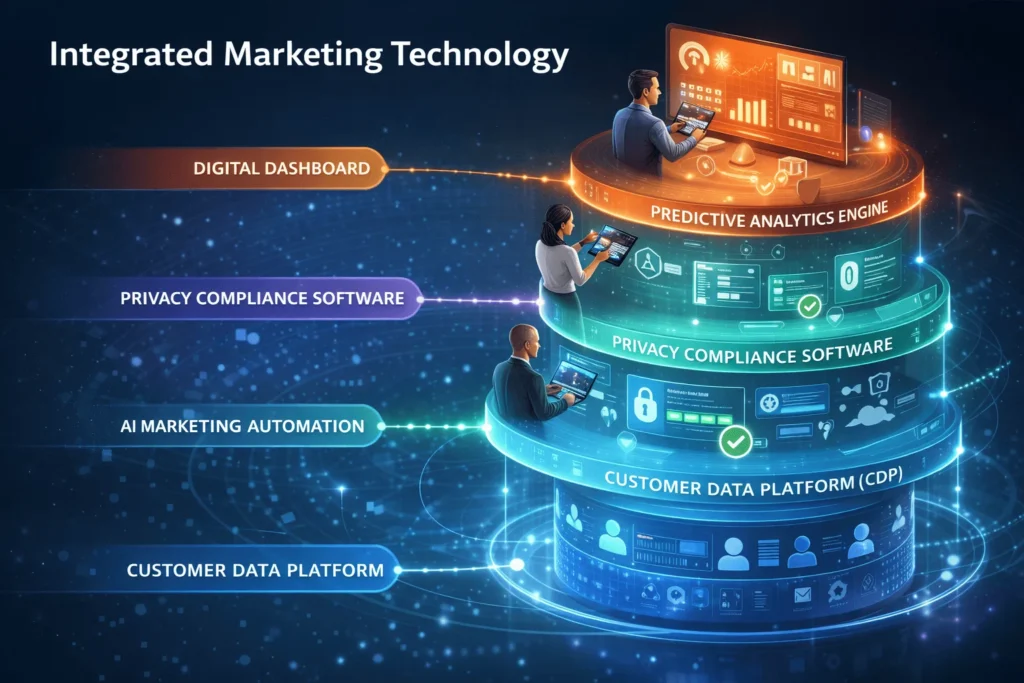
Essential MarTech Stack Components
2026 marketing technology priorities:
AI-powered marketing automation platform
Central hub orchestrating campaigns across email, social, web, SMS with predictive optimization.
Customer data platform (CDP)
Unified first-party data infrastructure with consent tracking, preference management, and identity resolution.
Privacy compliance software
Automated consent management, cookie banners, preference centers, and audit trails across jurisdictions.
Predictive analytics engine
Tools forecasting customer behavior, churn risk, next-best-action, and campaign performance.
Digital dashboards and attribution
Real-time performance tracking with privacy-preserving measurement and multi-touch attribution modeling.
Integration imperative: These tools must work together—siloed martech creates compliance gaps and prevents unified customer experiences.
Emerging Technologies Shaping 2026
Technologies gaining serious traction:
Augmented reality in advertising
AR in ads expected to grow 25% in 2026, enabling virtual product try-ons and immersive experiences.
Conversational AI and chatbots
AI customer agents now recommend products and resolve support questions, serving as copilots for both marketing and service teams.
Voice search optimization
Growing adoption of voice assistants requires optimizing for conversational, long-tail queries.
Blockchain for ad transparency
Some advertisers exploring blockchain to verify ad delivery and combat fraud in programmatic buying.
Adoption pattern: High-growth companies invest in emerging tech 2–3 years earlier than market average, gaining first-mover advantages.
Explore comprehensive digital marketing trends driving real business growth for deeper platform-specific insights.
How To: Build a Privacy-Compliant AI Marketing Strategy
Times Needed: 14 Days & 8 Hours
Estimated Cost: 5000 USD
Description: Step-by-step framework for transitioning your marketing operations to privacy-first AI automation, including technology implementation, compliance setup, and performance optimization.
Steps:
Step 1: Audit current data collection and consent practices (2 days)
Map every data collection point across website, apps, and campaigns. Document consent mechanisms, data flows, and third-party integrations. Identify GDPR, CCPA, DPDP compliance gaps.
Step 2: Implement privacy compliance infrastructure (3 days)
Deploy consent management platform with granular opt-ins. Build preference centers allowing customers to control data usage. Set up automated audit trails and data retention policies.
Step 3: Build first-party data foundation (4 days)
Deploy customer data platform (CDP) unifying data from all touchpoints. Create value exchange models (gated content, tools, exclusive access) to collect zero-party data. Implement progressive profiling.
Step 4: Deploy AI marketing automation platform (3 days)
Select and configure AI-powered automation tool. Integrate with CDP for unified customer profiles. Set up predictive models for segmentation, next-best-action, and churn prediction.
Step 5: Train AI on brand voice and compliance rules (1 day)
Feed AI historical high-performing content to learn brand tone. Configure compliance guardrails preventing use of non-consented data. Test content generation across channels.
Step 6: Launch pilot campaigns and measure performance (1 day)
Run small-scale automated campaigns across email and social. Track engagement, conversion, and compliance metrics. Compare results to manual baseline.
Tools: Customer Data Platform (Segment, Treasure Data), Marketing Automation (HubSpot, Marketo), Privacy Compliance Software (OneTrust, TrustArc), AI Marketing Tools (Klaviyo, Robotic Marketer)
Materials: Current marketing tech stack documentation, Customer data inventory, Consent logs, Campaign performance benchmarks
Key Takeaways
AI transitions from assistant to autonomous operator in 2026, functioning as marketing copilot that builds campaigns, optimizes budgets, and personalizes at scale—Meta aims for full advertising automation by year-end.
Privacy enforcement reaches unprecedented levels with GDPR fines exceeding €1.2 billion in 2025, three new U.S. state laws activating January 2026, and India’s DPDP Act transforming Asia’s largest market.
Third-party cookie tracking dropped 60% effectiveness, forcing marketers toward first-party data strategies, contextual targeting, and zero-party preference collection.
Global digital advertising reaches $786–$807 billion in 2026, with social media capturing $275 billion and search $202 billion—mobile drives 69% of all spend.
High-growth companies are 2.5x more likely to deploy AI for market research and campaign planning, creating performance gaps versus slower adopters.
Privacy compliance is competitive advantage, not constraint—brands with transparent data practices earn consumer trust translating to higher conversion and customer lifetime value.
Short-form video dominates content strategy with $115.75 billion in ad spend, while 88% of consumers demand more video from brands.
Marketing technology must integrate seamlessly—CDPs, automation platforms, privacy tools, and analytics need unified data flow to enable compliant personalization.
Next Steps
- Audit current privacy compliance across all data collection points, consent mechanisms, and third-party integrations to identify GDPR, CCPA, and DPDP gaps.
- Implement first-party data infrastructure by deploying a customer data platform and creating value-exchange models for zero-party data collection.
- Deploy AI marketing automation starting with one channel (email or social), training AI on brand voice while configuring privacy guardrails.
- Build transparent consent UX with granular preference centers allowing customers to control data usage, not one-time checkboxes.
- Shift budget toward high-growth channels—increase allocation to short-form video, social media advertising, and AI orchestration roles.
- Document compliance processes rigorously, maintaining audit trails of consent procedures, data flows, and processing activities for regulatory defense.
- Measure privacy-compliant performance using first-party analytics, cohort analysis, and modeled attribution rather than individual user tracking.
A Few Links Suggestions for Research & Facts
- Digital Marketing for Small Businesses in 2026: What Actually Works
- Top Digital Marketing Trends 2026 Driving Real Business Growth
- How to Start Digital Marketing for New Business: Complete Guide
- Reverbico: How Data Privacy Laws Are Reshaping Digital Marketing in 2026
- Fuze7: 8 AI Trends That Will Change Marketing in 2026
- Search Engine Journal: The Top 10 Digital Marketing Trends For 2026
FAQ: Digital Marketing in 2026
Q1. How is AI changing digital marketing in 2026?
AI functions as a marketing copilot that automates campaign building, optimizes budgets in real-time, generates brand-voice content, and predicts customer behavior. Meta aims to fully automate advertising by end of 2026, and marketers report AI copilots now handle flow building and personalization at scale
Q2. What privacy laws impact digital marketing in 2026?
GDPR (Europe), CCPA/CPRA (California), DPDP Act (India), and 13 U.S. state comprehensive privacy laws regulate data collection, require explicit consent, and limit third-party tracking. GDPR fines exceeded €1.2 billion in 2025, making compliance mandator
Q3. How effective is third-party cookie tracking now?
Third-party cookie effectiveness dropped over 60% compared to pre-regulation benchmarks, particularly for retargeting and lookalike audiences. Marketers must transition to first-party data, contextual targeting, and zero-party preference collection
Q4. How much will be spent on digital advertising in 2026?
Global digital advertising market is projected to reach $786.2–$807 billion in 2026. Social media advertising will reach $275–$277 billion, while search advertising captures $202.4 billion.
Q5. What is first-party data and why does it matter?
First-party data is information collected directly from customers through your owned properties (website, app, email) with explicit consent. It’s become a competitive moat because third-party tracking restrictions make it the primary reliable data source for targeting and personalization.
Q6. Should small businesses invest in AI marketing tools?
Yes. High-growth companies are 2.5x more likely to use AI for market research and campaigns. Many AI tools offer tiered pricing making automation accessible to businesses of all sizes, with efficiency gains justifying costs.
Q7. How do I balance personalization with privacy compliance?
Use privacy-compliant signals (behavioral data, contextual targeting, zero-party preferences) rather than invasive tracking. Implement transparent consent mechanisms and preference centers. AI can personalize effectively using aggregated patterns without individual identifiers.
Conclusion
Digital marketing in 2026 represents a fundamental reset, not incremental evolution. The convergence of AI maturity, aggressive privacy enforcement, and collapsing third-party tracking forces businesses to rebuild marketing infrastructure around privacy-first automation and first-party data.
The opportunity is significant: organizations implementing AI copilots, predictive analytics, and transparent consent management gain measurable competitive advantages in conversion rates, customer lifetime value, and operational efficiency. The global digital advertising market reaching $786–$807 billion demonstrates continued growth for businesses that adapt successfully.
The risk is equally clear: brands clinging to outdated third-party tracking face declining campaign performance, regulatory penalties up to 4% of revenue, and erosion of consumer trust. With enforcement accelerating and consumer expectations rising, 2026 marks the end of transition periods—compliance and automation are now operational requirements, not future considerations.
Start with the audit and first-party data foundation outlined above, deploy AI in controlled pilots, and prioritize transparency in every customer interaction. The businesses thriving in this environment treat privacy compliance as brand-building strategy and AI deployment as growth infrastructure—not separate initiatives, but integrated transformation of how digital marketing operates.
Explore StartupMandi’s digital marketing resources for implementation guides, case studies, and strategic frameworks helping businesses navigate this transformation successfully.