
Introduction
A 30-60-90 day marketing roadmap for startups is a structured plan that helps founders move from confusion to clarity in their first three months of marketing. Instead of guessing what to do, you get a timeline-based system that builds foundations first, traction next, and growth last.
Most startups fail not because their idea is bad, but because no one knows they exist.
This guide breaks down exactly what to focus on in your first 90 days—step by step.
What Is a 30-60-90 Day Marketing Roadmap?
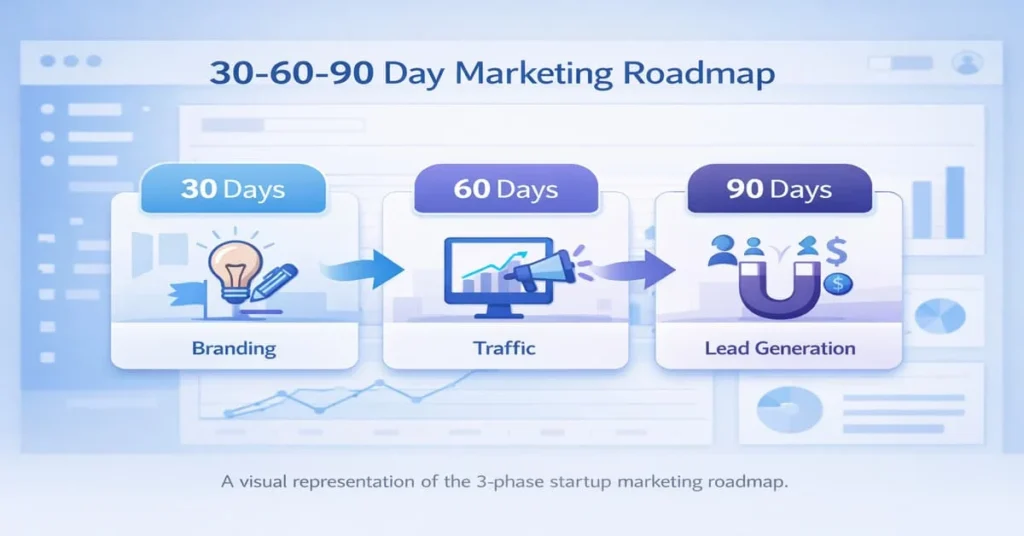
A 30-60-90 day marketing roadmap is a three-phase marketing execution plan:
- First 30 days → Foundation
- Next 30 days → Traffic & Engagement
- Final 30 days → Lead Generation & Optimization
Each phase builds on the previous one.
Instead of doing everything at once, you prioritize the right activities at the right time.
Why Do Startups Need a 90-Day Marketing Plan?
Startups operate with:
- Limited budgets
- Small teams
- High uncertainty
A roadmap prevents:
- Random posting
- Wasted ad spend
- Shiny object syndrome
Key benefits include:
- Faster traction
- Clear priorities
- Measurable progress
- Better resource usage
According to CB Insights, 38% of startups fail because they run out of cash, often due to ineffective customer acquisition.
What Should You Focus on in the First 30 Days?
Direct Answer:
The first 30 days should focus on positioning, branding basics, audience clarity, and digital asset setup.
Build Your Market Position
Define:
- Who you serve
- What problem you solve
- Why you are different
This becomes your core message.
Create Brand Foundations
Essential assets:
- Logo
- Brand colors
- Brand fonts
- Brand tone
You do not need perfection. You need consistency.
Set Up Digital Assets
- Website or landing page
- Google Business Profile
- Social media profiles
- Basic analytics
A simple website converts better than no website.
Define Your Core Channels
Choose only 2 platforms:
- One traffic channel (SEO or Social)
- One engagement channel (Email or Social)
Avoid spreading thin.
First 30 Days Checklist
| Area | Action |
|---|---|
| Brand | Define positioning |
| Website | Launch basic site |
| SEO | Keyword research |
| Social | Create profiles |
| Analytics | Install tracking |
How Do You Drive Traffic in Days 31–60?
Direct Answer:
The second phase focuses on consistent content creation, organic visibility, and audience building.
Start Content Marketing
Publish:
- Blog posts
- Short-form social content
- Educational videos
Content builds trust before selling.
You can reference frameworks like:
- 30-60-90 Day Marketing Plan by SlideUpLift
- Startup Marketing Planning Guide by MoreBusiness
These show how consistency compounds.
Implement Basic SEO
- Optimize page titles
- Add meta descriptions
- Create internal links
- Target long-tail keywords
SEO is a long-term asset.
Build Email List
Offer:
- Checklist
- Guide
- Template
Collect emails early.
Engage on Social Platforms
- Reply to comments
- Join discussions
- Share insights
Visibility comes from participation.
Traffic Channels Comparison
| Channel | Speed | Cost | Long-Term Value |
|---|---|---|---|
| SEO | Slow | Low | High |
| Social Media | Medium | Low | Medium |
| Paid Ads | Fast | High | Medium |
How Do You Generate Leads in Days 61–90?
Direct Answer:
The final phase focuses on lead capture, conversion optimization, and small-scale paid experiments.
Create Lead Magnets
Examples:
- Free audit
- Free consultation
- Template
- Ebook
Build Landing Pages
Each offer needs:
- Clear headline
- Benefits
- Form
- CTA
Introduce Paid Ads (Small Budget)
Start with:
- Google Search Ads
- Meta Lead Ads
Test with small daily budgets.
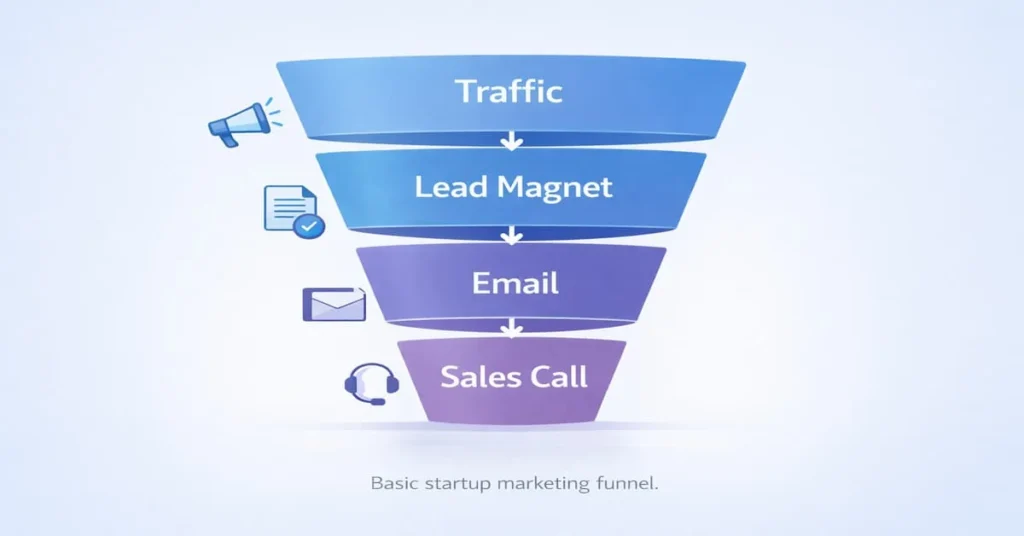
Set Up Basic Funnel
Flow:
Traffic → Content → Lead Magnet → Email Follow-Up → Call
Simple Funnel Example
| Stage | Tool |
|---|---|
| Traffic | SEO / Social |
| Capture | Landing Page |
| Nurture | |
| Convert | Sales Call |
What Metrics Should Startups Track?
Direct Answer:
Track only metrics tied to growth, not vanity numbers.
Key metrics:
- Website traffic
- Conversion rate
- Cost per lead
- Email subscribers
- Sales calls booked
Avoid obsessing over likes.
Common Mistakes to Avoid
- Running ads without landing pages
- Creating content without strategy
- Ignoring SEO
- Changing direction weekly
- Copying competitors blindly
Consistency beats complexity.
How Does This Roadmap Compare With Other Frameworks?
Resources you can explore:
- Growth Method 30-60-90 Playbook
- Medium’s Startup 90-Day Marketing Plan
- OpenOrg 30-60-90 Template
All emphasize phased execution, which aligns with this roadmap.
How To Build Your 30-60-90 Day Marketing Roadmap
Times Needed:
Days: 5, Hours: 6, Minutes: 00
Estimated Cost:
USD: 200
Description:
Create a practical 90-day marketing roadmap that aligns goals, channels, and execution.
Steps to Implement
Step 1: Define Business Goals
Decide revenue target and lead goals.
Step 2: Identify Target Customer
Document pain points and desires.
Step 3: Select Core Channels
Choose 2 platforms only.
Step 4: Create 90-Day Calendar
Map weekly tasks.
Step 5: Track Weekly Metrics
Review and adjust.
Tools Name:
Google Analytics, Notion, Canva, Google Search Console
Materials Name:
Content calendar template, KPI sheet, brand guide
Key Takeaways
- Marketing needs structure
- Foundations come first
- Traffic before ads
- Leads before scaling
- Track what matters
Next Steps
- Create your roadmap today
- Set up foundations
- Publish your first content
- Start collecting leads
If you need help, StartupMandi can build your customized roadmap.
Frequently Asked Questions
It is a phased marketing strategy covering three months.
Yes, it is designed for low budgets.
5–10% of projected revenue is common.
No, focus on foundations.
SEO and social media.
30–90 days for early traction.
Yes.
Conclusion
A 30-60-90 day marketing roadmap for startups removes guesswork and replaces it with clarity. By focusing on foundations first, traffic second, and leads third, you create sustainable growth.
For more structured marketing frameworks, explore StartupMandi’s growth resources and planning guides.
A Few Link Suggestions for Research & Fact Check