
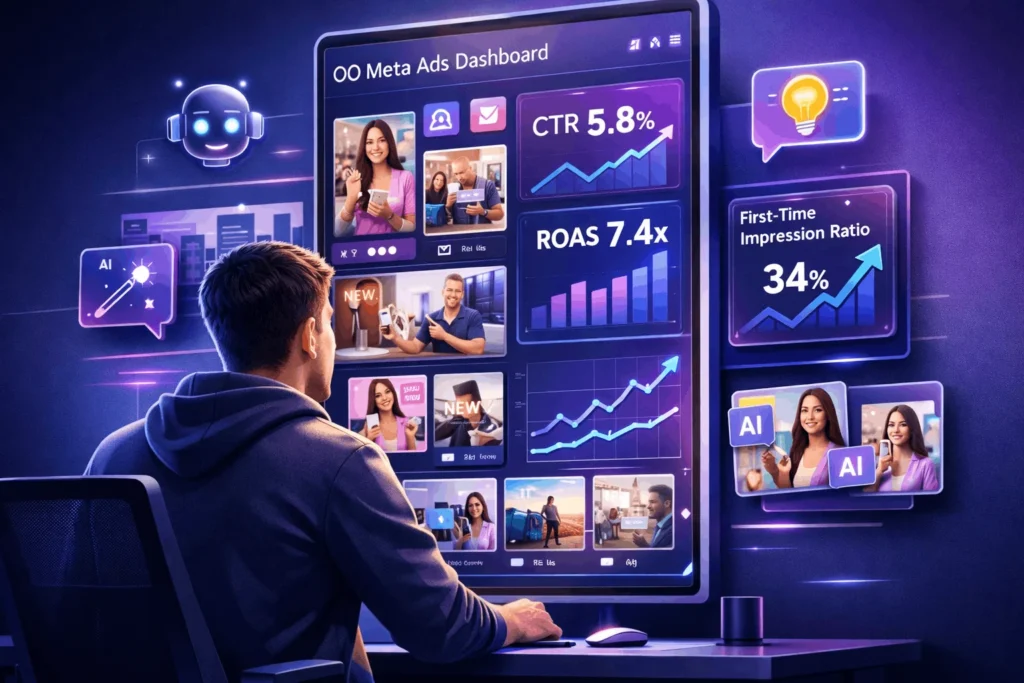
Meta Ads in 2026 are brutally simple: creative is now your biggest lever. Meta’s AI handles more of the targeting and bidding, which means ad performance is driven increasingly by how your ads look, sound, and feel.
This guide explains what makes Meta Ads convert today, combining creative psychology with AI-driven testing so you can build a structured, scalable creative strategy—not random ad ideas.
What Has Changed in Meta Ads Creative in 2026?
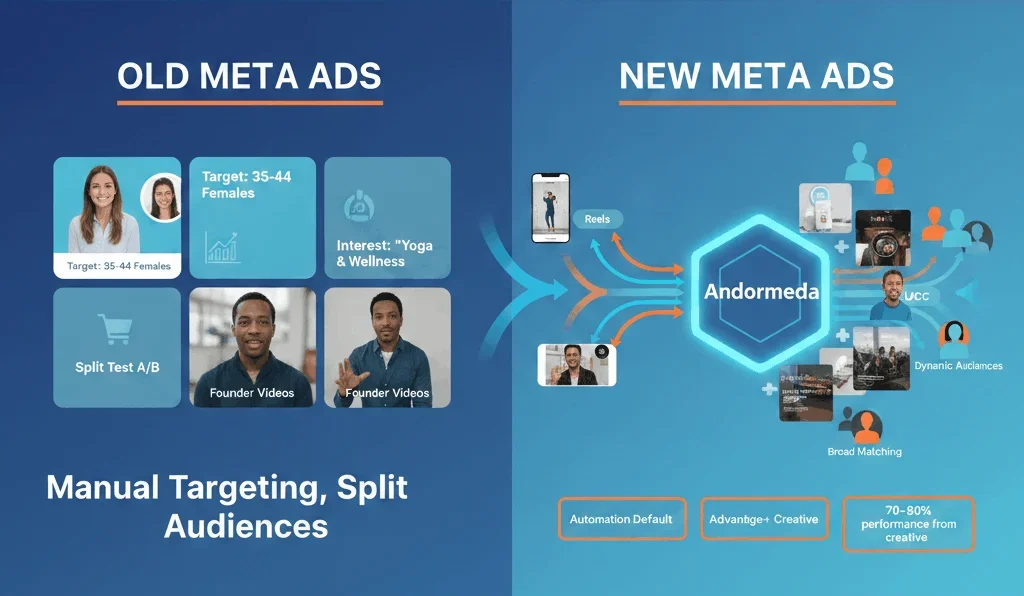
Meta’s 2025–26 updates shifted power from manual hacks to algorithm-friendly creative portfolios.
- The Andromeda AI engine now finds the best ad for each person, making creative variety more important than micro-targeting.
- Advantage+ Creative and AI-assisted tools automatically generate variations, backgrounds, and text tweaks.
- Meta and research partners confirm that creative quality drives most of sales ROI, with Nielsen attributing 56% of ROI to creativity and Google citing 70% of success to creative.
A 2025 AppsFlyer-style analysis referenced by Billo suggests 70–80% of Meta ad performance now depends on creative strength, not budget or targeting setup.
“Automation is the core framework now, not a feature. Creativity and data decide who wins.” — Meta ads practitioner summary of 2025 updates
Takeaway: You compete less on hacks and more on creative system design—angles, formats, and iteration speed.
What Creative Principles Make Meta Ads Convert?
To convert on Meta, ads must stop the scroll, build relevance, and reduce friction to action.
1. What Psychological Triggers Work Best?
High-performing Meta Ads consistently tap into a few core psychology levers:
- Attention and contrast
- Specific outcomes and proof
- Social proof and human presence
- Loss aversion and urgency (used ethically)
How Should I Structure Meta Ads Creatives Today?
Winning accounts in 2026 don’t rely on one “hero ad”—they run creative portfolios with diverse angles and formats.
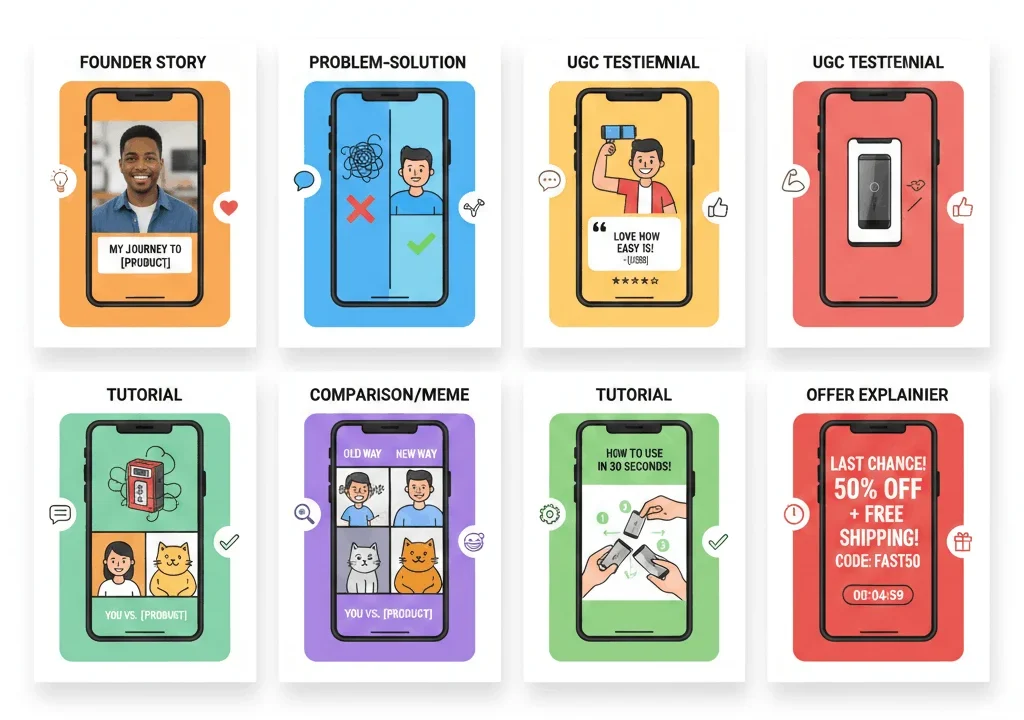
1. What Creative Archetypes Should I Use?
Anchour and other playbooks recommend radically different creative archetypes, not tiny variations.
Meta’s Reels Trending Ads and Partnership Ads make short-form, human-centred creatives especially powerful, given that more than half of the time on Instagram is now spent on Reels.
2. How Many Creatives Should I Run?
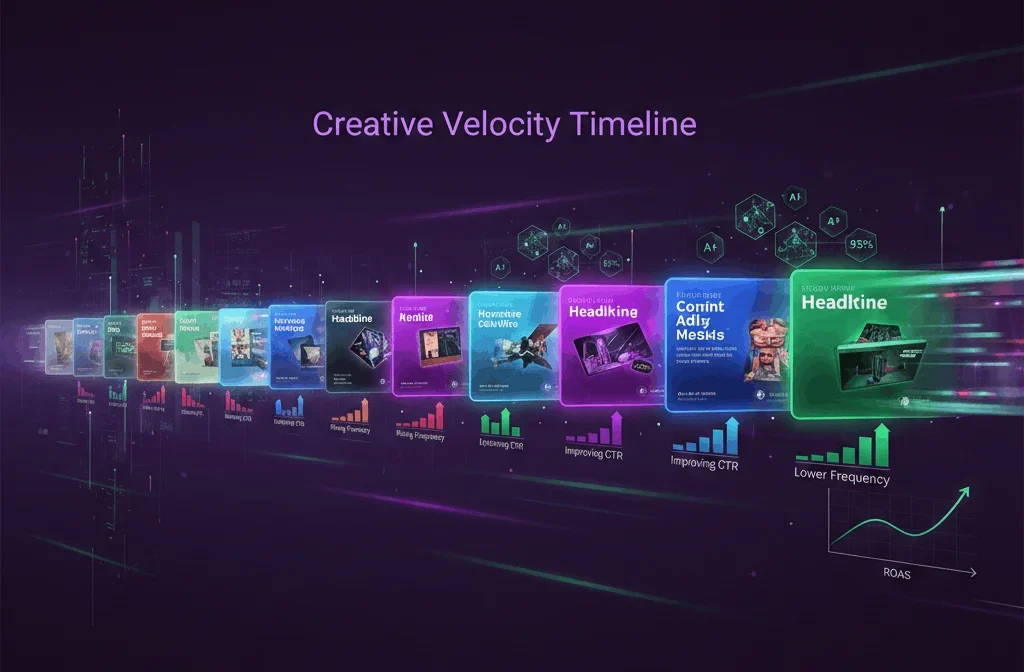
Logical Position’s “Creative Velocity” framework shows that the number of new creatives launched per time strongly predicts performance.
Meta’s internal and partner data cited there found:
- Reducing fatigue through fresh creatives improved conversion rates by 8% in high-fatigue cases.
- Dynamic creative optimisation led to ROAS lifts of 30–50%.
- Personalised creatives delivered 2–3x higher engagement.
The same article highlights the 70‑20‑10 rule for budget allocation:
- 70% on proven “winner” creatives
- 20% on new variants/angles
- 10% on wild experiments
Takeaway: Plan for ongoing creative production and testing, not quarterly one-offs.
How Do I Use AI and Meta Tools for Creative Testing?
AI now supports both creative ideation and testing, making it practical to test more variations without exploding production costs.
1. What Are Meta’s Own AI Creative Tools?
Recent Meta updates emphasise Advantage+ and AI-assisted Creative Technology:
- Advantage+ Creative automatically generates image backgrounds, text variations, and video edits, delivering higher CTR and conversions in Meta’s internal tests.
- AI-assisted creative features like dynamic headers and social proof comments produced 7.5% higher offsite conversions and 9.6% higher CTR.
- Generative AI tools (image and text) available platform-wide have achieved up to 11% higher click-through rates and better conversions when used thoughtfully.
Meta’s Andromeda engine and automation now prioritise creative portfolios over micro-structured manual campaigns, making Advantage+ setups the default in many ad accounts.
2. How Should I Approach Creative Testing Statistically?
Most Meta ad tests “declare winners” too early. Adstellar notes that for 95% confidence and a 20% improvement in detection, you need roughly 385 conversions per variation, and ~1,540 conversions for a 10% lift.
- Avoid “peeking” every day and making decisions on noise.
- Use sequential testing rules (e.g., check every 100 conversions; stop early only if p < 0.01).
- Consider Bayesian approaches that estimate the probability one creative is better, aligning decisions with your risk tolerance.
Practical compromise:
- For smaller budgets, aim for at least 100–200 conversions per creative before making big scaling decisions, and track CTR, conversion rate, and first-time impression ratio.
What Is a Practical Meta Ads Creative Framework I Can Use?
Here is a lightweight framework combining creative psychology and AI testing.
1. What Are the Core Building Blocks?
Structure your Meta Ads creative strategy around four pillars:
- Angles – core stories you tell (problem, desire, objection, proof).
- Formats – static, carousels, Reels/short video, Stories, UGC.
- Signals – hooks, visual cues, on-screen text, CTAs.
- Velocity – how fast you launch and retire creatives (creative velocity).
You want diverse angles, native formats, strong signals, and consistent velocity, all guided by data.
How To Build a Meta Ads Creative System (Step-by-Step)
Times Needed: Days: 21, Hours: 18, Minutes: 00
Estimated Cost: Currency: USD, Price: 1,500
Description: A 21‑day roadmap to design, produce, and test a high-performing Meta Ads creative system combining psychology, UGC, and AI-driven testing.
Step 1: Audit Current Creative and Performance
Step Title: Map Existing Creatives, Metrics, and Fatigue
Step Description:
Export recent Meta Ads reports and classify creatives by angle, format, and funnel stage. Identify top 10% and bottom 10% based on ROAS, CTR, and cost per result, and note signs of fatigue such as declining CTR and rising frequency.
Tools Name: Meta Ads Manager, spreadsheet tool, creative library
Materials Name: Creative thumbnails, performance reports, angle tags
Step 2: Define Customer Psychology and Core Angles
Step Title: Build Persona Insights and Ad Angles
Step Description:
Interview customers, read reviews, and analyse comments to extract pains, desires, and objections. From this, define 4–6 creative angles (e.g., time savings, social proof, price/value) mapping each to specific personas and funnel stages.
Tools Name: Survey tool, social listening tool, note-taking app
Materials Name: Customer transcripts, review exports, angle matrix
Step 3: Produce Diverse Creatives With AI Assistance
Step Title: Create Multi-Format Ads Using AI and UGC
Step Description:
For each angle, produce at least 3–4 creatives using a mix of UGC, Reels-style video, and static or carousel formats. Use generative AI to propose scripts, hooks, and layout variations, then refine to match brand and compliance needs.
Tools Name: Video editor, AI image/video tool, script generator
Materials Name: UGC clips, product shots, brand assets
Step 4: Test, Rotate, and Scale Creatives Scientifically
Step Title: Launch Controlled Tests and Use Stopping Rules
Step Description:
Launch creatives in structured test campaigns, monitoring CTR, conversion rate, and first-time impression ratio. Apply basic statistical thresholds (e.g., 100–200 conversions per ad) before scaling winners and pausing losers, rotating new variants to avoid fatigue.
Tools Name: Meta Ads Manager, analytics dashboard, experiment tracker
Materials Name: Test plan, stopping rules document, scaling playbook
FAQ on Meta Ads
Yes, but success depends on creative quality and testing discipline, not micro-targeting. Brands focusing on creative velocity and AI-assisted testing report 30–50% ROAS lifts versus static setups.
CTR and conversion rate are key, but Meta’s first-time impression ratio is crucial for managing fatigue. A falling ratio signals the need for fresh creatives.
Used carefully, Advantage+ Creative and AI variations can boost CTR and conversions. However, you should regularly review how AI edits affect branding and messaging.
For active accounts, aim for 5–15 net-new creatives per month, rotated systematically based on performance and fatigue indicators.
In many verticals, authentic UGC and creator-led ads consistently outperform polished studio assets, especially in Reels and Stories placements.
Avoid snap decisions. Try to gather at least 100–200 conversions per creative (or follow stricter statistical thresholds) before declaring winners or losers.
AI speeds up production, variation, and analysis, but human strategists remain critical for insight generation, angle selection, and brand storytelling.
Yes. Prospecting creatives should educate and hook new users, while retargeting creatives should focus on objections, proof, and offers to drive completion.
Key Takeaways
- Creative now drives the majority of Meta Ads performance, with studies from Nielsen, Google, and Meta putting creative’s contribution around 56–70% of ROI.
- Creative portfolios beat hero ads—you need diverse angles and formats that Meta’s AI can match to each user.
- Creative velocity is a growth lever; brands that produce and test new assets faster see 30–50% ROAS improvements and higher conversion rates.
- AI-assisted tools like Advantage+ Creative, generative image/video tools, and multivariate testing improve speed and reduce waste when used with clear guardrails.
- Statistically disciplined testing prevents false winners; using proper sample sizes and stopping rules turns creative testing into a reliable growth engine.
Next Steps You Can Follow
- Run a creative audit of your Meta account and tag ads by angle, format, and performance, identifying fatigue and gaps.
- Build a 4–6 angle matrix rooted in real customer pains and desires, mapped against funnel stages and placements.
- Implement basic testing discipline: clear hypotheses, minimum sample sizes, and documented decisions on which creatives to scale or kill.
Conclusion
Meta Ads in 2026 reward marketers who treat creative as a scientific yet psychological discipline. When you combine human insight into why people buy with AI-powered testing and iteration, you turn creatives from guesswork into a predictable performance lever.
Instead of chasing new hacks in Ads Manager, build a repeatable creative framework: understand your customer’s mind, design diverse angles and formats, leverage AI for speed, and let data choose your winners. That’s how Meta Ads creatives convert—today and in the cycles ahead.
REFERENCE LINKS USED FOR RESEARCH
Deep-dive playbook on Meta ads automation and creative
Analysis of Meta’s Andromeda AI engine and Advantage+ creative updates
Case study on creative velocity and ROAS uplift in Meta Ads
Guide to statistically sound Facebook ad creative testing
Overview of how data and creative together drive performance