


startupmandi-blog-background

Government Business Loans in India 2026: MSME Schemes & Easy Approval Guide ๐Ÿš€

Secure govt business loan scheme funding with our complete guide. Learn about MUDRA, PMEGP, CGTMSE & apply for collateral-free loans today!

Government business loansย represent the most accessible financial pathway for Indian entrepreneurs today. Essentially, the Indian government actively supports small enterprises through multiple structured schemes. Consequently, securing capital no longer requires extensive collateral or complicated paperwork.ย 

Moreover,ย Govt business loan schemeย options have expanded dramatically over the past decade. Therefore, understanding these opportunities separates successful business owners from those struggling for funding. Currently, over โ‚น50,000 crores flow annually through government-backed schemes.ย 

Additionally, millions of entrepreneurs across India benefit from subsidized interest rates and collateral-free funding mechanisms. The government’s commitment to financial inclusion ensures that aspiring business owners can access affordable capital.

Here’s what makesย government business loansย your best funding choice:

  1. โ‚น10 Lakh Collateral-Free Loansย โ€“ MUDRA Yojana provides completely unsecured loans through Shishu, Kishore, and Tarun categories without property guarantees.

  2. Capital Subsidies Up to 35%ย โ€“ PMEGP offers government subsidies reducing your actual borrowing burden significantly for new enterprises.

  3. โ‚น2 Crore Unsecured Accessย โ€“ CGTMSE scheme enables MSMEs to borrow large amounts without collateral through government credit guarantee coverage.

  4. Fast Approvals in 59 Minutesย โ€“ Digital MSME loan portals now approve applications within one hour, enabling rapid business expansion.

  5. Targeted Support Programsย โ€“ Stand-Up India, SIDBI SMILE, and sector-specific schemes provide specialized support for women, SC/ST, and specialized enterprises.

How to Prapre Documents to Raise Funds:ย Complete Fundraising Package โ€“ Investor Ready Documents

What Are Government Business Loans & Why They Matterย 

Undeniably,ย government business loansย function as powerful catalysts for entrepreneurial growth. Specifically, these schemes emerged to address India’s credit gap affecting small enterprises. Subsequently, traditional banks often reject MSMEs due to limited collateral or credit history.ย 

Therefore, the government created structured programs ensuring financial accessibility across all social strata. Meanwhile, these loans carry significantly lower interest rates than conventional banking products. Additionally, many schemes eliminate collateral requirements entirely, democratizing access to capital.ย 

Importantly, the government backing reduces lender risk, enabling faster approvals. Furthermore, subsidies embedded within schemes reduce your effective borrowing cost substantially.

Key Benefits of Government-Backed Financingย 

Government business loansย deliver multiple advantages beyond simple capital access. Firstly, interest rates typically start from 7-9% annually for government schemes. Meanwhile, traditional business loans from private lenders range from 15-25% annually.ย 

Consequently, this 8-16% difference saves thousands in interest payments annually. Additionally, collateral-free structures mean entrepreneurs retain complete asset ownership for reinvestment. Furthermore, repayment tenures extend up to 10 years, reducing monthly EMI burdens significantly.

Notably, government schemes include credit guarantee coverage protecting lenders against defaults. Meanwhile, this protection encourages banks to approve applications faster. Additionally, many schemes provide interest subventions for specific borrower categories.ย 

Therefore, women entrepreneurs and SC/ST business owners enjoy additional cost reduction. Importantly, flexible repayment structures accommodate seasonal business fluctuations.

Who Qualifies for Government Business Loans?ย 

Eligibility for Govt business loan schemeย varies across different programs but follows common principles. Basically, applicants must be Indian citizens aged 18-65 years with business viability. Additionally, non-farm income-generating activities receive priority under most schemes.ย 

Meanwhile, manufacturing, trading, and service sectors all qualify equally. Importantly, first-time entrepreneurs receive priority in government allocation. Furthermore, women entrepreneurs and SC/ST communities enjoy preference in processing.ย 

However, applicants with existing defaults or severe credit issues face rejection. Therefore, maintaining clean banking relationships improves approval probability significantly. Notably, even startup founders without business experience can access government funding.

Checkout Our Latest Services

Interest Rates & Repayment Terms Comparisonย 

Government business loanย interest rates vary substantially from traditional commercial lending. Specifically, MUDRA loans charge interest based on bank policies, typically 8-15% annually. Meanwhile, CGTMSE and PMEGP schemes offer competitive 8-12% rates.ย 

Conversely, private business loans range 15-25% depending on creditworthiness. Additionally, government schemes waive processing fees for smaller loan categories. Furthermore, prepayment penalties rarely exist in government programs. However, late payment charges apply uniformly across schemes.

Loan TypeInterest RateCollateral RequiredTenureProcessing Fee
MUDRA Loans8-15% p.a.None1-7 yearsNil-minimal
PMEGP8-12% p.a.None1-10 yearsCovered by scheme
CGTMSE8-12% p.a.None1-10 yearsNominal
Private Banks15-22% p.a.Required1-5 years1-2%

The Top Government Business Loan Schemes You Must Know

Essentially, India offers numerousย government business loansย through dedicated schemes. Subsequently, each program targets specific business types and entrepreneur profiles. Therefore, understanding these schemes enables strategic selection matching your needs. Meanwhile, the government allocates billions annually across these initiatives.ย 

Additionally, application requirements and approval timelines differ significantly by scheme. Importantly, entrepreneurs should explore multiple options before deciding. Therefore, this section details India’s most impactful government funding programs.

Pradhan Mantri Mudra Yojana (PMMY) โ€“ Start Small, Scale Bigย 

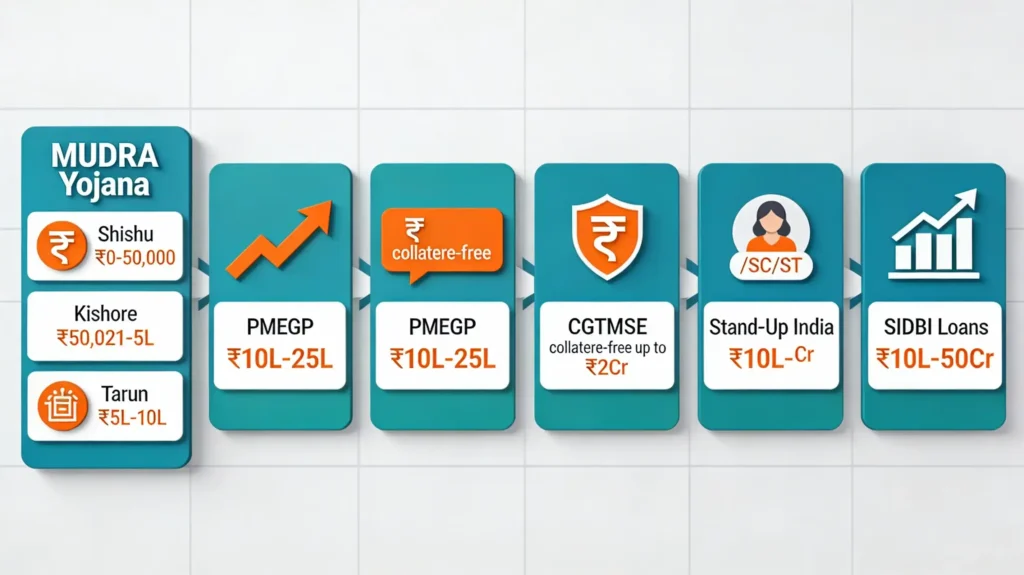
MUDRA Yojana remains India’s most successful microfinance initiativeย since its 2015 launch. Specifically, this scheme provides collateral-free loans up to โ‚น10 lakhs through three categories. Basically, Shishu loans go up to โ‚น50,000 for startup validation. Meanwhile, Kishore loans range โ‚น50,001 to โ‚น5 lakhs for expanding enterprises. Additionally, Tarun loans support โ‚น5 lakh to โ‚น10 lakh borrowers scaling operations.

Furthermore, MUDRA loans charge minimal or zero processing fees across all categories. Importantly, no collateral, guarantees, or personal security requirements exist. Meanwhile, approval timelines range 3-7 days through participating banks and NBFCs. Additionally, repayment periods extend up to 5 years for Shishu loans.ย 

Notably, the Credit Guarantee Fund for Micro Units (CGFMU) covers 100% of losses up to โ‚น20 lakhs. Therefore, lender risk elimination accelerates approval processes significantly. Over 45 crore MUDRA loans have been disbursed, creating millions of livelihoods.

How MUDRA Loans Work

MUDRA loans function through a straightforward application process. Firstly, entrepreneurs apply through participating banks, NBFCs, or microfinance institutions. Meanwhile, eligibility verification completes within 24-48 hours.ย 

Subsequently, loan approval occurs upon basic document verification. Finally, funds transfer directly to your business bank account. Importantly, online portals like UdyamiMitra simplify the entire process.

government-business-loans-india-msme-schemes-how-to-apply
Government business loan schemes in India - MUDRA, PMEGP, CGTMSE and other options
Checkout Latest Grants Listed

PMEGP encourages self-employment through capital subsidies and favorable financing.ย Specifically, this scheme offers loans up to โ‚น50 lakhs for manufacturing and โ‚น20 lakhs for services. Meanwhile, the government provides 15-35% capital subsidies reducing your actual debt burden. Additionally, PMEGP targets both first-time entrepreneurs and established business owners. Consequently, this scheme particularly benefits rural entrepreneurs and traditional artisans.

Notably, PMEGP loans carry 8-12% annual interest rates with flexible repayment. Furthermore, repayment tenures extend up to 10 years for capital investments. Meanwhile, government-sponsored training precedes loan disbursement at no cost. Additionally, PMEGP prioritizes youth, women, SC/ST, and minorities. Therefore, special interest rates apply for targeted beneficiaries. Importantly, Project Investment Fund (PIF) and government subsidy cover project costs jointly. Over 50 lakh employment units have been created through PMEGP since its inception.

CGTMSE eliminates collateral barriers for micro and small enterprises entirely.ย Specifically, this scheme guarantees collateral-free loans up to โ‚น2 crores. Meanwhile, guarantee coverage reaches 85% for loans up to โ‚น5 lakhs. Additionally, the government absorbs credit losses reducing lender risk dramatically. Consequently, banks approve applications faster with government backing.

Furthermore, CGTMSE covers both working capital and term loans. Meanwhile, eligible MSMEs include manufacturers, traders, and service providers. Importantly, no credit history or business vintage restrictions apply. Additionally, first-time entrepreneurs qualify readily. However, businesses generating income through agriculture face exclusion. Meanwhile, guarantee fees remain nominal (0.75-1.5% annually). Notably, individual proprietors and partnership firms both qualify equally.

Step-by-Step Application Guide for Government Loans

How to Apply for Government Business Loans โ€“ Complete Roadmapย 

Clearly, securingย government business loansย requires systematic preparation and documentation. Subsequently, following proper procedures increases approval probability significantly. Therefore, we’ll guide you through five essential steps. Meanwhile, understanding each stage eliminates confusion and accelerates processing. Additionally, proper preparation prevents rejection and reapplication delays.

Prepare Your Documentation & Business Planย 

First, compile comprehensive documentation before initiating applications.ย Your business registration certificate, GST registration, and Aadhaar card form the foundation. Meanwhile, 2-3 years of bank statements demonstrate financial discipline clearly.ย 

Additionally, business plans outlining operations, market analysis, and revenue projections convince evaluators. Importantly, tax returns and financial statements prove business viability. Furthermore, collateral documents (if available) strengthen your application.

Additionally, prepare a project report detailing investment amount, loan requirement, and repayment capacity. Meanwhile, market research supporting business demand strengthens your case. Importantly, your business plan should address potential challenges transparently.ย 

Furthermore, financial projections must show realistic growth rates. Therefore, hiring chartered accountants to prepare professional documents often helps significantly.

Choose the Right Scheme for Your Businessย 

Next, identify which govt business loan scheme matches your specific needs.ย Essentially, matching your business profile to appropriate schemes determines approval likelihood. Subsequently, consider your loan amount, business type, and expansion stage.ย 

Meanwhile, entrepreneurs starting fresh should explore MUDRA or PMEGP schemes. Additionally, established businesses seeking capital upgrades should consider CGTMSE or SIDBI options. Importantly, research each scheme’s specific eligibility criteria thoroughly.ย 

Furthermore, understand the benefits and restrictions for your chosen scheme. Therefore, consulting with MSME facilitators or bank advisors prevents poor scheme selection.

government-business-loans-india-msme-schemes-how-to-apply
Step-by-step application process for government business loans and MSME schemes

Submit Applications & Track Your Progressย 

Finally, submit applications through proper channels after documentation completion.ย Basically, MUDRA loans require submission through banks or online portals. Meanwhile, PMEGP applications go through District Industries Centres (DICs) and state agencies.ย 

Additionally, CGTMSE applications reach facilitating banks directly. Importantly, keep application receipts and reference numbers for tracking purposes. Furthermore, maintain email communication copies with financial institutions. Therefore, follow-up calls every 5-7 days expedite processing. Notably, approvals typically occur within 15-45 days depending on scheme complexity.

Additionally, post-approval requires fund utilization according to declared project scope. Meanwhile, lenders conduct physical verification of asset creation. Importantly, maintain proper accounts and documentation for future fund releases. Furthermore, timely EMI payments establish positive banking relationships. Therefore, consistent repayment enables access to additional funding rounds.

Conclusion:ย ย 

Government business loansย represent accessible, affordable capital pathways for Indian entrepreneurs. Clearly, the government’s extensive support through multiple schemes demonstrates commitment to entrepreneurship. Subsequently, collateral-free structures and subsidized interest rates eliminate traditional barriers. Therefore, your business growth opportunity has never been better.ย 

Moreover,ย govt business loan schemeย options cater to every business stage and entrepreneur profile. Additionally, processing speeds have accelerated dramatically through digitalization. Importantly, millions of successful enterprises built their foundations on government backing.ย 

Meanwhile, financial inclusion policies ensure equitable access across all communities. Therefore, don’t delayโ€”explore your eligible schemes today. Ultimately, strategic government funding combined with your business acumen creates unstoppable growth momentum.

Frequently Asked Questions:ย 

Q1: Can I apply for multiple government business loan schemes simultaneously?

Yes, absolutely you can. Actually, borrowers often combine multiple schemes strategically for maximum capital. Specifically, MUDRA loans work perfectly alongside CGTMSE or PMEGP support. Meanwhile, ensure your total borrowing stays within regulatory limits per institution. However, each scheme maintains separate disbursement and repayment timelines independently.ย 

Therefore, manage multiple EMI schedules carefully to avoid payment defaults. Additionally, maintain transparent disclosure with all lenders regarding simultaneous borrowing. Ultimately, professional financial planning helps optimize combined loan structures effectively.

Q2: What’s the difference between MUDRA Yojana and PMEGP loans?

Fundamentally, MUDRA loans cap at โ‚น10 lakhs for non-farm microenterprises. Meanwhile, PMEGP extends up to โ‚น50 lakhs (manufacturing) and โ‚น20 lakhs (services). Additionally, MUDRA focuses on existing or startup microenterprises quickly. Conversely, PMEGP targets employment generation through new business creation.ย 

Furthermore, PMEGP includes government subsidies (15-35%) reducing actual borrowing. Meanwhile, MUDRA offers collateral-free lending without subsidies. Importantly, MUDRA processes approvals faster (3-7 days typically). Therefore, choose MUDRA for quick microfinance and PMEGP for subsidized larger projects.

Q3: Do government business loans require personal guarantees or collateral?

No, most government schemes eliminate collateral requirements entirely. Specifically, MUDRA, CGTMSE, and PMEGP all offer collateral-free lending. However, the Credit Guarantee Fund absorbs risk through government guarantee coverage. Meanwhile, your business viability determines approvalโ€”not asset possession.ย 

Additionally, some lenders may request post-dated cheques for security. Therefore, personal guarantees rarely become necessary. Importantly, this fundamental benefit differentiates government loans from private banking. Consequently, asset-poor entrepreneurs access capital equally. Ultimately, government schemes democratize entrepreneurial financing across all economic strata.

Q4: How quickly can I receive funds after loan approval?

Generally, fund disbursement occurs within 5-15 days post-approval. Specifically, MUDRA loans disburse within a week through most participating banks. Meanwhile, PMEGP and CGTMSE require project verification before disbursement. Additionally, digital processing accelerates timelines substantially compared to traditional methods.

However, documentation delays on your end can extend timelines significantly. Therefore, maintain responsive communication with your bank throughout the process. Importantly, fund transfer happens directly to your business account electronically. Consequently, you avoid physical currency handling entirely. Ultimately, modern banking systems ensure relatively rapid fund accessibility.

Q5: What happens if I fail to repay my government business loan?

Defaulting on government loans triggers regulatory consequences and recovery actions. Specifically, your CIBIL score suffers immediate damage affecting future borrowing. Meanwhile, lenders initiate legal proceedings for loan recovery. Additionally, your assets become subject to attachment under recovery procedures. Importantly, defaulters face bank account freezing and salary garnishment.ย 

Furthermore, criminal prosecution may occur for willful defaults. However, genuine financial hardship situations allow loan restructuring negotiations. Therefore, communicate proactively with lenders during business difficulties. Additionally, government schemes often provide moratoriums during specified hardship periods. Ultimately, maintaining timely repayments remains crucial for long-term credit access.

DISCLAIMER:

This blog provides general informational content regarding government business loans and MSME schemes available in India. The information presented is sourced from publicly available government portals, bank websites, and official scheme documentation as of January 2026. However, government schemes, eligibility criteria, loan limits, interest rates, and benefits may change periodically without advance notice. Therefore, we strongly recommend consulting with qualified financial advisors, bank officials, and authorized government representatives before making loan application decisions. Additionally, interest rates, processing fees, and repayment terms may vary significantly across different lending institutions, regions, and individual credit profiles. Furthermore, loan approval remains subject to each lender’s risk assessment and internal policies. Past experiences with government loans do not guarantee similar future outcomes. Startupmandi.in and its contributors assume no responsibility for individual loan outcomes, application rejections, or unfavorable loan terms experienced by readers. Entrepreneurs bear complete responsibility for their borrowing decisions and subsequent repayment obligations. Please conduct thorough independent research and due diligence directly with government agencies, state-recognized banks, and authorized financial institutions before proceeding with any government business loan application. Additionally, verify all scheme details through official channels listed on India’s portal (myscheme.gov.in) and respective ministry websites.

Arshia Jahan
Arshia Jahan

Digital Marketing and SEO professional, focused on content strategy & optimizing content, improving search rankings, and delivering results through smart, audience-focused strategies. As a Content Strategist and SEO professional, I believe that search engines don't buy productsโ€”people do. By blending technical SEO precision with a human-first content approach. I provide readers with the strategic blueprints needed to scale in a competitive digital world.

Articles: 42

Leave a Reply

Your email address will not be published. Required fields are marked *