


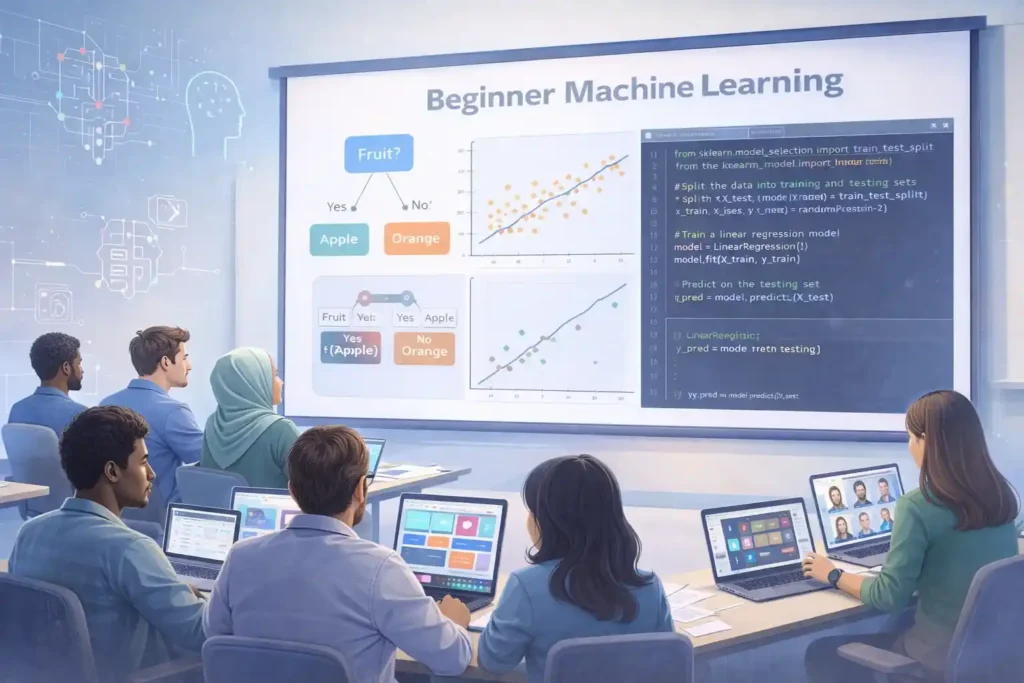
If you are a student, working professional, orstartup/MSME founder in India who keeps hearing about AI and machine learning but is not sure where to start, this guide is for you. Machine Learning Class for Beginners is for who may have basic math and some Python—or are willing to learn them—but want a clear picture before committing time and money to a course.
Here you will find, in one place, what a beginner machine learning class actually covers: the level of math you need, the coding you should be comfortable with, the tools you will use, how classes are structured week by week, and the kind of mini‑projects you will build so you can enroll with realistic expectations.
Also read: Data Science Career Path in 2026: Roles, Skills, and Salary Growth
What Is a Machine Learning Class for Beginners?
A machine learning class for beginners is a structured course that teaches computers to learn from data using mathematical models and algorithms. It usually combines theory, coding labs, and projects so you can move from understanding basic concepts to building simple models that solve real problems.
If you cleared 10+2 math and basic engineering/CS math, you are likely fine to start. To refresh essentials quickly, your go‑to resource: Mathematics for Machine Learning Specialization
Most beginner classes cover:
- Core concepts like supervised and unsupervised learning
- Basic algorithms such as linear regression, decision trees, and clustering
- Hands‑on coding using Python and libraries like scikit‑learn
“Machine learning is not magic; it is statistics, optimisation, and code working together on data.” – Adapted from common ML teaching philosophy
Early in your learning journey, you can also supplement with structured crash courses such as Google’s Machine Learning Crash Course, which offers interactive exercises and concise theory explanations.
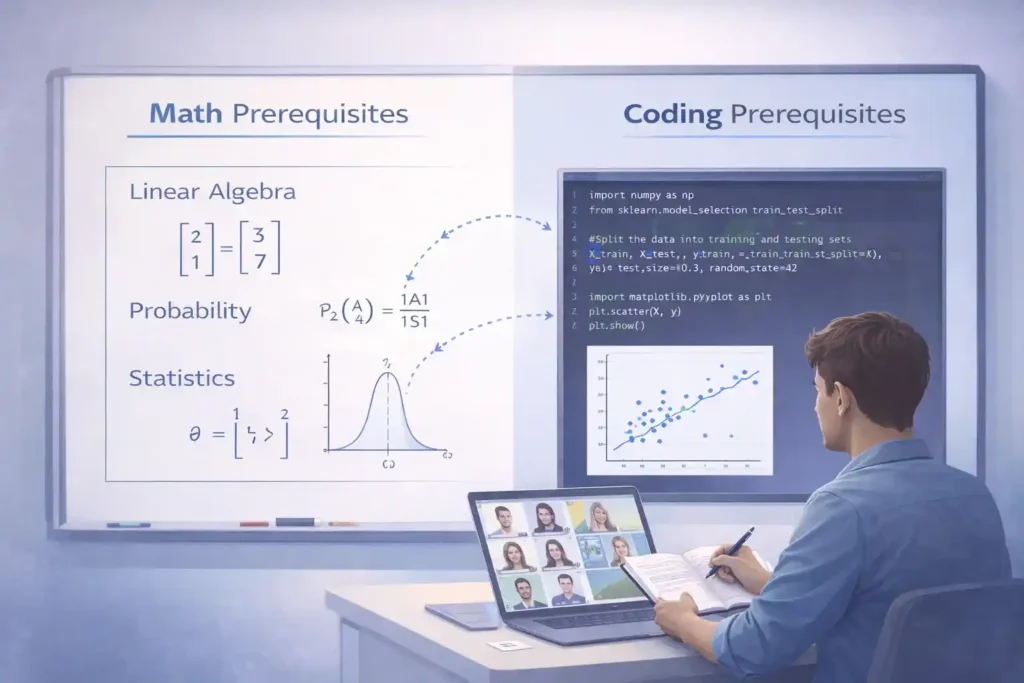
What Math Do You Really Need for a Beginner Machine Learning Class?
You do not need to be a math genius to start a beginner machine learning class. However, you do need comfort with a few foundational topics.
Here are the most important areas for beginners:
| Math Topic | What You Actually Need (Beginner Level) | Why It Matters for ML |
|---|---|---|
| Linear algebra | Vectors, matrices, basic operations | Represent data and model parameters |
| Probability | Basic probability, conditional probability | Understand uncertainty and predictions |
| Statistics | Mean, variance, correlation, distributions | Evaluate models and interpret results |
| Calculus | Derivatives, gradients at a high level | Understand how models learn (optimization) |
Most introductory classes teach or revise this math when needed, so you do not need research‑level calculus to begin. Many learners start with basic math and progressively deepen their skills while doing projects. Spend 1–2 weeks revising vectors and matrices, basic probability, averages and variance, and interpreting simple derivatives so that the formulas they see in class feel familiar rather than frightening.
For extra clarity about math expectations, Google’s Machine Learning Crash Course explains that you mainly need comfort with high‑school math and some familiarity with linear algebra and statistics to benefit from the material.
Do You Need Python Coding Before a Machine Learning Class?
You do not need to be an expert programmer before joining a beginner machine learning class, but you should be comfortable with a few basics in Python: variables and data types, if conditions, for and while loops, simple functions, and reading and slightly modifying existing code. If you can understand what a short script is doing, print values to debug, and work with lists or arrays, you are already in a good position to start.
If you are not there yet, spend 1–2 weeks with beginner‑friendly resources such as the official Python tutorial or an interactive “Python for Data Science” notebook series that walks through variables, loops, functions, and basic libraries step by step. Many true beginner machine learning classes also include an intro‑to‑Python module in the first few lessons, so your goal is not mastery in advance—just enough familiarity that you are not seeing both Python and machine learning for the very first time on day one.
What are realistic prerequisites for a beginner ML class?
Before you join a beginner machine learning class, you do not need a PhD—but you should meet a few realistic checkpoints. Think of it as a readiness checklist rather than a strict exam.
Minimum checklist (tick most of these before you enroll):
- Math: Comfortable with high‑school math (algebra, basic functions, percentages, averages) and willing to revise some linear algebra and probability.
- Programming: Basic familiarity with Python or another language—variables, conditions, loops, simple functions, and reading/modifying short scripts.
- Data handling: Able to work with spreadsheets or CSV files, understand rows/columns, and make simple charts or summaries.
- Curiosity and patience: Interest in solving problems with data, and willingness to debug errors instead of giving up quickly.
Quick self‑check mini‑quiz (yes/no):
- Can I explain what a variable and a loop do in a simple Python or C/Java program?
- Can I look at a small table of numbers (say, sales by month) and calculate or interpret averages and trends?
- Am I comfortable using Excel/Sheets (or similar) to sort, filter, and graph basic data?
- Am I ready to spend at least 5–8 focused hours per week for 8–12 weeks learning and practicing?
If you answered “yes” to at least 3 of these, you are likely ready for a beginner ML class—with a bit of warm‑up.
For Indian learners specifically:
Non‑technical backgrounds (BCom, BA, BBA, etc.): If you are comfortable with school‑level math, can learn basic Python from a crash course, and are willing to practice regularly, you can still succeed—start with a slightly slower‑paced beginner ML or “AI for beginners” course and focus heavily on the prep checklist before jumping in.
Engineering / CS students: If you have cleared first‑year math and done basic programming labs in C, C++, Java, or Python, you probably meet the prerequisites and just need a short Python + math refresh.
Is machine learning hard to learn as a beginner?
Machine learning can feel intimidating because it combines math, programming, and real‑world problem‑solving—but at a beginner level, it is very manageable if you take it step by step. Good introductory classes start with simple ideas (like predicting numbers or classifying emails), gradually introduce the necessary math, and guide you through code you can run and tweak, rather than throwing you into complex theory on day one.
Common myths vs reality:
- Myth: “You must know advanced calculus before any ML class.”
Reality: Most beginner courses only use light calculus ideas (like gradients) and focus far more on intuition, basic algebra, and simple statistics. - Myth: “If I am not a ‘math person’ or top coder, ML is impossible for me.”
Reality: Consistent practice with beginner‑friendly materials matters much more than being naturally gifted; many successful ML practitioners started with average math and programming skills and improved over time.
A practical way to judge difficulty before enrolling is to watch 1–2 sample lectures or preview lessons from the course you are considering. If you can follow at least 70–80% of the explanation and code with a bit of pausing and rewinding, that class is probably at the right level; if every line feels confusing, you might want a more basic Python or math refresher first.
What Will You Learn in a Beginner Machine Learning Class?
A beginner machine learning class focuses on core ideas and hands‑on skills rather than advanced theory. By the end, you should understand how to prepare data, choose simple models, train them, and evaluate their performance on realistic problems.
Here is a typical learning path for beginners:
Here’s an updated version of the table with industry examples and typical durations.
| Module | Topics Covered | Common Industry Example | Typical Duration* |
|---|---|---|---|
| Foundations of ML | What machine learning is, common uses (recommendation systems, fraud detection, forecasting), types of learning: supervised, unsupervised, basic reinforcement learning. | Loading datasets, cleaning missing values, handling outliers, splitting data into train/test sets, and basic feature scaling. | 0.5–1 week |
| Data Handling & Preprocessing | Building a housing price prediction model or an email spam classifier. | Cleaning customer transaction data before modelling churn or risk. | 1–1.5 weeks |
| Fundamental Algorithms | Linear and logistic regression, decision trees, k‑means clustering, Naive Bayes, with focus on intuition over heavy equations. | Creating a recommendation or segmentation mini‑project that you can showcase in a portfolio. | 1.5–2 weeks |
| Model Evaluation | Metrics such as accuracy, precision, recall, F1‑score, mean squared error, basics of overfitting and cross‑validation. | Comparing two credit‑risk models and choosing the safer one using precision/recall. | 1 week |
| Mini‑Projects | End‑to‑end workflows like spam detection, housing price prediction, or customer segmentation. | Creating a recommendation or segmentation mini‑project you can showcase in a portfolio. | 1–2 weeks |
*Assuming a beginner class with 5–8 study hours per week.
What tools and libraries will you use in class?
Most industry‑aligned machine learning classes use modern tools that you are likely to encounter in real jobs. This makes your learning highly practical and immediately transferable.
Commonly used tools include:
| Category | Tool / Library | Beginner Use Case |
|---|---|---|
| Programming | Python | Primary coding language for ML scripts |
| ML library | scikit‑learn | Implement standard algorithms quickly |
| Data handling | NumPy, pandas | Work with arrays and tabular data |
| Visualization | Matplotlib, Seaborn | Plot charts and understand model behavior |
Many beginner programs also use browser‑based notebooks such as Google Colab, which lets you run Python code without installing anything locally, making it easier to focus on learning instead of complex setups.
Online course catalogs highlight that beginner ML curricula almost always list these tools explicitly, so checking the syllabus before enrolling ensures you are comfortable with the technology stack.
How is a typical machine learning class structured?
Understanding the structure of a machine learning class helps you manage your time and expectations. Most programs organise learning into short theory segments followed by immediate practice.
A common weekly structure looks like this:
- Short video lectures explaining concepts and algorithms.
- Reading materials and simple quizzes to test understanding.
- Coding notebooks with step‑by‑step exercises.
- A mini‑project or assignment that integrates the week’s concepts.
You can also set expectations around time and duration using a simple guideline:
| Course Type | Typical Duration | Weekly Time Commitment* |
|---|---|---|
| Fast bootcamp / crash course | 4–6 weeks | 8–10 hours per week |
| Standard beginner ML course | 8–10 weeks | 5–8 hours per week |
| Slow‑paced / weekend program | 10–12 weeks | 4–6 hours per week |
*Includes lectures, readings, coding, and assignments.
Many beginner‑friendly courses add support layers on top of this structure: discussion forums or Discord/Slack groups where you can ask questions, mentor or TA sessions for code and concept doubts, and occasional live Q&A or doubt‑clearing classes. These assessments, assignments, and support channels significantly improve accountability and completion rates for new learners, especially if you are studying alongside a full‑time job or degree.
How can you choose the right machine learning class?
Choosing the right class is critical, especially with so many competing options. A structured selection approach helps you avoid courses that are either too easy, too advanced, or too focused on hype instead of learning outcomes. Use this decision table to quickly compare beginner‑friendly options:
| Question to Ask | What to Look For in a Beginner Class |
|---|---|
| Is it truly beginner‑friendly? | Clear “Beginner” label, no prior ML required, realistic math/coding prerequisites explained. |
| How heavy is the math? | Focus on intuition and visuals, gentle math reviews, minimal advanced calculus. |
| How much coding is involved? | Focus on intuition and visuals, gentle math reviews, and minimal advanced calculus. |
| Are there real projects? | At least 2–3 end‑to‑end projects using real or realistic datasets. |
| Is the instructor or provider reputable? | Solid reviews, clear profile, past student feedback, and transparent syllabus. |
| Is there career support (optional)? | Interview prep, resume/LinkedIn tips, project review, or basic placement assistance if you want a job‑oriented course. |
For Indian learners, also pay attention to a few practical details:
- Fees and value: Compare fee ranges with your budget and check whether the course offers lifetime access, live support, or only recorded content.
- Certificate recognition: Prefer certificates from platforms, institutes, or universities that Indian recruiters know, but remember that projects and skills still matter more than the logo.
- Language and pace: Ensure the primary teaching language (English/Hindi/regional language) and accent are comfortable for you, and that subtitles or transcripts are available.
When researching options, prioritise syllabi that emphasise practical projects, clear prerequisites, and structured support (forums, mentors, feedback) over marketing claims alone. If you are unsure where to start, you can also use curated machine learning learning paths and course lists from StartupMandi to shortlist beginner‑friendly options that fit Indian students, working professionals, and founders.
How Should You Prepare Before Your First Machine Learning Class?
A small amount of focused preparation can reduce anxiety and help you enjoy your first machine learning class much more. You can build a minimum foundation in about 1–3 weeks of part‑time study if you follow a clear plan.
Here is a simple preparation roadmap:
- Refresh core math basics
- Spend a few hours revising school‑level algebra (equations, functions), probability (basic events, conditional probability), and descriptive statistics (mean, median, variance).
- Use visual, beginner‑friendly resources (videos, blogs, or interactive notebooks) that explain ideas with graphs and examples rather than dense proofs.
- Learn basic Python and data handling together
- Work through an introductory Python track that covers variables, data types,
ifconditions, loops, functions, and simple error messages. - Practice loading CSV files, selecting columns, filtering rows, and doing basic calculations using either plain Python, pandas, or even spreadsheets as a bridge.
- Work through an introductory Python track that covers variables, data types,
- Watch a few intro ML videos
- Watch 2–3 short beginner videos or a mini‑playlist that explains what machine learning is, common use‑cases (spam detection, price prediction, recommendations), and how data, models, and evaluation fit together.
- Your goal here is familiarity with terms like “training data”, “labels”, and “accuracy”, not a deep understanding.
- Organise your prep in one place
- Create a single prep notebook or Google Doc where you save key links, short notes, and code snippets from your math, Python, and ML revision.
- Keep adding to this document during the class so it becomes your personal quick‑reference guide instead of scattered bookmarks.
How to complete your first ML mini‑project?
A small, well‑structured mini‑project is the fastest way to move from theory to real understanding. You can usually finish one in about 1 week with ~10 hours of focused work, using free public datasets and tools.
Project overview
- Goal: Build a simple end‑to‑end machine learning mini‑project (like predicting house prices) to reinforce concepts from your first machine learning class.
- Estimated time: Around 1 week of part‑time work (about 8–10 hours total).
- Estimated cost: Free, using public datasets and tools like Google Colab.
Example beginner‑friendly datasets (including India‑relevant options):
- Housing price or rental datasets (predicting prices from features like size, location, rooms).
- Retail or sales data for a small store or e‑commerce shop (predicting monthly sales or flagging high‑value customers).
- Loan default sample data (classifying whether a loan is likely to default, similar to what many Indian finance/fintech firms do).
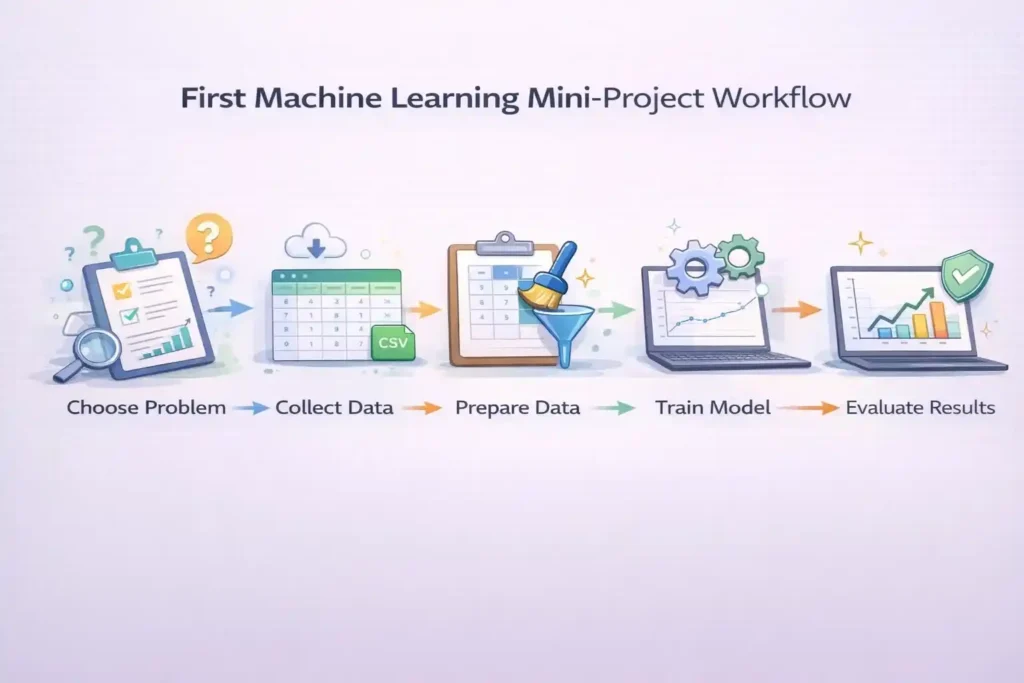
5‑step mini‑project flow:
STEP 1: Define a simple prediction problem
Choose a clear question, such as “Can we predict house prices from size and location?” or “Can we classify loan applications as likely to default or not?” and write it down in one sentence before you start.
STPE 2:Collect and explore a clean dataset
Download a beginner‑friendly dataset from a public repository (Kaggle, UCI, or open government portals), then inspect columns, missing values, and basic statistics using Python, pandas, or spreadsheets.
STEP 3: Prepare data and select a baseline model
Handle missing values and obvious outliers, split the data into training and test sets, and start with a simple model like linear regression for numeric prediction or logistic regression for yes/no classification.
STEP 4: Train, evaluate, and interpret your model
Fit the model in Python (for example, using scikit‑learn), measure performance with basic metrics such as accuracy or mean squared error, and inspect coefficients or feature importance to see which inputs influence predictions the most.
STEP 5: Document learnings and next improvements
Write a short summary of what worked, what did not, and at least one improvement you would try next, such as adding more features, collecting more data, or experimenting with decision trees or random forests.
Tools Name: Python, scikit‑learn, Google Colab
Materials Name: Public dataset, Jupyter/Colab notebook, basic math notes
A structured first project like this mirrors the workflows taught in beginner ML courses and helps move concepts from theory to practical understanding.
FAQs
Is a machine learning class suitable for complete beginners?
Yes, many machine learning classes are designed for complete beginners as long as you are willing to learn basic math and Python alongside the course.
How much time does it take to finish a beginner machine learning class?
Most beginner classes run for 4–12 weeks, with 5–10 hours of study per week, depending on whether they are self‑paced or instructor‑led.
Do I need a powerful computer for a machine learning class?
For beginner courses, a standard laptop is usually enough because most introductory exercises use small datasets or cloud‑based notebooks like Google Colab.
Can non‑engineers succeed in a machine learning class?
Yes, motivated non‑engineers can succeed if they invest time in basic math and programming, and choose beginner‑friendly courses with strong explanations and guided projects.
Will a beginner machine learning class get me a job immediately?
A single beginner class is usually not enough for a full‑time ML role, but it can be a strong first step toward data‑related internships or further specialized learning.
What if I struggle with the math during class?
You can rely on supplemental resources that teach linear algebra, probability, and statistics at a slower pace, while focusing on conceptual understanding rather than proofs.
Can I take a machine learning class without prior data science knowledge?
Yes, many ML classes assume no prior data science experience and introduce data handling, preprocessing, and evaluation step by step.
Is it better to study machine learning online or in a university classroom?
Is it better to study machine learning online or in a university classroom?
Both formats work; online courses offer flexibility and self‑paced learning, while university classes often provide deeper math coverage and more structured assessment.
Key takeaways:
- A beginner machine learning class focuses on core concepts, basic algorithms, and small projects rather than heavy advanced theory.
- You only need solid high‑school math and basic Python to start; deeper topics like advanced calculus and deep learning can come later.
- Understanding prerequisites, class structure, and tools in advance helps you choose a course that matches your level and avoids frustration.
- Completing at least one end‑to‑end mini‑project early makes ML feel real and gives you something concrete to show in interviews or reviews.
- For Indian students, professionals, and founders, ML literacy improves decision‑making, product building, and collaboration with data/AI teams, even before you specialize.
Next steps you can follow
- Shortlist three beginner‑friendly machine learning classes that clearly list prerequisites, tools, and project details in the syllabus.
- Spend one week revising basic math and Python fundamentals using free online resources dedicated to ML prerequisites.
- Plan a simple mini‑project you want to complete during or immediately after your first machine learning class to consolidate your learning.
As you move forward, treat machine learning as a long‑term skill, not a one‑week sprint. Consistent practice, small projects, and gradually harder problems will compound into strong competence over time.
Conclusion: Turn a Machine Learning Class for Beginners into Real Skills
A well‑designed machine learning class for beginners can turn scattered YouTube tutorials into a clear roadmap, guiding you through the right math, coding, tools, and mini‑projects in a structured way. Once you understand what to expect, you can pick a course that matches your level, prepare smartly, and get far more value from every hour you invest. Use StartupMandi’s guides on data and AI careers, skills development, and startup tech adoption to plan your next steps, and explore its services or resources whenever you are ready to apply machine learning in a real business or build a stronger tech career in India.
Disclaimer: This article is for educational purposes only and does not contain affiliate links or promote any specific paid course. Always review official course pages for the latest prerequisites, pricing, and curriculum details.
Few link suggestions for fact‑checking and depth






As someone considering diving into machine learning, I appreciated how this guide breaks down the prerequisites without overwhelming beginners. It’s reassuring to see a clear outline of what to expect in terms of math, coding, and project work. The emphasis on hands-on learning and real-world application really sets a strong foundation for anyone looking to build a career in this space.
Thank you for your comment. To use your site link & generate backlink on our platform, 1st go through a paid plan on this page: https://startupmandi.in/services/digital-services/premium-brand-promotion-on-startupmandi/
As someone considering diving into machine learning, I appreciated how this guide breaks down the prerequisites without overwhelming beginners. It’s reassuring to see a clear outline of what to expect in terms of math, coding, and project work—especially the emphasis on hands-on learning. This kind of clarity helps set realistic expectations and builds confidence before enrolling.
Thank you for your comment. To use your site link & generate backlink on our platform, 1st go through a paid plan on this page: https://startupmandi.in/services/digital-services/premium-brand-promotion-on-startupmandi/
As someone considering diving into machine learning, I appreciated how this guide breaks down the prerequisites without being overwhelming. It’s reassuring to know that even if you’re not a math genius or coding pro, there are beginner-friendly paths that focus on practical application and hands-on learning. The emphasis on real-world projects and clear structure really sets the right expectations upfront.
Thank you for your comment. To use your site link & generate backlink on our platform, 1st go through a paid plan on this page: https://startupmandi.in/services/digital-services/premium-brand-promotion-on-startupmandi/