

Labour codes November 2025: Historic India Labour Reforms Explained
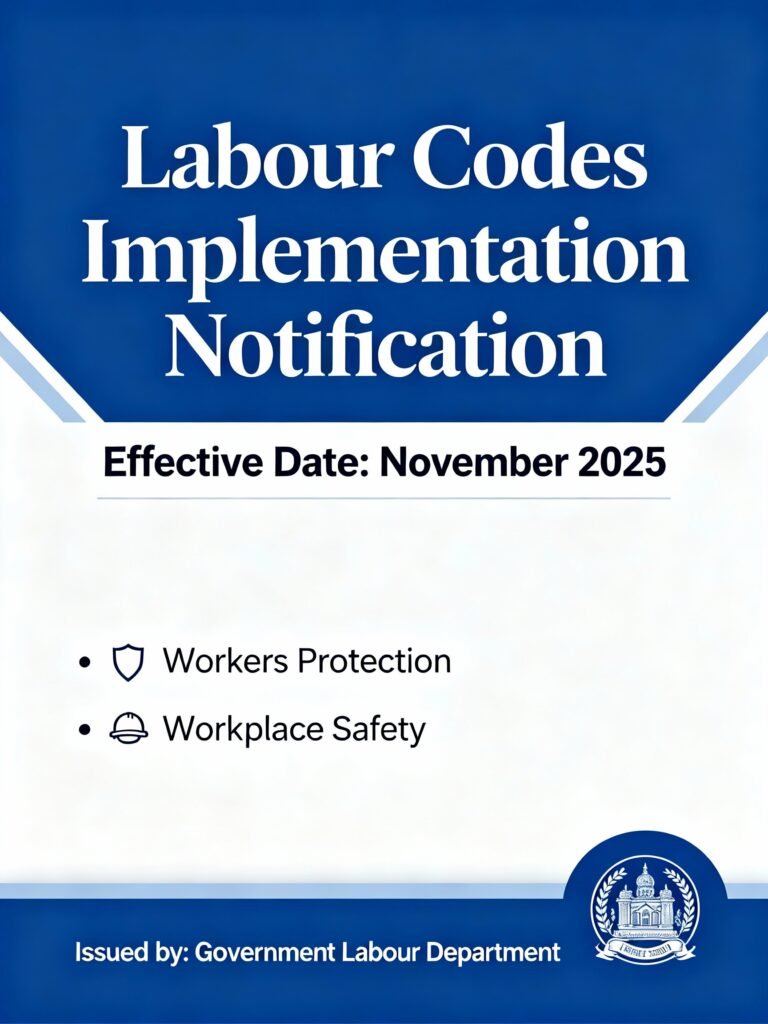
On November 21, 2025, India’s government notified four revolutionary labour codes, consolidating 29 outdated colonial-era laws into modern, worker-centric legislation. Therefore, the labour codes November 2025 represents a watershed moment for workplace rights, social security, and employment dignity across the nation.
Moreover, this labour codes implementation means 64.33 crore Indian workers now access universal minimum wages, comprehensive social security, and enhanced workplace safety protections. Consequently, understanding how labour codes affects your employment rights, business operations, and social security benefits proves essential for every Indian worker, entrepreneur, and HR professional.
Labour codes November 2025: Historic Labour Reforms Implementation
Labour codes November 2025: The Four Transformational Codes Explained
Understanding Labour codes: Code on Wages, 2019
The labour codes November 2025 begins with comprehensive wage protection through the Code on Wages, 2019. Specifically, this labour codes provision establishes statutory minimum wage rights for all employees across organized and unorganized sectors. Therefore, the labour codes eliminates previous wage gaps where approximately 70% of workers had no minimum wage protection. Moreover, labour codes introduces a National Floor Wage set by the central government, ensuring no worker receives compensation below minimum living standards.
The labour codes November 2025 mandates:
- Universal minimum wage coverage for all employee categories
- Equal pay for equal work eliminating gender-based wage discrimination
- Timely wage payment with mandatory compliance deadlines
- Overtime compensation at double the regular rate for work beyond standard hours
- Transparency provisions preventing unauthorized salary deductions
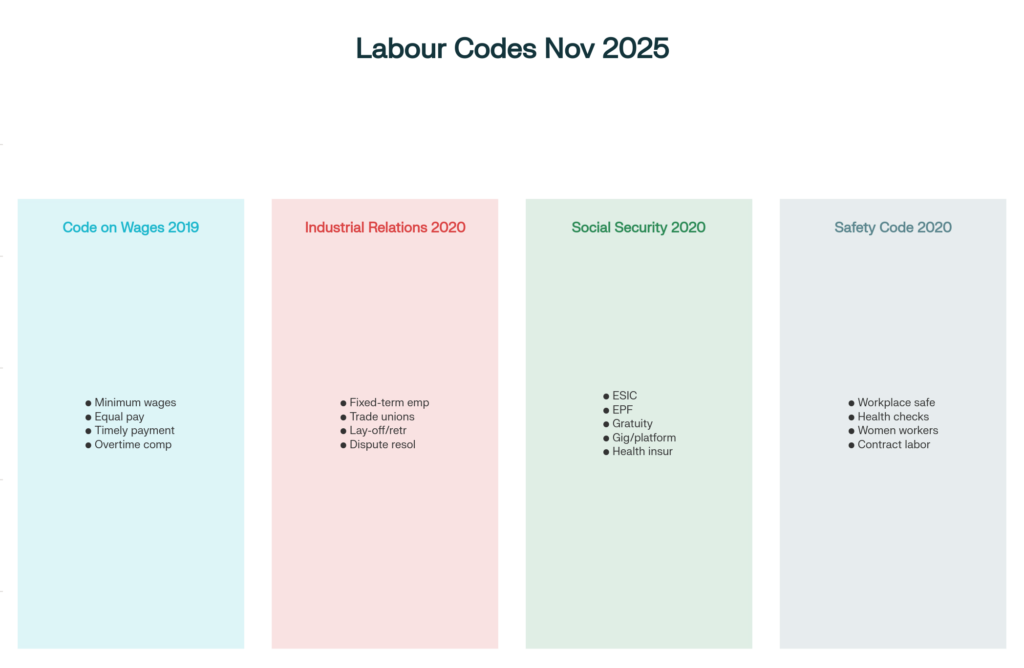 Labour codes November 2025 introduces four consolidated codes replacing 29 laws, providing universal minimum wages, social security, and workplace safety for all Indian workers
Labour codes November 2025: Fixed-Term Employment Revolution
Importantly, the labour codes November 2025 introduces structured fixed-term employment provisions, granting such employees complete parity with permanent staff. Therefore, fixed-term employees now receive identical benefits including leave, medical cover, and social security protections. Moreover, the labour codes reduces gratuity eligibility from five years to just one year of continuous service—a monumental shift improving income security for millions of contract workers.
Labour codes: Industrial Relations Code, 2020
Subsequently, the labour codes transforms industrial relations governance through comprehensive dispute resolution mechanisms. Specifically, labour codes establishes two-member industrial tribunals ensuring faster case resolution compared to previous multi-member panels. Therefore, parties can approach tribunals directly after failed conciliation within 90 days, streamlining processes significantly.
The labour codes November 2025 also:
- Raises retrenchment approval thresholds from 100 to 300 workers, simplifying compliance
- Recognizes trade unions with 51% membership as primary negotiating bodies
- Permits work-from-home arrangements in service sectors through mutual consent
- Establishes reskilling funds financed through mandatory contributions equal to 15 days’ wages per retrenched worker
Labour codes November 2025: Code on Social Security, 2020
Dramatically, the labour codes November 2025 extends social security to previously excluded worker categories. Therefore, gig workers, platform workers, and self-employed individuals now access ESIC, EPF, gratuity, and health insurance through dedicated social security funds. Moreover, labour codes implements:
- Pan-India ESIC coverage eliminating geographic restrictions
- Reduced EPF appeal deposits from 40-70% to just 25%, improving employer access to justice
- Gratuity for fixed-term employees after one year instead of five
- Social security funds financing life, disability, health, and old-age benefits for unorganized workers
- Expanded dependent definitions including parents-in-law for female employees
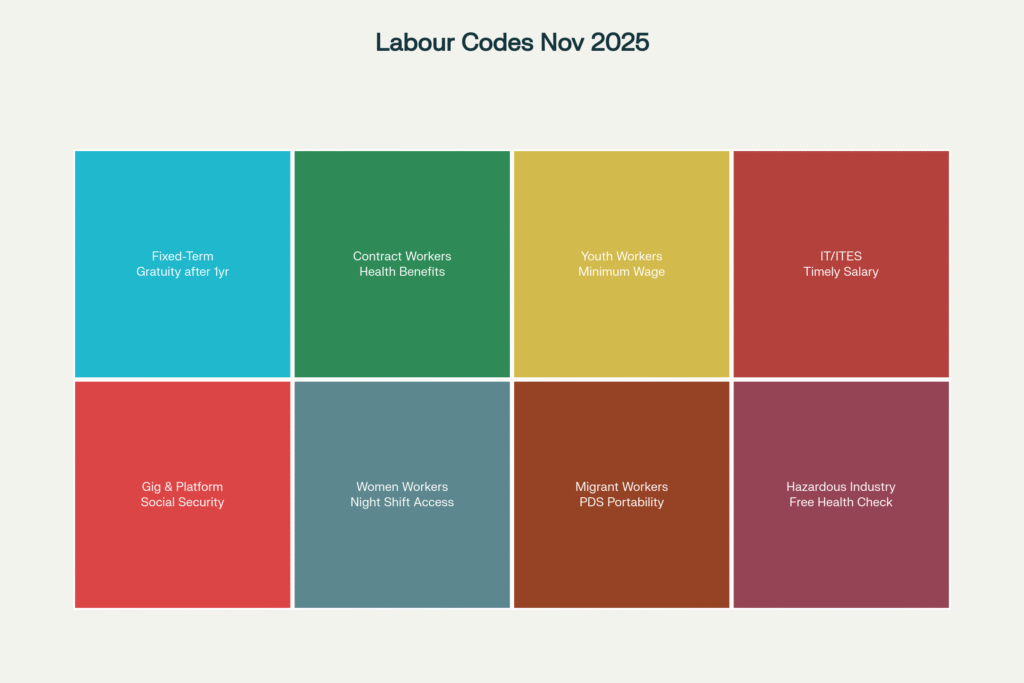 Labour codes November 2025 provides targeted benefits to 15+ worker categories including fixed-term employees, gig workers, women, and hazardous industry workers ensuring universal protection
Labour codes: Gig and Platform Worker Inclusion
Specifically, the labour codes November 2025 defines “gig worker,” “platform worker,” and “aggregator” for the first time in Indian legislation. Therefore, aggregators must contribute 1-2% of annual turnover (capped at 5% of worker payments) to social security funds. Moreover, labour codes enables Aadhaar-linked Universal Account Numbers making welfare benefits portable across states—critical for migrant workers.
Labour codes: Occupational Safety, Health and Working Conditions Code, 2020
Finally, the labour codes November 2025 establishes comprehensive workplace safety standards through occupational safety consolidation. Therefore, labour codes mandates:
- Free annual health check-ups for all workers
- Standard 8-hour workdays and 48-hour work weeks across all sectors
- Appointment letters specifying job details, wages, and social security entitlements
- Women’s employment rights permitting night shifts and hazardous work with consent and safety measures
- Safety committees in establishments with 500+ workers
How Labour codes November 2025 Transforms 15+ Worker Categories
Labour codes: Fixed-Term Employee Benefits
Fixed-term employees benefit dramatically from labour codes through wage parity, rapid gratuity eligibility, and enhanced leave provisions. Specifically, the labour codes eliminates the previous distinction where fixed-term workers received substantially fewer benefits than permanent staff. Therefore, millions of contract employees now enjoy equivalent social security, medical coverage, and retirement provisions. Moreover, gratuity eligibility after one year versus five years represents an 80% acceleration in benefit access—transforming financial security for vulnerable workforces.
Labour codes November 2025: Women Workers’ Empowerment
Revolutionary provisions within labour codes November 2025 permit women to work night shifts across all establishments and undertake hazardous work including underground mining and heavy machinery operation—with consent and mandatory safety measures. Therefore, the labour codes eliminates gender-based employment restrictions while guaranteeing equal pay for equal work. Additionally, labour codes mandates mandatory women’s representation in grievance redressal committees, ensuring gender-sensitive dispute resolution.
Labour codes: IT and ITES Sector Reforms
IT professionals benefit from labour codes November 2025 mandating salary release by the 7th of every month, establishing payment transparency and predictability. Therefore, labour codes eliminates arbitrary wage delays that previously plagued tech sector employment. Moreover, labour codes guarantees women IT workers night shift access and overtime compensation, expanding earning opportunities while maintaining safety protocols.
Labour codes November 2025: Migrant Worker Protections
Migrant workers gain tremendous protection through labour codes November 2025, which expands the definition to include directly employed, contractor-employed, and self-migrated workers. Therefore, the labour codes ensures migrant workers receive equal wages, welfare benefits, and portable public distribution system access across state boundaries. Moreover, labour codes establishes 3-year claim periods for settling pending wage dues, facilitating flexible resolution mechanisms for workers facing delayed payments.
Labour codes November 2025: Implementation Framework and Compliance
Labour codes: Simplified Registration and Licensing
The labour codes November 2025 dramatically reduces compliance burden through “Single Registration, Single License, Single Return” mechanisms. Specifically, establishments now register once electronically instead of maintaining multiple registrations across various labour acts. Therefore, labour codes introduces:
- Unified registration thresholds of 10 employees for electronic registration
- Pan-India single license validity for five years (versus work-order based licenses)
- Auto-generated licenses eliminating manual application processes
- Digitized compliance through electronic record-keeping and communication
Labour codes: Inspector-cum-Facilitator System
Significantly, labour codes November 2025 replaces traditional adversarial inspection with “Inspector-cum-Facilitator” roles emphasizing guidance and compliance support. Therefore, labour codes transforms enforcement from punitive prosecution toward collaborative compliance assistance. Moreover, labour codes implements randomized, algorithm-driven web-based inspections improving transparency and reducing arbitrary harassment of establishments.
Labour codes: Decriminalization and Compounding
The labour codes November 2025 decriminalizes non-imprisonable first-time offences, replacing imprisonment with monetary fines for most violations. Therefore, labour codes makes offences compoundable at 50% of maximum fine for fine-only cases and 75% for combined fine/imprisonment scenarios. Moreover, labour codes redirects compounding fee collections toward dedicated social security funds for unorganized workers.
Labour codes: Sector-Specific Benefits and Protections
Labour codes: MSME Sector Advantages
MSMEs benefit substantially from labour codes November 2025 through simplified compliance frameworks while maintaining comprehensive worker protections. Therefore, labour codes ensures MSME workers access guaranteed minimum wages, free annual health check-ups, and mandatory appointment letters establishing formal employment relationships. Moreover, labour codes maintains worker facilities including canteens, drinking water, and rest areas while establishing standard working hours and paid leave provisions.
Labour codes November 2025: Hazardous Industry Workers
Workers in hazardous industries gain extraordinary protection through labour codes November 2025 mandating free annual health check-ups, national safety standards, and mandatory safety committees. Therefore, labour codes expands women’s employment in underground mining and heavy machinery operation—previously restricted—while establishing robust protective equipment and chemical handling protocols.
Labour codes: Audio-Visual and Digital Media Workers
Notably, labour codes November 2025 extends formal employment protections to digital media workers, electronic media journalists, dubbing artists, and stunt performers for the first time. Therefore, labour codes mandates appointment letters, timely wage payment, and double-rate overtime compensation for this previously unprotected creative workforce.
Conclusion: Labour codes Reshape India’s Workplace
Labour codes November 2025 marks a transformational moment in Indian labour history, consolidating fragmented colonial-era regulations into cohesive, worker-centric legislation. Therefore, labour codes extends universal minimum wages, comprehensive social security, and enhanced workplace safety to India’s 64.33 crore-strong workforce. Moreover, labour codes balances worker protection with business-friendly compliance frameworks, establishing “Inspector-cum-Facilitator” roles and simplified registration processes. Consequently, labour codes validates India’s commitment to building fair, future-ready labour ecosystems supporting both worker dignity and industrial resilience aligned with global standards and modern employment realities.
Learn More About Labour codes November 2025
For comprehensive understanding of implementation details and official documentation: