

Introduction
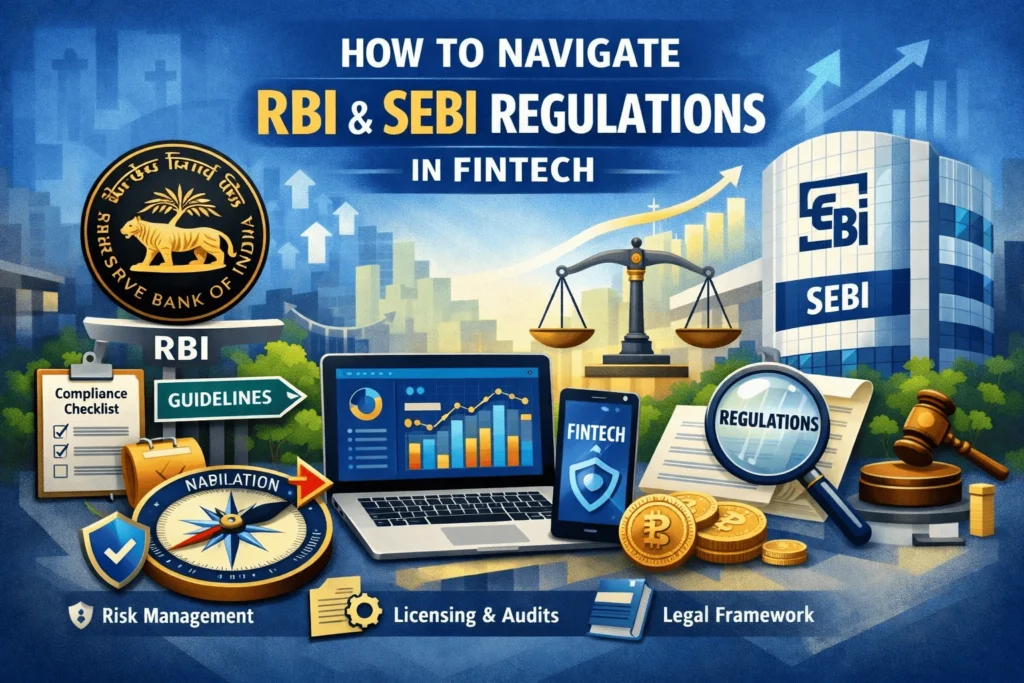
How to Navigate RBI & SEBI Regulations in Fintech has become a survival skill for Indian founders in 2026. RBI has tightened rules on digital lending, payment aggregators, FLDGs, fraud monitoring, and fund flows, while SEBI has sharpened oversight of investment apps, advisers, and research platforms. Moreover, the Fintech Laws & Regulations 2025‑2026 India report shows that serious players now treat compliance as a product and culture pillar, not a legal afterthought.
Understand the regulatory map: RBI vs SEBI roles.
Learn key RBI expectations for lending and payments.
Grasp SEBI registration and tech‑driven compliance for wealth apps.
See a simple table of common fintech models and licences.
Follow a practical roadmap to embed compliance into your startup.
Know your regulators: RBI vs SEBI in fintech
Who regulates what in Indian fintech
The Fintech Laws & Regulations India report explains that the Reserve Bank of India (RBI) mainly regulates payments, banks, NBFCs, and digital lending, while the Securities and Exchange Board of India (SEBI) oversees securities, investment advice, research, and broking/wealthtech platforms. RBI also shapes the ecosystem via Payments Vision 2025, digital lending directions, and payment aggregator rules.
In practice:
A UPI app, wallet, or lending app lives under RBI guardrails.
A mutual‑fund, stocks, or advisory app sits under SEBI rules.
Many full‑stack fintechs must satisfy both, depending on features.
Recent RBI focus areas: digital lending and payments
Commentary on RBI’s digital‑lending framework highlights several pillars:
Direct fund flow – money must flow directly between borrower and regulated entity, not via intermediary wallets, except for tightly defined structures.
FLDG cap and board oversight – First Loss Default Guarantee from fintechs to lenders is capped (e.g., 5% of portfolio) and must be board‑approved, bringing informal guarantee models under scrutiny.
Key Fact Statement & cooling‑off – borrowers must receive clear loan terms and enjoy a window to exit by paying principal and proportionate APR.
Data, consent, and fraud monitoring – only essential data may be collected, with explicit consent, encryption, and real‑time fraud detection for digital payments.
Therefore, lending and payment fintechs must treat flows, disclosures, and data as core product design constraints.
- Select options This product has multiple variants. The options may be chosen on the product page
SEBI compliance for fintech investment and advisory apps
RBI & SEBI Regulations in Fintech: Do you trigger SEBI registration?
Finlaw’s 2026 SEBI‑compliance guide says the first step is deciding whether your app is a SEBI‑regulated intermediary. Common categories relevant to fintech:
Investment Adviser (IA) – if you give personalised recommendations, asset allocations, or goal‑based advice, you need IA registration.
Research Analyst (RA) – if you publish reports, model portfolios, or stock/ETF calls to subscribers, RA registration applies.
Stockbroker / RIA, Portfolio Manager, AIF manager – if your product embeds these functions, you or your partner must hold the right licence.
If you only offer execution through a registered broker, with no advice or research, you may not require IA/RA registration yourself, but you must respect advertising and risk‑disclosure codes.
What SEBI expects before registration
Finlaw summarises core SEBI prerequisites for fintech intermediaries:
Corporate and legal documentation – incorporation papers, board resolutions, business plan, audited net‑worth statements where required.
Qualified personnel and compliance officer – key staff with NISM certifications and a designated compliance officer responsible for adherence.
Policies and internal controls – documented KYC, AML/CFT, conflict‑of‑interest, grievance redressal, cyber‑security, and data‑protection policies that are actually implemented, not just written.
SEBI frequently checks whether these controls are embedded into operations, not just slides.
Building SEBI‑ready technology
The Finlaw blog stresses tech‑driven compliance for wealth apps:
KYC and onboarding systems aligned with SEBI and PMLA (ID checks, address checks, beneficial owner identification, periodic refresh).
Consent and disclosure management – display SEBI registration numbers, capture explicit consent for advisory, log consent with timestamps and immutable audit trails.
Record‑keeping and audit trails – long‑term retention of client communications, advice logs, model outputs, and transaction records.
Consequently, your engineering roadmap must treat compliance features as first‑class product requirements, not add‑ons.
Fintech models, licences, and a practical navigation roadmap
Common fintech models vs likely regulators
ICLG’s India chapter and recent commentary outline how different models map onto RBI and SEBI domains.
| Fintech model | Main regulator(s) | Typical licences / rules |
|---|---|---|
| UPI / wallet / prepaid | RBI | Payment System Operator / PPI guidelines, KYC & IT norms |
| Payment gateway / aggregator | RBI | Payment Aggregator authorisation, net‑worth & escrow rules |
| Digital lending platform (co‑lending, FLDG) | RBI | Digital Lending Directions, FLDG cap, DLG norms |
| BNPL / card‑like credit products | RBI | Consumer‑credit risk weights, unsecured guidelines |
| Equity / MF advisory app | SEBI | IA / RA / broker, KYC, suitability, disclosure codes |
| Robo‑advisory / goal‑planning | SEBI + RBI (payments) | SEBI IA + RBI for fund flows and payment rails |
Knowing this mapping lets founders scope the licence and partner strategy early.
5‑step roadmap to navigate RBI & SEBI as a startup
Synthesising ICLG, Finlaw, and policy commentary:iclg+3
Map activities to regulations
List every user‑facing feature.
Tag each as payment, lending, deposit, advice, research, execution.
Map tags to RBI, SEBI, or both.
Decide “licence vs partner” strategy
For early stage, consider partnering with regulated entities (REs) – banks, NBFCs, brokers.
Put clear contracts around DLG/FLDG, KFS, complaint handling, and fund flow.
Design product around regulatory guardrails
For lending, enforce direct borrower↔RE fund flow, KFS, cooling‑off, consented data use.
For wealth, enforce risk disclosures, category limits, and suitability checks before advice.
Build a compliance cockpit and culture
App‑level dashboards for KYC status, risk alerts, suspicious patterns, and failed transactions.
Appoint a compliance lead who can say “no” when features break rules.
Monitor circulars and update fast
Track RBI press releases, FAQs, and master directions as they evolve.
Track SEBI circulars and enforcement orders to see new expectations.
Maintain a quarterly “regulation → backlog” review to align roadmap.
This playbook turns regulatory change into a structured backlog instead of constant fire‑fighting.
Conclusion
Learning How to Navigate RBI & SEBI Regulations in Fintech is now part of the founder job description in India. RBI’s digital‑lending directions, FLDG caps, payment‑aggregator rules, and data‑consent norms set tight guardrails for credit and payments, while SEBI’s registration, KYC, disclosure, and record‑keeping rules shape the entire investment‑app stack. Startups that embrace these as design inputs and culture, rather than obstacles, earn long‑term trust from users, partners, and regulators.iclg+3
Disclaimer
This blog is for information and education only and does not constitute legal, regulatory, or investment advice. RBI and SEBI regulations evolve continuously through circulars, notifications, and enforcement orders. Founders should always consult a qualified securities / financial‑services lawyer or compliance professional before launching regulated fintech products or relying on any summary of laws.
FAQs
Q1. Does every fintech need an RBI licence?
Not always. If you directly operate payment systems, issue PPIs, or lend as an NBFC, you require authorisations; if you only provide tech to a regulated bank/NBFC under proper contracts, you may operate as a Lending Service Provider or technical vendor, still subject to RBI’s digital‑lending expectations.
Q2. When does a fintech app require SEBI registration?
Finlaw explains that if your app gives personalised investment advice or publishes paid research / calls, you must register as Investment Adviser or Research Analyst; pure execution through a registered broker, without advice, usually does not require separate IA/RA licences.
Q3. How serious is RBI about FLDG and digital‑lending caps?
Commentary on RBI’s Digital Lending Directions notes a formal cap on FLDG coverage and board‑level approval requirements, forcing fintech–NBFC partnerships to move away from informal “guarantee everything” models and adopt transparent risk‑sharing.
Q4. What are the biggest tech priorities for SEBI‑compliant apps?
Finlaw highlights robust KYC systems, consent and disclosure management, immutable audit trails, and long‑term record retention as critical; SEBI increasingly expects these to be built into the platform, not managed manually.
Q5. How can StartupMandi help a fintech founder on regulation?
StartupMandi can connect you with specialised fintech‑reg lawyers and compliance advisors, help map your features to RBI/SEBI regimes, and introduce reg‑tech partners so that your product and processes stay aligned with evolving rules.
Referring Blog / Fact Source Links
Dikshant Choudhary
I’m Dikshant Choudhary, a University of Delhi student and freelance writer specializing in SEO blogs, transcription, and business analysis. I create engaging, research-driven content for academic and client projects with creativity and discipline.