
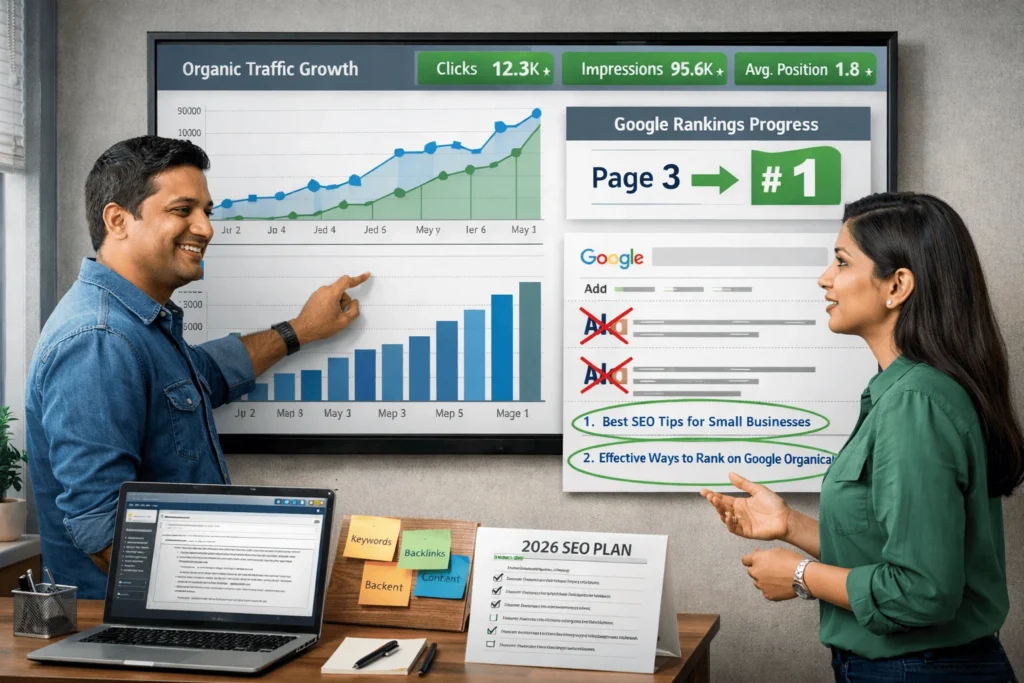
To rank business website on Google without ads, you need a simple system: research the right keywords, optimize each page, build authority with content and links, and keep your site technically fast and mobile-friendly. Organic search now drives 53% of all website traffic and delivers an average 400% ROI for small businesses. Done right, SEO becomes your always-on traffic engine that keeps working even when ad budgets are zero.
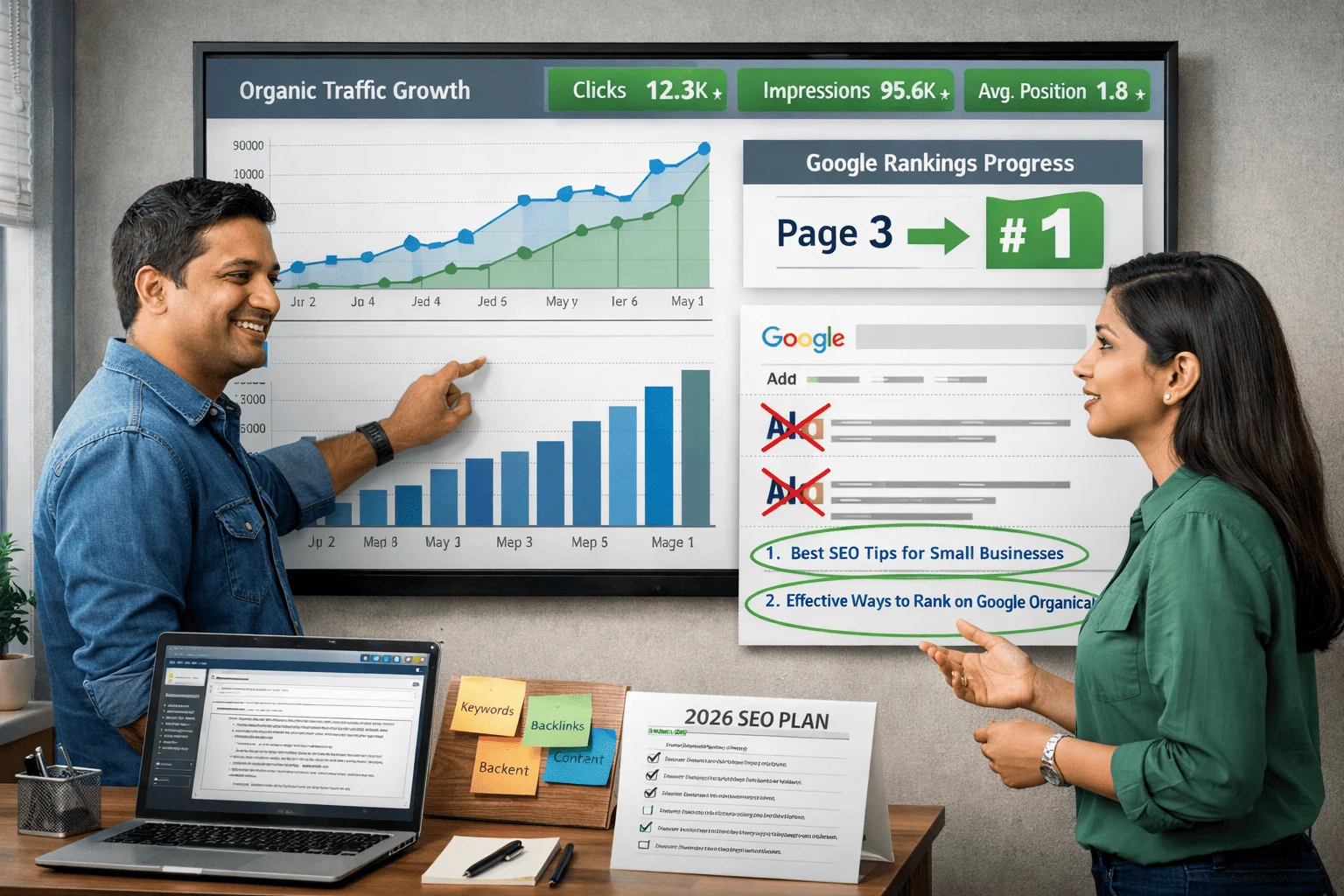
Quick Summary
- Understand Google’s ranking factors: relevant content, backlinks, search intent, and Core Web Vitals.
- Research low-competition keywords for free using Google, Keyword Planner, and question-based tools.
- Optimize every page (titles, metas, headings, internal links) around search intent, not just keywords.
- Fix technical basics: mobile-friendly design, fast loading, clean site structure, and Core Web Vitals.
- Create helpful content answering real customer questions; organic search drives 53% of traffic and 28.5% CTR for position 1.
- Build authority with safe links via local SEO, partnerships, and zero-cost outreach.
- Track results monthly in Google Search Console and adjust based on rankings, clicks, and conversions.
How Do I Rank Business Website Without Ads?
Follow a 7-step, zero-budget SEO blueprint keyword research, on-page optimization, technical fixes, content creation, local SEO, link building, and analytics tracking to replace paid ads with sustainable organic traffic.
- Research intent-based keywords
Focus on “buying intent” and “problem-solving” phrases like “best dentist in Shivpuri” instead of just “dentist”. - Optimize each key page
Align titles, meta descriptions, headings, and content with a single primary keyword + 2-3 related phrases. - Fix UX and Core Web Vitals
Google now treats Core Web Vitals as essential ranking signals, and pages with strong scores see up to 40% better visibility. - Publish helpful, original content
High-quality, unique content remains Google’s #1 ranking factor in 2026. - Leverage local SEO
With 46% of Google searches having local intent, optimizing for Maps and local results is critical for small businesses. - Earn authoritative links
Use guest posts, resource pages, and local partnerships—no shady link-buying. - Measure, learn, and iterate monthly
Organic search converts at around 5% on average, making it one of the highest-ROI channels.
Here is the high-level blueprint:
What Are Google’s Key Ranking Factors in 2026?
In 2026 Google prioritizes high-quality content, relevant backlinks, search intent alignment, page experience (Core Web Vitals), mobile friendliness, site structure, and security (HTTPS).
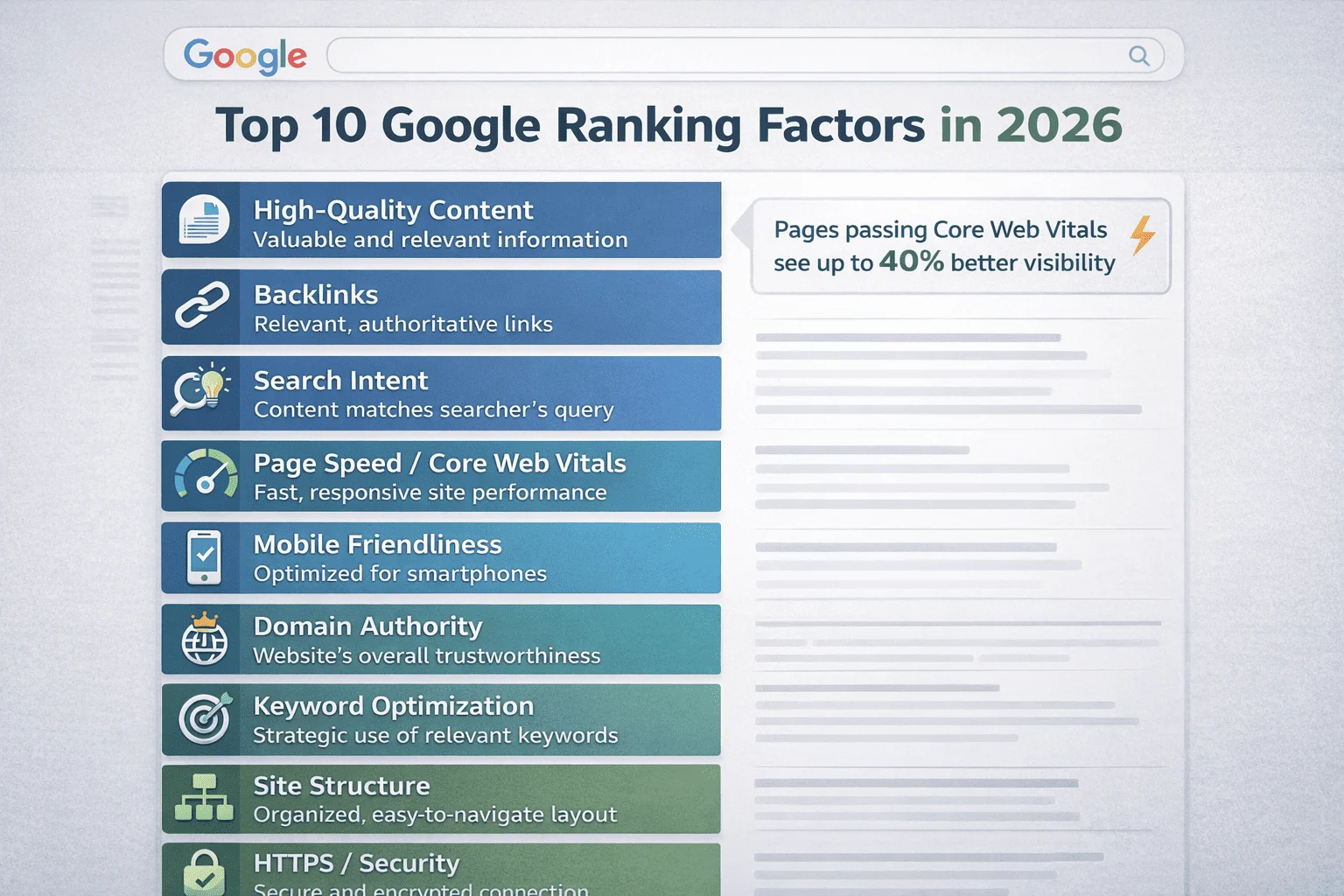
10 Most Important Ranking Factors (Simplified)
“Core Web Vitals have evolved from ‘nice-to-have’ to essential ranking factors, acting as a tiebreaker when content quality is similar.”
How Do I Do Keyword Research for Free?
Combine Google itself + free tools like Keyword Planner, Ubersuggest (free tier), and AnswerThePublic to find long-tail, low-competition phrases that real customers search.
5-Step Free Keyword Research Flow
1. Start with seed topics
List 5–10 core topics (e.g., “wedding photographer Bhopal”, “GST consultant for startups”).
2. Use Google Autocomplete & People Also Ask
Type phrases into Google and collect suggestions and “People Also Ask” questions—these are real user queries.
3. Use free tools for volume & ideas
- Google Keyword Planner (via Google Ads account) for volume estimates
- Ubersuggest free for SEO difficulty and content ideas
4. Check competitors’ keywords
Search your target keyword and study top 3 results—note their titles, headings, and topics they cover.
5. Prioritize long-tail intent keywords
Example: instead of “SEO”, target “SEO tips for small businesses in India” or “how to rank business website on Google without ads”.
Simple Keyword Types Table
| Type | Example | When to Use |
|---|---|---|
| Head term | “accounting software” | Very competitive, avoid early |
| Long-tail | “cloud accounting software for freelancers India” | Easier to rank, higher intent |
| Local intent | “dentist in Shivpuri near bus stand” | For local services / Google Maps |
| Question-based | “how to rank website organically” | Great for blog posts & FAQs |
How Do I Optimize On-Page SEO Without Ads?
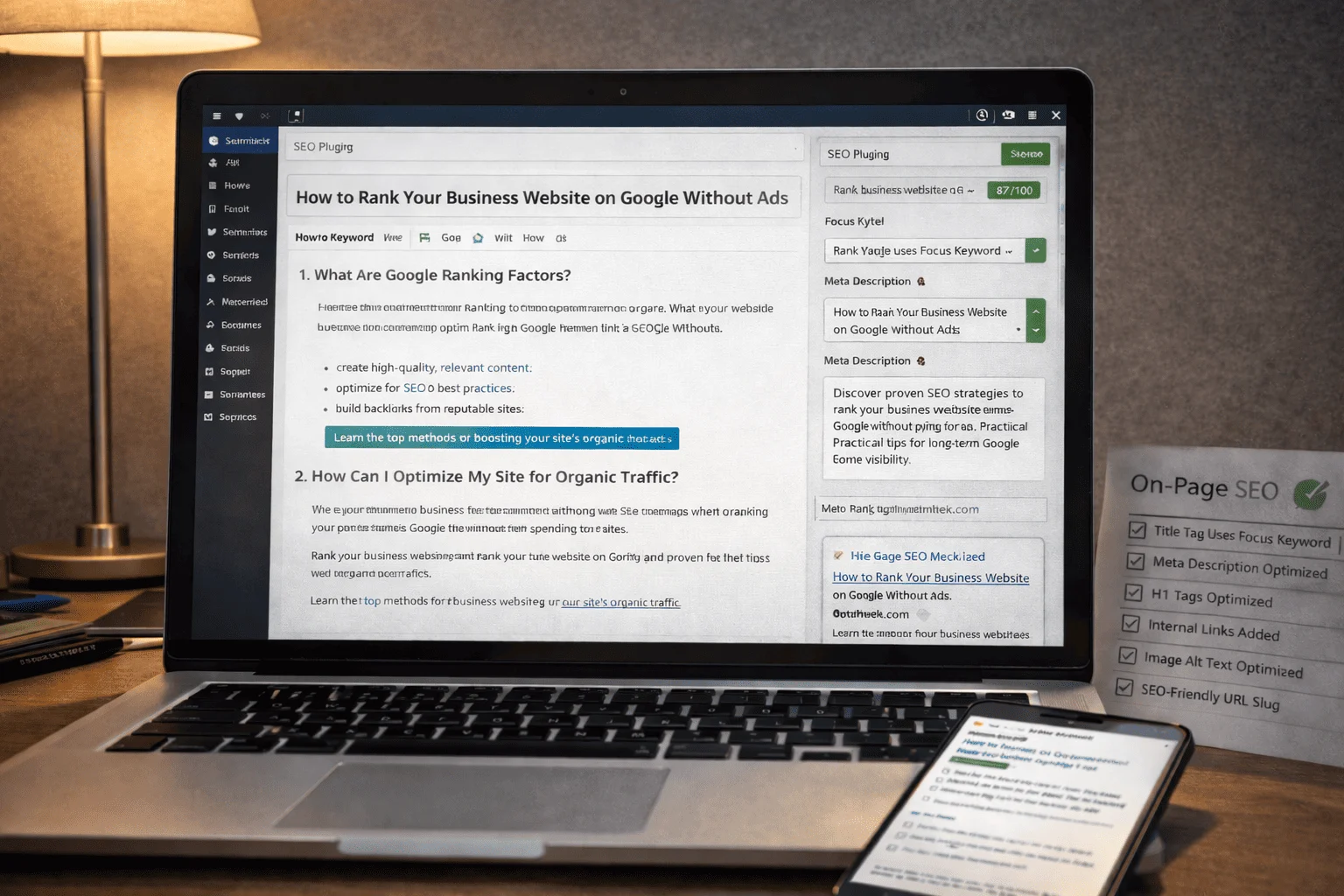
For each important page, optimize title, meta description, headings, URL, content, and internal links around one main keyword and user intent.
On-Page SEO Checklist (Per Page)
- SEO title (H1 + title tag)
- Include focus keyword near the start
- Add benefit or result (e.g., “increase leads in 90 days”)
- Meta description
- 120–155 characters, 1x keyword, clear benefit + CTA
- URL structure
- Short, readable, keyword-based:
/rank-website-without-ads
- Short, readable, keyword-based:
- Headings (H2/H3)
- Question-based headings matching voice-search style (“how to…”, “what is…”)
- Content depth & structure
- 800–2,000 words for main pages; answer related sub-questions clearly
- Use short paragraphs, lists, and tables for readability
- Internal links
- Link to related guides and service pages using descriptive anchor text
- Image optimization
- Compressed images, descriptive file names, and alt text
Example SEO Title & Meta (Code Block)
xml<title>How to Rank Your Business Website on Google Without Ads [2026 Guide]</title>
<meta name="description" content="Learn how to rank business website on Google without ads using a practical 7-step SEO blueprint for small businesses in 2026.">
To speed up on-page work, you can also leverage AI-powered SEO tools—see best AI tools for SEO in 2026 for automation ideas.
How Can I Improve Technical SEO for Free?
Focus on Core Web Vitals, mobile responsiveness, secure HTTPS, crawlability, and clean site structure using free Google tools.
Core Technical Tasks
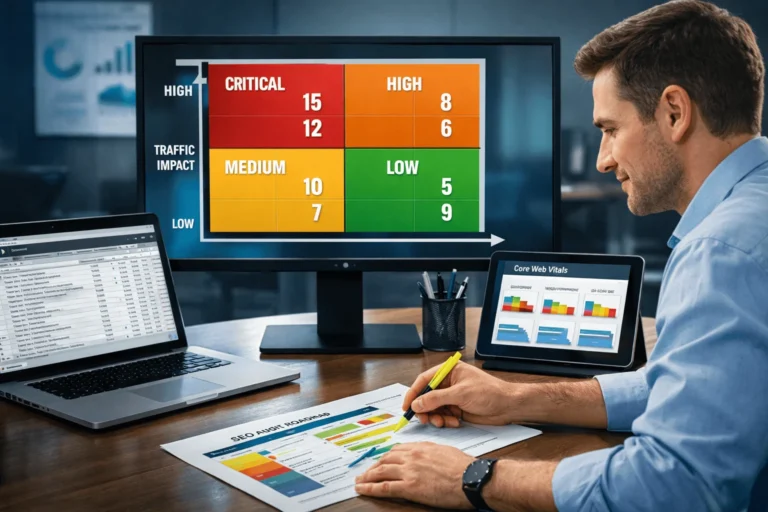
Run Core Web Vitals & speed tests
- Use PageSpeed Insights and Search Console Core Web Vitals report
- Aim to pass all three metrics (LCP, INP, CLS)—position 1 pages are 10% more likely to pass than position 9.
Ensure mobile-first design
- Use responsive themes, large tap targets, readable fonts
- Small businesses with mobile-friendly sites see 32% higher conversion rates.
Fix crawl and index issues
- Use Google Search Console to check coverage, submit sitemaps, and fix 404s/redirects
Use HTTPS and basic security
Clean up site structure
- Logical navigation: Home → Category → Service/Post
- Use breadcrumb navigation for clarity
Core Web Vitals are now non-negotiable ranking factors that act as a tiebreaker when content quality is similar.
How Do I Use Content to Drive Organic Traffic?
Publish consistent, helpful, original content that answers customer questions and targets long-tail keywords; organic search drives 53% of traffic and #1 results get 28.5% CTR.
Content Strategy for Zero-Budget SEO
- Turn FAQs into blog posts
Every question customers ask on WhatsApp, calls, or email becomes a blog topic (e.g., “how much does home deep cleaning cost in Indore”). - Create problem-solution guides
Explain problems, show DIY steps, and naturally position your product/service as the expert solution. - Use local + industry modifiers
“Digital marketing agency for gyms in Pune” beats “digital marketing agency” for real business leads. - Add data, examples, and visuals
Data-driven content performs better and earns more links.
Simple Content Calendar Example
| Week | Content Type | Example Title |
|---|---|---|
| 1 | How-to guide | How to Rank Your Local Salon on Google Maps in 30 Days |
| 2 | Comparison post | Google Ads vs SEO: What Works Better for Small Businesses |
| 3 | Case study | How We Increased Organic Leads by 175% in 6 Months |
| 4 | FAQ roundup | 21 SEO Questions Small Business Owners Ask (Answered Simply) |
How Can Small Businesses Build Links Safely?
Focus on earning links via local partnerships, guest posts, resource pages, and helpful content—not buying links or using spammy tactics.
Zero-Budget Link Building Ideas
- Local partnerships & associations
- Join local business groups, chambers, startup communities
- Offer to write expert tips for their blogs (with link back)
- Guest posting & resource pages
- Contribute articles to niche blogs and “useful resources” pages
- Share practical guides instead of sales pitches
- Supplier & client testimonials
- Write detailed testimonials for your vendors/partners and request a website credit link
- Digital PR & stories
- Local SEO listings
- Consistent NAP (Name, Address, Phone) across Google Business Profile, Justdial, IndiaMART, etc.
For deep local visibility, use this local SEO in 2026 guide on how to rank on Google Maps.
How Do I Rank on Google Maps Without Ads?
Optimize your Google Business Profile (GBP), get consistent NAP citations, and earn genuine reviews—crucial because 46% of searches have local intent and Local Pack listings get 40% higher CTR.
Local SEO Quick Wins
- Claim and fully complete your Google Business Profile.
- Use consistent Name, Address, Phone across all directories.
- Add categories, service areas, photos, and business hours.
- Ask happy customers for detailed Google reviews.
- Post regular updates and offers in GBP.
Local search is one of the fastest ways for small businesses to rank business website on Google without ads, especially for “near me” searches.
How Do I Track SEO Results and Improve?
Use Google Search Console + Google Analytics to track impressions, clicks, positions, and conversions—then adjust pages monthly based on data.
Essential SEO Metrics to Monitor
- Impressions & Clicks (Search Console)
- Average Position for main keywords
- Organic CTR (target 5–10% depending on position)
- Organic Conversion Rate (avg ~5% across industries)
- Pages with rising or falling clicks
Set a monthly review routine: update titles/metas, refresh outdated articles, and add FAQs based on new search queries.
How Can I Apply This SEO Plan Step-by-Step?
Times Needed: 30 Days,10 Hours
Estimated Cost: 0 USD [Free]
Description: A 30-day, zero-budget SEO sprint to rank your business website on Google without ads using free tools, content, and local SEO tactics.
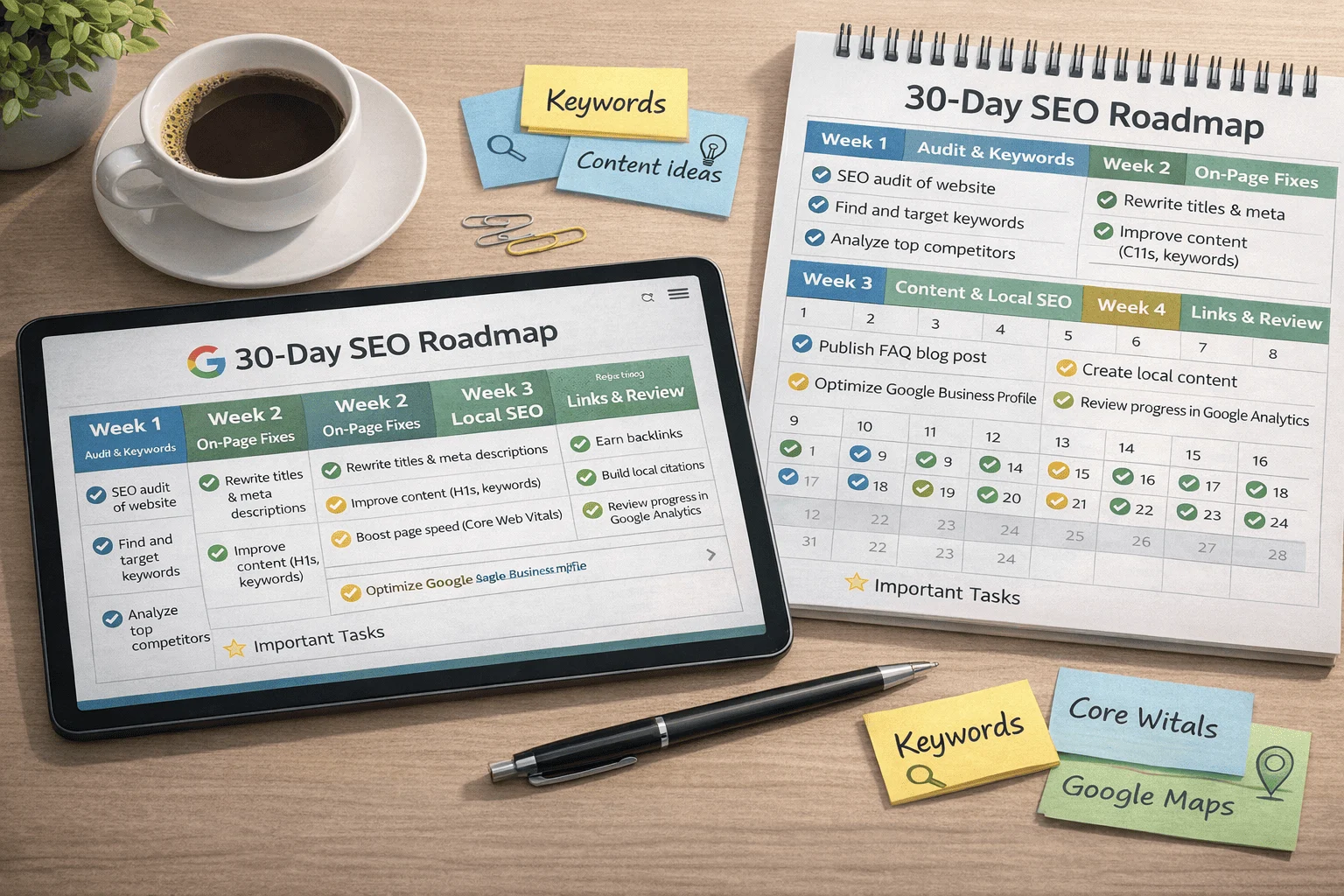
Steps:
1. Map your SEO goals and core pages (Day 1)
Define main services, target locations, and 5–10 core pages to optimize. Clarify whether you want calls, leads, or store visits as primary goals.
2. Do free keyword research (Days 2–3)
Use Google, Keyword Planner, Ubersuggest, and AnswerThePublic to find long-tail, low-competition keywords for each page. Save them in a simple sheet.
3. Rewrite titles and metas (Days 4–5)
Craft unique SEO titles and meta descriptions for each key page. Include the focus keyword and a clear benefit/CTA to improve CTR.
4. Improve on-page content (Days 6–10)
Expand thin pages to at least 800–1200 words where relevant. Add headings, FAQs, internal links, and examples that fully answer search intent.
5. Fix technical basics (Days 11–15)
Run PageSpeed Insights and Search Console. Compress images, enable caching, fix broken links, ensure HTTPS, and improve mobile responsiveness.
6. Launch content calendar (Days 16–22)
Publish 2–4 blog posts answering real customer questions. Target one long-tail keyword and location (if relevant) per article.
7. Set up local SEO + link building (Days 23–27)
Optimize Google Business Profile, claim directories, request reviews, and pitch 2–3 guest posts or resource page placements.
8. Review performance and adjust (Days 28–30)
Check Search Console for new queries, rising pages, and underperforming URLs. Tweak titles, add content, and plan next month’s content.
Tools Name: Google Search Console, Google Analytics, Google Keyword Planner, Ubersuggest (free)
Materials Name: Keyword spreadsheet, Content calendar, Website access (CMS), Image assets.
Key Takeaways Section
- Organic search powers 53% of all website traffic and delivers ~400% ROI for small businesses when done consistently.
- To rank business website on Google without ads, follow a 7-step blueprint: keywords → on-page → technical → content → local → links → analytics.
- Core Web Vitals are now essential, with strong scores driving up to 40% better visibility and acting as ranking tiebreakers.
- Local SEO is critical: 46% of Google searches are local, and Local Pack listings enjoy 40% higher CTR.
- You can do all of this with zero ad spend and mostly free tools, as long as you invest time and consistency.
Next Steps Section
- Run a quick SEO audit using free tools (Search Console, PageSpeed Insights, Mobile-Friendly Test).
- Choose 5–10 primary keywords and map them to your most important pages.
- Rewrite titles and meta descriptions this week using the examples above.
- Publish one helpful blog post per week answering real customer questions.
- Claim and optimize your Google Business Profile if you serve local customers.
- Set a recurring monthly calendar reminder for SEO review and updates.
- Download or create a simple SEO checklist and use it for every new page you publish.
Conclusion
Ranking your business website on Google without ads isn’t about tricks; it’s about systematic, user-first SEO—understanding what people search, creating better answers than competitors, and delivering them on a fast, trustworthy site. For small businesses and startups with limited budgets, this approach replaces unstable ad spend with compounding organic visibility that keeps working for years.
By focusing on intent-based keywords, on-page optimization, Core Web Vitals, local SEO, and safe link building, you can realistically compete with larger brands in your niche. Start with one month of focused effort using the 30-day plan above, measure results in Search Console, and iterate.
To automate parts of your workflow, explore AI tools for SEO in 2026 that help with audits, keyword research, and content outlines while you stay in control of strategy and quality.
FAQ Section
For most small businesses, expect 3–6 months to see meaningful organic improvements, depending on competition, content quality, and technical health
Yes. Free tools like Search Console, Analytics, Keyword Planner, Ubersuggest (free), AnswerThePublic, and basic WordPress plugins are enough to start.
SEO is slower initially but delivers 400% average ROI, while 70% of marketers say SEO generates more sales than PPC over the long term. Ads stop the moment you stop paying.
Content is still Google’s #1 ranking factor in 2026. Unique, helpful, intent-matched content outperforms thin or duplicated pages and earns more backlinks.
Yes. Sites with strong Core Web Vitals see up to 40% better search visibility, and position 1 URLs are 10% more likely to pass thresholds.
There’s no fixed number, but many small businesses see traction around 15–30 high-quality articles covering their niche topics and local queries
If you have time and willingness to learn, you can start DIY using this blueprint. Later, you can bring in experts to scale, especially for technical and link building work.
AI can help with drafting and ideation, but Google prioritizes original, expert-reviewed content. Always add your experience, examples, and local context.
A few links suggestions for more Research & Facts Check
- Best AI Tools for SEO in 2026: Automate Rankings Like a Pro
- Local SEO in 2026: How to Rank on Google Maps
- Digital Marketing for Small Businesses in 2026: What Actually Works
- Top Digital Marketing Trends 2026 Driving Real Business Growth
- How to Start Digital Marketing for New Business: Complete Guide