

startupmandi-blog-background

How to Become a PRO in AI : Transform Your Career in Early 2026

Discover how to master AI 2026 with proven steps, tools, and projects. Unlock high-demand jobs, boost income, and future-proof your career now.

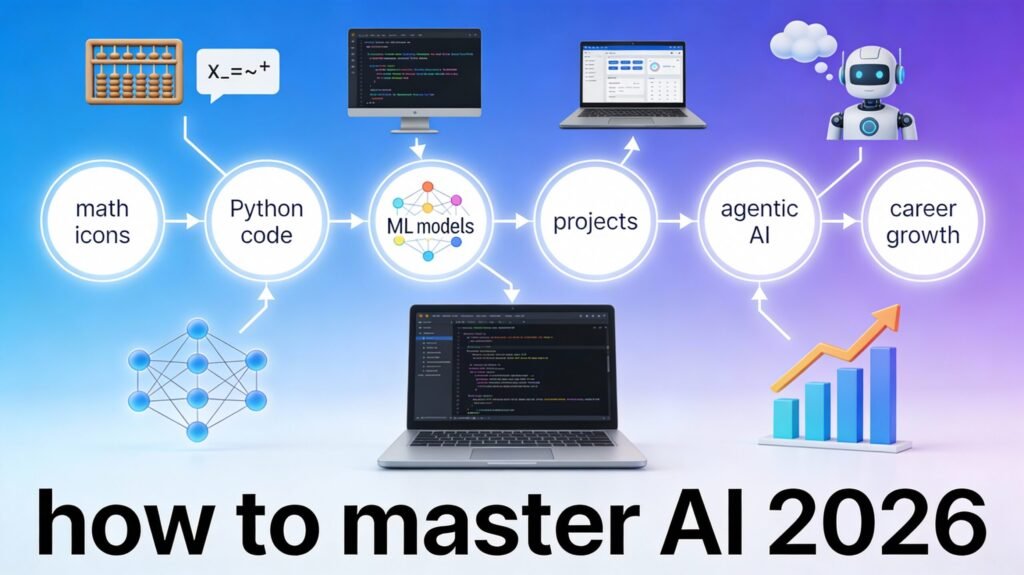
To master AI in 2026, follow a clear roadmap by first choosing a role like AI engineer or data scientist. Build foundational skills in Python and math, then learn machine learning and LLMs. Prove your abilities by creating real-world projects for a strong portfolio that attracts employers. Use communities and structured courses to accelerate your journey to an in-demand career

How to master ai in 2026: start with the right path

how to master ai in 2026 means picking your AI role, learning core skills, and building real projects fast. You must blend theory, tools, and portfolios, otherwise recruiters never see your true potential.In 2026, you do not need a PhD to work in AI, however you must stay disciplined and intentional. Some people focus on AI engineering, while others choose data science, AI product, or prompt engineering.

Once you choose a direction, you can follow a stepwise plan instead of jumping between random tutorials. 


Pick your AI role first

Different AI roles need different skill stacks, so you should decide early where you want to play. This choice saves time and helps you design the right projects for your portfolio.

  1. AI engineer: builds and ships AI-powered apps using APIs, LLMs, and MLOps tools.

  2. Data scientist / analyst: turns data into insights, dashboards, and models for decisions.

  3. Prompt / AI automation specialist: connects workflows, LLMs, and tools to automate business tasks.

Build strong foundations

Before advanced topics, solid foundations in Python, math basics, and data handling matter a lot. Without them, you struggle to debug models and understand why they behave in certain ways.

  1. Learn Python, Git, and basic data structures to write and share reliable code.
  2. Study core linear algebra, probability, and statistics to grasp how models learn.
  3. Practice with libraries like NumPy and Pandas while exploring real datasets.

Use a structured learning roadmap

Random videos feel exciting, but a structured roadmap gets you hired faster. Therefore, follow a month-by-month plan that mixes theory, coding, and projects.

Platforms like roadmap.sh outline steps from beginner to AI engineer.Guides such as the AI Engineer Roadmap 2026 bundle tools, skills, and free resources.

Sample 6‑month AI learning roadmap

MonthFocus AreaKey Outcomes
1–2Python, Git, math basicsClean code, comfort with data
3ML fundamentals, small modelsFirst regression and classification
4Deep learning, NLP or visionBasic neural networks and use cases
5Generative AI, LLMs, RAGApps using ChatGPT‑style models
6Projects, deployment, portfolioDeployed apps and GitHub portfolio

Checkout Our Latest Services

Which Skills and tools you must master:

AI careers in 2026 demand both technical skills and core skills like communication and problem solving. When you combine both, you become much more valuable to any team or client.

Core AI and ML skills:

First, you must understand how classic machine learning works before chasing every new model. This knowledge helps you reason about performance, data quality, and tradeoffs instead of guessing.

  • Learn supervised and unsupervised learning, including regression, classification, and clustering.

  • Study evaluation metrics, overfitting, and model validation so results stay trustworthy.

  • Explore deep learning with frameworks like TensorFlowKeras, or PyTorch. 


Generative AI and LLMs:

In 2026, companies heavily use LLMs, generative models, and AI agents, so you should master them. These tools power chatbots, copilots, content systems, and internal automation.

  • Understand prompting, function calling, and API integration for tools like OpenAI and Hugging Face.

  • Learn Retrieval‑Augmented Generation (RAG) to connect models with live company data.

  • Experiment with simple agents that plan tasks, call tools, and update system automatically.

Practical tools for 2026 AI careers

Modern AI engineers use a set of core tools daily, not just theory. These tools keep projects reproducible, collaborative, and ready for production.

AreaTools to Learn
CodingPython, Git, GitHub
DataPandas, SQL, basic dashboards
ML & DLscikit‑learn, TensorFlow, PyTorch
LLM & Gen AIOpenAI / Anthropic APIs, Hugging Face
OrchestrationLangChain, LlamaIndex, vector databases

how-to-master-ai-in 2026-with-a-clear-roadmap-powerful-skills
Featured image showing how to master AI 2026 roadmap with neural networks and code camps

How to turn learning into real AI projects:

Reading teaches concepts, but projects prove you can ship real value. Because hiring managers care about outcomes, your portfolio often matters more than certificates.

Start with beginner projects:

At first, build small, clear projects that solve simple problems. These teach the full cycle: data, model, and deployment basics.

  • Predict housing prices or customer churn using open datasets.

  • Build a sentiment analysis tool for reviews with a simple classifier.

  • Create a chatbot using an LLM API and a small knowledge base.


Move to generative and agentic projects:

Once comfortable, you can design more advanced apps using generative AI and agents. This stage shows employers you can handle 2026‑ready systems.

  • Build a document assistant that answers questions over PDFs using RAG.

  • Create an AI workflow that reads emails, drafts replies, and updates a CRM.

  • Design a test automation agent that generates and executes test cases.


Share and document your work:

Finally, document your projects clearly so others understand your decisions. A well-written README often turns a simple project into a strong proof of skill.

  • Host code on GitHub with explanations, diagrams, and screenshots.

  • Write short case studies on LinkedIn or a personal site for visibility.

Checkout Latest Grants Listed

How to Grow faster with communities and structured resources:

You learn much faster when you do not study alone. Communities, mentors, and curated courses help you stay accountable and avoid common mistakes.

Join AI communities and mentors:

Communities give feedback, collaborations, and insights into real hiring needs. As a result, you develop both skills and a strong network.

  1. Join Discords, LinkedIn groups, or specialized clubs focused on AI careers.

  2. Look for mentors who are already AI engineers or data scientists in industry.

Use high‑quality AI courses:

Well-designed courses compress years of trial and error into months. However, pick programs that emphasize projects instead of endless theory.

  1. Free and paid AI tracks from Coursera and Google AI cover fundamentals and applied skills.

  2. Roadmaps from Codebasics and similar platforms explain step-by-step AI engineer journeys.

Keep your skills updated:

AI changes fast, so you must treat learning as an ongoing habit. Weekly small updates beat rare, intense study bursts.

  1. Follow AI blogs, newsletters, and conference conference talks to track new trends.

  2. Regularly refactor old projects using newer tools or better patterns.

Conclusion

how to master ai in 2026 comes down to clear foundations, focused tools, and consistent, public projects. When you combine a solid roadmap, strong communities, and real practice, AI turns from confusing buzzword into a career-changing skill stack.

FAQs

1. Do I need a degree to master AI in 2026?

You do not strictly need a degree, although strong fundamentals help. Many AI engineers come from bootcamps, self-study, or career switches with solid portfolios.

2. How long does it take to master AI?

With focused effort, six to twelve months are enough to reach a junior level. The key is consistent practice, real projects, and feedback from mentors or peers.

3. Which language should I learn first for AI?

Python remains the most widely used language for AI in 2026. It has rich libraries, tutorials, and community support for beginners and experts.

4. Is generative AI enough, or must I learn classic ML too?

Generative AI is powerful, but classic ML still matters for many business problems. Understanding both lets you pick the right solution instead of forcing every task into LLMs.

5. How can I stand out in AI job applications?

You stand out with clear projects, strong communication, and a visible online presence. Recruiters love candidates who explain their work simply and show real impact.

Shubhangi Mishra
Shubhangi Mishra

I’m a passionate content writer who loves transforming ideas into engaging stories. With a focus on clarity, creativity, and connection, I create blog posts, website copy, and digital content that captivate audiences and drive results.

Articles: 24

Leave a Reply

Your email address will not be published. Required fields are marked *