

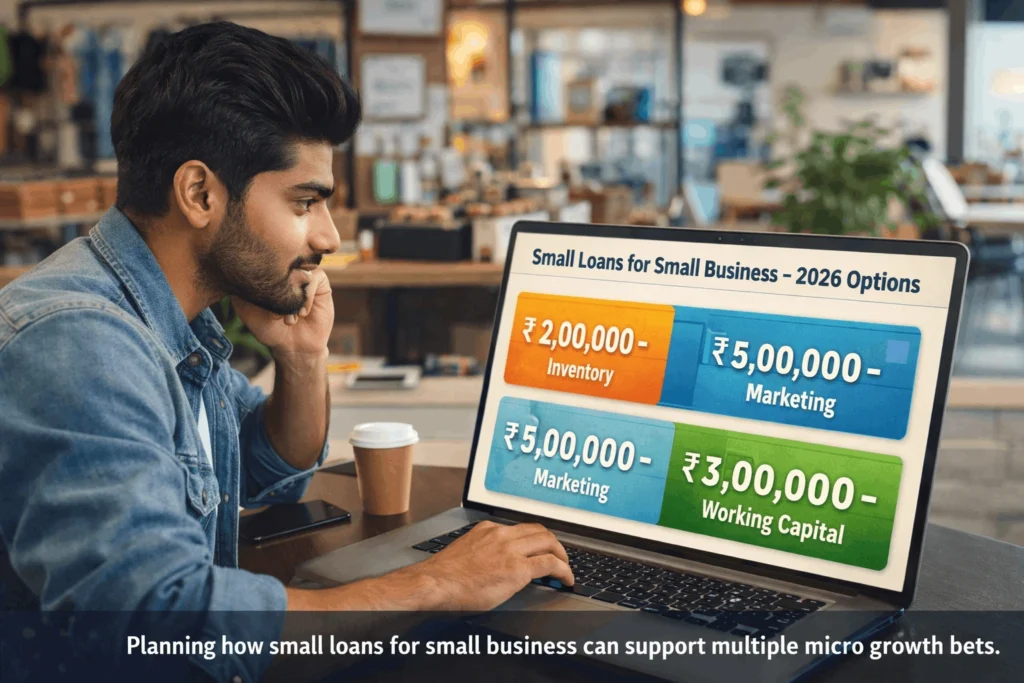
Small loans for small businesses are often the difference between survival and shutdown in a tight 2026 funding climate. Instead of chasing huge rounds, founders increasingly rely on smart ticket sizes from banks, NBFCs, fintechs, and government schemes to plug short‑term gaps and test new growth bets. Moreover, a well‑chosen small business micro loan can build your credit track record and unlock bigger limits later. Therefore, this guide focuses on practical, accessible options for Indian and global small businesses.
- Key use cases for small loans in 2026
- Best formal and alternative funding sources
- Crucial government schemes and microloan programs
- Simple comparison table of options and requirements
- Actionable readiness checklist before you apply ✅
What counts as small loans for small businesses in 2026?
Typical loan sizes, tenures, and use cases
Onramp and other funding guides describe “small” business loans today as ₹50,000–₹50 lakh (or $1,000–$50,000 globally), used for inventory, marketing, salaries, and emergencies. Short‑term business loans often run 3–18 months, while government schemes stretch to 5–7 years for MSMEs.
Founders usually seek a small business micro loan when they need to:
- Buy first inventory or stock for a new category
- Cover GST, rent, or payroll during a seasonal dip
- Upgrade small equipment or laptops
- Run performance marketing experiments before scaling
Because these requirements are modest, micro and small loans are easier to get and faster to close than big term loans.
Where these loans commonly come from
In 2026, small loans for small business typically come from:
- Government schemes (MUDRA, CGTMSE, PMEGP)
- Banks and NBFCs offering MSME, overdraft, and short‑term loans
- Fintech lenders and revenue‑based financing for online businesses.
- Nonprofits and microfinance institutions providing community microloans
Each has different speed, cost, and documentation – so choosing well matters.
Snapshot table – small business micro loan options
| Source type | Typical ticket size | Tenure | Speed |
|---|---|---|---|
| Govt schemes (India) | ₹50k – ₹10 lakh | 3–7 years | Slow–medium |
| Bank/NBFC | ₹2 lakh – ₹50 lakh | 1–5 years | Medium |
| Fintech / online | ₹50k – ₹50 lakh | 3–24 months | Fast |
| Nonprofit microloan | ₹25k – ₹5 lakh | 1–6 years | Medium |
Best formal options: government and bank‑linked schemes
Government small business micro loan schemes in India
Updated MSME lists highlight several collateral‑free government schemes that are perfect for smaller needs:
Pradhan Mantri MUDRA Yojana (PMMY)
- Shishu: up to ₹50,000
- Kishor: ₹50,001–₹5 lakh
- Tarun: ₹5–₹10 lakh
- No collateral, low processing fees, used for setup, working capital, or expansion.
- CGTMSE (Credit Guarantee Fund Trust for MSE)
- Collateral‑free loans up to ₹2 crore through banks/NBFCs
- Govt provides up to 85% guarantee for loans up to ₹5 lakh.
- Stand-Up India / Udyogini / PM Vishwakarma
- Specially for SC/ST, women, artisans, and specific micro segments
- Offer concessionary rates and support services.
Because these schemes sit inside banks and NBFCs, you still apply through your home bank, yet the guarantee reduces collateral pressure.
Bank and NBFC products for small loans
Many banks now brand “MSME Express” or “Quick Business Loans” with ticket sizes from ₹2 lakh to ₹50 lakh, tenures 1–5 years, and simplified documentation. Alternative lenders highlighted in US short‑term loan reviews, like OnDeck, Fundbox, and Fora Financial, offer quick approvals in 24–72 hours for amounts $5k–$250k, albeit at higher APRs.
For an Indian founder, banks and NBFCs usually evaluate:
- Vintage: 12–24 months in business
- Turnover: often ₹15–₹40 lakh+ annually
- Bank statements and bureau score
Therefore, this channel suits businesses with some operating track record and stable, recorded revenue.
Alternative and global small business micro loan options
Fintech cash‑flow lenders and e‑commerce funding
Onramp‑style lenders and other fintechs use sales data, Stripe accounts, and marketplace histories to advance short‑term capital without traditional collateral. They assess your online revenue, then provide a lump sum repaid as a percentage of daily or weekly sales.
This works well for:
- D2C brands,
- Marketplace sellers, and
- Subscription businesses
Because underwriting is data‑driven, approval is often faster but total cost (effective APR) can be higher.
Nonprofit and community micro lenders
In the US and some global markets, SBA microloan programs and nonprofits like Kiva offer $500–$50,000 loans to minority, women, and low‑income founders. These carry:
- Friendlier application processes
- Longer terms up to 6 years
- Often training and mentoring attached
For Indian founders with US entities or global entrepreneurs, these can be attractive first‑credit steps.
Quick comparison – which small business micro loan suits you?
| Situation / Profile | Best starting option |
|---|---|
| New Indian micro‑business, no collateral | MUDRA Shishu/Kishor, small MFIs |
| 2+ years income, need ₹5–₹25 lakh | Bank/NBFC MSME loan, CGTMSE guarantee |
| E‑commerce brand with strong online sales | Fintech revenue‑based facility, Onramp‑type |
| Global / US minority founder | SBA microloan, Kiva, nonprofit micro lenders |
Conclusion
In 2026, small loans for small business are no longer just tiny, rigid bank products; they form a flexible funding toolkit spanning government schemes, MSME loans, fintech lines, and nonprofit microfinance. By picking the right small business micro loan for your stage, sector, and cash‑flow pattern, you can test ideas, survive shocks, and build credit without over‑leveraging or over‑diluting.
For the StartupMandi community, the smartest move is to:
- Start small,
- Pay back on time, and
- Use each facility to unlock the next level of credible funding.
Disclaimer
This article is for educational purposes only and does not constitute financial, legal, or investment advice. Loan programmes, eligibility norms, interest rates, and limits change frequently across banks, NBFCs, fintechs, and government schemes. Always confirm details with official scheme websites, regulated lenders, or licensed advisors before borrowing. Taking any small business micro loan involves repayment obligations, potential collateral risk, and possible impact on your credit profile.
FAQs
What qualifies as small loans for small business?
These are usually loans from ₹50,000 up to ₹50 lakh (or $1,000–$50,000) used for working capital, inventory, or minor capex, typically with shorter tenures than large term loans.
Which government schemes are best for a first‑time Indian founder?
For first‑time micro‑entrepreneurs, MUDRA (Shishu/Kishor) and CGTMSE‑backed loans are strong starting points because they are collateral‑free and tailored to micro and small enterprises.
Are fintech small loans safe for my business?
Fintech loans are fast and flexible, but they often carry higher effective APRs and frequent repayments. They work best when you have clear, short‑term ROI use cases like inventory flips or campaigns.altline.
How can I increase my approval chances for a small business micro loan?
Keep clean bank statements, separate business and personal accounts, file GST and tax returns on time, and maintain a decent credit score. Even nonprofits and government schemes check basic financial discipline.
Can virtual offices help with loan approvals?
Having a registered business address and proper documentation, including a virtual office where accepted, can improve your business credibility, though lenders still rely heavily on revenue, banking history, and compliance.
Referring Blog / Fact Source Links
- Top 9 Government Schemes for Business Loans in India (2025)
- Top Government Loan Schemes for Small Businesses – Eligibility & Benefits
- Small Business Funding in 2026- Get Fund Fast
- 11 Common Alternatives to SBA Loans | altLINE
- wsj.com/buyside/personal-finance/business-loans/best-short-term-business-loans
- Government MSME Loan Schemes in India 2025–26: Complete List